
A hospital cyberattack can turn into a patient harm event fast. In the research cited here, ED visits fell 16.21% after ransomware, while in-hospital mortality for already admitted patients went up 34% to 38%.
If I had to sum up the article in plain English, it’s this:
- AI helps spot cyber threats sooner across EHRs, EMS tools, identity systems, endpoints, networks, medical devices, and dispatch platforms.
- It works best as decision support, not autopilot. People should approve any action that could affect triage, dispatch, imaging, or bedside care.
- The biggest risks are false alarms, model drift, and unclear alerts. In emergency care, those problems can slow staff or block access at the worst time.
- Safe rollout starts with basics: clean logs, asset inventory, narrow use cases, pilot testing, fallback plans, and audit trails.
- Governance matters as much as detection. HIPAA, NIST CSF 2.0, and the NIST AI RMF all point to tight access, logging, model review, and change control.
Here’s the short version of where AI fits:
| Area | What AI looks for | Main caution |
|---|---|---|
| Network and endpoint | Lateral movement, ransomware signs, odd traffic, strange tasks | False positives during surges or crisis events |
| Identity and access | Impossible travel, odd logins, privilege changes, service account misuse | Blocking the wrong user can delay care |
| EHR and EMS logs | Mass chart access, bulk exports, VIP snooping, off-pattern use | High alert volume if baselines are weak |
| Medical devices | Traffic outside normal protocols, unusual outbound connections | Isolation must not interrupt patient monitoring |
| Dispatch and communications | Failed routing, odd unit rerouting, rule changes, delays | Automation should stay limited and tightly scoped |
Bottom line: I’d use AI to sort signals and flag risk across emergency systems, but I would keep human review in front of any high-impact response. That gives teams a better shot at cutting downtime without putting care at risk.
The rest of the article explains where AI helps most, where it can fail, and how healthcare teams can roll it out with guardrails.
safeMEDInet | AI Systems for Security | Threat Detection in Healthcare
sbb-itb-535baee
How AI Detects Threats Across Emergency-Critical Workflows
In emergency care, AI has to spot threats across users, devices, apps, and life-critical communications all at once.
Network, Endpoint, and Identity Anomaly Detection
AI learns normal behavior for users, devices, and apps, then flags activity that drifts from that baseline as workflows shift.[5] In an ED or EMS setting, that means different profiles for a night-shift nurse, an EMS dispatcher, a vendor service account, and a bedside ventilator.
On the network side, AI reviews NetFlow and packet data from hospital networks, VPNs, and cloud gateways to spot unusual traffic volume, odd protocols, or connections to unfamiliar outside destinations.[3][5] Lateral movement - when an attacker jumps from one internal system to another - often shows up as a string of small warning signs. A workstation may start scanning internal subnets it has never touched before. Or a service account may authenticate across several clinical servers in quick succession.
At the endpoint level, EDR tools on ED workstations, EMS tablets, and clinical servers watch for ransomware warning signs such as mass file renames, attempts to reach backup volumes, rapid creation of scheduled tasks, or the launch of encryption tools.[6][10] When those signals show up, AI can isolate the affected device.
Identity anomalies can be just as telling. AI flags logins from impossible locations for EMS staff, sudden privilege escalation on a nurse account, a service account using an interactive login, or a run of failed logins followed by a successful one from a new device.[3][8] During mass casualty events, though, normal login volume can spike fast and look suspicious. That’s why these systems need context-aware thresholds and human review, so security controls don’t get in the way of care at the worst time.
The same behavior-based approach also helps expose misuse inside clinical apps.
EHR, EMS, and Insider Threat Monitoring
EHR and EMS logs are rich sources for insider threat monitoring. AI models learn access patterns by user and role: how many charts a triage nurse opens in an hour, which record types an ED physician tends to view, and which EMS run sheets get accessed from which stations.[4][5] When those patterns shift - a sudden jump in chart openings, repeated searches for VIP or celebrity patients, or lookups across departments with no clinical reason - the system scores that activity as high risk.
Mass exports are another major warning sign. AI tracks query volume, report generation, and export activity to catch odd bulk downloads, like an ED clerk pulling thousands of records within minutes outside any normal workflow pattern.[1][4] Research on supervised ML using real-world hospital EHR data found detection accuracy of 0.9896 on a test set, which suggests these models can separate malicious behavior from routine clinical activity with a high degree of precision.[12]
Account-device mismatch is another strong signal. If an ED physician’s account logs in from a generic kiosk in a non-clinical area, or an EMS user connects from an unregistered personal laptop instead of an assigned fleet device, AI marks that login as suspicious even if the credentials are correct.[4][9] The same idea applies to remote EMS and telehealth access. Logins from unfamiliar networks, unusual VPN destinations, or off-hours access from non-EMS devices can point to stolen credentials.
AI uses this same pattern-based monitoring for connected medical devices and dispatch systems.
Medical Device and Emergency Communications Security
Connected devices in emergency care - monitors, infusion pumps, ventilators, and defibrillators - usually follow predictable protocols and ports. AI builds a baseline for each device type, then flags anything outside that pattern: a ventilator starting outbound connections to an unknown external IP, an infusion pump sending large data volumes to non-clinical systems, or a sudden burst of traffic from one device.[2][3][5]
When a device starts acting suspiciously, AI can segment or isolate it by blocking the specific connection in question while still allowing patient monitoring data to keep flowing.[6][7] That split matters in an ED or trauma bay. Cutting off a device entirely could harm a patient.
Emergency communications and dispatch systems need a different setup. Because 911 routing and EMS dispatch are life-critical, AI monitoring here runs out-of-band through logs and mirrored traffic, so the main path stays untouched.[3][5] AI can surface anomalies like unusual delays in call routing, odd rerouting of EMS units, repeated failed dispatch attempts, or unexpected changes to priority rules.[2][8] Instead of jumping straight to automated blocking, these findings move through tiered response steps:
- Low-confidence anomalies trigger passive monitoring.
- Medium-confidence issues go to a human analyst.
- Only high-confidence threats with narrow, clearly defined scope lead to automated action.
These detections work best when they’re tuned to clinical context and checked by humans. The next issue is where they help most - and where they fall short.
Benefits and Limitations of AI in Emergency Cyber Defense
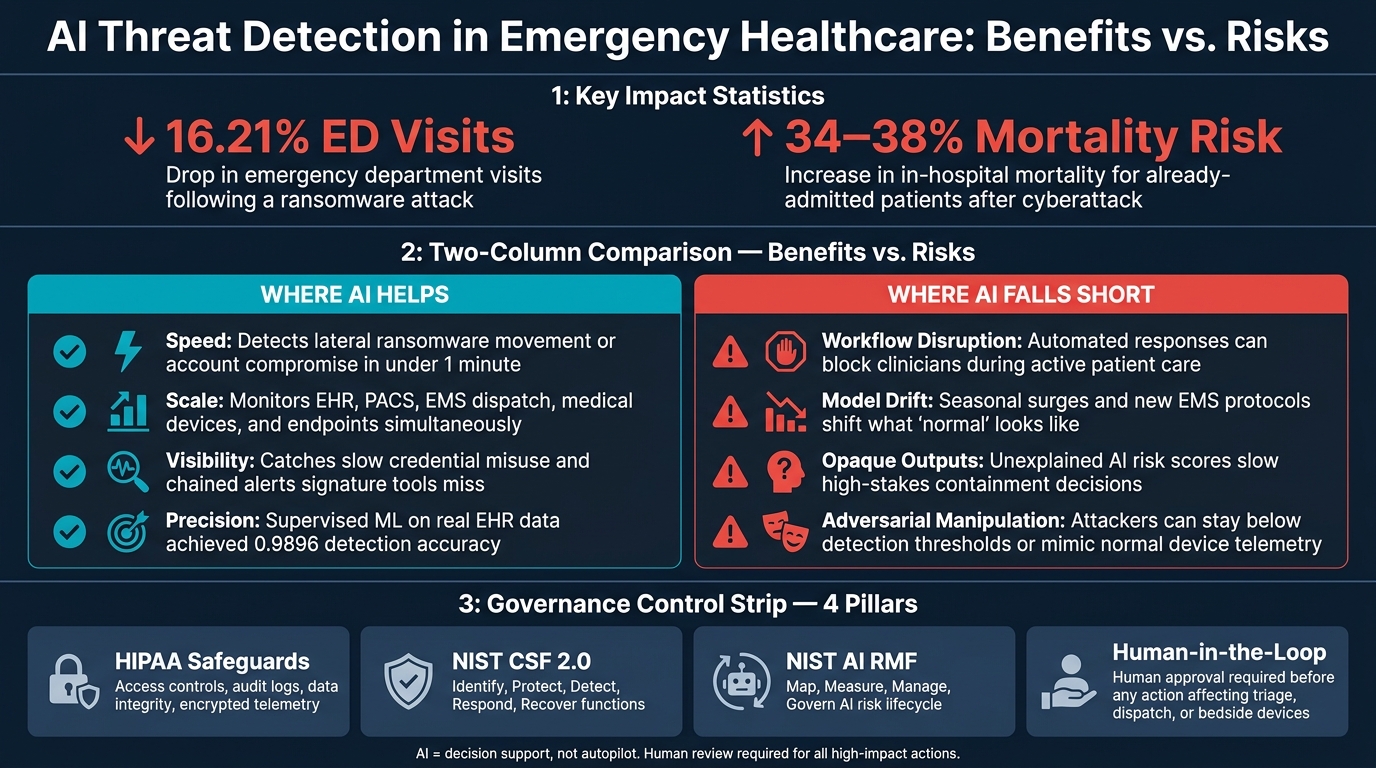
AI Threat Detection in Emergency Healthcare: Benefits vs. Risks & Key Governance Controls
AI can help a lot in emergency cyber defense. But it also comes with risk. Security and healthcare leaders need to understand both sides before rolling it out at scale.
Where AI Improves Speed, Scale, and Visibility
The biggest upside is speed. In emergency care, AI can detect and contain threats fast. By correlating events in real time, it can spot ransomware moving laterally or catch account compromise in under a minute.[14][15][18] That faster response can cut downtime and lower the odds that an attack will disrupt triage, imaging, dispatch, or medication access.
AI also helps with scale. Hospitals and emergency teams generate a huge amount of telemetry across EHR systems, PACS, EMS dispatch, remote monitoring platforms, and medical device networks. AI can watch that stream nonstop, then push only the highest-risk anomalies to human analysts.[14][15] For smaller teams, that kind of filtering can be a lifesaver during high-alert periods.
Another plus: AI can spot behavior that signature-based tools may miss. Think slow credential misuse on ED workstations, or a chain of related alerts that looks harmless one by one but points to a single attack when grouped together.[18][11] That said, these gains depend on good governance and review in the right clinical context. Without that, speed can turn into noise.
Where AI Creates Risk or Underperforms
The downside is pretty simple: more speed and more coverage can also mean more operational trouble if the models are not tuned well. In emergency care, three risks matter most.
| Risk | Description | Emergency Impact |
|---|---|---|
| Workflow disruption | Automated responses trigger on legitimate clinical activity | Automated isolation can block clinicians during active care |
| Model drift | Seasonal surges, new protocols, and evolving EMS routing shift what normal looks like | A drifted model may flag legitimate trauma activity or miss an attacker blending into a busy ED[13][17][19] |
| Opaque outputs | AI risk scores without clear explanation make containment decisions harder to justify | Slows high-stakes decisions and reduces clinical trust under time pressure[13][16] |
There’s also adversarial manipulation. Attackers can stay just under detection thresholds or imitate normal device telemetry, which lets them move through hospital networks without setting off alarms.[13][19][20]
That’s why emergency deployments need human oversight, drift monitoring, and clear limits on automated response.
Governance, Risk Management, and Human Oversight
AI can drift, get tampered with, or react too aggressively. In emergency settings, that means one thing: tight control matters. AI-based detection only helps when governance keeps false actions, model drift, and unauthorized changes in check. Otherwise, the same system meant to help can get in the way of care.
Regulatory Alignment for U.S. Healthcare Organizations
Any AI platform that handles ePHI from the ED, EMS, or device telemetry must meet HIPAA’s technical safeguards. That includes access controls so only authorized SOC analysts, security engineers, and clinical leads can view alerts; audit controls so every model decision and automated action is logged for later review; integrity so source records stay unchanged; and transmission security so all telemetry from ED systems, EMS platforms, or medical devices is encrypted in transit.[21][22][23][24][25][26]
The table below sums up the main AI risks and control areas across HIPAA, NIST CSF 2.0, and the NIST AI RMF.[27][28][29][30]
| AI Risk | Emergency Context | HIPAA Safeguard | NIST CSF 2.0 Function | NIST AI RMF Function |
|---|---|---|---|---|
| Data poisoning | Manipulated training or detection data skews results in ED or EMS environments | Integrity (45 CFR §164.312(c)(1)) | Protect, Detect | Map, Manage |
| Model compromise | Unauthorized changes to detection models through adversarial attacks | Access Controls, Audit Controls (45 CFR §164.312(a), (b)) | Identify, Protect | Map, Manage |
| Model drift | Changing data patterns shift what "normal" looks like | Periodic retraining and validation against current ED/EMS patterns | Detect | Measure, Manage |
| Shadow AI | Clinicians or IT staff deploy unapproved AI tools during a crisis | Workforce security, information access management | Identify, Govern | Govern |
Detection by itself isn’t enough. Teams also need response playbooks that spell out when the model should be stopped and who has the authority to make that call. Respond and Recover playbooks should be updated to cover AI alert triage, model shutdown, and documentation of any model compromise.[30]
Human-in-the-Loop Decisions for Emergency Operations
Any action that affects triage, dispatch, or bedside devices needs human approval before it happens. That includes isolating EHR instances, disabling clinician accounts, or blocking network access for medical devices.[32][33][34] In practice, SOC analysts review alerts and suggest next steps, but they do not carry out high-impact changes on clinical systems.
Major containment decisions sit with the CISO or a delegated senior security leader. When patient care or field operations could be affected, privacy leadership and ED/EMS leadership also have decision-making authority. A brief call among the SOC, the CISO, and ED leadership can approve time-limited mitigation without slowing the response to a crawl.[31][32][35]
Third-Party and Enterprise Risk Governance with Censinet
Vendor AI tools bring third-party risk, so they need review before deployment. Censinet RiskOps™ gives healthcare delivery organizations a single place to manage third-party and enterprise risk assessments. That lets security teams review vendors offering AI-driven detection tools and examine how those tools handle patient data, PHI, clinical system telemetry, medical device logs, and supply chain data. It also includes cybersecurity benchmarking, remediation tracking, and shared risk management workflows.
How to Implement AI Threat Detection Safely in Emergency Care
After defining where AI helps, the next step is controlled deployment.
A Phased Deployment Model for Healthcare Organizations and Vendor Ecosystems
Before deployment, confirm centralized logging, 12-month retention, and a complete asset inventory for ED, EMS, identity, and device systems. That inventory should include ED workstations, EMS tablets, connected medical devices, and even devices that never made it into the CMDB. If that base layer is missing, AI will run on partial data and produce results you can't trust.[36][37][38][39] In emergency care, that gap can put triage, dispatch, imaging, and device uptime at risk.
Once logging and visibility are in place, teams can define a small set of high-risk use cases. These are situations where a cyber event could affect patient care within hours. Good starting points include bulk exports of ED patient records during off-hours, odd changes to EMS routing rules, or ransomware encryption activity on ED imaging systems. Keep these use cases narrow, specific, and easy to measure.
A phased rollout helps limit disruption in clinical settings. It also turns governance from a policy document into daily work.
| Phase | Primary Objective | Key Activities | Stakeholders | Success Metric |
|---|---|---|---|---|
| Assessment | Validate logging and asset visibility | Inventory ED/EMS assets and related telemetry; confirm security information and event management (SIEM) platform ingestion; review response readiness | CISO, CIO, clinical engineering | Percentage of emergency-critical assets with confirmed log coverage |
| Design | Define use cases and select tooling | Prioritize threats such as ransomware in the ED, EMS dispatch tampering, and ED physician credential compromise; align with U.S. healthcare regulations; map to SOC workflows | CISO, compliance, ED leadership, vendors | Documented use cases with defined detection thresholds |
| Deployment | Pilot on limited workflows | Read-only monitoring on a limited set of ED workstations or EHR logs; 60- to 90-day pilot with rollback plan and joint testing with vendors | SOC, ED leadership, clinical engineering, key vendors | Precision |
| Optimization | Tune, measure, and govern | Reduce false positives, track mean time to detect and mean time to respond, log model updates, and integrate third-party vendor risk management through Censinet | CISO, cybersecurity steering committee, third-party risk team | Reduction in detection time for emergency-impacting incidents; audit trail completeness |
Vendors that host emergency-critical services, such as external EMS and telehealth platforms, should join the pilot from day one. They need to provide standardized logs, clear event schemas, contractual SLAs for incident collaboration, and joint testing. Without that, AI-driven monitoring won't reliably cover both internal and external systems.[37][38][39][40]
Incident Response and Resilience Planning
Detection only helps if response paths are approved ahead of time.
Existing IR playbooks should be updated so AI alerts are treated as a separate input. For each critical scenario - suspected ransomware in the ED, EMS dispatch compromise, or unauthorized access to patient records - the playbook should spell out which AI alerts trigger it, who gets notified, and what human validation has to happen before any disruptive action is taken.[30][41]
Fallback procedures matter just as much as the AI itself. If the SIEM goes down or cloud analytics are disrupted, teams should switch to manual log review, add on-call coverage, and turn on backup monitoring sources. Downtime planning should line up with current clinical downtime procedures: offline ED workflows, pre-identified degraded-mode workflows, and tested segmentation that keeps emergency care running even when monitoring systems are partly offline.[30][41][42]
After any incident, a structured post-incident model review is a must. Teams should check whether the AI caught the issue early enough, whether alert volume stayed manageable, and whether blind spots showed up, including underrepresented ED sites. Those findings should go straight into governance forums and vendor management work, including contract terms around vendor participation in resilience exercises and third-party risk reviews with Censinet.[43][44]
Conclusion: Practical Use of AI in Emergency Healthcare Security
The goal is faster detection without giving up human control.
AI can improve threat detection speed, scale, and visibility in emergency healthcare settings. It can connect signals across high-volume logs from networks, endpoints, identity providers, EHR systems, EMS platforms, and medical devices much faster than a manual process. But strong model performance in testing doesn't automatically carry over into production. Teams still need careful tuning, representative training data, and regular validation.
The limits are real. False positives can drain SOC analyst time and lead to unnecessary escalation to clinical teams. New attack patterns may slip past detection if the training data doesn't include them. Data quality problems and adversarial manipulation are also real risks, especially when patient safety is at stake. That's why governance can't be optional.
Use AI as decision support only: let it surface threats fast, but keep people responsible for any action that could affect care.
FAQs
How can AI detect ransomware in emergency systems faster?
AI spots ransomware faster by moving past reactive, rule-based systems and leaning on behavioral analytics. It keeps watch over network, device, and user activity, learns what normal looks like, and flags unusual behavior in seconds instead of waiting the 24–48 hours manual detection can take.
It also connects signals across endpoints, cloud environments, and IoMT devices to spot threats in real time. And when it finds something suspicious, it can act on its own by isolating infected devices or blocking malicious IP addresses.
When should humans override AI alerts in emergency care?
Humans need to overrule AI alerts when a decision could affect life-or-death care or interrupt core healthcare services. AI can manage low-risk monitoring, but people have to take over when a threat is hard to read, unclear, or tied to clinical operations.
Manual approval should happen before isolating a critical server or taking a medical device out of service. If an AI tool starts showing biased recommendations, model drift, or risks to patient safety, it should be turned off and replaced with manual workflows.
What should hospitals set up before deploying AI detection?
Before rolling out AI detection, hospitals need to get the basics right first.
That starts with a full asset inventory, clear device ranking based on clinical impact and exposure, and strong data management built on standard formats like HL7 FHIR. If a hospital doesn’t know what devices it has, how risky they are, or how their data is structured, adding AI to the mix can get messy fast.
They also need the right guardrails in place: governance, zero-trust architecture, network segmentation, baseline monitoring, security audits, and tabletop exercises. Think of it as setting the rules of the road before traffic picks up.
Tools like Censinet RiskOps can help bring assessments, benchmarks, and device inventories into one place, which makes integration safer and easier to coordinate.
