
AI use in healthcare is now too common and too risky for loose oversight. I’d sum up the article this way: if an AI tool can affect patient care, PHI, billing, or a vendor link, it needs one company-wide governance process with named owners, approval steps, monitoring, and shutdown rules.
By the end of 2024, healthcare AI adoption reached 85%, and predictive AI tied to the EHR rose from 66% in 2023 to 71% in 2024. That growth changes what health systems need to do. I don’t think team-by-team review is enough anymore. You need one program that covers:
- Patient safety
- Model risk and bias
- HIPAA and privacy
- Cybersecurity
- Vendor and fourth-party risk
Here’s the plain-English takeaway:
- Set one governance committee with clear approval power
- Use one intake path for every AI use case
- Rank use cases by risk so clinical AI gets deeper review
- Test before launch for safety, performance, and bias
- Watch production use for drift, errors, overrides, and incidents
- Apply HIPAA controls to prompts, logs, outputs, and connected tools
- Check vendors hard before contract sign-off and after model changes
- Map work to NIST AI RMF, HIPAA, and FDA rules
- Start with a 90-day plan so governance moves from policy to daily work
A short way to think about it: AI governance in healthcare now works like change control for care systems. If you can’t show who approved a model, how it was tested, what data it touched, and how you’ll turn it off, your process has a gap.
This article is not saying “use less AI.” It’s saying: use AI with documented control, audit trails, and clear accountability across the whole enterprise.
Governance, Compliance, and Risk Management for Healthcare AI Agents
sbb-itb-535baee
Build an Enterprise AI Governance Operating Model
A healthcare AI governance operating model turns five risk domains into clear owners, decision rights, workflows, and tools. In plain English, it's how an enterprise makes sure those risks don't float around with no one in charge. Enterprise governance is the mechanism that assigns ownership across those five risk domains. Those risks become manageable only when ownership, intake, review, and monitoring sit inside one operating model.
Form a Multidisciplinary AI Governance Committee with Clear Decision Rights
A committee needs documented authority. That means a formal charter, defined membership, and explicit decision rights - not advisory input alone.
Bring in clinical, security, privacy, legal, procurement, quality, data, and AI leaders, and give each one direct decision rights. Those owners map to safety, model risk, privacy, cybersecurity, and vendor accountability.
Escalation paths need to be just as clear. If model performance affects patient care, the issue should first go to clinical and quality leaders, then move to the full committee. If an AI system is tied to a security incident, it should route through the CISO's incident response process. Policy exceptions - such as deploying a preproduction AI tool - should need full committee approval plus documented compensating controls. A RACI matrix helps spell out who owns, approves, advises, and is informed for audit and regulatory review.
With decision rights in place, the next move is a standard intake path for every AI use case.
Standardize AI Use-Case Intake, Risk Triage, and Approval Workflows
Intake is the first control that stops unmanaged AI from slipping into clinical or operational workflows. A structured intake form should capture the business and clinical purpose, data sources, whether PHI is involved, expected user groups, clinical impact classification, system integrations, and third-party vendor risks.
After submission, the intake should route based on risk. High-risk use cases - AI that influences diagnosis, triages ED patients, or prioritizes radiology studies - should go to full committee review and need clinical validation, bias assessment, safety testing, and alignment with FDA expectations. Moderate-risk tools that affect care coordination or patient outreach can move through a lighter review led by clinical, compliance, and security owners. Low-risk administrative tools like automated coding suggestions can follow a faster path with a smaller review group under pre-approved control baselines. Every decision should include the timestamp, rationale, conditions, and approvers.
In 2024, 82% of U.S. hospitals evaluated predictive AI for accuracy, 74% evaluated for bias, and 79% conducted post-implementation evaluation or monitoring.[1] That's a solid baseline, but evaluation alone isn't governance. Intake and triage are what turn those checks into repeatable, documented decisions.
That process gets much easier to run at scale when intake, routing, and approval live in one central system.
Use Centralized Tools to Keep AI Governance Running
Email threads and shared spreadsheets can't support enterprise AI governance for long. They don't enforce steps, keep audit trails intact, or give teams a live view of risk.
Censinet RiskOps™ and Censinet AI replace that patchwork with a centralized platform built for healthcare risk management. Intake forms, automated routing based on risk attributes, task assignment, and enforcement of required steps before deployment all run through one system. The platform sends findings and tasks to the right stakeholders. Human review stays in place for high-risk decisions, while automation handles routing and tracking. CISOs, CIOs, and compliance leaders get a live view of open reviews, vendor risk levels, incident trends, and overall AI risk posture.
That structure sets the base for lifecycle controls.
Apply Core Controls Across the AI Lifecycle
Once intake routes are in place, the next job is simple to state and hard to do well: show that models are safe before launch and keep them under control after deployment. That’s how patient safety and model risk move from policy talk into day-to-day work across the AI lifecycle.
Validate Safety, Performance, and Bias Before Deployment
Before approval, verify output traceability, keep test and production data separate, and document the decision path for legal and compliance review. The level of review should match the level of risk. A sepsis alert, for example, needs tighter validation than an administrative summary tool [2].
Monitor Models in Production for Drift, Incidents, and Control Breakdowns
Pre-deployment testing does not replace production oversight.
In production, monitoring should track usage volume, output quality, confidence or refusal rates, override rates, drift, and incidents. Teams should also log inputs, outputs, prompts, overrides, and model versions in an audit-ready format so root-cause review is possible when something goes wrong.
Formal re-evaluation should be triggered by model version changes, shifts in data sources, detected metrics drift, or changes in the clinical workflow. For the governance board to do its job, it needs direct technical hooks into the model registry, access controls, logging, and incident response systems [2].
Governance should run from a risk register, not a meeting schedule. Each use case needs a designated owner, a rollback plan, and a specific review date. If performance drops or a safety incident occurs, the team should be able to disable the model fast [2].
Effective governance treats AI oversight like change control for clinical decision support, with immutable logging and clear separation between test and production environments [2].
Set Explainability Rules That Match Clinical Risk
Explainability rules should match clinical risk. High-impact use cases need a clear, reviewable decision path. Lower-risk administrative tools need less depth.
Govern AI Privacy, Cybersecurity, and Third-Party Vendor Risk
Once model controls are in place, governance has to follow the data. That means tracking where PHI moves, who can get to it, and which vendors can see it. AI creates new paths for PHI - prompts, embeddings, vector databases, vendor logs, and outputs - so HIPAA controls can't stop at the EHR.
Map HIPAA, Security, and Data Handling Controls to AI Systems
Apply ePHI controls to every AI system that handles PHI. That includes minimum-necessary access, RBAC, MFA, AES-256 at rest, TLS 1.2+ in transit, plus field-level PHI access logs and admin-action logs across training, inference, and administration.[3][4][5][6]
If your AI system pulls EHR data through FHIR, field-level logging is a big deal. Resource-level logs by themselves don't show minimum-necessary access.[7] That's the gap. You also need data retention and deletion rules that clearly cover model snapshots, fine-tuning datasets, and prompt interaction logs - not just the source EHR.
AI incidents need their own breach playbooks too. Plan for prompt-log exposure, compromised vendor APIs, and silent misconfiguration. Spell out what happens first: revoke API keys, disable model endpoints, shift to manual workflows, and work with the vendor's technical team.[3][4] These risks are not abstract. In 2024, 386 healthcare cyberattacks were reported, with data theft and ransomware affecting both providers and mission-critical third-party vendors.[8]
Strengthen Due Diligence for AI Vendors, Subcontractors, and Fourth Parties
Internal controls are only half the job. Procurement has to check the same standards before a vendor ever touches PHI.
AI procurement needs vendor-specific due diligence. You need visibility into model behavior, training data provenance, output handling, and prompt retention practices.[4] Before signing a contract, get direct answers to questions such as:
- Is customer data excluded from model training by default?
- How are model changes communicated?
- What's the contractually guaranteed incident notification timeline?
- What independent security assessments exist?
Fourth-party risk matters just as much. A vendor's own vendors - upstream model providers, annotation partners, observability tools, and cloud platforms - can affect model performance, data retention, and breach exposure, even if the health system never signed with them directly.[4] Contract terms should require notice before new subprocessors are added, ban secondary use of PHI for unrelated model training, and include audit rights for high-risk use cases.
Business Associate Agreements are required when AI vendors create, receive, maintain, or transmit PHI on behalf of a covered entity.[6] BAAs should also be updated to address AI training-data use, model updates, and logging practices.
Rank Vendor Reviews by Clinical Impact and Dependency Risk
Use clinical impact and dependency risk to decide how deep the vendor review should go. A clinical decision support tool that shapes care decisions needs far more scrutiny than a lower-risk use case like de-identified analytics or administrative summarization with tightly controlled data.
| Vendor Category | Patient Safety Impact | PHI Exposure | Integration Complexity | Oversight Frequency |
|---|---|---|---|---|
| Clinical decision support / diagnostics | High | High | High | Continuous |
| Ambient documentation / transcription | Medium–High | High | Medium | Frequent |
| De-identified analytics / administrative summarization | Low | Low | Low–Medium | Periodic |
Infrastructure and transcription vendors can still create broad dependency risk, even if they don't make clinical recommendations. Top-tier vendors - especially those tied to clinical decisions or diagnostic workflows - need the strictest initial review and close monitoring over time. Reassess those vendors after model updates, new subprocessors, or changes to retention policies.[4]
Align Governance to US Frameworks and Build a Roadmap

Healthcare AI Governance: 90-Day Implementation Roadmap
Once your operating controls are set, line them up with the frameworks regulators and auditors already look for.
Map Governance Activities to NIST AI RMF, HIPAA, and FDA Expectations
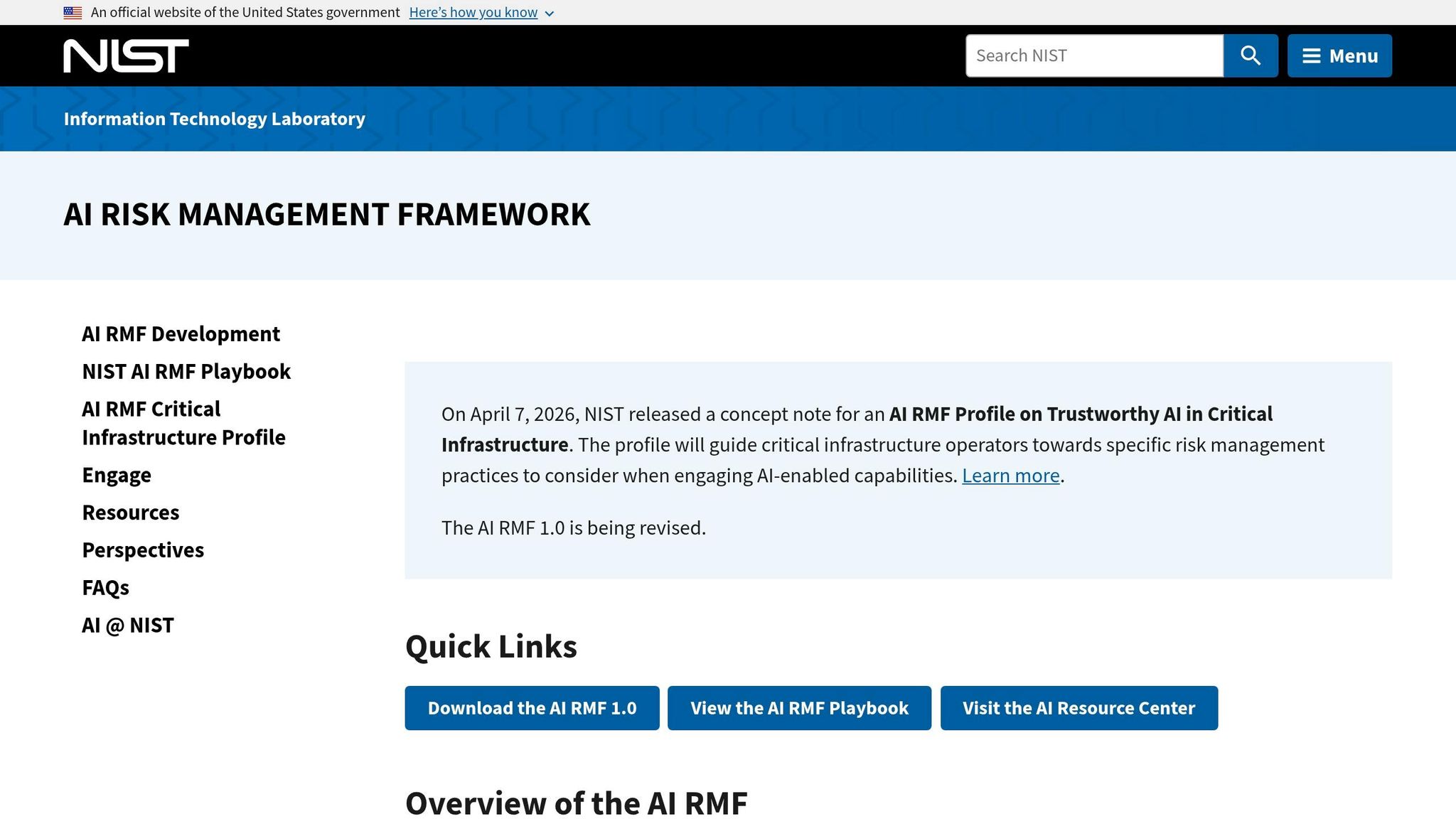
Don’t treat NIST AI RMF like a stack of forms. The RMF calls for operating controls, not just documents. The smart move is to use one workflow set across HIPAA, FDA, and safety controls instead of running separate tracks.
Each of the four RMF functions - GOVERN, MAP, MEASURE, and MANAGE - lines up with work healthcare teams already need to do for HIPAA, FDA, and clinical safety.
| AI Governance Activity | NIST AI RMF Function | Healthcare Regulatory Alignment |
|---|---|---|
| Risk triage & use-case approval | GOVERN | HIPAA Security Rule (Administrative Safeguards); decision rights |
| Use-case context mapping | MAP | FDA SaMD (Intended Use); HIPAA (Data Minimization/Allowable Use) |
| Bias & subgroup validation | MEASURE | FDA Post-Market Surveillance; Health Equity/Non-discrimination laws |
| Continuous drift monitoring | MEASURE | FDA Quality Management Systems (QMS); Clinical Safety Standards |
| Vendor due diligence | GOVERN / MAP | HIPAA Business Associate Agreements (BAA); Third-party risk |
| Incident & signal response | MANAGE | HIPAA Breach Notification; FDA Adverse Event Reporting |
For FDA-regulated SaMD, MEASURE should be treated as post-market surveillance. And for high-stakes clinical decision support, use the strictest controls.
Use this mapping to set the order of implementation.
Start with a 90-Day Implementation Plan
Use a 90-day rollout.
Days 1–30 should focus on GOVERN readiness. Define your organization’s risk tolerance for clinical AI versus administrative AI. Document escalation paths to executive leadership. Assign named accountability owners who have the authority to pause or shut down a deployment - not just point out issues. [10] This comes before you assess any specific AI system.
Days 31–60 move to MAP work. Identify your 2–3 highest-risk AI deployments across safety, bias, privacy, cybersecurity, and vendor exposure. In many cases, these are clinical decision support tools tied to high-acuity patient populations. For each one, document the affected populations, likely error types, and outcome boundaries. [10] Then map those use cases to your regulatory duties: HIPAA, FDA, and any state laws that apply. Do this early, or you may run into remediation work, contract changes, and deployment delays later.
Days 61–90 are about putting MEASURE and MANAGE into day-to-day use. Start with monitoring for your highest-risk systems: performance metrics, subgroup checks, and intervention thresholds. Then set a quarterly MANAGE cadence with structured performance reviews against defined thresholds, along with documented residual risk decisions. [10]
With the roadmap in place, governance stops being an idea on paper and becomes part of routine work.
Conclusion: Formal, Measurable, and Accountable AI Governance Is the New Standard
The new standard is formal, measurable, and accountable AI governance - backed by clear decision rights, lifecycle controls, monitoring, and vendor oversight.
That means aligning governance activities to NIST AI RMF, HIPAA, and FDA expectations through operational workflows, not policy documents. It also means applying that same level of discipline to third-party vendors, subcontractors, and fourth parties that handle PHI or shape clinical decisions.
As Marty Barrack, CISO and Chief Legal and Compliance Officer at XiFin, Inc., puts it:
"The goal is AI-ready governance: safe, compliant, repeatable, and cost-effective adoption." [9]
That’s the new standard.
FAQs
Who should own AI governance in a health system?
AI governance should sit with a multidisciplinary committee, not a single person. Shared accountability matters here. Clinical leadership, IT, security, legal, compliance, privacy, procurement, and operations all need a seat at the table.
A senior executive who reports to the CEO should coordinate the work and keep leadership up to date. Just as important, the committee needs real authority to make decisions about model intake, validation, and day-to-day monitoring.
How do we decide which AI use cases need the strictest review?
Use a tiered, risk-based approach tied to patient impact and exposure.
Start with the risk register created during early AI use-case registration. Then apply stricter review to tools that handle PHI and could affect diagnosis, treatment, or escalation. That matters most for patient-facing tools and clinician decision tools where timing is urgent and the output could shape care in the moment.
Use lighter review for tools with indirect PHI exposure or no PHI at all.
If a tool’s output could drive clinical action, require a clinician or other human to review it before launch. Also require documented validation and vendor due diligence before it goes live.
What should trigger an AI model shutdown or rollback?
An AI model should be shut down or rolled back when it drops below agreed benchmarks or starts causing serious operational or clinical problems.
If an update performs worse than the prior model, roll it back. Use automated circuit breakers to turn models off when severe errors show up. Set alerts for error rates that pass preset limits, such as 5%. And keep the right to suspend the model if live performance falls short of vendor promises.
