
Most vendor reviews should not go through the same path. In healthcare, that slows down low-risk purchases and can still miss high-risk issues. A better model is simple: tier each vendor at intake, send low-impact vendors through a short review, move high-risk vendors into a deep review, and re-check vendors when risk changes.
Here’s the article in plain English:
- Start with routing, not paperwork. Check a few early signals first: PHI, patient care impact, system access, replaceability, AI use, and fourth parties.
- Use two main review paths.
- Rapid review for low-impact vendors with limited access and low downtime risk
- Third-party risk assessments for vendors tied to patient care, large PHI use, admin access, or hard-to-replace services
- Do not treat a BAA as proof of security. A BAA sets PHI terms. It does not show that the vendor can stop attacks or recover from them.
- Escalate fast when facts change. Hidden subprocessors, vague breach terms, expired evidence, AI model training on submitted data, or links into clinical systems should stop a light review.
- Use conditions only with deadlines and owners. If you approve with limits, set a due date, name an owner, and force follow-up.
- Keep people in the loop. AI can help sort evidence and draft summaries, but people must review source documents and approve risk calls.
- Why this matters: the article notes that 90% of serious healthcare data breaches were tied to a third party, and the average vendor-related breach cost reached $4.88 million in 2025.
Creating Cyber Resilience: Your Guide to Healthcare Vendor Risk Management [On-Demand Webinar]
sbb-itb-535baee
Quick Comparison
| Review path | Best fit | Main checks | Typical timing | Approval |
|---|---|---|---|---|
| Rapid review | Low-impact vendors with no PHI or limited exposure, no admin access, and easy replacement | Short questionnaire, data flow, contract terms, one assurance artifact | Days | Delegated business or procurement approval |
| Deep dive | Vendors that affect care, handle PHI, have privileged access, rely on key fourth parties, or use AI in high-stakes workflows | Data-flow mapping, control review, resilience testing, privacy terms, subprocessor review, AI governance, cross-team review | Weeks | Security, privacy, legal, clinical, and senior approval as needed |
Bottom line: I’d sum up the article this way: move fast on low-risk vendors, slow down where failure can hurt patients, expose PHI, or shut down care. That is how vendor risk teams keep reviews moving without cutting review depth where it matters.
Build a vendor routing model before starting any assessment
Many hospital systems juggle more than 1,000 vendors at the same time [2]. Putting every single one through the exact same review flow doesn’t just slow things down - it creates a system-level bottleneck. That’s where proportionate assurance turns into day-to-day practice. The better approach is simple: route vendors at intake before any questionnaire goes out.
Tier vendors using healthcare-specific risk factors
Set a provisional tier during intake, not halfway through review. To do that, the intake form needs to collect enough detail up front. In healthcare, the main factors are PHI access, clinical criticality, and fourth-party dependencies.
Clinical and operations teams should define criticality because they deal with the fallout when a vendor fails. Security and privacy teams check the evidence, while procurement handles sanctions screening and financial risk [2].
Concentration risk also needs to be flagged at intake. The Change Healthcare incident is a clear warning: when too many critical functions depend on one vendor or shared infrastructure, the blast radius gets big fast [2]. If one failure could ripple across systems or facilities, the provisional tier should go up.
Map each vendor tier to a review path and approval level
Once a vendor gets a provisional tier, the review path should follow automatically. PHI access, clinical dependency, and concentration risk should drive that intake logic. In practice, the tier should assign the review path before any evidence request is sent. Here’s how that can look across four vendor types.
| Vendor Characteristics | Recommended Review Path | Evidence Requirements | Approval Authority | Monitoring Cadence |
|---|---|---|---|---|
| Critical: EHR, cloud hosts, connected medical devices | Deep-Dive Assessment | SOC 2 Type II, SBOM, pen test, architecture review | CISO & Clinical Leadership | Continuous |
| High: Billing, labs, clinical staffing, telehealth | Standard Review | Security questionnaire, BAA, HIPAA training proof | Privacy Officer / Dept. Head | Annual |
| Medium/Low: Shredding, general supplies, non-PHI SaaS | Rapid Review | Signed BAA, basic security attestation | Procurement Manager | Every 2 to 3 years |
| Low Impact: No PHI access, no clinical dependency | Conditional Approval | Standard terms & conditions | Procurement / Operations | Event-driven |
This kind of routing keeps review time focused on vendors that can do the most harm if something goes wrong, instead of burning that time on low-risk cases. And that matters. With 90% of serious healthcare data breaches tied to a third party [2], and the average vendor-related breach costing $4.88 million in 2025 [2], using the wrong level of review isn’t just inefficient - it creates exposure. Once the tier is set, low-impact vendors can move through rapid review, while high-consequence vendors move into a deep-dive assessment.
How to run rapid reviews for low-impact vendors without creating blind spots
Once a vendor is routed to rapid review, keep the evidence set tight but defensible. For low-impact vendors, a rapid review is a controlled path that lines up evidence with risk. And this route is ONLY for vendors that were already placed in the rapid-review lane.
Define the minimum evidence needed for a defensible rapid review
Before you ask for documents, confirm a few basics: the vendor's function, hosting model, data locations, integrations, and whether it handles PHI on your behalf. That last point matters. A BAA is required when a vendor creates, receives, maintains, or transmits protected health information on your behalf. But a signed BAA, by itself, does not show security resilience, tested incident response, or strong access controls [3][4]. It sets the permitted uses of PHI. It does not prove the vendor can protect it.
Beyond the BAA, a defensible rapid review should include:
- A short, standard security questionnaire
- Data-flow confirmation
- Access and integration details
- Breach and security-incident notification commitments
- Data deletion and retention practices
- Subcontractor disclosure
- One relevant assurance artifact
That assurance artifact might be a SOC 2 Type II report, an ISO 27001 certificate, a penetration-test executive summary, or a relevant security policy set [6]. The point is simple: gather enough proof to approve or escalate. Don't collect paperwork just to collect paperwork.
When to stop a rapid review and escalate
Escalate when you spot unsupported privileged access, vague breach-notification terms, no believable deletion process, expired evidence, conflicting answers, hidden subcontractors, or direct connectivity to clinical or core systems [5]. A vendor may look low-impact during intake and still set off alarms once the review starts.
Take a patient-education platform that was first described as a public-facing content tool. During review, the vendor reveals that it collects email addresses and appointment identifiers, uses a third-party analytics service, and may use submitted text to improve an AI model. That's the moment to hit pause. Production approval should wait until privacy, security, legal, and clinical owners clear the data flow and the contract terms.
If residual risk is plain and controlled, conditional approval may make sense. That could mean:
- Restricting the vendor to test data
- Requiring multifactor authentication
- Limiting access to named users
- Setting a firm remediation deadline with a named owner
Any conditional approval should expire on its own. It should never quietly turn into a permanent exception. If any of these red flags show up, the vendor belongs in a deep-dive assessment.
Cut evidence handling time with shared libraries and human-reviewed automation
Shared evidence libraries can cut repeat document requests. A well-kept library stores SOC reports, certifications, penetration-test summaries, security policies, and privacy documentation with metadata like vendor name, service covered, issue date, expiration date, system scope, and geographic boundaries. Before you reuse any document, make sure it fits the exact service, environment, and date range under review. A SOC 2 report for one business unit does not automatically cover a different service from the same vendor.
Censinet RiskOps™ can act as the central workflow for assessments, evidence, findings, remediation, approvals, and audit records. Censinet AI™ can help with questionnaire responses, evidence summaries, integration-detail capture, fourth-party exposure identification, and draft risk summaries. Still, human reviewers need to validate the source evidence, confirm that it applies to the service being procured, clear up ambiguity, and approve any risk acceptance. AI output supports the review process. It does not approve anything on its own. If reused evidence doesn't match the exact service or scope, escalate instead of trying to squeeze it into a rapid review.
When and how to run deep-dive assessments for high-consequence vendors
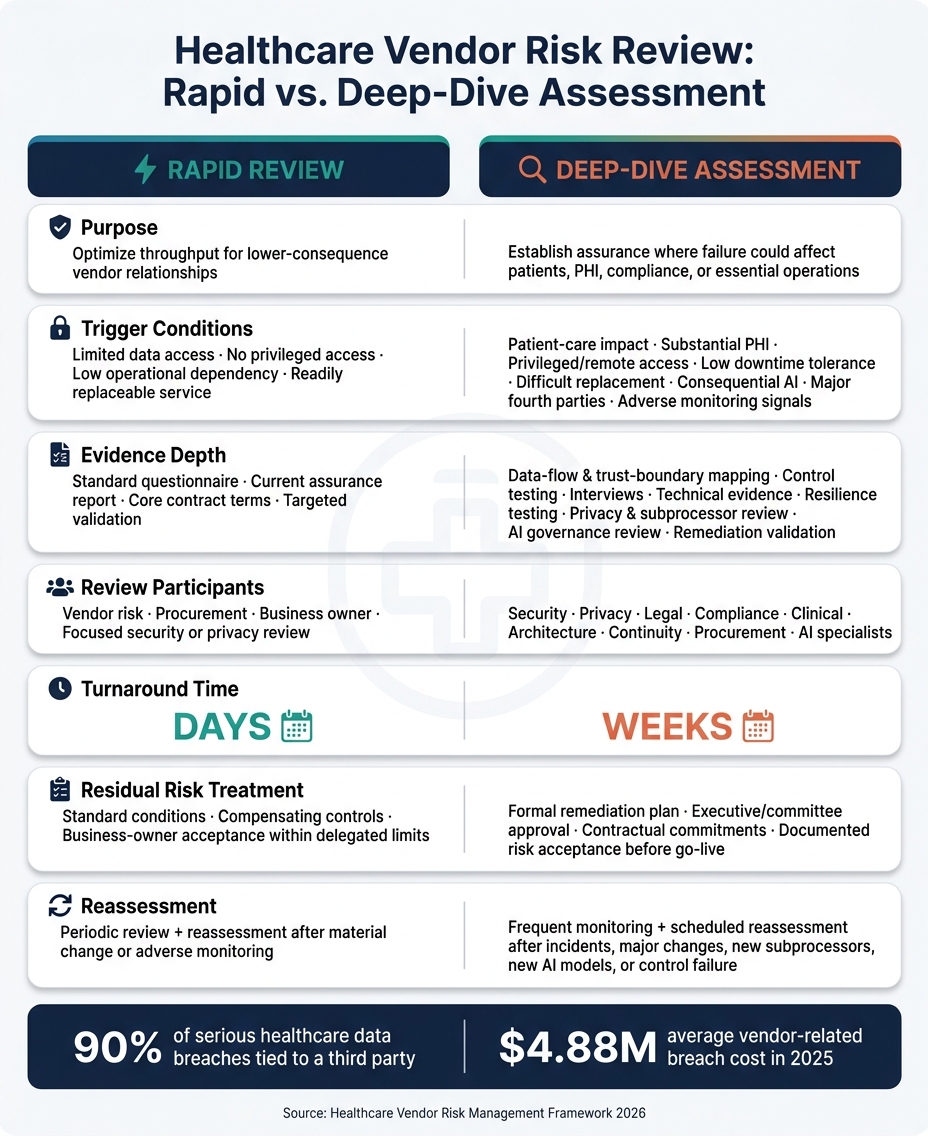
Healthcare Vendor Risk Review: Rapid vs. Deep-Dive Assessment Guide
Once intake places a vendor in the high-consequence lane, the job changes. At that point, speed matters less than proof. Some vendors need close review because missing one serious issue can lead to patient harm, compliance trouble, or major disruption to day-to-day operations. After provisional tiering, the deep dive checks whether the vendor actually belongs in that lane.
Conditions that require a full deep-dive assessment
If a vendor is already in the high-consequence lane, a deep dive is usually the next move. Escalate when the vendor touches patient care, has privileged access, or supports operations that would be hard to replace. The same goes for vendors that handle large amounts of PHI or ePHI, or are so tied into operations that swapping them out would take months.
Move to a full deep dive when any of these are true:
- AI affects consequential decisions such as triage, utilization management, coding, scheduling, or patient communications
- The vendor depends on critical fourth parties that it cannot clearly name or oversee
- Independent monitoring has flagged exposed services, unresolved critical vulnerabilities, a recent breach or ransomware event, or declining security ratings [7][8]
A vendor may look fine on paper and still end up causing a reportable breach.
What to validate in a deep-dive assessment
Start with a service and data-flow map before you test anything. Map where PHI enters the vendor’s environment, how it moves, where it is stored, who can access it, and how it is deleted or returned. Include EHR integrations, identity providers, APIs, backup environments, and any subprocessors. That map helps you aim testing at the places that matter instead of leaning on a generic questionnaire.
Then validate controls across four areas.
First, access and vulnerability management. Review privileged-access architecture, MFA enforcement, role design, patch timelines, and proof that critical findings are fixed.
Second, incident response and resilience. Confirm notification timelines, forensic cooperation commitments, recovery-time objectives, recovery-point objectives, and actual restoration test results, not just written procedures. Ransomware accounted for 51.7% of known attack methods against third parties in 2024 [1], so recovery matters just as much as prevention.
Third, privacy and subprocessor terms. Check that the BAA matches the operating contract, that allowed data uses are spelled out, and that the vendor cannot use PHI, prompts, or outputs for model training without explicit authorization [4].
Fourth, AI governance. If AI affects consequential decisions, require records on training-data use, human oversight, model-change notices, and a rollback or suspension process.
Cross-functional review is mandatory. Information security, privacy, legal, compliance, clinical leadership, and architecture should all be involved. If residual risk stays high, senior approval is required. Procurement alone should not sign it off.
Rapid review versus deep-dive: a side-by-side comparison
These two paths serve different levels of risk. Rapid review is built for lower-consequence relationships and keeps work moving. Deep dives are for vendors where failure could hit patients, PHI, compliance, or core operations. Use the table below before sending evidence requests.
| Dimension | Rapid Review | Deep-Dive Assessment |
|---|---|---|
| Purpose | Optimize throughput for lower-consequence relationships | Establish assurance where failure could affect patients, PHI, compliance, or essential operations |
| Trigger conditions | Limited data, no privileged access, low operational dependency, readily replaceable service | Patient-care impact, substantial PHI, privileged or remote access, low downtime tolerance, difficult replacement, consequential AI, major fourth parties, or adverse monitoring signals |
| Evidence depth | Standard questionnaire, current assurance report, core contract terms, targeted validation | Data-flow and trust-boundary mapping, control testing, interviews, technical evidence, resilience testing, privacy and subprocessor review, AI governance review, and remediation validation |
| Review participants | Vendor risk, procurement, business owner, focused security or privacy review | Cross-functional security, privacy, legal, compliance, clinical, architecture, continuity, procurement, and AI specialists as needed |
| Turnaround | Days | Weeks |
| Residual-risk treatment | Standard conditions, compensating controls, or business-owner acceptance within delegated limits | Formal remediation plan, executive or committee approval, contractual commitments, compensating controls, and documented risk acceptance before go-live |
| Reassessment requirements | Periodic review and reassessment after material change or adverse monitoring | More frequent monitoring and scheduled reassessment after incidents, major changes, new subprocessors, new AI models, expanded access, or control failure |
Criticality is not just about volume. A vendor with privileged access to a life-critical system, or one running an AI model that affects triage decisions, may pose more risk than a vendor processing much larger amounts of routine administrative records. If there’s still doubt, send the vendor to deep dive.
Conclusion: A decision framework for moving faster without reducing assurance
The main issue isn't speed by itself. It's using the same level of scrutiny for every vendor.
That approach slows teams down on low-risk vendors and, at the same time, can give too little weight to vendors with much higher stakes.
Once the routing model is in place, the next step is straightforward: route each vendor based on a small set of signals before sending any questionnaire.
- Patient safety / operational impact: Could an outage, compromised output, or unsafe device delay diagnosis, treatment, or critical operations?
- Regulated data / PHI exposure: Does the vendor access, store, transmit, or infer PHI, financial information, or other regulated data?
- Access / integration / credentials: Does it hold administrative credentials, remote-access permissions, API keys, or connections to clinical networks?
- Replaceability / fourth parties / AI / recent signals: Would replacing it take months? Does it rely on fourth parties that expand the attack surface, use AI for consequential outputs, or carry unresolved findings or adverse monitoring alerts?
A "yes" to patient safety, privileged access, material PHI exposure, hard-to-replace services, or consequential AI use will usually mean a deep dive. A "yes" tied to incomplete evidence or a gap that can be managed may still support time-bound approval. But that only works if the conditions have named owners, fixed deadlines, and follow-up or escalation when those conditions are missed. Everything else should move through a rapid review with a documented minimum evidence package.
Each answer pattern should lead to one of three actions: rapid review, time-bound approval, or deep dive. Here's the routing rule:
| Risk signal | Resulting action |
|---|---|
| No PHI or privileged-system access, low operational dependency, current, scoped evidence | Rapid review with delegated approval |
| Limited risk but incomplete evidence or a compensating control needed | Rapid review with time-bound conditions and a designated owner |
| Patient care impact, material PHI, privileged access, hard-to-replace service, consequential AI, or adverse monitoring | Deep-dive assessment with cross-functional approval |
| Any vendor whose risk profile can change after onboarding | Continuous monitoring and automatic re-review triggers |
Key takeaways for healthcare leaders in 2026
The scale of third-party exposure makes right-sized assurance a business need, not just a process choice. Putting deep-dive resources on every vendor doesn't hold up. Using rapid reviews for high-consequence vendors doesn't hold up either.
For U.S. healthcare organizations in 2026, four ideas should shape the way teams work: tier early, review in proportion to risk, monitor continuously, and keep human approval in place. Automation and AI-assisted triage can cut repetitive work like collecting evidence, flagging missing documents, and summarizing control gaps. But a qualified reviewer should approve every high-risk decision and every exception.
Speed matters only when it doesn't add risk. The strongest programs route vendors early, review them in proportion to risk, and escalate without delay. A documented model, clear escalation triggers, and a central workflow make that balance repeatable.
FAQs
How do we tier vendors at intake?
Use a structured, automated process that begins with a short inherent risk questionnaire completed by the internal business owner. It should cover PHI access, clinical connectivity, data volume, and operational impact.
From there, the platform can weight those factors to calculate an inherent risk score and assign a tier. That way, high-risk vendors move into a deeper assessment, while low-risk utilities go through a lighter review path.
When should a rapid review become a deep dive?
A quick review should turn into a deep dive when a vendor is Tier 1 or Critical, especially if they handle large amounts of protected health information, have direct access to clinical systems, or could affect patient safety.
You should also escalate when continuous monitoring or AI triage flags major risks. That includes a drop in security scores, a data breach, a material security change, or conflicting evidence that calls for expert human judgment.
What evidence is enough for low-risk vendors?
For low-risk vendors, the bar is pretty low. In most cases, you only need minimal evidence: a basic intake screen and a signed contract with standard terms.
If a vendor has no access to PHI and no network connectivity, they’ll usually fall into the shortest review path.
Typical evidence looks like this:
- A short self-attestation
- A signed contract with standard security clauses
- A commitment to basic hygiene practices, like HTTPS and password policies
Review usually happens at contract renewal or after a major change.
