
AI governance in healthcare now comes down to one question: can you prove who owned the system, who approved it, and what happened after go-live? That is the core shift in ANSI/HSI 2800:2025, approved on December 17, 2025.
From what I see, the standard turns AI accountability into a set of plain business tasks. You need named owners, written approval steps, risk reviews, monitoring, incident handling, and records that can hold up in an audit. And that matters because the gap is still large: only 12% of U.S. healthcare groups have a formal AI governance framework, 59% lack a documented approval process before AI use, and more than 90% do not have automated monitoring.
If I had to sum up the article in a few points, it would be this:
- Committees are not enough. One person must own each AI system.
- The board and CEO are on the hook. AI is treated as enterprise risk.
- Controls must cover the full lifecycle. That means intake, validation, approval, monitoring, change review, and retirement.
- Vendors count too. Third-party tools need the same review, contract terms, and proof.
- Evidence is the test. If your team cannot show time-stamped records, version history, and incident logs, accountability is weak.
A few facts stand out:
- Fewer than 20% of institutions report board-level AI oversight
- Of 295 FDA-cleared AI/ML devices in 2025, only 30 had an authorized PCCP, or about 10%
- Many teams still find AI issues through staff complaints or vendor notices instead of structured monitoring
So the article is not just about AI policy. It is about how healthcare teams can move from good intentions to clear ownership, written controls, and proof of action across every AI system they use.

AI Governance in Healthcare: Key Stats & Accountability Gaps (ANSI/HSI 2800:2025)
1. What ANSI/HSI 2800:2025 requires from healthcare organizations
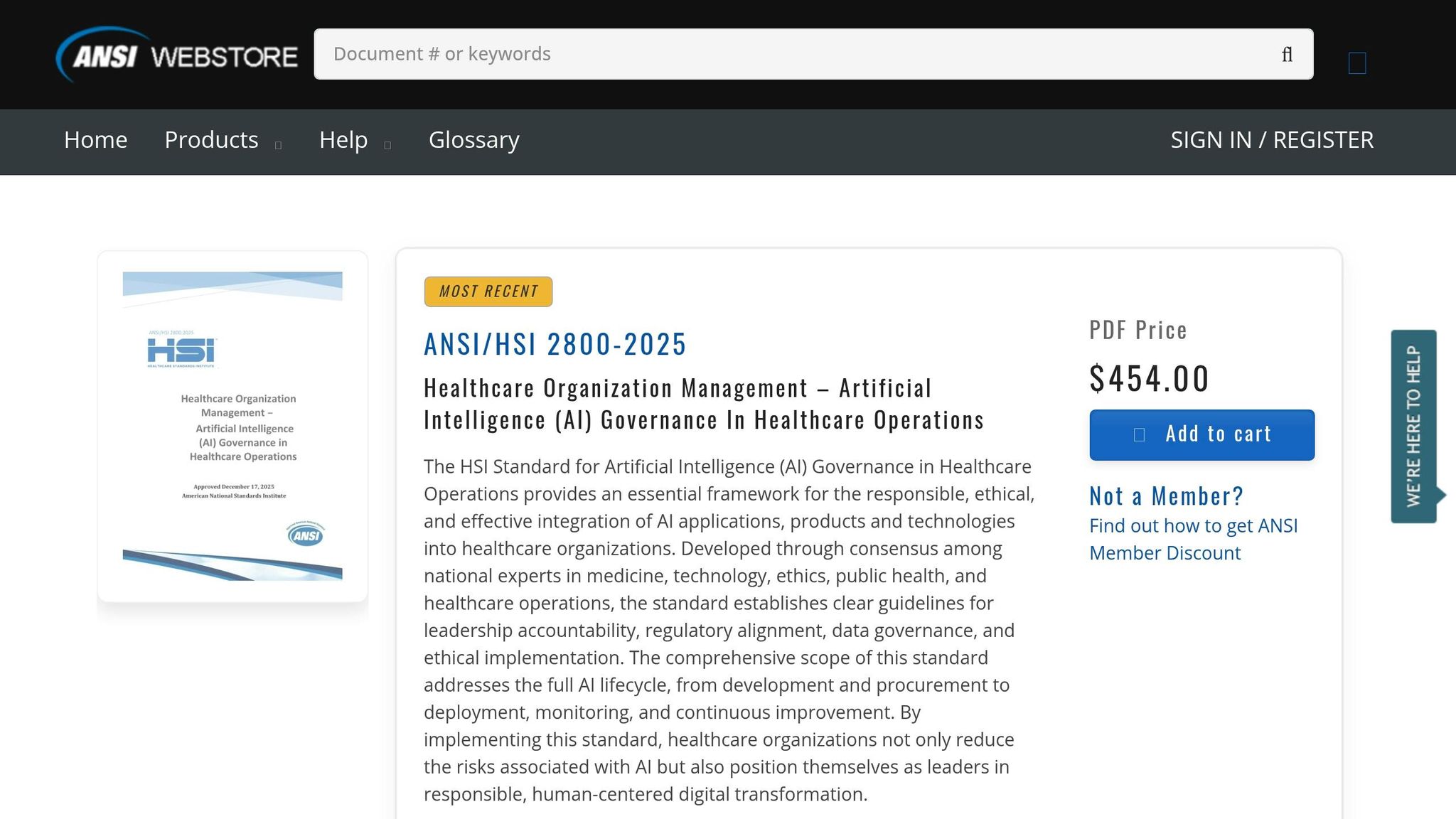
ANSI/HSI 2800:2025 moves AI governance out of the IT corner and puts it where it belongs: at the enterprise risk level. The standard gives oversight to the Board of Directors and makes the CEO and executive leadership accountable for execution. It also requires documented ownership, approval steps, and escalation paths [1][2]. Once that board-level duty is in place, the day-to-day issue becomes pretty clear: who makes AI decisions, who approves them, and who steps in when something goes wrong?
From ethics statements to documented accountability
The standard goes past broad ethics language and asks for clear, documented accountability for AI outcomes. Healthcare organizations need to name owners, define approval steps, and document escalation paths for clinical and operational use cases [2]. AI responsibility can't sit in a gray area.
In plain terms, organizations need audit-ready evidence showing who approved the system, what risk review it went through, and how performance issues move up the chain.
Scope across procurement, deployment, monitoring, and retirement
The standard covers the full AI lifecycle: development, procurement, deployment, monitoring, improvement, and retirement [2]. That lifecycle view sits at the center of its governance model.
It applies across care delivery, diagnostics, revenue cycle, scheduling, documentation, and predictive analytics [2]. If a tool is built in-house, it counts. If it comes from a vendor, it still counts. The governance bar stays the same either way. Organizations also need to make sure third-party partners meet the same standard, including HSI certification [2].
Right now, many healthcare groups aren't there yet. 59% of healthcare organizations lack a formal documented process requiring governance approval before AI implementation [3]. Under ANSI/HSI 2800:2025, that isn't just a missing workflow. It's an accountability failure. Which is why the next part of the standard zeroes in on named roles, governance committees, and escalation authority.
2. Who owns AI accountability under ANSI/HSI 2800:2025
Board and executive responsibility
ANSI/HSI 2800:2025 puts AI accountability on named leaders, starting at the top.
The board sets risk tolerance, reviews material issues, and treats AI as an enterprise risk, not just an IT project. Below the board, the CEO holds ultimate accountability for execution and compliance. [2][1] In plain English, AI ownership can't float around the org chart. It has to land with specific people, backed by committees, named system owners, and clear escalation paths.
At the executive level, a chief AI, data, or risk leader needs explicit authority to run the operating model and make sure every system has a named owner. Clinical leadership matters here too. A CMO or VP of Clinical Operations should be involved so the organization can judge clinical fit and respond when adverse events happen. [5][4]
That matters even more when you look at the gap in the market: fewer than 20% of institutions report board-level AI oversight. [5]
Governance committees, model owners, and escalation authority
This is where a lot of healthcare organizations get tripped up. They hand AI accountability to a committee and assume the work is covered. ANSI/HSI 2800:2025 doesn't treat committees that way.
Committees coordinate. They do not own.
The standard calls for one named person accountable for each consequential AI system. That ownership shifts across the lifecycle: the Business Sponsor owns use-case approval, the Independent Validation Lead signs off on validation, the Business Owner owns production deployment, and decommissioning is shared with Data Governance. [5]
Here’s how accountability maps across the AI lifecycle:
| Lifecycle Stage | Primary Accountable Owner |
|---|---|
| Use Case Approval | Business Sponsor |
| Validation | Independent Validation Lead |
| Production Deployment | Business Owner |
| Monitoring & Retraining | Named System Owner |
| Decommissioning | Business Owner + Data Governance Lead |
Escalation paths need the same level of clarity. If a risk team spots a performance issue but another business team owns the system, there should be a documented handoff, not a hallway chat or a vague email thread. Board or CEO escalation triggers should also be written down, especially for events like material drift or a patient safety event. [2][5]
3. The controls that make AI accountability measurable
Named owners help, but they don't do much on their own. Accountability starts to mean something when controls force repeatable decisions and leave a record behind. At that point, you're not dealing with vague intent anymore. You're dealing with proof. And that's a controls issue.
Intake, risk assessment, validation, and approval controls
Every AI system needs a formal front door before it touches clinical or operational workflows. In plain English, there has to be a documented intake process that spells out what the tool does, who it affects, what data it uses, and which rules apply, including FDA, ONC, CMS, and relevant state laws. [3] After that, the assigned governance lead sets a risk tier, and that tier decides how much review the system must clear before it can move forward.
For higher-risk tools, the review needs more depth. Validation should cover training data demographics, exclusion criteria, and a bias and health equity impact assessment. Human oversight also needs to be mapped at this stage: who checks outputs, when a human override is required, and how exceptions move up the chain.
Before production use, the organization should document approval with a signed record from executive leadership.
After approval, the system still needs continuous monitoring, along with clear triggers that tell the organization when to step in.
Monitoring, retraining, rollback, and retirement triggers
ANSI/HSI 2800:2025 requires continuous monitoring and feedback loops to spot drift, adverse effects, and safety issues. [2] Right now, more than 90% of healthcare organizations do not have automated AI product monitoring. Most of them find problems through vendor release notes or staff complaints instead of structured oversight. [3]
The standard also calls for predefined triggers that force a governance response. That includes retraining approval when performance falls below a set threshold, a rollback trigger when a safety risk appears, and retirement criteria when a system no longer meets validation standards. For adaptive AI, a Predetermined Change Control Plan (PCCP) lays out which autonomous changes are allowed after deployment without a new regulatory submission. Of the 295 FDA-cleared AI/ML devices in 2025, only 10% - 30 devices - had an authorized PCCP in place. [3] That leaves most organizations dealing with model changes without a documented playbook.
Monitoring isn't separate from approval. It's what approval looks like over time. The table below shows how the main accountability domains connect to the control and evidence that ANSI/HSI 2800:2025 expects:
| Accountability Domain | Required Control | Required Evidence |
|---|---|---|
| Intake & Risk | Use-case intake & risk tiering | Intake record and risk assessment |
| Validation | Bias & health equity audit | Statistical bias assessment |
| Approval | Documented production sign-off | Signed approval record |
| Monitoring | Drift & performance detection | Real-world performance logs |
| Vendor Oversight | HSI certification requirement | Vendor certification and business associate agreement |
| Retirement | Retirement criteria | Retirement summary report |
Using workflow and oversight tools to support accountability
None of these controls work well if the evidence is spread all over the place. If one team has intake records, another has vendor files, and someone else is tracking approvals in email, things break down fast.
Governance work should move through one workflow for intake, risk review, approvals, vendor checks, and evidence capture. A centralized platform can route tasks, store records, and flag exceptions in one dashboard. Censinet RiskOps™ supports this by pulling together assessment findings, routing tasks to designated stakeholders, and keeping an AI risk dashboard where automation handles routing and evidence capture while risk teams keep decision authority.
sbb-itb-535baee
4. What evidence organizations need to prove accountability
Once controls are in place, the next step is proof.
Controls and ownership mean very little if the organization can't show what happened, when it happened, and who signed off on it. ANSI/HSI 2800:2025 asks for documented evidence across the full AI lifecycle. A policy by itself doesn't cut it. What matters is what you did and how you can prove it.
Required records across the AI lifecycle
Each stage of an AI system's lifecycle inside your organization needs its own documentation, from development and procurement to deployment, monitoring, and continuous improvement.
This goes beyond a general inventory. You need records tied to specific systems, specific decisions, specific people, and the oversight behind them.
| Lifecycle Stage | Required Records & Artifacts |
|---|---|
| Intake & Procurement | Vendor accountability evidence, risk assessment reports, BAA addenda, and procurement contracts with governance requirements |
| Validation & Approval | Validation summaries, risk scoring rationale, time-stamped approval histories, and version IDs for each model release |
| Deployment & Use | Logs that identify both the user and the AI system, access logs showing which records were accessed, and staff training records |
| Monitoring & Review | Model drift reports, performance logs, periodic reassessment records, and SIEM alerts |
| Incident & Retirement | Adverse-event logs, incident response actions, corrective action plans, and retirement/decommissioning logs |
These records give teams a way to reconstruct each decision, defend each control, and trace each owner.
How healthcare teams can build audit-ready traceability
Good evidence has a few non-negotiable traits. It should be time-stamped, tied to a specific model version, and linked to the person who made the decision.
For example, when a validation summary is approved, the record should show who approved it, when they approved it, and what criteria they used. It shouldn't just say that approval occurred.
Version-controlled policies matter too. If your governance policy changed between the date a system was approved and the date an incident took place, you need to show which version was active at that time and what it required. A policy-to-control map helps connect requirements to the controls that enforced them.
The same idea applies to incidents. Incidents and corrective actions should link straight to the AI system record, not sit in a separate folder where someone has to piece things together by hand. For high-stakes clinical AI, feeding audit logs into a Security Information and Event Management (SIEM) platform helps show continuous monitoring instead of after-the-fact reporting.
Audit failures usually happen because the evidence is weak, not because the policy is weak. Under ANSI/HSI 2800:2025, accountability has to be reconstructable at every stage. It can't live only in a governance document that no one can connect to a specific decision or control. That same traceability also helps with incident response and third-party review.
5. Incident response, third-party accountability, and continuous review
Once records are in place, the next test is simple: can the organization respond fast when an AI system goes off track, and can it hold vendors to that same standard?
AI-specific incident response and incident handling
When an AI system produces harmful output, a clinician flags odd behavior, or monitoring shows a drop in performance, the response can't be made up on the fly. ANSI/HSI 2800:2025 expects pre-defined escalation paths for both clinical and operational incidents, with that process documented ahead of time.
Your incident response playbook should spell out the accountability chain from day one:
- Who detects the issue
- Who decides whether action is needed
- Who has the authority to pause or roll back the system
- Who signs off on restoration
For clinical AI incidents, clinician review is required before the system goes back into use.
After containment, the response should be documented and linked to the affected system's record. If a system has been paused or rolled back, bringing it back online should go through the organization's formal approval process, not an improvised restart.
And this can't stop with internal tools. The same discipline needs to apply to third-party systems too.
Vendor accountability, contractual controls, and periodic reassessment
ANSI/HSI 2800:2025 applies that same governance standard to vendors. Contracts need to define accountability in plain terms. Incident notification timelines should be written into agreements so your organization can still meet its own breach notification duties. Change management terms should require vendors to disclose model updates before deployment, not after. Audit support should also be written into the contract, including evidence of performance and security posture.
A BAA should cover every party in the AI supply chain, including model providers, cloud hosts, and vector database vendors. Before deployment, notify malpractice and cyber insurance carriers in writing to confirm coverage for third-party processor data flows.
Signing the contract isn't the finish line. Vendor governance calls for periodic review of performance, updates, and security posture. It's smart to define reassessment triggers in advance, such as:
- A vendor security incident
- A regulatory change
- A performance regression found through monitoring
That way, the process doesn't depend on someone's judgment in the heat of the moment. Those reviews should feed back into monitoring and auditing so model drift and unintended consequences are caught over time.
Conclusion: What AI accountability looks like under ANSI/HSI 2800:2025
ANSI/HSI 2800:2025 turns AI accountability into named ownership, documented controls, incident discipline, and vendor oversight. Organizations that treat accountability as an operating discipline, not just a paperwork exercise, will be in the strongest position to defend their AI decisions.
FAQs
How should we start implementing ANSI/HSI 2800:2025?
Start with Board-level oversight and clear executive accountability for AI across the organization. Put simply, AI can't sit in a side corner of IT. It needs direct attention from leadership.
Set up a multidisciplinary AI governance committee that includes leaders from clinical, security, legal, compliance, and IT. Then assign every AI tool a named executive owner. That way, each system has someone on the hook for decisions, risk, and follow-through.
Next, build a centralized AI inventory so the organization has one place to track every AI tool in use. From there, apply risk tiering and line up internal policies with the standard for:
- pre-launch risk assessments
- ongoing performance monitoring
- clear incident response
This gives teams a simple way to know what is being used, how much risk it carries, and what has to happen before and after launch.
What makes an AI system high risk under this standard?
Under ANSI/HSI 2800:2025, an AI system is high risk if it has a material effect on patient safety, quality of care, access to services, clinical trust, liability, or a healthcare organization’s financial performance.
That usually covers systems used for:
- Diagnostics
- Treatment recommendations
- Clinical decision support
- Revenue cycle management
- Patient triage
These systems need tighter oversight. That includes committee approval, bias testing, performance monitoring, and human oversight safeguards.
What evidence would an auditor expect to see first?
First, an auditor will look for proof that your documented AI governance policies are doing more than sitting on a shelf. In plain English, they want to see that the rules are being used in day-to-day work. That often means a formal inventory of AI tools, along with evidence of a documented authorization process that shows leadership approved each tool before people started using it.
They’ll also expect completed records, not half-finished paperwork or loose notes. That includes risk assessments with residual scores, signed checklists, meeting minutes, pre-launch review evidence, and technical logs that tie data access to specific individuals instead of shared service accounts.
