
- Censinet: Specializes in healthcare risk management with strong HIPAA compliance tools and seamless EHR integration.
- Risotto: Offers continuous presence verification and AI governance for digital agents, ensuring secure workflows.
- Imprivata: Focuses on clinical environments with features like Secure Walk-Away and deep EHR integrations.
- SailPoint: Provides enterprise-level identity governance with automated provisioning and compliance reporting.
- Saviynt: Combines identity governance and privileged access management for unified oversight.
- Okta: Cloud-based, scalable, and supports SMART on FHIR and EPCS workflows.
- CyberArk: Excels in privileged access management with a Zero Trust approach.
Each solution addresses unique challenges like HIPAA compliance, EHR integration, and scalability, making them suitable for varying organizational needs. Below is a quick comparison to help you decide.
Quick Comparison
| Solution | Key Strength | EHR Integration | Deployment Time | Pricing |
|---|---|---|---|---|
| Censinet | Healthcare-specific risk tools | Clinical apps, devices | Custom timelines | Custom pricing |
| Risotto | Continuous presence verification | SMART on FHIR | Hours | Free trial |
| Imprivata | Clinical workflow focus | Deep integrations | 4–8 weeks | Per-user basis |
| SailPoint | Automated compliance tasks | API-based connectivity | 9–18 months | Scalable |
| Saviynt | Unified IGA and PAM | Cloud-native integrations | Flexible | SaaS pricing |
| Okta | Cloud-first, scalable | SMART on FHIR, EPCS | Weeks | $6–$17/user/mo |
| CyberArk | Privileged access management | EMR, IoT devices | 6–12+ months | High upfront |
Choose the solution that aligns with your organization's size, budget, and compliance needs. Effective IAM not only secures sensitive data but also streamlines operations in healthcare.

Healthcare IAM Solutions Comparison: Features, Pricing, and Deployment Times
Top 10 Best IAM Tools – Identity Access Management (Pros & Cons)
sbb-itb-535baee
1. Censinet
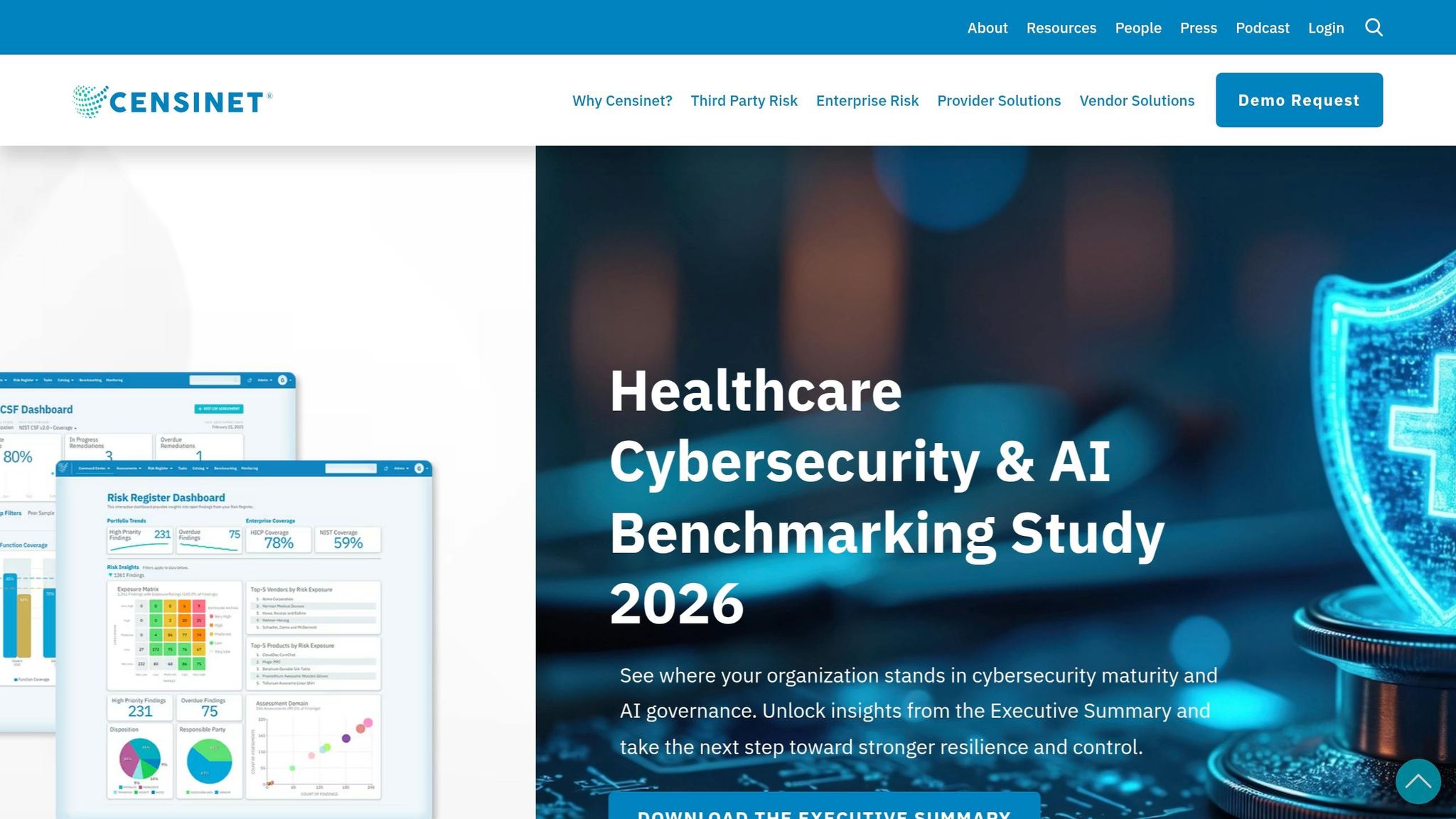
Censinet RiskOps™ is a cybersecurity platform designed specifically for healthcare organizations. Unlike general-purpose IAM tools, it addresses the unique challenges faced by healthcare delivery organizations, focusing on protecting patient data and managing access within complex healthcare environments. This includes robust third-party vendor risk management to ensure external partners meet security standards.
HIPAA Compliance and PHI Protection
Censinet RiskOps™ prioritizes patient privacy, clinical safety, and regulatory compliance[1]. With HIPAA regulations requiring stringent access controls and detailed audit logs, the platform automates the creation of comprehensive audit trails. This automation not only simplifies compliance reporting but also reduces the workload for security teams. By implementing the principle of least privilege, Censinet ensures that employees access only the information relevant to their roles. For instance, a billing specialist wouldn't have access to clinical notes. These strict access measures play a critical role in safeguarding both patient care and data integrity.
EHR Integrations and Healthcare-Specific Workflows
Beyond compliance, Censinet enhances operational efficiency. It uses APIs and middleware to integrate seamlessly with legacy EHR systems, centralizing data from HR, visitor management, and EHR platforms[1]. This integration resolves the inconsistencies often found in siloed hospital systems. Additionally, open API automation ensures that HR updates - like role changes - are instantly reflected in access permissions. The platform also supports Single Sign-On (SSO), allowing clinicians to quickly and securely access patient records without unnecessary login delays, ultimately enabling faster and safer patient care.
2. Risotto
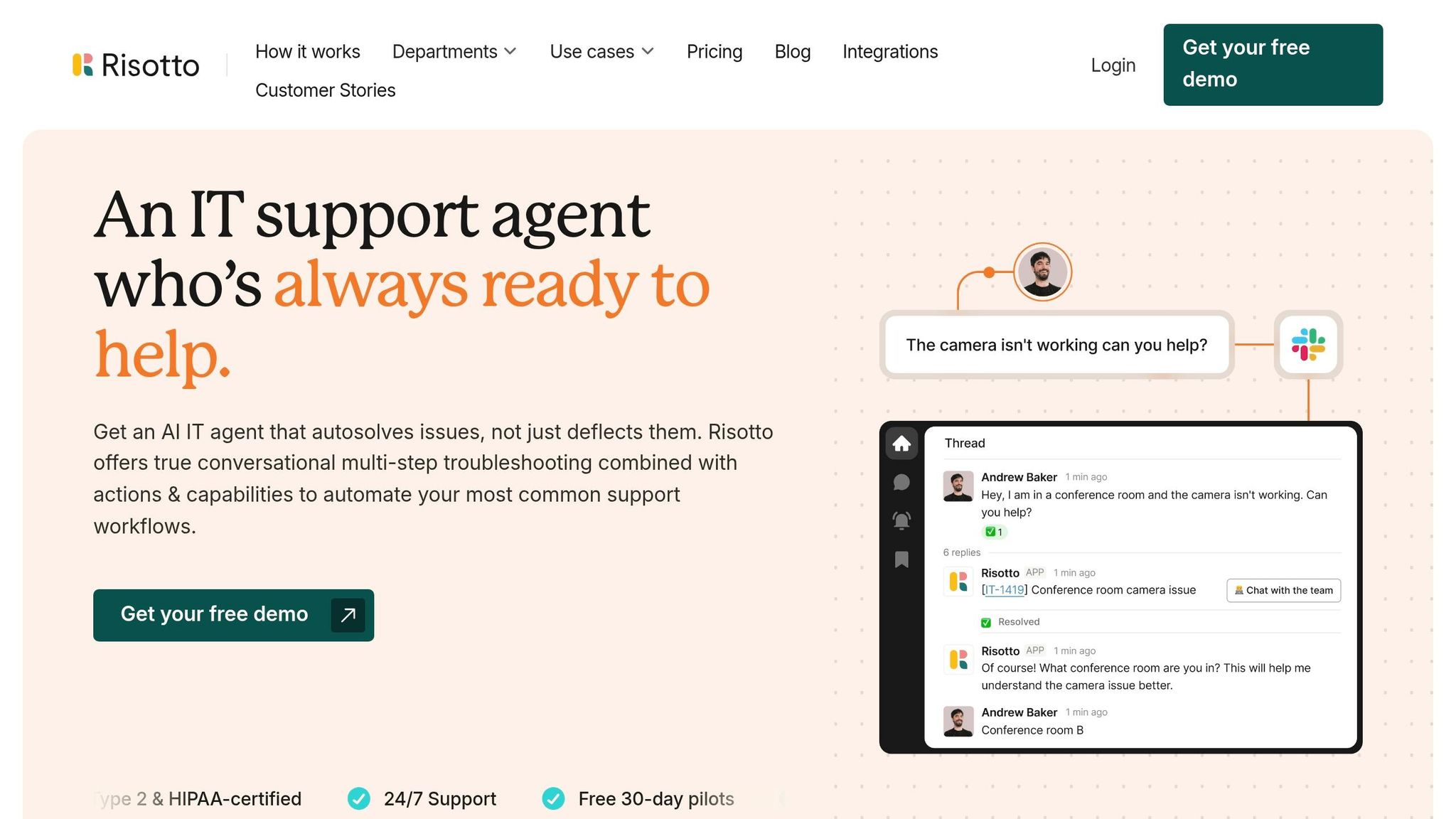
Advanced Identity and Access Management Features
Risotto offers modern Identity and Access Management (IAM) tools tailored specifically for healthcare environments. One standout feature is Continuous Presence Verification, which ensures that the person accessing sensitive patient information is authorized at that exact moment. This is especially critical at shared workstations, where multiple clinicians may use the same device during a shift. Unlike systems that depend solely on an initial login, Risotto continuously validates user authorization throughout the session, adding an extra layer of security in busy clinical settings[5].
Another pressing issue Risotto tackles is AI Governance for digital agents. With tools like ambient AI documentation systems and diagnostic agents becoming routine in healthcare workflows, there’s a need for strict oversight. Risotto handles this by implementing scoped permissions, time-limited credentials, and comprehensive audit logs to secure these digital agents, ensuring they operate within clearly defined boundaries[5].
These features make it easier to integrate advanced technologies into healthcare workflows while maintaining rigorous security standards.
EHR Integrations and Healthcare-Specific Workflows
Risotto leverages SMART on FHIR standards alongside OAuth 2.0 and OpenID Connect to ensure smooth interoperability with Electronic Health Records (EHR) systems. It also automates Joiner-Mover-Leaver (JML) lifecycles, which is a game-changer for healthcare organizations. This automation ensures that new staff gain immediate access to necessary systems while access for departing employees is promptly revoked. The result? New hires experience "Day-One Productivity", even in the fast-paced healthcare environment, without compromising security.
3. Imprivata
Imprivata offers a multi-layered solution specifically designed to meet the unique demands of the healthcare industry, focusing on advanced Identity and Access Management (IAM) features.
HIPAA Compliance and PHI Protection
Imprivata helps healthcare organizations stay compliant with HIPAA by maintaining three years of searchable audit logs, simplifying regulatory inquiries and compliance checks [8].
The platform uses AI-driven privacy monitoring to identify and flag inappropriate access to Protected Health Information (PHI) [8]. It also provides context-aware insights into user behavior, allowing privacy officers to determine whether access was appropriate based on the user's role [8]. By automating these processes, Imprivata reduces the need for manual investigations, improving overall security.
For shared workstations - common in areas like nursing stations and emergency departments - Imprivata includes the Secure Walk-Away feature. This automatically ends sessions when clinicians leave their workstations without logging out, preventing unauthorized access in busy environments where staff may overlook locking their screens. It supports various authentication methods, such as fingerprint biometrics, proximity badges, FIDO2 passkeys, and facial recognition, which remains reliable even when users wear masks or glasses [6][7][9].
Beyond protecting individual workstations, the platform also integrates seamlessly into clinical workflows.
EHR Integrations and Healthcare-Specific Workflows
Imprivata works with major Electronic Health Record (EHR) systems like Epic, Cerner, Meditech, McKesson, Siemens, and Healthland, offering over 400 integrations [8][9]. Features like "No Click Access" allow clinicians to resume their sessions on any workstation by simply swiping a badge or scanning a fingerprint, eliminating the need for repeated logins [6][9]. This roaming session capability ensures that desktop and application states follow clinicians as they move between shared workstations [9].
The platform also supports Electronic Prescribing of Controlled Substances (EPCS) via Imprivata Confirm ID, which incorporates DEA-compliant two-factor authentication [7]. For Epic users, Imprivata offers deep integrations with tools like Generic Auth and SMART on FHIR, streamlining photo handling and authentication within clinical workflows [7].
Scalability for Healthcare Delivery Organizations (HDOs)
Imprivata OneSign is designed to scale effortlessly, requiring no changes to existing IT infrastructure. This makes it easier to deploy across multiple facilities [6][9]. The platform also supports redundant pair configurations with automatic system backups, ensuring uninterrupted access to patient data even during technical issues [9].
For large healthcare systems managing thousands of users across numerous locations, centralized features like enterprise Single Sign-On (SSO), EPCS, medical device access, and remote access are crucial. Imprivata addresses these challenges from a unified platform. Additionally, its AI-powered monitoring automatically flags high-risk PHI access events, a feature that becomes increasingly important as healthcare systems grow and handle larger volumes of access events [8].
4. SailPoint
SailPoint delivers enterprise-level identity governance tailored to healthcare organizations, focusing on automated compliance and efficient provisioning. It was named Best in KLAS 2025 for its role in securing healthcare digital identities [12].
HIPAA Compliance and PHI Protection
SailPoint enforces least privilege access, ensuring clinicians only access the ePHI necessary for their roles across applications, data, and cloud infrastructure [10]. By automating compliance tasks, the platform generates audit-ready HIPAA and SOX reports in just minutes [10].
Using AI and machine learning, SailPoint identifies outliers and high-risk access combinations, cutting breach risks from 30% to 5% [10][13].
"We are using SailPoint's AI capabilities to identify outliers, users that have more access privileges than they should as compared to others. We're using it as a basis for cleaning up and auditing our access privileges and tightening our identity governance structure." - Nickisha Bennett-Burton, Identity and Access Manager, ECU Health [10]
The platform also includes Non-Employee Risk Management (NERM), which governs access for third-party vendors, nursing students, and contractors who need temporary access to sensitive systems [10][14].
These compliance measures set the stage for seamless EHR integration.
EHR Integrations and Healthcare-Specific Workflows
SailPoint provides pre-built integrations with major EHR systems like Epic, Cerner, and MEDITECH, eliminating the need for custom development [10][14]. For Epic users, the platform automates EMP (Employee) and SER (Schedulable Epic Resource) provisioning, reducing manual provisioning tasks by 70% [14].
Temple Health offers a striking example of SailPoint’s capabilities. Between 2021 and 2024, Temple Health integrated SailPoint IdentityNow with Epic for 20,000 users, slashing onboarding time by 99% (from 120 hours to just 1.5 hours), cutting password reset time by 93%, and saving about $100,000 monthly by eliminating 13,000 inactive accounts [15].
"Within minutes of SailPoint IdentityNow recognizing a new identity, their user template, access privileges, and security needs are all fully provisioned within Epic." - TJ Mallozzi, Director of Epic Security and Access Management, Temple Health [15]
Using Role-Based Access Control (RBAC), SailPoint assigns access privileges automatically based on predefined roles and job descriptions, ensuring clinicians receive the necessary access without over-provisioning [10][15].
Scalability for Healthcare Delivery Organizations (HDOs)
SailPoint's capabilities extend to large healthcare systems, offering scalable solutions for complex ecosystems.
For example, SailPoint automates the Joiner–Mover–Leaver process, preventing access creep in large systems [10][14]. Main Line Health, a non-profit health system managing 20,000 identities, implemented SailPoint in about six months. The result? A 75% boost in provisioning speed and a savings of 15–20 staff hours per recertification campaign [14].
"With SailPoint, we've evolved identity management from a highly manual process into a more automated and efficient system. This has improved operational workflows and helped our teams stay focused on delivering exceptional patient care." - Richard Layne, Manager of Identity and Access Management, Main Line Health [14]
SailPoint also extends governance to machine identities (like bots and AI agents) and unstructured data access, addressing the growing complexity of healthcare systems [10]. Through its partnership with Imprivata, the platform integrates identity governance with clinical access management, enabling passwordless SSO and secure workflows tailored for busy clinical environments [11][12].
5. Saviynt
Saviynt Healthcare Identity Cloud (HIC) is a cloud-native platform designed to unify Identity Governance and Administration (IGA), Privileged Access Management (PAM), Application Access Governance (AAG), and Third-Party Access Governance (TPAG). It currently secures more than 60 million identities for global healthcare organizations [16].
HIPAA Compliance and PHI Protection
Saviynt ensures compliance with regulations like HIPAA, HITRUST, and PCI DSS by offering preconfigured controls to safeguard Protected Health Information (PHI) and other sensitive data [17][18]. It directly integrates with Learning Management Systems (LMS), granting access to critical systems only after staff complete mandatory HIPAA training [17].
The platform addresses toxic access combinations through Cross-Application Segregation of Duties (SoD) enforcement. By combining PAM with Identity Governance, it provides just-in-time access elevation, ensuring time-limited access and removing standing privileges [17][18].
Saviynt has delivered measurable results for its clients. For instance, Syneos Health saw a 75% improvement in processing change requests after adopting Saviynt’s identity governance solution, while also preparing for rapid growth [16][17]. Similarly, an international biotech firm achieved a 100% SOX compliance rate, even as its audit volume doubled [16].
"Security and compliance are paramount in healthcare, where protecting patient data is as critical as providing quality care. With Saviynt Identity Cloud, we have created a blueprint for modern healthcare security, one that ensures seamless and timely access for healthcare workers while maintaining strict governance and regulatory compliance." - Saviynt Healthcare Customer [16]
These compliance-focused features integrate seamlessly with Saviynt's broader platform capabilities.
EHR Integrations and Healthcare-Specific Workflows
Saviynt enhances efficiency with native integration for electronic health record (EHR) systems like Epic (via the Epic App Market) and Cerner. This allows automation of EMP templates, subtemplates, and Schedulable Epic Resource (SER) items without requiring custom development [16][19]. The platform also supports healthcare workflows with tools like "match and merge" for fragmented identities and automated role succession [19].
Intermountain Healthcare, a nonprofit serving Utah, Idaho, and Nevada with 40,000 caregivers, implemented Saviynt to manage access for over 6,000 physicians (both employed and affiliated). The solution provided granular access controls for SoD evaluations, improved access reviews, and created a centralized identity repository to meet growing audit demands [20].
"As we're more modern, there's more scrutiny of that. So we set out some objectives in our program, saying we need to create a centralized identity repository of all users' access." - Michael Allred, Cybersecurity Director, Identity & Access Management, Intermountain Healthcare [16][20]
Scalability for Healthcare Delivery Organizations (HDOs)
Saviynt’s scalability addresses the dynamic needs of Healthcare Delivery Organizations (HDOs). The platform automates the Joiner, Mover, Leaver lifecycle, maintaining a single "identity for life" for clinicians as they transition between roles or departments [19]. For example, a pharmacy organization secured over 10 million lifecycle tasks using Saviynt [16].
Saviynt also simplifies onboarding for medical suppliers, research partners, and affiliated clinicians through self-service portals with a sponsorship model to regulate third-party access [18]. For research purposes, the platform can restrict access to de-identified patient records, ensuring privacy while supporting clinical studies.
The platform’s advanced risk analytics use peer and behavioral analysis to detect high-risk activities, outlier access patterns, and toxic entitlement combinations across multiple applications. Additionally, it offers "break-glass" emergency access management, designed for clinical settings where immediate access to patient data is critical during emergencies.
6. Okta
Okta offers a cloud-based platform focused on identity and access management, tailored to meet the specific security and compliance demands of healthcare organizations. It operates on a FedRAMP Moderate cloud, featuring end-to-end encryption and hardware designed to adhere to HIPAA requirements [21].
HIPAA Compliance and PHI Protection
Okta supports federal healthcare security standards with certifications like FedRAMP ATO and FIPS 140-2. Its Zero Trust model secures access across legacy systems, on-premises setups, and cloud applications - a critical feature considering healthcare's long-standing record of the highest breach costs, averaging over $9 million annually [3]. The platform's Adaptive Multi-Factor Authentication (MFA) uses context-aware controls, analyzing factors like location, device, and network. McKesson, for example, achieved a 69% boost in MFA adoption within just two weeks of using Okta [3]. Additionally, automated provisioning and deprovisioning ensure that access to PHI is revoked promptly when necessary [23].
EHR Integrations and Healthcare-Specific Workflows
Okta integrates seamlessly with Epic Systems, delivering identity verification and assurance [22]. Its MFA capabilities support Electronic Prescribing for Controlled Substances (EPCS) workflows, meeting DEA standards [3][22], and it aligns with the 21st Century Cures Act by supporting SMART on FHIR interoperability requirements [3]. Dignity Health reported that 86% of its hospitals saw better physician-to-patient communication through Okta-enabled patient portals [3]. By integrating with patient portal providers, Okta simplifies digital access and assists federal agencies like the Centers for Medicare and Medicaid Services in consolidating multiple websites into a single, secure interface [23]. These features help healthcare organizations streamline identity management at scale.
Scalability for Healthcare Delivery Organizations (HDOs)
Okta's cloud-based infrastructure allows organizations to scale without disruptions or downtime for upgrades. IT teams can manage growing application portfolios while keeping sensitive PHI secure [25]. During mergers and acquisitions, Okta simplifies identity consolidation without requiring Active Directory unification, enabling "day-one access" to critical clinical tools [3]. Innovive Health reported a 30% improvement in employee productivity after implementing Okta solutions [3]. The platform connects users to applications across both cloud and on-premises environments while centralizing security for service accounts, API tokens, and machine-to-machine interactions [24].
Advanced Identity and Access Management Features
Okta enhances its scalability with advanced API management. Its API Access Management secures the APIs used for sharing clinical data with external partners, addressing third-party risk management gaps [23]. The platform serves a wide range of users through its Workforce and Customer Identity clouds, with automated access reviews that simplify HIPAA audits [24].
7. CyberArk
CyberArk stands out as a specialized IAM solution, particularly in managing privileged access within the healthcare sector.
Its Privileged Access Management (PAM) tools are designed to secure high-level credentials across systems like EMR, telehealth platforms, and IoT devices. Recognized as a Leader by Gartner seven times [27], CyberArk is trusted by nearly 10,000 organizations worldwide, including prominent U.S. hospitals. In February 2026, Palo Alto Networks acquired CyberArk, integrating its identity security capabilities into a broader AI-driven security ecosystem [27].
HIPAA Compliance and PHI Protection
CyberArk employs a Zero Trust model, ensuring continuous verification of every identity. It minimizes exposure to PHI by issuing temporary, session-based credentials through Just-In-Time (JIT) provisioning [26][27]. The platform also automates critical processes like audit log collection, session recordings, and identity lifecycle management. This approach enforces least privilege access, ensuring permissions are aligned with the user’s role throughout their tenure, whether they are a clinician or contractor [26][27].
EHR Integrations and Tailored Healthcare Workflows
The platform integrates seamlessly with EHR systems, telehealth platforms, and IoT devices. It dynamically adjusts permissions as roles change, enabling healthcare organizations to securely and efficiently manage patient data access.
"If we can control identity, we can stop most modern attacks. And if you control identity, then you control every perimeter, application, container – effectively every part of the environment. That is what I call true Zero Trust and that is why we use CyberArk." – Brian Miller, CISO at Healthfirst [26]
Advanced Identity and Access Management Features
CyberArk’s Adaptive MFA incorporates AI-driven, risk-aware methods and real-time behavior analytics to validate identities. The platform also excels in managing machine identities, which outnumber human identities by an estimated 82 to 1. It automates TLS certificate renewals, a critical feature as certificate lifespans are expected to shrink from 398 days in 2025 to just 47 days by 2029, helping prevent system outages [28].
Feature Comparison Table
The table below provides a quick summary of the strengths and features of each IAM solution, tailored for healthcare needs. These solutions differ in how they handle HIPAA compliance, EHR integration, deployment timelines, and pricing structures, making it easier to evaluate which might be the best fit for your organization.
HIPAA compliance is a non-negotiable for healthcare organizations. All seven solutions meet this requirement by supporting Business Associate Agreements (BAAs) and offering features like encrypted data storage, granular access controls, and audit logging [2]. However, their specific focus areas vary. For example, Okta provides configurable data residency options to manage PHI storage in certain regions [30][2], while SailPoint emphasizes automating identity lifecycle management with detailed audit capabilities [29]. CyberArk, on the other hand, focuses on securing privileged access through a Zero Trust approach to minimize PHI exposure risks.
EHR integration is another critical factor. Okta stands out with its support for SMART on FHIR interoperability and EPCS workflows [3], making it compatible with major EHR platforms like Epic and Cerner. A notable success story is McKesson, which achieved a 69% increase in MFA adoption within two weeks using Okta’s platform [3].
Deployment speed and pricing show significant differences between the solutions. Risotto is one of the fastest to deploy, taking just hours, and offers a 30-day free trial [34]. Okta also boasts quick deployment thanks to its cloud-native architecture, with starter packages starting at $6/user/month [33]. In contrast, SailPoint and CyberArk require longer deployment timelines, ranging from 9–18 months and 6–12+ months, respectively [32]. Saviynt offers a combined IGA and PAM-lite platform, which can reduce vendor sprawl and lower the total cost of ownership [32][34].
Here’s a side-by-side comparison of these platforms:
| Solution | HIPAA Compliance Strength | EHR Integration | Implementation Time | Pricing Model | Scalability Focus | PHI Protection |
|---|---|---|---|---|---|---|
| Censinet | Specialized healthcare risk management | Clinical applications, medical devices | Custom deployments | Custom pricing | Healthcare-specific | Risk assessments for PHI |
| Risotto | BAA support and audit logging | SMART on FHIR support | Hours | 30-day trial; low overhead | Rapid/Slack-integrated | AI-powered automation |
| Imprivata | Healthcare-focused compliance | Deep EHR workflows | 4–8 weeks | Per-user licensing | Clinical environments | Single sign-on for shared workstations |
| SailPoint | Mature IGA for HIPAA/SOX | API-based connectivity | 9–18 months | Scales with entitlements | Large enterprise/complex | Automated identity lifecycle and audit reports |
| Saviynt | Converged IGA/PAM compliance | Cloud-native integrations | Flexible deployment | Competitive SaaS | Cloud-native/mid-upper | Unified governance across applications |
| Okta | BAA, adaptive MFA, data residency | SMART on FHIR, EPCS | Cloud-fast (weeks) | $6–$17/user/month starter | Cloud-first/high | Risk-aware authentication with 7,000+ app integrations |
| CyberArk | Zero Trust PAM for privileged access | EMR, telehealth, IoT devices | 6–12+ months | High implementation/SI costs | Large enterprise/deep | Robust privileged access management |
This comparison highlights the unique strengths of each solution, helping healthcare organizations identify the best fit for their specific needs. Whether your focus is rapid deployment, cost efficiency, or advanced compliance features, there’s a solution designed to meet those priorities.
Conclusion
A well-thought-out IAM strategy is essential for ensuring both security and efficiency in healthcare operations. Selecting the right IAM solution isn't just about compliance - it's about protecting patient lives and securing your organization's future. With the surge in data breaches and the hefty penalties that follow, implementing a strong IAM system has become a necessity.
Today's IAM platforms do more than just block breaches. They simplify workflows by reducing login fatigue, automating user provisioning, and integrating seamlessly with EHR systems. The solutions discussed here provide practical tools for meeting compliance standards, securing EHR access, and managing users effectively.
"Identity management is the foundation for patient privacy, clinical safety, and compliance." - Acre Security [31]
Each platform comes with its own strengths, catering to various organizational needs. The key is to choose one that fits your organization's size, budget, timeline, and compliance requirements.
With healthcare now responsible for generating over 30% of the world's data [35] and the mHealth market projected to hit $296 billion by 2032 [4], your IAM strategy must adapt to these growing challenges. The right IAM platform can safeguard sensitive patient information while enabling your organization to deliver efficient, high-quality care.
FAQs
What’s the best way to choose an IAM for my hospital?
To find the best IAM solution for your hospital, prioritize features such as Multi-Factor Authentication (MFA), Role-Based Access Control (RBAC), and Identity Governance and Administration (IGA). These tools help protect patient data and ensure compliance with critical regulations. Make sure to assess your hospital's unique requirements, including how well the solution scales, how easily it integrates with your current systems, and whether it aligns with standards like HIPAA. The goal is to choose a platform that delivers secure and efficient access management designed specifically for healthcare needs.
How do I integrate IAM with my EHR without disrupting clinicians?
To connect IAM with your EHR system effectively, prioritize solutions that balance security with clinician productivity. Start by using role-based access control (RBAC) and multi-factor authentication (MFA) designed specifically for clinical workflows.
Carefully define roles and permissions, incorporate single sign-on (SSO) for easier access, and use adaptive MFA to enhance security without adding unnecessary complexity. Automating user provisioning can also save time and reduce errors. Finally, thorough testing of the IAM system before rolling it out ensures it fits seamlessly into existing workflows, minimizing interruptions and helping clinicians stay focused.
How can IAM reduce HIPAA audit and access review work?
IAM makes HIPAA audits and access reviews more manageable by automating user lifecycle management, implementing role-based access controls, and centralizing identity governance. These tools help cut down on manual work, improve compliance processes, and ensure access is monitored effectively.
