
A vendor issue can turn into a patient care issue fast. In healthcare, the best vendor risk programs do 7 things: build a full vendor list, rank vendors by risk, check proof of controls, put clear terms in contracts, watch vendors by tier, prepare for downtime, and assign clear owners.
Here’s the short version:
- Know which vendors matter most. A vendor is high risk if it can affect care, PHI, or core systems.
- Keep one vendor inventory. Track data access, system links, contract dates, and review status.
- Use tiers. Not every vendor needs the same review depth or review timing.
- Ask for proof. BAAs, SOC reports, test results, and outage history matter more than self-reported answers.
- Write terms into contracts. Set breach notice windows, security requirements, recovery targets, and exit terms.
- Watch vendors after onboarding. Risk does not stop at contract signature.
- Plan for failure. Downtime playbooks, manual workflows, and DR testing help keep care moving.
- Put leaders in charge. Security, privacy, legal, procurement, and clinical teams all need clear roles.
A few numbers show why this matters:
- Healthcare breaches cost an average of $6.45 million
- Business associates made up 16% of large breach reports but 85% of affected individuals
- The Change Healthcare event affected up to 192.7 million people
If I had to sum up the article in one line, it would be this: vendor risk management in healthcare is not just an IT task - it is patient safety work.
Creating Cyber Resilience: Your Guide to Healthcare Vendor Risk Management [On-Demand Webinar]
sbb-itb-535baee
What Counts as a Critical Vendor in an HDO?
A vendor is critical when its failure, compromise, or noncompliance would directly affect patient care, expose PHI, or disrupt core operations.
In plain terms, criticality comes down to impact, not vendor size. The vendors that usually fall into this group include EHR platforms, medical device manufacturers, PACS/LIS systems, clinical SaaS tools, cloud and hosting providers, telehealth platforms, revenue cycle and clearinghouse partners, and outsourced service providers with privileged access.
The Change Healthcare ransomware attack made that risk painfully clear. One claims intermediary disrupted thousands of providers, payers, and pharmacies and exposed PHI at massive scale. The event ultimately exposed PHI affecting up to 192.7 million individuals.[8][9][10] Afterward, HHS reminded covered entities and their partners to confirm that BAAs were in place and that breach notification timelines were being met.[7]
Privileged access by itself can make a vendor critical, even if that vendor does not store PHI directly. An MSP with administrator-level access to your network can create system-wide risk if compromised. The same goes for a biomedical engineering contractor with remote update privileges on connected devices.[11][12] A big name does not make a vendor critical, and a small one does not make it low risk. If a vendor supports a core clinical workflow, it may matter far more than a larger back-office provider with no clinical touchpoints.
Contract details matter here too. For critical vendors, track renewal dates so reassessments and renegotiations happen before the contract expires. BAAs should spell out breach notification timelines, incident response cooperation, and minimum security controls. Weak or missing exit clauses are a red flag. If a vendor has a major incident and you need to move fast, those clauses can be the difference between a rough transition and a full-blown mess.
That critical-vendor list becomes the starting point for risk-based inventory and tiering.
1. Build and Maintain a Risk-Based Vendor Inventory
Create one master vendor inventory that tracks each vendor’s function, data access, integrated systems, clinical impact, downtime dependency, contract owner, and review date. That record is the starting point for due diligence, contract terms, and ongoing monitoring.
The numbers make the case plain. According to HHS's 2024 breach report, business associates made up only 16% of large breach reports but accounted for 85% of affected individuals.[17] If a vendor isn’t on your map, its risk isn’t under control.
PHI and Sensitive Data Exposure
Each vendor record should clearly show whether the vendor accesses, stores, transmits, or processes PHI or ePHI. It also helps to group vendors by exposure level:
- No access
- Limited non-sensitive access
- Indirect access
- Direct PHI/ePHI access
A Ponemon Institute study found that 54% of healthcare vendors had experienced at least one data breach exposing PHI, and 41% of those had suffered six or more breaches in the prior two years. The average breach cost was $2.75 million.[16]
Clinical and Operational Criticality and Resilience
Record the business process each vendor supports and what breaks if the service goes down. You should also note whether the vendor has a patient-facing role, whether a manual fallback exists, and the maximum outage the business can tolerate.
This gives business continuity planning something solid to work from. It also shows which vendors need tighter recovery terms in their contracts.
Evidence and Oversight Cadence
Link each vendor to its latest security evidence, including third-party risk assessment questions, SOC reports, BAAs, penetration test summaries, insurance certificates, and remediation status, along with the last review date and next review date.[14][13]
Treat the inventory as a shared control across procurement, legal, privacy, security, compliance, and business teams. No single group sees the whole picture on its own. Shared ownership closes those gaps.
Update the inventory whenever there is:
- A new contract or renewal
- A scope change
- A system integration
- A data-sharing change
- An incident or service degradation
A formal intake process helps stop vendors from being brought in outside the inventory. Periodic reconciliation with procurement, accounts payable, and legal records can also catch shadow vendors.
Use this inventory to assign criticality and set tiered assessments.
2. Classify Vendor Criticality and Tier Risk Assessments
Once you have the inventory, tiering turns it into something your team can actually use. A simple three-tier model - Tier 1 (critical), Tier 2 (high/important), and Tier 3 (moderate/low) - gives you a clear way to rank vendor risk and focus oversight where it matters most.
Use the tier to decide three things:
- how deep the assessment should go
- what evidence the vendor needs to provide
- how often the vendor should be reviewed
PHI and Sensitive Data Exposure
Any vendor that handles PHI should land in Tier 1 or Tier 2. Patient-facing systems and vendors with heavy PHI exposure - like EHR platforms, patient portals, imaging archives, and telehealth services - should default to Tier 1.
A data flow questionnaire helps support the decision. BAAs, data maps, and security attestations help confirm that the tier makes sense on paper, not just in theory.
Clinical and Operational Criticality
Data access is only part of the story. Workflow impact matters just as much. The simplest way to look at it is this: what breaks if the vendor goes down?
Vendors that support real-time clinical workflows - such as EHR, CPOE, LIS, medication management, and device connectivity - belong in Tier 1. If those systems fail, patient care can suffer right away.
Systems that matter to operations but are not tied to immediate patient safety, like scheduling platforms or claims clearinghouses, usually fit in Tier 2. Non-clinical tools, such as survey platforms or general analytics tools, are usually Tier 3.
A clinical impact matrix can make these calls far more consistent. Score vendors based on patient safety impact, risk of care delays, and whether staff can fall back on manual workarounds. That gives you an audit trail instead of a gut call.
Resilience and Downtime Impact
Tiering should also reflect how long the HDO can function without the vendor's service. That part can't be brushed aside. A review of more than 80,000 patient safety event reports found 76 EHR downtime events, including delayed lab results, medication errors, and canceled procedures.[19]
Vendors with almost no room for downtime and tight Recovery Time Objectives (RTOs) belong in Tier 1. If staff can use safe manual workarounds for a few hours, the vendor may fit Tier 2, as long as recovery stays within set limits. Vendors whose services can be paused without material patient or regulatory impact belong in Tier 3.
A simple downtime map helps keep this grounded in day-to-day operations. For example:
- no interruption tolerated
- ≤4 hours acceptable
- ≥24 hours acceptable
That kind of framework keeps tiering tied to actual risk instead of guesswork.
Evidence and Oversight Cadence
Each tier should also set the reassessment schedule:
| Tier | Assessment Frequency | Key Evidence Required | Performance Reviews |
|---|---|---|---|
| Tier 1 | Annual or event-triggered | SOC 2 Type II, HITRUST, pen test summaries, BC/DR test results | Quarterly |
| Tier 2 | Every 2–3 years | SOC 2, attestations, annual questionnaire | Semiannual |
| Tier 3 | Baseline + renewal check | Basic questionnaire or contract renewal | At renewal |
Censinet RiskOps™ can automate tier-based workflows, surface overdue evidence, and flag open remediations - so your team spends time where the risk actually is.
These tiers should determine how deep the next due diligence review goes.
3. Perform Structured Due Diligence and Evidence-Based Risk Assessments
Once vendors are tiered, review each one with a documented, evidence-based process. The vendor’s tier should decide how deep the review goes and what proof the vendor needs to provide.
That matters because third-party risk is not hypothetical. One analysis found that third-party-related breaches climbed from 74 in 2018 to 254 in 2023, and that 35% of healthcare data breaches in 2023 were directly tied to third-party vendors.[20][18] A structured review gives your team a clear way to spot trouble early, before it turns into an incident.
PHI and Sensitive Data Exposure
Start by mapping the vendor’s access to PHI in plain terms. Document exactly what PHI the vendor can access, where that data moves, where it is stored, and which subcontractors handle it.
Then ask for proof that controls are in place, including:
- BAAs
- SOC 2 Type II
- HITRUST
- Encryption details
- Access controls
- Penetration test results
The key point is simple: check claims against actual documentation instead of taking self-reported answers at face value.
Clinical and Operational Criticality
Due diligence should also show how deeply the vendor is tied into care delivery. That means gathering specifics: how many clinicians depend on the system, which departments use it, whether the product includes FDA-regulated devices or software, and how it connects to core clinical systems.
This is where cross-functional input matters. CMIOs, CNIOs, and clinical engineering can point out dependencies that IT may not see right away. That input helps confirm hidden dependencies and test whether the assigned tier still makes sense. More importantly, it ties the vendor’s role in care delivery to patient safety, not just system dependency.
Resilience and Downtime Impact
Resilience should be part of every structured assessment, not only for Tier 1 vendors. Ask for documented RTOs and RPOs, uptime commitments such as 99.9% availability, failover architecture, backup frequency, and results from recent DR tests or tabletop exercises.[22]
It also helps to look backward, not just at promises on paper. Review prior incident logs and root-cause analyses. Outage history often tells you more than SLA language ever will.
For high-criticality vendors, make sure downtime procedures have been tested with clinical staff and that manual workarounds are both practical and safe. Those resilience findings should feed straight into review timing and renewal decisions.
Evidence and Oversight Cadence
Some events should trigger an off-cycle review right away:
- Breaches
- Extended outages
- Mergers
- New PHI integrations
- Expansion to new facilities
Don’t allow renewal without current risk documentation. Censinet RiskOps™ centralizes evidence, tracks expirations, and flags overdue reviews, which helps keep reviews audit-ready without manual tracking. Those gaps should then flow straight into contract terms and renewal gates.
4. Embed Security, Privacy, and Resilience Requirements in Contracts
Assessment findings should end up in the contract and the BAA as clear obligations. Vendor tier should shape how deep the contract goes, including audit rights, reporting duties, and escalation paths. That’s how risk findings move from a spreadsheet into controls you can enforce.
PHI and Sensitive Data Exposure
Spell out exactly how PHI can be used, what disclosures are allowed, and which safeguards the vendor must maintain.[25][29] Put the basics in writing: encryption, MFA, logging, and incident response. Loose wording like “industry-standard safeguards” leaves too much room for debate.
BAAs also need to pass the same restrictions down to subcontractors.[24][30] If a subcontractor is high risk, review or pre-approve that party before any access is granted. Breach timing matters too. HIPAA allows up to 60 calendar days after discovery for breach notification.[26][27] Your contract should set a shorter deadline.
For critical clinical vendors, the agreement has to cover more than data. It also has to protect care delivery.
Clinical and Operational Criticality
If a vendor touches patient care, the contract should define uptime, performance, and escalation duties.[23] In plain terms, SLAs should match the HDO’s RTOs and RPOs. The contract should also require written escalation procedures and downtime processes that let clinical work continue safely, such as read-only access, offline exports, or contingency interfaces.[3][5][23]
The vendor should also support tested change management, regular disaster recovery and business continuity testing, and priority restoration during major outages.[23] Liability, indemnification, and insurance terms should match the higher stakes here, because failures can affect patient safety.
For critical vendors, resilience needs to be written into the deal - not treated like a nice idea.
Resilience and Downtime Impact
Set firm terms for maximum downtime, recovery targets, backup procedures, and outage notifications.[23] Don’t settle for a vendor saying tests happened. Require them to share DR test results on a set schedule.
If an SLA is missed, there should be a measurable consequence. That can mean service credits or dollar-based penalties. If resilience problems keep happening, the contract should allow termination.[11][31]
Evidence and Oversight Cadence
Audit rights should cover updated certifications, test results, remediation status, and current policies.[24][28] Those rights should scale with vendor tier. A low-risk vendor may need light reporting. A critical vendor may need much more frequent proof. To streamline this process, teams can use automated security questionnaire tools to handle high volumes of assessments.
You should also keep the right to suspend access or demand immediate remediation when a control check fails or a serious breach is left uncured.[11][31] HHS makes this point plainly: covered entities must take reasonable steps to cure a material breach by a subcontractor and must terminate the BAA if the issue is not cured.[31]
| Contract area | Minimum HIPAA-aligned expectation | Stronger HDO practice |
|---|---|---|
| Breach reporting | Report breaches of unsecured PHI within 60 days[26][27] | Shorter notification window in the contract |
| Safeguards | Implement appropriate safeguards under the Security Rule | Require encryption, MFA, logging, and documented incident response |
| Subcontractors | Flow down restrictions to subcontractors | Pre-approve or review high-risk subcontractors |
| Termination | Terminate if serious breach is not cured | Add immediate suspension rights for severe risk |
| Resilience | Often missing from BAAs | Include recovery targets, DR testing, and outage notification terms |
Once the contract is in place, the next job is to monitor the vendor against those terms on a steady schedule.
5. Monitor Vendor Risk Continuously Based on Risk Tier
A signed contract sets the baseline, but it doesn't make risk go away. Vendors can still have breaches, outages, and patient safety issues after the paperwork is done. That's why tier-based monitoring should kick in right after contracting.
The key idea is simple: higher risk needs tighter oversight. Monitoring intensity, automation, and escalation thresholds should scale with vendor tier, not contract value or vendor size.
PHI and Sensitive Data Exposure
For vendors that process or store ePHI, monitoring should track vulnerability aging, scope drift, BAA updates, and incident-triggered escalation. One practical threshold stands out: any critical vulnerability that stays unpatched for more than 30 days, or any PHI-related incident, should automatically trigger a risk review and escalate to the right team.[1]
Scope changes matter too. If a vendor moves from handling de-identified feeds to full patient records, that calls for an immediate reassessment, not a review later on the calendar.
Clinical and Operational Criticality
Security posture matters, but clinical performance matters just as much. Track SLA adherence, MTTR, and outage patterns that delay orders, documentation, or care delivery.[3][33]
These signals point to patient-facing risk. They also give clinical and IT leadership a shared, concrete way to judge vendor performance without talking past each other.
Resilience and Downtime Impact
Review resilience evidence on a set schedule, not just during onboarding.[3][33] Monitoring should compare actual downtime with SLA commitments and flag cases where outage trends or DR test gaps call for a remediation plan with defined timelines.
In plain terms, don't wait for a bad outage to find out a recovery plan looks good only on paper.
Evidence and Oversight Cadence
A vendor risk committee or executive risk council should review monitoring results on a set cadence, with clear escalation paths when evidence goes stale or risk scores decline. Censinet RiskOps™ automates evidence requests by tier, sends expiration alerts, and delivers governance reporting when key documents lapse or risk scores cross defined thresholds.[15]
When monitoring shows outage risk going up, move the vendor into downtime and recovery planning.
6. Plan for Vendor Downtime and Service Failures
Monitoring cuts risk, but it doesn't stop outages. Vendors still go down. And when that happens, a recovery plan that looks fine on paper but hasn't been tested can put patients in danger. The next move is simple: make sure the HDO can keep care moving when a critical vendor fails.
Clinical and Operational Criticality
Tier 1 and Tier 2 vendors need documented Recovery Time Objectives (RTOs) and Recovery Point Objectives (RPOs) tied to the clinical function they support. Those targets should drive the level of playbook detail, how often teams test, and who gets pulled in first when something breaks. Put plainly, the same tiering model used for risk should also shape the downtime playbook.
Manual workflows need to be ready before an outage starts. That includes paper orders, manual med rec, and backup communication methods. If downtime steps are partial or unclear, the result can be misidentified specimens, delayed results, and medication errors.[36][38][39] Printing forms and calling it a plan won't cut it. Each workflow needs to match the exact downtime scenario people may face in the moment.
PHI and Sensitive Data Exposure
Recovery planning also needs clear data-handling rules. Why? Because outage workarounds often change how PHI moves through the organization.
In an emergency, staff may fall back on side channels or manual steps that skip normal access controls. Downtime procedures should limit access to the minimum needed in manual mode, require secure storage for paper records, and spell out how data gets reconciled back into the main system after service returns. HIPAA safeguards still apply during downtime.
Resilience and Downtime Impact
Vendor failures can hit patient care hard. Healthcare ransomware attacks have exposed PHI for nearly 42 million patients, caused EHR downtime, and increased in-hospital mortality.[19][34][37][35]
Real resilience means more than having a backup file somewhere. It means:
- Redundant paths
- Local caching
- Tested failover
- Annual drills with clinical staff, not just IT
Downtime drills should include clinicians, pharmacy, and IT. Then use what those drills show to update the procedures. If no one owns the plan and no one practices it, it isn't much of a recovery plan.
Evidence and Oversight Cadence
Recovery plans get stale fast as systems, workflows, and staffing shift. Tier 1 vendors should provide disaster recovery and business continuity test results at least quarterly or semiannually, plus an incident review after any real event.
Censinet RiskOps™ can centralize vendor risk profiles, contract obligations, and incident documentation so teams can respond with less scrambling. Governance forums should review downtime trends, SLA performance, and DR evidence on a set schedule. Each contingency plan should also have named owners for every critical vendor:
- A business owner
- A technical owner
- A response lead
7. Assign Executive Governance and Cross-Functional Accountability
Once monitoring and downtime plans are in place, governance is what keeps them alive. Those plans only work when executive ownership is clear. Each critical vendor should have one accountable leader, along with named owners across business, technical, privacy, legal, and clinical teams. Overall TPRM accountability should sit with the CISO or a designated TPRM program lead. A RACI matrix - defining who is Responsible, Accountable, Consulted, and Informed for each key activity - helps keep roles clear across security, privacy, legal, compliance, procurement, and clinical operations.[43][3]
The model should also change based on the type of risk. A vendor handling PHI does not need the exact same oversight as one that could disrupt care delivery.
PHI and Sensitive Data Exposure
Vendors that handle PHI need joint oversight from Privacy, Security, Compliance, and Legal. Privacy owns data mapping and HIPAA obligations. Legal owns BAA language. Security validates controls. Compliance keeps the evidence trail documented.[4][43][41]
Clinical and Operational Criticality
If a vendor can affect care delivery, clinical leaders need a seat at the table. Vendors tied to EHRs, medical devices, imaging, scheduling, or revenue cycle should stay in the governance loop with clinical and operations leaders - not IT alone.[40][4][2][41]
When a service disruption could affect patient care, clinical leaders should help validate downtime plans, weigh risk decisions, and take part in incident exercises for high-criticality vendors.[40][4][2][41]
Resilience and Downtime Impact
For critical vendors, governance should also guide escalation and continuity decisions. Board and executive review is required for any critical vendor whose outage could interrupt clinical services or block access to PHI.[32][21][42]
That means governance should cover:
- Contingency planning
- Escalation paths
- Service recovery expectations
- Clearly defined maximum tolerable downtime
- Clear internal ownership for business continuity decisions
Critical vendors may also need more frequent monitoring, formal fallback processes, and executive review of outage history, SLA failures, and continuity test results.[32][21][42]
Evidence and Oversight Cadence
Set a fixed review cadence for each tier. Executive and cross-functional teams should spend their time on exception review, escalations, and decision accountability - not routine tracking that monitoring already covers.
Off-cycle review should be triggered by changes that shift risk, such as new PHI flows, scope changes, subcontractor additions, mergers, major incidents, recurring outages, contract changes, new integrations, or hosting shifts.[40][21][2]
Vendor Tiering Framework at a Glance
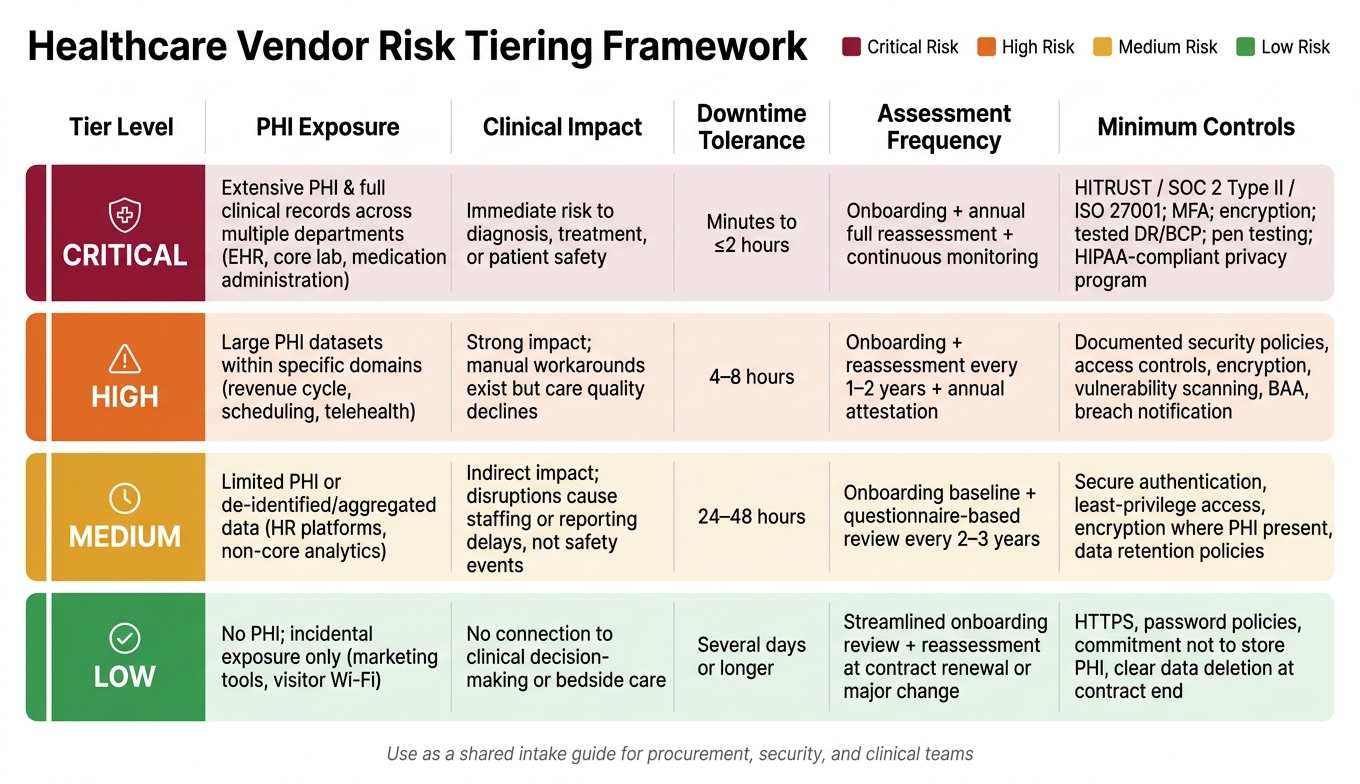
Healthcare Vendor Risk Tiering Framework: Critical to Low Risk
Use the matrix below as a fast reference point when you need to sort vendor risk during intake.
| Tier | PHI Exposure | Clinical Impact | Downtime Tolerance | Assessment Frequency | Minimum Controls |
|---|---|---|---|---|---|
| Critical | Extensive PHI and full clinical records across multiple departments (e.g., EHR, core lab systems, medication administration systems) | Immediate risk to diagnosis, treatment, or patient safety | Minutes to ≤2 hours | Onboarding + annual full reassessment + continuous monitoring | Independent security certifications or frameworks (e.g., HITRUST, SOC 2 Type II, ISO 27001) or equivalent evidence; MFA; encryption; tested DR/BCP; penetration testing; HIPAA-compliant privacy program |
| High | Large PHI datasets within specific domains (e.g., revenue cycle, scheduling, telehealth visits) | Strong impact; manual workarounds exist, but care quality declines | 4–8 hours | Onboarding + reassessment every 1–2 years + annual attestation | Documented security policies, access controls, encryption, vulnerability scanning, BAA where applicable, breach notification requirements |
| Medium | Limited PHI or de-identified/aggregated data (e.g., HR platforms, non-core analytics) | Indirect impact; disruptions cause staffing or reporting delays, not safety events | 24–48 hours | Onboarding baseline + questionnaire-based review every 2–3 years | Secure authentication, least-privilege access, encryption where PHI is present, data retention policies |
| Low | No PHI; incidental exposure only (e.g., marketing tools, visitor Wi‑Fi management) | No connection to clinical decision-making or bedside care | Several days or longer | Streamlined onboarding review + reassessment at contract renewal or major change | HTTPS, password policies, commitment not to store PHI, clear data deletion procedures at contract end |
Treat this framework as a shared intake guide for procurement, security, and clinical teams. When everyone uses the same tier definitions, intake becomes simpler, reviews stay more consistent, and monitoring is easier to standardize.
How Healthcare-Specific Risk Platforms Can Help
Spreadsheets and email threads fall apart when review work touches security, privacy, legal, procurement, clinical operations, and compliance. A healthcare-specific platform puts risk data into one auditable workflow, which cuts down on manual evidence chasing and uneven scoring. Once that setup is in place, the payoff is pretty simple: more speed, more consistency, and a cleaner audit trail.
As vendor tiers move up, manual tracking gets harder to keep up with. Healthcare breach volume also makes manual vendor tracking too slow and too uneven to trust as the main system.[6][45][46][47]
Censinet and Censinet RiskOps™ are built for HDO vendor-risk workflows. The platform supports centralized assessments, cybersecurity benchmarking, and shared oversight for vendors connected to critical care delivery. Healthcare-specific platforms can also help with fourth-party risk management, so HDOs can track downstream subcontractors, cloud providers, and managed service partners that a direct vendor depends on. That extra line of sight helps close gaps that direct-vendor reviews often miss.
Censinet AI™ speeds up the process with AI-assisted questionnaire completion, evidence summaries, downstream dependency mapping, and continuous alerts. In Censinet RiskOps, continuous monitoring assigns letter-grade risk ratings across 10 categories. These include patch management, DNS health, compromised credentials, and email security. The platform also estimates probable financial impact.[44]
Even with automation, risk acceptance still sits with the organization. The platform supports governance. It does not replace it.
Conclusion
Vendor risk management in HDOs is never “done.” It’s a continuous effort that protects patient safety, day-to-day operations, and the organization’s ability to keep going when something breaks.
The core practices - inventorying vendors, tiering risk, validating controls, tightening contracts, monitoring continuously, planning downtime, and assigning ownership - don’t work in isolation. They work as one system. And in healthcare, that matters a lot, because a vendor outage can disrupt care directly.
Vendors support EHRs, imaging, lab interfaces, telehealth, and revenue cycle operations. So when a vendor fails, the impact doesn’t stop with IT. It reaches patients, clinicians, and the bottom line.
That’s why vendor risk shouldn’t be treated like a one-time audit or a box-checking exercise. It should be treated like a patient safety program.
In healthcare, vendor risk management is patient safety work.
FAQs
How do we identify our highest-risk vendors?
Start with a full vendor inventory. Then sort each vendor by how much it can affect patient safety, data sensitivity, and day-to-day operations.
From there, rank vendors based on:
- access to PHI
- importance to mission-critical clinical or business operations
- regulatory compliance status
A scoring matrix can then place vendors into risk tiers, so you can focus time and effort on the ones that could cause the most harm.
What evidence should we request from critical vendors?
For critical vendors, HDOs should ask for specific, verifiable proof - not just a box checked on a questionnaire.
That proof can include recent audit reports, such as SOC 2 Type II, along with certifications like HITRUST CSF or ISO 27001.
It also helps to ask for documentation covering the basics that matter most when patient data is on the line:
- Encryption
- Key management
- Data classification
- Endpoint security
- Incident response drills
- Penetration testing
- Signed Business Associate Agreements
- Security awareness training for employees who handle sensitive patient data
The goal is simple: don’t settle for claims. Ask vendors to show their work.
Who should own vendor risk management in an HDO?
Vendor risk management in a healthcare delivery organization works best when it sits inside a cross-functional governance framework. The board sets the overall direction, approves policy, and defines risk tolerance. From there, leaders such as the CIO, CISO, and CFO turn that direction into day-to-day work.
Responsibility is shared across several teams:
- Procurement handles screening and contracts
- IT and security lead evaluations and monitoring
- Legal and compliance oversee HIPAA and other regulatory requirements
- Operational managers handle risks tied to their own departments
