
If 71% of U.S. hospitals use predictive AI and 66% of physicians use AI, boards can’t treat it like a side tool. I’d boil the article down to this: boards need a written AI policy, a live AI inventory, clear committee ownership, tighter vendor risk management, and regular dashboard reporting.
Here’s the short version:
- AI now touches board-level risk: patient safety, HIPAA, liability, cyber risk, and vendor risk
- Old oversight models don’t fit AI: models change, vendors update tools, and performance can slip over time
- Boards need direct visibility into drift, override rates, incidents, bias checks, and PHI exposure
- Third-party AI adds more risk because vendors and subprocessors can change systems between review cycles
- Core controls should include:
- a written AI governance policy
- committee ownership and decision rights
- an AI risk register
- model approval and re-approval rules
- vendor contract terms for model changes, data use, and incident response
- board dashboards tied to enterprise risk and quality reporting
- The article’s main point: if a board lacks a policy, inventory, and vendor oversight process, it lacks the line of sight to govern AI use
I’d read this as a warning: AI use in healthcare has moved fast, but board oversight often still runs on periodic review. That gap can leave leaders blind to changes in model behavior, vendor updates, and care risk.
The piece then lays out what boards should own, what controls should be in place, and how a platform like Censinet can help keep those reviews, registers, and reports in one place.
Health Care Corporate Governance: Critical New AI-Related Issues for Health Care Boards
sbb-itb-535baee
The problem: Existing board oversight models are not built for AI risk
Most healthcare board governance frameworks were built for fixed systems. AI doesn't work like that.
It changes through retraining. Patient data patterns shift. Vendors ship updates. So boards are using point-in-time oversight to govern something that keeps moving. That creates a governance load boards can't hand off entirely to IT or procurement. And that's the mismatch: AI governance has to move from periodic review to continuous board oversight.
There's another issue. Board reports often highlight pilots and productivity gains but leave out incidents, drift, and bias findings. When that happens, leaders are flying blind on AI risk.
New risk categories boards must see clearly
AI brings risk categories that don't fit neatly into current reporting.
Model drift is one of the least noticed. As patient populations shift, coding practices change, or data inputs evolve, a model's performance can slip without any visible system failure [8][2][6]. A board may approve a model based on one level of performance, then months later that same model may no longer act the way leaders expected. Without continuous performance tracking, boards may never see that change.
Automation bias makes things worse. When AI tools do well at first and become part of daily workflow, clinicians can start trusting the output too much over time [3][4][5]. Override rates fall. Independent checks happen less often. Then even a small drop in performance, or one hallucinated recommendation, can do harm at scale before anyone spots it. Most boards never see behavior signals like override rates or clinician feedback loops.
Limited explainability adds more risk. If a model's logic is hard to interpret, clinicians may not be able to meaningfully question its output. And boards may not be able to tell why the system acted the way it did in a given case [1][2][5]. That's not just a technical problem. It's a governance problem.
Board-level oversight should spell out a few basics:
- AI is decision support, not a replacement for clinical judgment
- Training should cover model limits and failure modes
- Reporting should include behavior signals such as override rates and clinician feedback loops [1][3][4][5]
Put simply, boards need controls that turn hidden failure into visible risk signals.
Third-party AI expands accountability beyond internal systems
A lot of AI risk in healthcare comes from vendors and embedded features. Vendor systems and built-in AI tools can change over time, often without clear disclosure of when those models changed [8][9][10][12].
The main issue is timing. Old-school vendor management relies on point-in-time due diligence: contract review, security questionnaire, then an annual reassessment. But vendors can push model updates on their own timelines, including new training data, retuned parameters, and expanded capabilities [11][12]. Those changes can quietly shift a product's risk posture between committee reviews.
That means the board may approve one level of risk, while the tool in use months later reflects something else. If a vendor changes its model or swaps subcontractors, the board's approved risk posture can change too. And if contracts don't include AI-specific change-control terms and update notice rules, boards have no steady way to know when an approved tool has changed in the clinical setting.
Downstream subprocessors add yet another layer. Fourth-party dependencies extend PHI and data governance duties to subprocessors and downstream providers [14][13][7]. That gap calls for explicit AI controls, clear ownership, and steady reporting.
Boards need defined ownership, approval rules, and vendor reporting.
What boards need to govern: Core AI controls and decision rights

AI Governance Framework for Healthcare Boards
Once the risks are on the table, boards need actual controls to manage them. That means moving past informal oversight and putting clear rules, owners, and approval paths in place.
AI governance policy, committee ownership, and risk appetite
Every healthcare board should approve a written AI governance policy before any clinical, administrative, or cybersecurity AI tool moves past the pilot stage. The policy should spell out which AI uses are approved, which are prohibited, and which ones must be escalated, especially if they affect care, medication, diagnosis, or access to care.
A RACI map helps turn that policy into day-to-day governance. It should show who owns, approves, and reviews each type of AI use across committees. For example:
- Clinical AI should sit with quality and patient safety
- Compliance AI should sit with audit and compliance
- Technical or vendor AI should sit with IT and cybersecurity
That mapping should be published in an AI governance charter so there’s no guesswork about who does what.
AI risk registers and model approval policies
A board can't govern what it can't see. That’s why an AI risk register matters so much. It should serve as a central inventory of every AI and algorithmic system in use.
Each entry should include the system, owner, use case, data source, validation status, known limits, regulatory status, and incident history. Patient safety risk and PHI exposure should be flagged in plain view.
Risk ratings also need to reflect what matters at the board level, not just what looks neat on paper. That includes impact on patient safety, degree of automation, data sensitivity, and third-party dependency. A sepsis model using ePHI should rank above a no-show prediction model.
Model approval policies are what make the register useful. Before any AI that affects patient care, operations, or cybersecurity goes into production, it should pass a multidisciplinary review. That review should include clinical, data science, IT security, and compliance teams, with sign-off documented.
Re-approval should also be required when a vendor retrains the model, updates the algorithm, changes its clinical indication, or when there’s a major shift in regulatory guidance. Before production - and again after any material model change - organizations should require regression testing, bias review, and security review. Every approval should be logged in the register.
Third-party AI oversight and board dashboards
Vendor AI needs tighter contract terms than many organizations use today. Contracts should cover change notices, updated validation, audit rights, data-use limits, and incident response. Data ownership clauses should block vendors from reusing patient data for unrelated purposes. SLAs also need to cover security flaws and regulatory inquiries, not just uptime.
Board dashboards should then bring this into one clear view. At a minimum, they should show system count by risk level, the top high-risk systems, open control gaps, and incident trends.
When AI metrics feed into existing enterprise risk heat maps and quality dashboards - instead of living off to the side in a separate report - boards can ask better questions and act faster on the issues that matter most.
These controls work best when inventory, approvals, and vendor monitoring all sit in one live governance view. That’s where centralized workflow and reporting start to matter.
How healthcare organizations can operationalize AI governance with Censinet
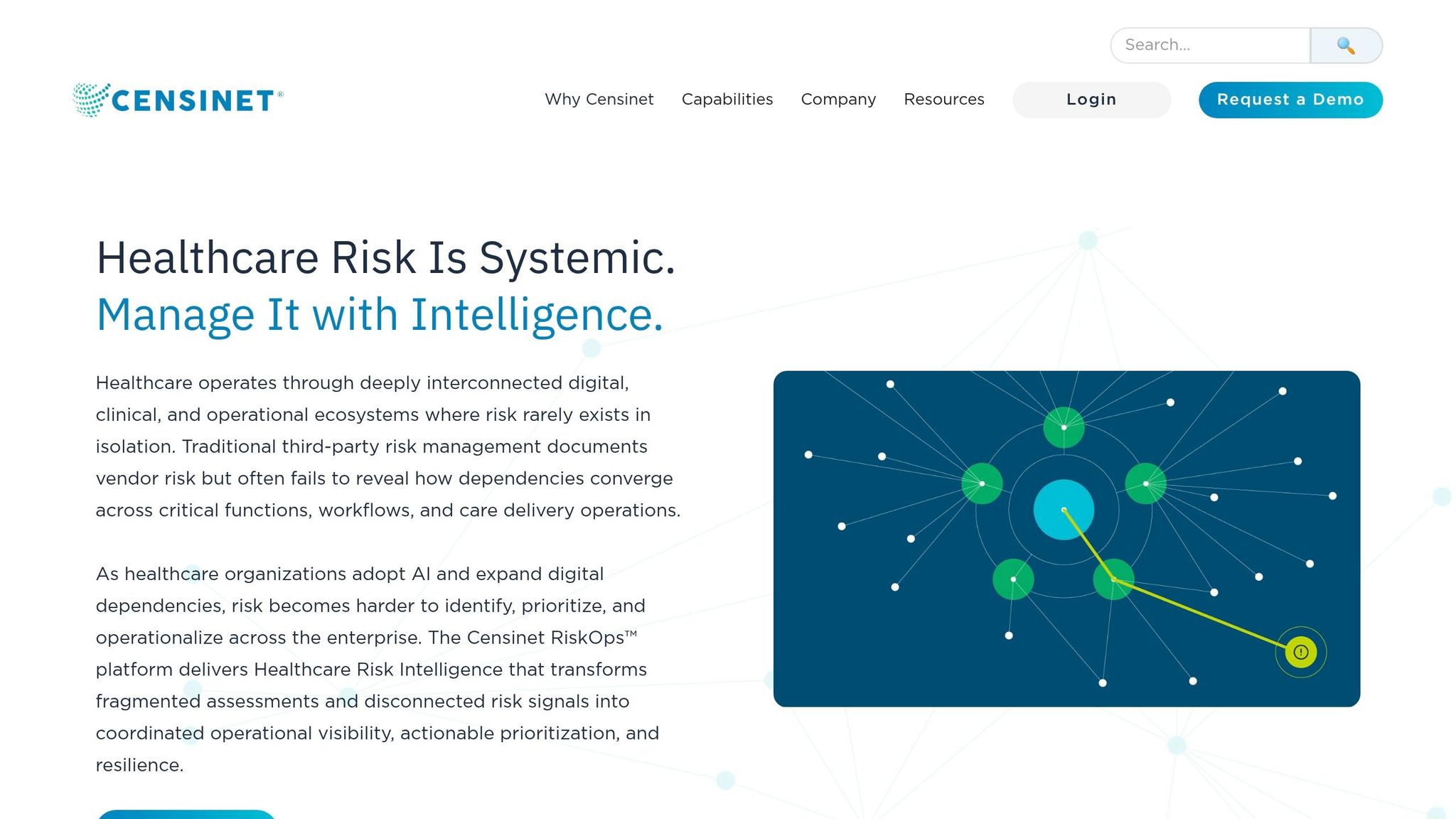
Those controls matter only if they show up in day-to-day work. Censinet puts AI governance into the workflow by connecting policies, risk reviews, and task routing in one place.
Using Censinet RiskOps to centralize AI risk registers and dashboards
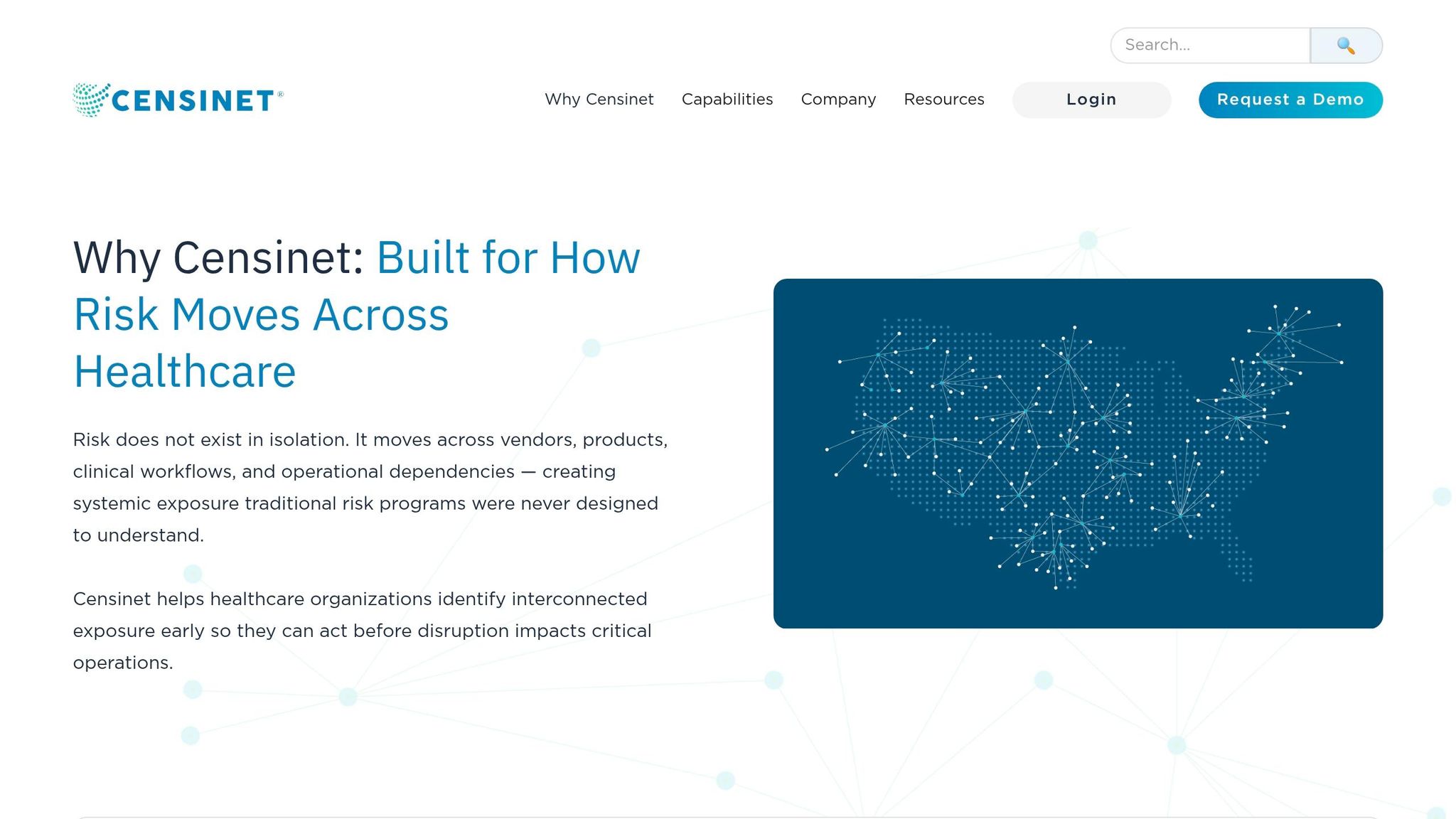
Censinet RiskOps™ gives teams a live AI risk register and a board-ready dashboard for internal systems and third-party tools. Instead of juggling static spreadsheets or scattered trackers, risk teams manage the register right inside the platform.
The dashboard turns that register into board reporting. Leadership gets real-time visibility into:
- system count by risk level
- open control gaps
- incident trends
That lines up with federal expectations for formal AI risk management across safety, security, privacy, and fairness.[15][16]
Third-party review is often the next bottleneck.
Using Censinet AI to strengthen third-party AI oversight and workflow routing
Censinet AI™ can speed up security questionnaire response workflows. It can summarize supporting evidence, capture integration details, and flag downstream vendor risk.
It can also route findings and mitigation tasks to the right reviewers, while keeping human review at key decision points. Risk teams can use Censinet AI to draft mitigation plans and policy language, then feed those outputs back into RiskOps for approval tracking and risk visibility.
That gives the board a current view of AI risk across both internal and third-party workflows.
Conclusion: A board-ready framework for reducing AI governance risk
With policies, inventories, dashboards, and vendor controls in place, the board’s role is simple in theory and serious in practice: keep AI risk visible and make sure someone owns it.
AI governance is no longer something boards can hand off fully to IT or compliance. The exposure runs straight through the organization. Clinical workflows, patient safety, third-party vendors, and regulatory accountability all tie back to decisions boards are ultimately on the hook for.
Boards without a written AI policy, a current inventory, and vendor oversight don’t have the line of sight needed to govern AI risk. HHS has explicitly emphasized written policies and procedures, internal AI registries, and obtaining information from vendors about inputs and factors used in decision-support tools.[17] HHS also states that divisions unable to meet the April 3, 2026 deadline to apply minimum risk management practices to high-impact AI must stop the applicable AI tool or solution until they achieve compliance.[19] That same level of discipline shows up in HHS’s recent governance expectations. HHS’s department-wide governance structure for AI approvals - complete AI inventories and tighter controls for high-impact tools - shows the degree of formality healthcare boards need.[18]
Boards should act now. Assign committee ownership for the risk register, model approval, vendor oversight, and reporting dashboards. Then hold leadership accountable for closing control gaps before they turn into compliance findings or patient safety events. Organizations that move now will cut risk and show that AI governance is under control.
FAQs
Why is AI now a board-level issue?
AI now sits at the board level. Why? Because the risk doesn’t stop with IT. It can touch patient safety, clinical outcomes, and enterprise liability.
Once AI starts shaping care, handling data, or automating decisions, a bad failure can set off a chain reaction: regulatory violations, malpractice claims, and day-to-day disruption. That’s why boards need formal oversight.
That oversight should cover clear accountability across:
- approvals
- third-party vendors
- bias and performance drift
- escalation paths
This isn’t just a tech issue. It’s a governance issue with direct impact on care, compliance, and organizational risk.
What should an AI risk register include?
An AI risk register should act as the central record for each AI tool. At a minimum, it should track the tool’s intended use, where it fits in the workflow, the patient safety goals tied to it, its risk tier, and the named internal owner.
It should also document data provenance, validation methods, and key controls such as human review and override paths. On top of that, the register should include risk metrics for bias, safety, drift, transparency, privacy, and consent, along with logs for approvals, audits, and incident escalation.
How often should boards review AI vendor changes?
Boards should require regular reporting on all AI tools, with clear review dates. How often those reviews happen should depend on the tool’s risk level.
Contracts should also require notice of any material changes that could affect performance, intended use, or clinical safety. And oversight shouldn’t stop at the first green light. It needs to continue through ongoing monitoring for vendor updates and model drift.
