
Healthcare organizations face growing cyber threats, from ransomware to breaches involving medical devices. Threat modeling frameworks help identify and mitigate these risks, ensuring patient safety, data protection, and compliance with regulations like HIPAA. This article examines four frameworks - STRIDE, PASTA, OCTAVE, and Censinet RiskOps™ - highlighting their strengths, limitations, and fit for healthcare environments.
Key Takeaways:
- STRIDE: Easy-to-use, focuses on six threat categories, ideal for teams with limited security expertise.
- PASTA: Risk-focused, connects technical threats to business impacts, but resource-intensive.
- OCTAVE: Organizational risk management led by internal teams, suitable for smaller setups.
- Censinet RiskOps™: Healthcare-specific platform integrating compliance, PHI tracking, and vendor risk management assessments.
Each framework offers unique benefits depending on organizational size, technical expertise, and specific security needs. While STRIDE and PASTA are strong for technical and operational risks, Censinet RiskOps™ provides a tailored solution for healthcare's complex regulatory and clinical environments.
Threat Modeling for Medical Devices: Practical Steps for Stronger Cybersecurity
sbb-itb-535baee
1. STRIDE
STRIDE is a well-known threat modeling framework that breaks down security threats into six distinct types: Spoofing, Tampering, Repudiation, Information Disclosure, Denial of Service, and Elevation of Privilege. Each category corresponds to a specific security property, making it easier for teams to systematically identify vulnerabilities and address potential enterprise risks without missing critical areas.
| STRIDE Category | Property Violated | Healthcare Relevance |
|---|---|---|
| Spoofing | Authentication | Impersonating a clinician or authorized medical device |
| Tampering | Integrity | Unauthorized changes to patient records or device configurations |
| Repudiation | Non-Repudiation | Denying responsibility for a clinical action or data entry |
| Information Disclosure | Confidentiality | Unauthorized access to Protected Health Information (PHI) |
| Denial of Service | Availability | Interrupting access to critical clinical systems |
| Elevation of Privilege | Authorization | Gaining unauthorized access to sensitive medical data |
Clinical Workflow Fit
STRIDE uses Data Flow Diagrams (DFDs) to map the movement of data and define trust boundaries - key points where data transitions between users, processes, or external systems. This visualization is crucial for protecting the integrity of clinical workflows. For instance, in a hospital, DFDs could track how a patient’s lab results move from an electronic health record (EHR) system to a third-party analytics platform, ensuring that vital processes remain uninterrupted [2].
Patient Safety Focus
In healthcare, attacks like Denial of Service can have life-threatening consequences. Imagine a scenario where a critical alert system is rendered inaccessible - patient care could be severely impacted [6]. Similarly, the Tampering category ensures clinical data remains accurate and unaltered. As Forrest Shull and Nancy R. Mead from Carnegie Mellon University's Software Engineering Institute highlighted:
"STRIDE seems an ideal approach for teams that don't have a lot of security expertise because the checklist-based approach constrains users and limits the potential for false positives." [5]
Privacy and PHI Protection
The Information Disclosure category addresses risks tied to exposing PHI, such as sensitive patient data unintentionally appearing in error messages or debug logs [2]. Likewise, Elevation of Privilege becomes critical when systems like analytics platforms - sometimes acting as shadow EHRs - gain unauthorized access to complete patient histories. To reduce these risks, limit the data provided to only what's necessary for the workflow. For example, instead of sharing all underlying data, return a simplified output like a risk tier [6].
Regulatory Alignment
The Centers for Medicare & Medicaid Services (CMS) recommends using STRIDE for early and continuous threat modeling during the system development life cycle [2]. Completed threat models can be uploaded to the CMS FISMA Continuous Tracking System (CFACTS) to support compliance with FISMA requirements. STRIDE’s six categories also align closely with HIPAA’s core principles of confidentiality, integrity, and availability of electronic PHI. This makes it a practical choice for organizations aiming to establish a security posture that meets regulatory requirements [2][6]. These advantages make STRIDE a strong contender when comparing threat modeling frameworks.
2. PASTA
PASTA (Process for Attack Simulation and Threat Analysis) is designed to connect business risks with technical security needs, ensuring that operational goals align with security measures. Bill Wells captures its essence perfectly:
"The Process for Attack Simulation and Threat Analysis (PASTA) is a dynamic risk-centric approach that correlates organizational risk with technical requirements." [1]
PASTA operates through seven stages: Define Objectives, Define Technical Scope, Application Decomposition, Threat Analysis, Vulnerability Detection and Weakness Analysis, Attack Modeling, and Risk and Impact Analysis [1]. This structured approach keeps the focus on addressing risks that matter most to the organization rather than getting lost in generalized threats. Its focus on real-world risks makes it particularly effective in complex settings like healthcare.
Clinical Workflow Fit
One of PASTA's strengths is how it integrates stakeholders from various areas - clinical, administrative, and IT - ensuring that the threat model reflects the hospital's daily operations [1]. During the Application Decomposition phase, the framework dives into clinical workflows and data flows, mapping out trust boundaries within the healthcare information system (HIS) [1]. This makes it a natural fit for healthcare, where sensitive patient data flows across multiple systems and departments.
Patient Safety Focus
PASTA's risk-oriented approach allows it to simulate realistic attack scenarios, uncovering vulnerabilities that might go unnoticed with standard methods [7]. Maril Vernon, Senior Application Security Architect at CMS, highlights its value:
"PASTA can help identify gaps in the security controls, allowing security teams to prioritize remediation efforts based on the most critical threats." [7]
In healthcare, this prioritization is key. For example, a vulnerability in a medication dispensing system would naturally take precedence over one in a billing portal, ensuring patient safety remains the top priority.
Regulatory Alignment
Like STRIDE, PASTA supports security practices essential for both patient safety and compliance with regulations. The CMS Threat Modeling Team uses PASTA to embed security into the application development lifecycle and uphold federal privacy and security standards [7]. Maril Vernon emphasizes:
"PASTA is best applied when a security team is looking to evaluate the effectiveness of the security controls for a system or application." [7]
While PASTA's thorough approach delivers deep insights, it does require a higher level of security expertise compared to simpler frameworks. This makes it particularly well-suited for organizations with complex systems and robust security teams.
3. OCTAVE
OCTAVE (Operationally Critical Threat, Asset, and Vulnerability Evaluation) takes a unique approach by focusing on organizational risk management through internal expertise. Developed in 1999 by the Software Engineering Institute (SEI) at Carnegie Mellon University, this framework emphasizes a self-directed process. According to its creators - Christopher J. Alberts, Sandra Behrens, Richard D. Pethia, and William R. Wilson:
"The Operationally Critical Threat, Asset, and Vulnerability Evaluation (OCTAVE) is a framework for identifying and managing information security risks. It defines a comprehensive evaluation method that allows an organization to identify the information assets that are important to the mission of the organization, the threats to those assets, and the vulnerabilities that may expose those assets to the threats." [8]
What makes OCTAVE stand out is its reliance on the organization’s own staff to lead the evaluation. In healthcare, this means clinical teams themselves - not external consultants - take charge of assessing risks, ensuring the process aligns with the nuances of their day-to-day operations.
Clinical Workflow Fit
OCTAVE prioritizes operationally critical assets like EHR systems, medical device security risks, and communication platforms, tailoring its security focus to ensure uninterrupted patient care. By involving clinical staff in the assessment, the framework ensures that real-world challenges are addressed. Additionally, OCTAVE adapts to organizations of varying sizes. For instance, OCTAVE-S, introduced in 2003, was specifically designed for smaller setups like private practices, specialty clinics, or individual departments within larger healthcare systems [9].
Privacy and PHI Protection
One of OCTAVE's strengths is its ability to spotlight where Protected Health Information (PHI) is most at risk. By starting with a detailed mapping of critical information assets, the framework naturally identifies vulnerabilities in patient record management. As the Software Engineering Institute explains:
"By putting together the information assets, threats, and vulnerabilities, the organization can begin to understand what information is at risk. With this understanding, the organization can implement targeted protections to minimize risk exposure." [8]
This approach allows clinical and IT teams to use their in-depth knowledge of data flows to pinpoint weak spots and implement focused safeguards for PHI [8].
Regulatory Alignment
OCTAVE’s structured and repeatable evaluation process aligns well with regulatory requirements like HIPAA and HITECH. By documenting risk assessments and mitigation strategies, organizations can demonstrate due diligence in protecting sensitive patient data [1][8]. Next, we’ll dive into the strengths and limitations of these frameworks.
4. Censinet RiskOps™
Censinet RiskOps™ is a cloud-based platform designed specifically for the healthcare sector. Unlike traditional frameworks that focus on theoretical models, RiskOps™ translates threat insights into actionable controls that align directly with clinical operations. While methodologies like STRIDE, PASTA, and OCTAVE provide structured ways to analyze threats, RiskOps™ goes further by offering tools to implement solutions within clinical settings. This approach addresses the unique challenges of managing patient data, PHI, and vendor relationships, effectively bridging the gap between theoretical models and the practical needs of healthcare environments.
Clinical Workflow Fit
RiskOps™ takes a different approach to asset categorization by focusing on clinical relevance. Instead of using generic IT labels, it classifies assets as clinical applications, EHRs, medical devices, or third-party vendors. This ensures that risk findings are directly tied to critical workflows, such as CT scan ordering, medication administration, OR scheduling, or telehealth services.
A standout feature of RiskOps™ is its seamless integration with procurement and change management processes. Every new clinical application or device undergoes a thorough risk assessment, helping organizations avoid unsafe or noncompliant integrations from the start.
Patient Safety Focus
One of the platform's core strengths is its focus on patient safety. RiskOps™ prioritizes risks based on clinical criticality. For instance, a vulnerability in an anesthesia device integration system is flagged as more urgent than one in an HR tool because it directly impacts OR operations. The platform also supports clinical compensating controls, such as downtime procedures and alternative workflows, to ensure patient safety during disruptions. Many healthcare organizations incorporate these insights into safety and quality governance committees, which often include CMIOs and CNIOs, allowing cybersecurity decisions to be evaluated with a clinical lens.
Privacy and PHI Protection
RiskOps™ embeds privacy considerations into every assessment, aligning with HIPAA Security and Privacy Rules. It addresses key areas like encryption, access controls, audit logging, breach notifications, and data segregation. The platform also tracks critical details, such as whether PHI is stored domestically or offshore, how subcontractors are involved, and whether data is properly de-identified. Organizations can tag systems and vendors based on the specific types of PHI they handle - such as clinical notes, imaging, genomics, behavioral health, or substance use disorder data - ensuring compliance with 42 CFR Part 2 and applicable state privacy laws. Many healthcare organizations rely on RiskOps™ as their go-to system for managing BAAs, privacy impact assessments (PIAs), and security risk analysis documentation.
Regulatory Alignment
RiskOps™ aligns with the safeguards outlined in the HIPAA Security Rule - administrative, physical, and technical - helping organizations meet the risk analysis requirements under 45 C.F.R. § 164.308(a)(1)(ii)(A). It also supports frameworks like the Health Industry Cybersecurity Practices (HICP) and the NIST Cybersecurity Framework, enabling healthcare organizations to present their risk posture effectively to regulators, boards, and cyber insurers. The platform’s detailed reporting and evidence repository streamline compliance efforts, making it easier to handle OCR investigations, accreditation reviews, and payer security questionnaires. For example, one health system highlighted by the AHA was able to cut its average third-party risk assessment cycle time from several months to just a few weeks, thanks to RiskOps™’ standardized workflows and reusable vendor responses [10].
Pros and Cons of Each Framework
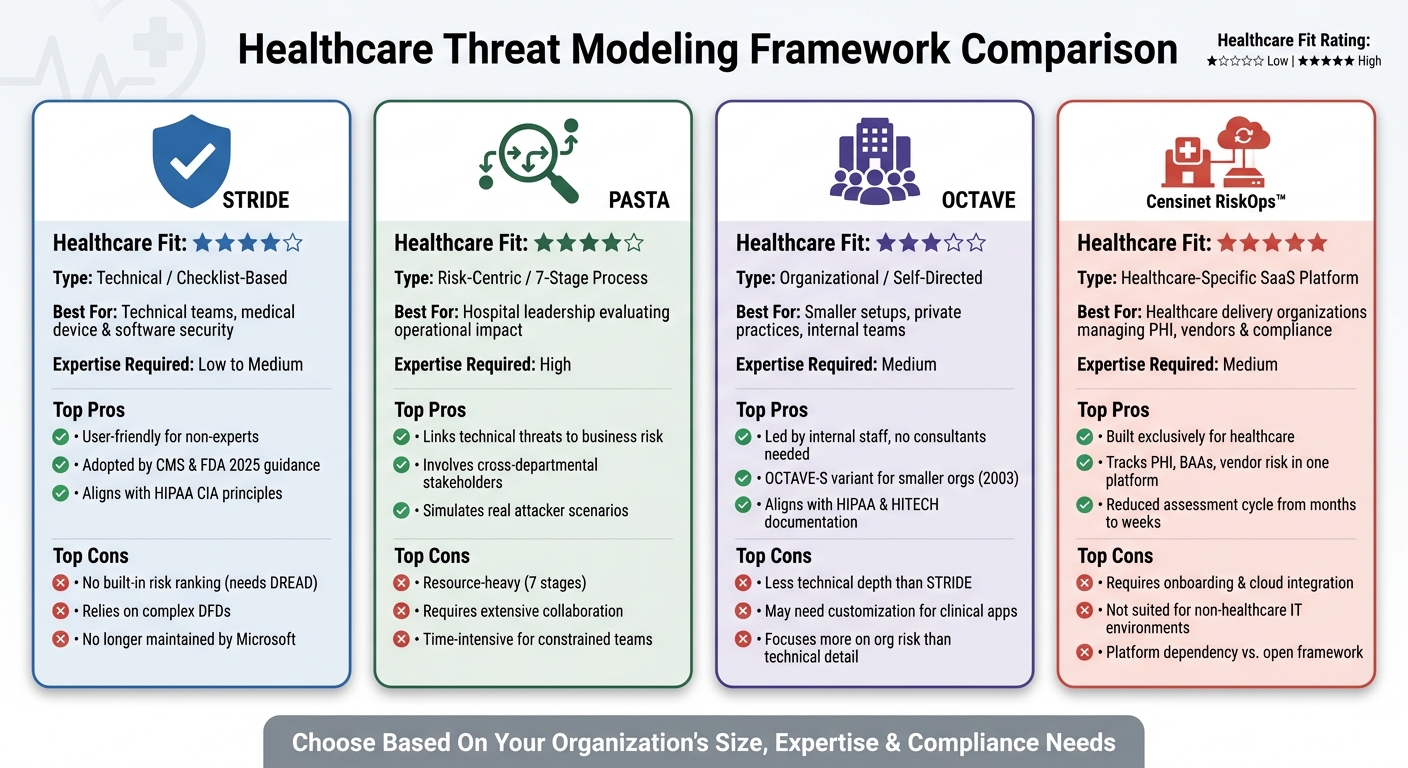
Healthcare Threat Modeling Frameworks Compared: STRIDE vs PASTA vs OCTAVE vs Censinet RiskOps™
The table below provides an overview of the strengths and weaknesses of each framework used in healthcare threat modeling.
| Framework | Pros | Cons |
|---|---|---|
| STRIDE | Well-established, thoroughly documented, and user-friendly even for non-experts; widely adopted by CMS for defining system security requirements; aligns with FDA 2025 cybersecurity guidance and ISO 14971 risk management standards [1][2][3] | No longer directly maintained by Microsoft; lacks a built-in risk ranking system (often paired with DREAD); relies on detailed Data Flow Diagrams (DFDs), which can be complex to manage [1][3] |
| PASTA | Focuses on tying technical threats to business impacts; involves decision-makers across departments; uses an attacker’s perspective to simulate realistic scenarios [1][2] | The seven-stage process is resource-heavy and requires extensive collaboration across hospital departments [1][2] |
| OCTAVE | Emphasizes operational risks; led by internal teams instead of relying on external consultants; ideal for organizations evaluating their own risk posture | Provides less technical depth compared to STRIDE; may need customization to address specific clinical application security needs |
| Censinet RiskOps™ | Tailored for healthcare; categorizes assets based on clinical importance (e.g., EHRs, medical devices, third-party vendors); integrates HIPAA compliance and PHI tracking into assessments | As a cloud-based platform, it requires setup and integration; primarily suited for healthcare delivery organizations rather than broader IT environments |
Framework Analysis
Each framework brings unique value to healthcare organizations, depending on their specific needs and resources.
STRIDE serves as a solid foundation for identifying technical threats. Its widespread use by entities like CMS ensures it’s a dependable choice. However, its limitations - such as the absence of built-in risk ranking - mean it often needs to be paired with tools like DREAD for a more comprehensive approach.
PASTA shines in connecting cybersecurity efforts to operational and financial risks. By involving decision-makers from various departments, it ensures that cybersecurity strategies align with broader organizational priorities. That said, its extensive seven-stage process demands significant time and coordination, which can be challenging for resource-constrained hospitals.
OCTAVE takes a more operational focus, empowering internal teams to assess risks without relying heavily on external consultants. While this makes it accessible to many organizations, its lack of technical depth compared to frameworks like STRIDE might require additional adjustments to address specific healthcare application needs.
Finally, Censinet RiskOps™ stands out as a healthcare-specific solution. Designed to handle the complexities of PHI management, vendor ecosystems, and regulatory compliance, it’s particularly suited for healthcare delivery organizations. However, its cloud-based nature requires onboarding and integration, which may pose challenges for some institutions.
Each framework has its niche, and the choice often depends on a healthcare organization’s priorities, resources, and the complexity of its systems.
Conclusion
There’s no one-size-fits-all framework for healthcare security. The best choice depends on your organization’s resources and how your teams work together.
For technical teams focused on developing or securing medical devices and clinical software, STRIDE is a strong fit. On the other hand, PASTA is better suited for hospital leadership and clinical stakeholders who need to evaluate the operational impact of security failures.
That said, even the most robust frameworks are only as effective as their implementation. In healthcare, threat modeling has shifted from being just a documentation task to becoming a critical operational necessity. According to the FDA’s 2026 Premarket Cybersecurity Guidance, threat modeling is now a gating activity, meaning it plays a central role in managing security risks, ensuring SBOM traceability, and providing testing evidence throughout a product's lifecycle [4].
This evolution means threat modeling must move beyond theory and into actionable processes. Tools like Censinet RiskOps™ make this possible by unifying PHI tracking, healthcare vendor risk assessments, medical device oversight, and HIPAA compliance into a single workflow designed specifically for healthcare organizations. It bridges the gap between identifying threats and managing risks in a practical way.
FAQs
Which framework fits my hospital’s size and security maturity?
The best threat modeling framework for your hospital depends on its size and level of security preparedness. NIST CSF 2.0 provides a flexible, risk-focused approach suitable for hospitals of any size, aligning well with HIPAA and similar standards. For smaller hospitals or those with less advanced security systems, HITRUST CSF offers structured, scalable controls that are easier to implement. Larger hospitals often blend frameworks like NIST CSF and HITRUST to tackle more intricate risks efficiently.
How do I tie threat modeling to patient safety and clinical workflows?
To bridge the gap between threat modeling, patient safety, and clinical workflows, the key is to pinpoint threats that could influence patient outcomes or interrupt clinical operations. Start by mapping data flows to reveal trust boundaries where vulnerabilities might arise. Tools like the STRIDE framework can help uncover risks across systems, tying these risks to clinical safety requirements and regulatory guidelines. By fostering collaboration between IT and clinical teams, organizations can address risks proactively while maintaining safe and efficient workflows.
What evidence should threat modeling produce for HIPAA and audits?
Threat modeling involves creating tangible evidence like documented threats, risk assessments, audit logs, data flow diagrams, and traceability matrices. These materials play a crucial role in proving compliance with HIPAA. They also help ensure audit preparedness by clearly showing how potential risks are identified, assessed, and managed effectively.
