
Aligning ISO 27001 with FDA cybersecurity guidelines is critical for medical device manufacturers to ensure patient safety and regulatory compliance. This article explains how to merge these frameworks effectively, saving time and reducing risks. Here’s a quick summary of the 5 steps:
- Establish the Baseline: Identify overlapping requirements between ISO 27001 and FDA guidelines to ensure nothing is missed.
- Control Mapping: Align ISO 27001 controls (e.g., risk assessment, secure development) with FDA requirements like SBOM and vulnerability management.
- Risk Assessment & Threat Modeling: Expand ISO 27001’s CIA model (Confidentiality, Integrity, Availability) to include Harm, focusing on medical device security risks and patient safety.
- Embed FDA Requirements into ISMS: Integrate FDA cybersecurity expectations into ISO 27001 processes, such as asset inventory and incident management.
- Prove Alignment: Use tools like a traceability matrix and measurable KPIs to demonstrate compliance and maintain alignment as standards evolve.
Key takeaway: Aligning these frameworks reduces duplicated efforts, strengthens security, and ensures smooth regulatory submissions, avoiding costly delays or vulnerabilities.
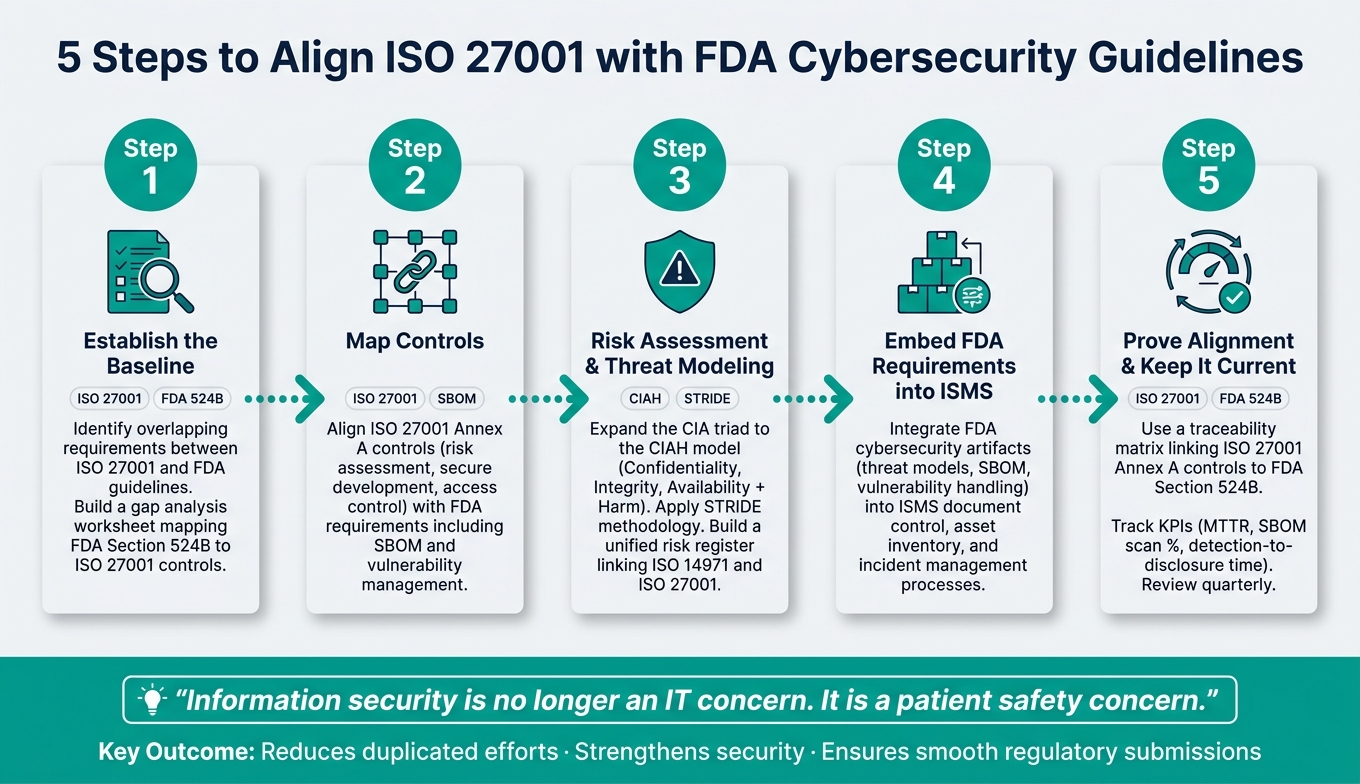
5 Steps to Align ISO 27001 with FDA Cybersecurity Guidelines
FDA cybersecurity requirements: What is surprising and new in 2026?
sbb-itb-535baee
Step 1: Establish the Regulatory and Standards Baseline
The first step is to lay out the requirements of each framework and identify where they overlap. This ensures nothing is missed and creates a solid foundation for aligning ISO 27001 with FDA guidelines. It also sets the stage for control mapping and risk assessment.
Mapping ISO 27001 Requirements
ISO 27001 is structured around Clauses 4–10 and Annex A, which contains 93 controls categorized into organizational, people, physical, and technological measures. For medical device manufacturers, some essential controls include:
- Risk assessment (Clause 6.1)
- Secure software development (Annex A 8.25–8.28)
- Access control (Annex A 5.15–5.18)
- Incident management (Annex A 5.24–5.26)
- Asset inventory (Annex A 5.9)
To ensure comprehensive coverage, document the Statement of Applicability (SoA), which lists Annex A controls and maps them to FDA premarket requirements.
Once ISO 27001 controls are outlined, the next step is to examine how FDA requirements influence cybersecurity for medical devices.
Understanding FDA Cybersecurity Requirements
The FDA emphasizes the Secure Product Development Framework (SPDF), a proactive approach that integrates security throughout the development process rather than treating it as an afterthought. Per Section 524B of the FD&C Act, manufacturers of "cyber devices" must provide:
- A cybersecurity risk analysis
- A Software Bill of Materials (SBOM)
- A plan for monitoring and patching vulnerabilities post-market
Starting February 2, 2026, the FDA's Quality Management System Regulation (QMSR) will formally incorporate ISO 13485:2016. This means all cybersecurity documentation must follow controlled processes within the QMS. Additionally, FDA inspections now include a dedicated cybersecurity section under the updated Compliance Program 7382.850 [2]. Recent evaluations continue to highlight vulnerabilities and issue safety alerts [2].
"A siloed SPDF rarely delivers consistent, comprehensive impact." - Exponent [3]
Building a Gap Analysis Worksheet
After detailing the frameworks, the next step is to compare your current practices against these standards using a gap analysis worksheet. This helps pinpoint where improvements are needed.
For example, you can align FDA Section 524B requirements with ISO 27001 controls in a table like this:
| FDA Section 524B Requirement | ISO 27001 Control(s) |
|---|---|
| Cybersecurity risk analysis | Clause 6.1 (Risk Assessment), Annex A 5.1 (Policies) |
| Secure software development | Annex A 8.25–8.28 (Secure Development Lifecycle) |
| Software Bill of Materials (SBOM) | Annex A 5.9 (Inventory of Information Assets) |
| Post-market vulnerability management | Annex A 5.24–5.26 (Incident Management) |
| Authentication and access control | Annex A 5.15–5.18 (Access Control), 8.5 (Secure Authentication) |
| Data encryption | Annex A 8.24 (Cryptography) |
Add columns to track your current state, gaps, and who is responsible for remediation. While external gap analyses can cost between $5,000 and $8,000, many organizations start with an internal review to define the scope before bringing in consultants [1].
Deciding the scope of your ISMS early is crucial. Whether it covers the entire organization or just specific product lines, a narrower scope might speed up implementation but could fall short of meeting hospital procurement requirements.
Step 2: Map ISO 27001 Controls to FDA Cybersecurity Requirements
Using the gap analysis worksheet, align each FDA requirement with its corresponding ISO 27001 control to create a strong security framework.
Control-by-Control Mapping
The controls outlined in ISO 27001 Annex A align well with the FDA's cybersecurity requirements:
| FDA Section 524B Requirement | ISO 27001:2022 Control(s) |
|---|---|
| Cybersecurity risk analysis | Clause 6.1 (Risk assessment), Annex A 5.1 (Policies) |
| Secure software development | Annex A 8.25–8.28 (Secure development lifecycle) |
| Transparency (SBOM) | Annex A 5.9 (Inventory of assets), 8.28 (Secure coding) |
| Post-market vulnerability management | Annex A 5.24–5.26 (Incident management) |
| Authentication and access control | Annex A 5.15–5.18 (Access control), 8.5 (Secure authentication) |
| Data encryption | Annex A 8.24 (Cryptography) |
| Incident response plan | Annex A 5.24–5.26 (Incident management) |
While ISO 27001 typically focuses on the CIA triad - confidentiality, integrity, and availability - medical device security adds a fourth element: Harm, emphasizing patient safety. This CIAH model shifts the focus, requiring teams to assess whether cybersecurity failures could directly jeopardize patient health.
"Information security is no longer an IT concern. It is a patient safety concern." - Ran Chen, Global MedTech Expert, MedDeviceGuide [1]
This approach ensures that controls are prioritized with patient safety in mind, laying the groundwork for expanding the Information Security Management System (ISMS) to encompass all relevant medical device assets.
Extending ISMS Scope to Cover Medical Devices
Most ISMS implementations start with corporate IT systems, but aligning with FDA requirements means extending the scope significantly. The FDA's definition of a "cyber device" is broad, covering any device with software, internet connectivity, or wireless communication capabilities (e.g., Bluetooth, USB, or magnetic inductive technologies) [3]. Compliance requires securing not only IT assets but also connected medical devices, manufacturing systems, and third-party components.
Your ISMS scope statement should explicitly include:
- Connected product lines
- Manufacturing networks (regulated under IEC 62443)
- Cloud services
- Third-party software components
Additionally, supplier qualification criteria must evolve to include specific information security requirements, not just quality or delivery standards. To achieve this, IT and Regulatory/Quality teams must work together, ensuring the ISMS comprehensively covers all necessary areas.
Documenting Device-Specific Artifacts
Once the ISMS scope is expanded, it’s crucial to integrate FDA-required artifacts into your processes seamlessly.
FDA premarket submissions demand specific artifacts, such as the Software Bill of Materials (SBOM) and threat models, which aren’t typically part of a standard ISMS. Instead of managing these separately, incorporate them directly into your ISMS:
- SBOM: Include this under Annex A 5.9 (Inventory of information assets).
- Threat modeling outputs: Integrate these into your Risk Treatment Plan.
If your team uses automated testing tools like Fuzz Testing, Software Composition Analysis (SCA), or Static/Dynamic Code Analysis, treat these as part of Annex A 8.28 (Secure coding) compliance. This approach keeps documentation streamlined and audit-ready, avoiding the complexity of parallel processes that could diverge over time. [3]
Step 3: Align Risk Assessment and Threat Modeling
Once you've expanded the scope of your ISMS and mapped the relevant controls, the next step is to ensure your risk assessment process works seamlessly for both enterprise IT and medical devices. These areas speak different "risk languages", so connecting them takes intentional effort.
Integrating Device Cybersecurity Risks
ISO 27001 risk assessments traditionally focus on the CIA triad - Confidentiality, Integrity, and Availability. However, when it comes to medical devices, you need to add a fourth element: Harm. This expanded CIAH model ensures you account not only for breach probabilities but also for the potential impact on patient safety. This approach naturally aligns ISO 27001 controls with the FDA's cybersecurity requirements.
To manage these risks effectively, link your ISO 27001 risk assessments with your existing ISO 14971 medical device risk files. A shared risk taxonomy is key here, as it eliminates the problem of IT and Quality teams maintaining disconnected, siloed risk registers.
After establishing this connection, take it a step further by incorporating focused threat modeling techniques.
Applying Threat Modeling Techniques
The FDA emphasizes the importance of identifying foreseeable threats and misuse scenarios, not just addressing known vulnerabilities. The STRIDE methodology (Spoofing, Tampering, Repudiation, Information Disclosure, Denial of Service, and Elevation of Privilege) is an effective tool to meet this expectation. It aligns well with the FDA's Secure Product Development Framework (SPDF) and ISO 27001's Clause 6.1. [3]
Your threat models should account for the device's operating environment. Consider how vulnerabilities might emerge when the device interacts with connected hospital systems or patient devices.
"A strong threat model incorporates details from the intended operating environment and does not simply focus on how the device functions in isolation." - Exponent [3]
Even devices not designed to connect to the internet but equipped with wireless protocols must be evaluated for potential attack surfaces. [3] The FDA's February 2026 guidance update underscores that threat modeling outputs must align with ISO 13485 Subclause 7.3.3 (Design Inputs). This means these artifacts should be integrated into your Quality Management System (QMS) rather than treated as separate documents. [2]
Once threats have been identified, consolidate all risks into a single, comprehensive register.
Building a Unified Risk Register
Develop a unified risk register that includes both enterprise and device-specific risks, with patient safety as a central consideration. Standards like AAMI TIR57 or ANSI/AAMI SW96 can help define how your security and safety risk management processes work together. This ensures that implementing a security control doesn't inadvertently create new safety risks for patients. [4]
A unified risk register, supported by tools like Censinet RiskOps™, can streamline your approach by integrating threat modeling, risk assessments, and incident response. This setup connects third-party risk assessments, medical device risk data, and cybersecurity benchmarks into a single, collaborative workflow.
| Cybersecurity Activity | ISO 13485 / QMSR Link | ISO 27001 Control Link |
|---|---|---|
| Threat Modeling | Design Inputs (7.3.3) | Clause 6.1 (Risk Assessment) |
| Security Risk Assessment | Risk Management (7.1) | Clause 6.1.2 (Info Sec Risk Assessment) |
| Vulnerability Management | Corrective Action (8.5.2) | Annex A 5.22 (Vulnerability Management) |
| Incident Response | Feedback/Complaints (8.2.1) | Annex A 5.24–5.26 (Incident Management) |
Step 4: Embed FDA Cybersecurity Requirements into ISMS Processes
Once you’ve established a unified risk register, the next step is to weave FDA cybersecurity requirements into your ISMS processes. This ensures that cybersecurity isn't treated as an isolated compliance task but becomes part of your routine operations.
Aligning FDA Documentation with ISMS Processes
The FDA's Secure Product Development Framework (SPDF) works best when it’s integrated into your existing ISO 13485 or QMSR processes. Instead of creating separate workflows, cybersecurity artifacts should flow through the same document control system as your quality records. For instance:
- Threat models align with Design Inputs (ISO 13485 Clause 7.3.3).
- Security architecture fits into Design Outputs (7.3.4).
- Vulnerability handling should be managed under Corrective Action (8.5.2).
Two key areas to focus on are updating your asset inventory (ISO 27001 Annex A 5.9) to maintain a living Software Bill of Materials (SBOM) and revising incident management procedures (Annex A 5.24–5.26) to include post-market vulnerability disclosure timelines, as required by Section 524B of the FD&C Act. The FDA’s February 2026 guidance emphasized that manufacturers treating cybersecurity as merely a documentation exercise risk receiving lengthy deficiency letters [2].
| FDA Section 524B Requirement | ISO 27001 Control(s) | Document Control Integration Point |
|---|---|---|
| Cybersecurity risk analysis | Clause 6.1, Annex A 5.1 | Design Inputs (ISO 13485 7.3.3) |
| Secure software development | Annex A 8.25–8.28 | Design Outputs (ISO 13485 7.3.4) |
| Software Bill of Materials (SBOM) | Annex A 5.9 | Asset Inventory (living, controlled process) |
| Post-market vulnerability management | Annex A 5.24–5.26 | Corrective Action (ISO 13485 8.5.2) |
These points of integration not only streamline compliance but also strengthen your ISMS policies and team training efforts.
Updating ISMS Policies and Procedures
Your current ISMS policies, likely designed for enterprise IT, will need adjustments to address the specific needs of medical devices. This includes:
- Updating supplier qualification procedures to incorporate cybersecurity criteria. Using automated vendor risk assessments can help streamline this process.
- Revising secure development policies to reflect FDA expectations and align with ISO 27001 Annex A controls 8.25–8.28.
- Combining quality and security performance data into a single management review cycle, offering leadership a unified perspective.
Recent high-profile attacks on medical device manufacturers highlight the risks of outdated enterprise policies. Keeping procedures aligned with current threats is critical [1].
Training Teams on Medical Device Cybersecurity
Policy updates only work if your team understands them. Tailor training to specific roles:
- Engineers need to focus on secure coding practices (Annex A 8.28) and generating compliant artifacts for the QMS.
- Quality and regulatory teams should learn to audit cybersecurity controls and trace them through design records.
- Internal auditors benefit from cross-training on ISO 27001 and ISO 13485/QMSR to conduct integrated audits.
A structured 90-day onboarding roadmap can help:
- Days 1–30: Secure executive sponsorship and define the scope.
- Days 31–60: Complete risk assessments and draft updated policies.
- Days 61–90: Roll out role-specific training.
For teams working on next-generation devices, insights from the April 2026 MITRE discussion paper on cybersecurity risks in AI/ML and cloud-connected devices can add depth to advanced training modules [2].
Step 5: Prove Alignment and Keep It Current
Proving alignment with standards isn't a one-and-done task - it’s an ongoing process. As regulations and risks evolve, you need to continuously update your approach to stay compliant.
Using a Traceability Matrix
The traceability matrix is your go-to tool for demonstrating alignment to FDA reviewers. It provides a clear, step-by-step link from each cybersecurity hazard to its mitigation, the relevant ISO 27001 control, and the test evidence showing it works.
"Incomplete traceability from risk analysis to test results jeopardizes your submission, as FDA reviewers must be able to follow each identified hazard through to its mitigation and verification." - Kristina Romanenko, Information Security Account Manager, Sekurno [5]
To make this work, your matrix should connect key ISO 27001 Annex A controls - especially those in A.5, A.8, and A.13 - to FDA Section 524B requirements like secure software development, SBOM (Software Bill of Materials), and incident response. Also, link ISO 27001’s information security risks to ISO 14971 patient safety risk files [1] [7]. For AI-enabled devices, a detailed matrix is crucial to avoid gaps. The FDA prefers deterministic scoring methods like CVSS over probabilistic estimates for assessing medical device risks [5].
This traceability approach forms the backbone of your compliance strategy, especially as new regulatory updates roll out.
Tracking Updates to Standards and Guidelines
Keeping your alignment current means staying on top of regulatory changes. For example, the FDA revised its cybersecurity guidance in February 2026, just seven months after the previous version from June 27, 2025. This update aligned with the new Quality Management System Regulation (QMSR), which incorporated ISO 13485:2016 by reference as of February 2, 2026 [2] [6]. Without active monitoring, your ISMS could quickly fall behind.
To stay updated:
- Regularly check the FDA's Digital Health Center of Excellence for guidance updates [6].
- Ensure compliance with the latest standards. For instance, the transition from ISO 27001:2013 to the 2022 edition closed on October 31, 2025, so all valid certifications must now align with the 2022 version [8].
Assign someone - typically from your regulatory or quality team - to track these changes. This person should initiate a documented review whenever new guidance is released. Then, map any new requirements to your ISMS and update your traceability matrix as needed.
Using Metrics to Drive Continuous Improvement
Proving alignment isn’t just about having the right systems in place - it’s about showing they work. Allen Chen of Rook Quality Systems emphasizes:
"QMSR alignment is no longer about readiness narratives; it is about operational proof." [9]
To demonstrate this, track measurable KPIs that show your controls are effective throughout the device lifecycle. Here’s a breakdown of key metrics to monitor:
| Metric Category | Specific KPI | Standards Alignment |
|---|---|---|
| Risk Management | % of identified cyber risks with active mitigations | ISO 27001 Clause 6.1 / FDA Risk Analysis |
| Vulnerability | Mean Time to Remediate (MTTR) critical vulnerabilities | Annex A 5.22 / FDA Post-market |
| Compliance | % of SBOM components with known vulnerability scans | Annex A 5.9 / FDA Section 524B |
| Incident Response | Detection-to-Disclosure time | Annex A 5.24 / FDA CVD Plan |
| Training | % of engineering staff who completed secure coding training | Annex A 7.2 / FDA SPDF |
Feed these metrics into a single management review cycle that combines ISMS performance data with quality system data. This ensures you’re not just meeting standards but actively improving. Platforms like Censinet RiskOps™ can help centralize risk visibility across devices, applications, and supply chains, making it easier to pull the right data for internal reviews or regulatory submissions.
"ISO 27001 certification is a point-in-time assessment, but cybersecurity threats evolve continuously. Companies must establish continuous monitoring to sustain your security posture that certification represents." - Ran Chen, Global MedTech Expert, MedDeviceGuide [1]
Treat your traceability matrix, monitoring processes, and KPI dashboards as living documents. Review them quarterly - or more often if new vulnerabilities, regulatory updates, or audit findings arise. This proactive approach ensures your ISMS stays aligned and effective.
Conclusion: Key Takeaways for Aligning ISO 27001 with FDA Guidelines
Aligning ISO 27001 with FDA cybersecurity guidelines goes beyond ticking regulatory boxes - it reshapes how healthcare organizations protect medical devices. As Ran Chen, Global MedTech Expert, aptly states: "Information security is no longer an IT concern. It is a patient safety concern." [1]
The five steps highlighted in this guide - establishing a regulatory baseline, mapping ISO 27001 controls to FDA requirements, aligning risk assessments and threat modeling, embedding FDA cybersecurity requirements into ISMS processes, and proving ongoing alignment - work together as a cohesive framework. Each step builds on the other, and neglecting any part can lead to regulatory vulnerabilities.
The stakes are real and significant. For instance, in March 2026, Stryker faced a cyberattack that affected approximately 200,000 managed endpoints across 79 countries. This incident underscores the importance of a well-aligned ISMS. When integrated with FDA Section 524B requirements and ISO 14971 product safety risk files, an ISMS can help prevent such large-scale failures.
Beyond mitigating risks, alignment brings tangible business benefits. Many major health systems in the US, UK, and EU now require ISO 27001 certification as a baseline for procurement of connected devices and SaMD. Certified manufacturers not only reduce the burden of redundant questionnaires but also speed up sales processes and cut down on incident costs [1]. Companies that embed cybersecurity into their design processes - rather than treating it as a paperwork exercise - also find themselves navigating the path to market authorization more efficiently.
As the regulatory environment evolves, staying ahead is crucial. Naomi Schwartz, VP of Regulatory Strategy at Medcrypt, warns: "The rules of the game have changed. Manufacturers that view cybersecurity merely as documentation are receiving multi-page deficiency letters that delay market authorization." [2] Keeping up requires treating your traceability matrix, ISMS policies, and risk register as dynamic tools - regularly updated, reviewed, and actively managed by accountable teams.
To keep these efforts on track, consider leveraging Censinet RiskOps™. This platform integrates risk assessments across devices and systems, provides cybersecurity benchmarking, and facilitates collaborative risk management, helping ensure that compliance is not only achieved but consistently maintained.
FAQs
What FDA documents should my ISO 27001 ISMS produce for a premarket submission?
The FDA advises that your ISO 27001 Information Security Management System (ISMS) include the following cybersecurity documents for a premarket submission:
- A Security Risk Management Plan outlining threat models and strategies to address potential risks.
- A Software Bill of Materials (SBOM) listing all software components and their dependencies.
- Detailed records of vulnerability management, penetration testing, and security testing results.
- Proof of secure-by-design practices and effective lifecycle management.
These documents are crucial for meeting FDA cybersecurity requirements and aligning with ISO 27001 standards.
How do I connect ISO 27001 risk assessments to ISO 14971 patient safety risk files?
To bridge the gap between ISO 27001 risk assessments and ISO 14971 patient safety risk files, incorporate cybersecurity risks into your safety management process. Treat security threats as potential hazards that could impact patient safety. Use the harm severity scales outlined in ISO 14971 to evaluate the clinical consequences of these threats. Ensure these risks are thoroughly documented within your safety files.
Tools like Censinet RiskOps™ can simplify this integration by centralizing risk assessments and maintaining clear traceability between cybersecurity issues and their potential effects on patient safety. This approach not only strengthens your safety framework but also ensures a more cohesive risk management strategy.
What KPIs best prove ongoing FDA and ISO 27001 cybersecurity alignment?
To showcase alignment with both FDA and ISO 27001 cybersecurity standards, it's crucial to track specific key performance indicators (KPIs). These metrics help ensure that your organization is meeting the required benchmarks effectively:
- Regular risk assessments and vulnerability evaluations: These help identify potential system risks and ensure they are addressed promptly to minimize exposure.
- Incident response and threat monitoring effectiveness: Measuring how quickly and effectively threats are detected and addressed ensures your systems remain secure and resilient.
- Compliance with documentation requirements: This includes maintaining critical records like Software Bill of Materials (SBOMs) and risk treatment plans, which are essential for both FDA and ISO 27001 standards.
- Training and awareness metrics: Tracking staff preparedness ensures your team is equipped to handle cybersecurity challenges and maintain compliance.
- Integration and review of controls: Continuous evaluation of implemented controls ensures they align with the requirements of both standards, providing consistent protection.
By monitoring these KPIs, organizations can better demonstrate their commitment to robust cybersecurity practices while aligning with regulatory and international standards.
