
Protecting PHI (Protected Health Information) requires strong encryption and effective key management. Starting January 2025, encryption became a mandatory HIPAA safeguard, emphasizing the importance of managing cryptographic keys securely. Two critical practices in this process are key rotation and key revocation. Here's the difference:
- Key Rotation: A scheduled, proactive process where encryption keys are replaced regularly to reduce risk. It ensures compliance and limits the exposure period of sensitive data if a key is compromised.
- Key Revocation: An emergency response to security incidents where a key is permanently invalidated to stop potential breaches. This action immediately blocks access to encrypted data.
When to Use Each:
- Rotate keys on a regular schedule (e.g., every 90 days for sensitive data) to maintain security and compliance.
- Revoke keys only when a compromise is detected, such as a breach or employee termination.
Both practices are essential for safeguarding PHI, but they serve different purposes. Rotation minimizes future risks, while revocation addresses active threats. A well-documented and automated key management strategy ensures smooth operations and aligns with HIPAA requirements.
What Is Key Revocation?
Definition and Purpose
Key revocation is the process of permanently invalidating a cryptographic key once it is deemed untrustworthy. Think of it like canceling a compromised credit card - the goal is to immediately neutralize any potential risks tied to the compromised key.
In systems handling PHI (Protected Health Information), revocation is typically a response to a security breach rather than a routine action. Bob Ertl of Kiteworks highlights the distinction:
"Rotation differs from key revocation, which represents emergency replacement when keys are compromised. Rotation follows a planned schedule as proactive security maintenance, while revocation responds to security incidents." [4]
When a key is revoked, it becomes completely unusable. This means any data that was previously encrypted with that key can no longer be accessed using it, ensuring attackers are locked out. Centralized Key Management Systems (KMS) or Hardware Security Modules (HSMs) are often used to execute revocation, giving administrators a reliable way to block unauthorized access. [1]
Effects on Day-to-Day Operations
While key revocation is a powerful security measure, it can also create operational challenges. Unlike scheduled key rotation, which is designed to happen smoothly in the background, revocation can cause immediate disruptions. Systems that rely on the revoked key lose the ability to decrypt data until a replacement is in place.
In healthcare settings, such disruptions can have serious ripple effects. Clinical applications, electronic health record (EHR) systems, and other critical workflows may go offline before all dependent services are identified. As the NHI Mgmt Group Editorial Team explains:
"In managed environments, a revoked credential can take down workloads before responders understand all dependants." [6]
To minimize downtime, having backup keys ready and designing systems to accept new keys automatically is essential. A carefully planned replacement strategy can make all the difference - this will be discussed in the next section.
When to Use Key Revocation in PHI Systems
In PHI environments, where maintaining data security is non-negotiable, immediate key revocation is critical when a compromise is detected. Some scenarios that call for swift action include:
- Suspected or confirmed key compromise: Any indication that a key may have been accessed by an unauthorized party.
- Employee termination: Especially when the departing employee had direct access to encryption keys. Best practices recommend revoking and replacing the key within 24 hours.
- Termination of a Business Associate Agreement (BAA): When a partnership with a vendor ends, their access to PHI keys must be revoked promptly.
- Discovery of cryptographic vulnerabilities: If flaws are identified in the encryption algorithm or key infrastructure.
The consequences of delaying revocation can be severe. For instance, a small orthopedic clinic faced a $150,000 settlement with the OCR after former employees exploited static, unrevoked encryption keys to steal patient records. This incident underscores the importance of a timely and well-enforced revocation policy.
What Is Key Rotation?
Definition and Purpose
Key rotation involves regularly replacing cryptographic keys with fresh ones. Think of it like changing the locks on a building at set intervals - it limits the cryptoperiod, or the time a single key is actively used to secure data. The main idea is to minimize risks: if a rotated key is compromised, only the data encrypted during its specific usage period is at stake, rather than an entire archive of sensitive information like PHI (Protected Health Information) [4].
This process is different from key revocation, which happens as a response to a security breach. Rotation is proactive and scheduled, acting as a safeguard against future threats. It also supports compliance efforts. For example, NIST SP 800-57 outlines a framework for managing key lifecycles, which aligns with HIPAA's technical safeguard requirements. This is especially critical when managing third-party risk management platforms that handle sensitive patient data. And starting January 2025, encryption will no longer be optional under HIPAA - it becomes mandatory [1].
Effects on Day-to-Day Operations
One of the advantages of key rotation is that it doesn’t require re-encrypting all existing data immediately. Many organizations use envelope encryption to manage this. In this setup, a Data Encryption Key (DEK) encrypts sensitive data like PHI, while a Key Encryption Key (KEK) secures the DEK. During a rotation, only the KEK is replaced, leaving the encrypted PHI untouched. This avoids the massive workload of re-encrypting large volumes of data, such as petabytes of patient records [1].
Key versioning also plays an important role - it keeps older key versions available so legacy data remains accessible, even as new encryptions use updated keys [4].
"The single most common audit finding in this area is 'you say you rotate every 90 days, but the KMS console shows the master key has not changed in 2 years.' Avoid lapses in rotation practices." - Garvita Amin, Healthcare Technology Expert, VertiComply [1]
This streamlined approach ensures key rotation can be integrated into routine security procedures without disrupting operations.
When to Use Key Rotation in PHI Systems
For systems handling PHI, regular key rotation is essential for maintaining security. For highly sensitive data, the best practice is to rotate keys every 90 days, with annual rotations being the bare minimum to meet HIPAA compliance standards [1][4]. Here’s a quick breakdown of recommended rotation frequencies:
| Data Sensitivity | Minimum Frequency | Recommended Frequency |
|---|---|---|
| Highly Sensitive (PHI, PII) | Quarterly | Monthly |
| Regulated Data (HIPAA, PCI) | Annually | Quarterly |
| Standard Business Data | Annually | Semi-annually |
In addition to scheduled cycles, key rotation should be triggered by specific events, such as a staff member leaving the organization, a system migration, or any suspicion of key misuse [3]. Automating this process with tools like AWS KMS, Google Cloud KMS, or Azure Key Vault helps reduce human error and ensures consistent execution [1][4].
For instance, a dental practice using AWS KMS with automated annual key rotation faced a ransomware attack in 2026. Thanks to their encryption and rotation practices aligning with NIST standards, the attackers couldn’t access the PHI. The Office for Civil Rights (OCR) confirmed the practice was exempt from HITECH breach notification requirements [2].
8 Cryptographic Key Management Best Practices
sbb-itb-535baee
Key Revocation vs. Key Rotation: A Direct Comparison
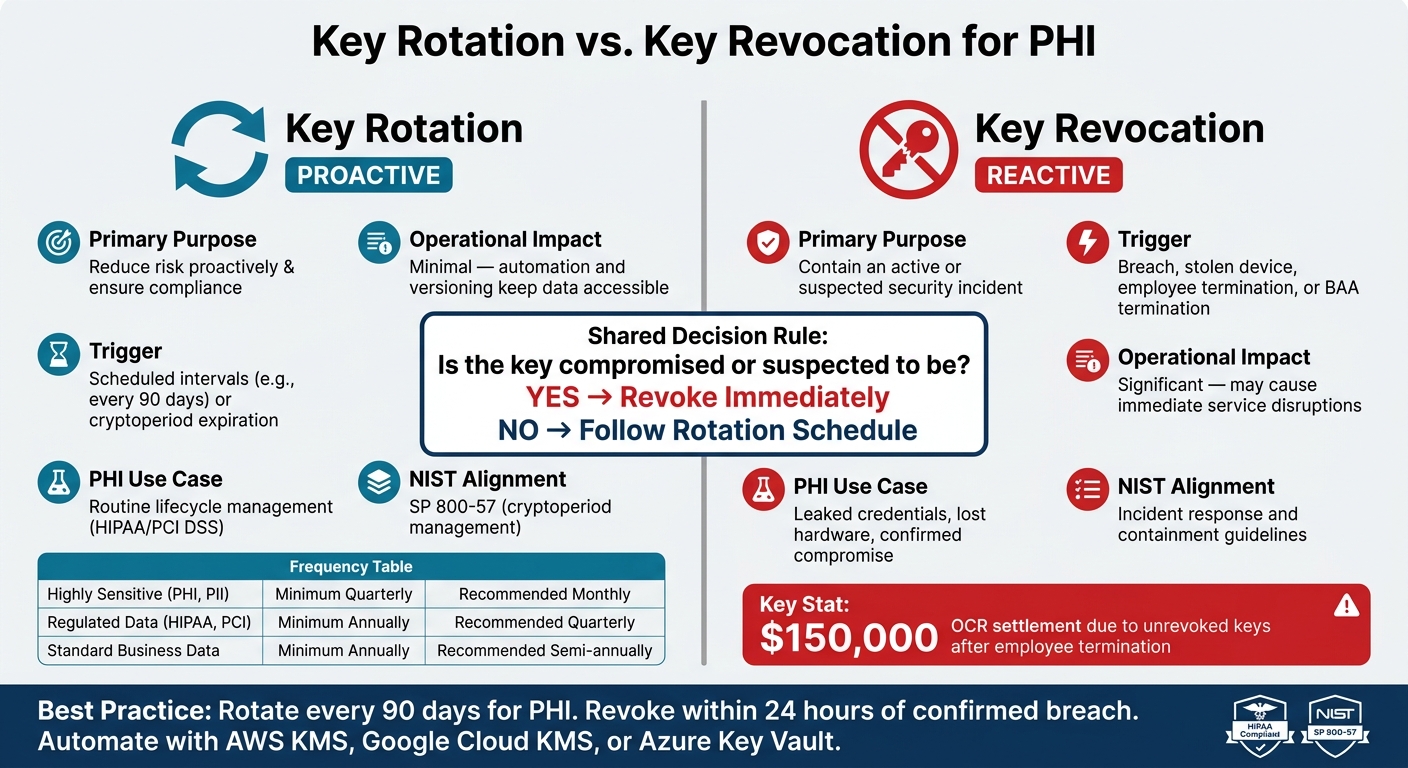
Key Rotation vs. Key Revocation for PHI: Side-by-Side Comparison
Key rotation and revocation tackle different challenges in managing PHI security. Think of rotation as routine upkeep - scheduled to minimize future risk. Revocation, on the other hand, is like pulling an emergency brake, used when something has already gone wrong. As the NHI Mgmt Group Editorial Team explains:
"Rotation is a change event; retirement is an enforcement event." [5]
This fundamental difference shapes their use cases, impact, and influence on PHI accessibility.
Comparison Table
| Dimension | Key Rotation | Key Revocation |
|---|---|---|
| Primary Purpose | Reduce risks proactively and ensure compliance | Contain an active or suspected security incident |
| Trigger | Regular intervals (e.g., every 90 days) or cryptoperiod expiration | Breach, stolen device, or employee departure |
| Operational Impact | Minimal with automation and versioning | Significant; may lead to service disruptions |
| Data Access | Historical PHI remains accessible via previous key versions | Access is immediately blocked; data may require re-keying |
| PHI Use Case | Routine lifecycle management (e.g., HIPAA/PCI DSS) | addressing leaked credentials or lost hardware |
| NIST Alignment | SP 800-57 (cryptoperiod management) | Incident response and containment guidelines |
This table highlights how rotation and revocation serve distinct purposes, helping you decide which approach fits your specific PHI security needs.
How to Choose Between Revocation and Rotation
The deciding factor boils down to this: is the key compromised or suspected to be? If the answer is yes, revoke it immediately. If not, stick to your regular rotation schedule.
In day-to-day operations, rotation should be your go-to. It protects PHI without disrupting access to patient records and aligns with HIPAA's technical safeguard requirements.
Revocation, however, becomes unavoidable when a key is compromised. The downside is availability: 62% of all secrets are duplicated across multiple locations [5], meaning revocation can break integrations reliant on that key. This is why a rotation-first approach is often better, even in urgent situations. By issuing a new key and ensuring service continuity first, you can disable the old key without causing unnecessary outages.
"Rotation reduces risk more than revocation when the credential is still required by production services and those services can accept a new value automatically. In those cases, revocation may cause an outage before the exposure is fully contained." - NHI Mgmt Group Editorial Team [6]
In short, prioritize rotation for routine operations and reserve revocation for confirmed incidents. Establishing strong key management policies can further streamline these practices, ensuring your PHI remains secure and accessible when needed. This is a critical component of healthcare cyber risk management to protect patient safety.
Best Practices for PHI Key Management
Key Management Policies and Procedures
The foundation of any effective key management policy is understanding what you're protecting. Start by maintaining a complete inventory of all PHI repositories. Overlooking this step can leave hidden data stores vulnerable.
Starting in January 2025, HIPAA's updated Security Rule makes encryption a required standard under §164.312(a)(2)(iv). This means your key management procedures must be well-documented, enforced, and auditable. Aligning with the NIST SP 800-57 framework is essential - not only for meeting compliance but also for qualifying for the HITECH breach notification safe harbor. This safe harbor means that a loss of properly encrypted PHI may not require a reportable breach.
Here are some structural essentials every healthcare organization should implement:
- Appoint at least two designated key custodians to oversee the key lifecycle.
- Store master keys securely in a managed Key Management System (KMS) or Hardware Security Module (HSM) that meets FIPS 140-3 Level 3 standards. Avoid using environment variables or configuration files.
- Use envelope encryption: A Key Encryption Key (KEK) wraps Data Encryption Keys (DEKs), allowing master key rotation without re-encrypting your entire dataset.
- Restrict access to keys using IAM and MFA, limiting permissions to designated custodians only.
Failing to meet these requirements can result in hefty OCR penalties. Once policies are in place, the next step is operational readiness for key revocation and rotation events.
Getting Ready for Revocation and Rotation Events
Having robust policies is just the start - being operationally prepared for key events is equally important to avoid disruptions. Automate key rotation wherever possible, as manual processes are prone to errors. OCR auditors will examine your KMS console to ensure compliance, not just your written policies [1].
For workloads involving high-sensitivity PHI, rotate keys every 90 days. All encryption and decryption activities - such as user actions, timestamps, key IDs, and resources - must be logged and retained for 6 years under 45 CFR 164.312(b). These logs should also be sent to a SIEM for centralized monitoring, with monthly reviews to quickly identify anomalies.
Two often-overlooked steps include:
- Regularly testing encrypted backup restore processes to ensure decryption keys work as expected.
- Conducting semi-annual drills to practice your contingency plan for key loss or compromise [2].
An example of this in action: A dental practice using AWS KMS with automated rotation and strict access controls successfully thwarted a ransomware attack. Since the attackers couldn't access the encryption keys, OCR determined the practice met NIST standards and was exempt from HITECH breach notification requirements [2].
| Task | Frequency | HIPAA/CFR Reference |
|---|---|---|
| Review KMS usage logs | Monthly | 164.312(b) |
| Rotate high-sensitivity KEKs | Every 90 days | 164.312(d) |
| Test contingency plans for key loss | Semi-annually | 164.308(a) |
| Retain key access logs | 6 years | 164.312(b) |
How Censinet Supports Healthcare Key Lifecycle Management
Key management doesn't operate in isolation - it's part of a larger cybersecurity strategy that healthcare organizations must manage across vendors, clinical systems, medical devices, and supply chains. This is where Censinet RiskOps™ comes into play.
Censinet's platform is tailored specifically for healthcare delivery organizations (HDOs), enabling them to perform structured, repeatable risk assessments. These assessments cover PHI handling practices, including how third-party vendors manage encryption and key lifecycle controls. Instead of relying on manual spreadsheet reviews, Censinet RiskOps™ provides automated workflows that highlight gaps in vendor security, including weaknesses in access controls and data protection.
For organizations aiming to meet HIPAA's 2025 updates and align with NIST standards, Censinet offers the visibility and benchmarking needed to prove that key management controls are not only documented but actively managed.
Conclusion
Rotating encryption keys regularly reduces the risk of exposing Protected Health Information (PHI), while revoking keys immediately stops unauthorized access after a breach. Each approach tackles different challenges and plays a critical role in a comprehensive key management strategy.
The effectiveness of these methods depends on using them at the right time. As the NHI Mgmt Group Editorial Team explains:
"Rotation is a change event; retirement is an enforcement event. Without retirement, old keys can still appear in code, pipelines, caches, or long-lived integrations." [5]
With HIPAA's updated Security Rule, effective January 2025, requiring encryption under HIPAA (§164.312(a)(2)(iv)), healthcare organizations must prioritize key management as a core responsibility. A 90-day rotation cycle for workloads involving sensitive PHI, paired with a revocation process that activates within 24 hours of a breach, establishes a strong compliance framework and an effective incident response plan.
As highlighted throughout this discussion, safeguarding PHI demands a proactive approach to key management. This means treating it as an ongoing process - one that involves regular inventory checks, automation, audits, testing, and third-party vendor risk management. Whether managed internally or through trusted third-party providers, every key must adhere to a well-defined and actively maintained lifecycle.
FAQs
Does revoking a key make old PHI permanently unreadable?
No, revoking a key doesn’t instantly make old protected health information (PHI) unreadable. While the key is removed from service and future validation paths, any stored or cached copies of the key could still allow access to the encrypted data. To make the data permanently unreadable, organizations need to either re-encrypt the information with a new key or use cryptographic erasure techniques to ensure the original key cannot be recovered.
How can we rotate keys without re-encrypting all PHI?
You can update encryption keys without re-encrypting all Protected Health Information (PHI) by using key versioning. This method allows multiple versions of a key to exist at the same time. Newly encrypted data will use the latest key, while older data remains accessible with its original key.
Another option is envelope encryption, where you rotate the master Key-Encryption Key (KEK) without altering the Data-Encryption Keys (DEKs). This approach eliminates the need to re-encrypt large datasets, saving time and resources.
What should a key revocation plan include to avoid downtime?
To avoid downtime when revoking a key, stick to the disable-before-destroy approach. Start by disabling the compromised key - this stops access but keeps the option to restore it if necessary. Over the next 30 days, monitor logs carefully to uncover any dependencies tied to the key. Re-encrypt any affected resources using a new key. Once you've confirmed that no active services are linked to the old key, you can schedule its permanent deletion. In most cloud environments, this involves a 30-day pending period before the key is fully destroyed.
