
Medical Imaging Vendor Risk Assessment: PACS, Radiology, and Diagnostic Safety
Post Summary
Medical imaging vendor risks fall across four categories: cybersecurity threats including ransomware, malware, phishing, insider breaches, and zero-day vulnerabilities that can disrupt workflows and delay critical diagnoses; IoMT connectivity risks from insecure integration with medical devices; AI integration risks in AI-driven diagnostic tools that introduce algorithmic vulnerabilities; and regulatory compliance risks including HIPAA violations and legal consequences from vendor security failures.
The December 2022 breach at 365 Data Centers, a vendor for Avem Health Partners, exposed the medical information of over 271,000 patients — illustrating that vendor security failures in medical imaging infrastructure can compromise sensitive diagnostic data at scale regardless of how secure the healthcare organization's own systems are, and underscoring that healthcare organizations bear consequences when their vendors fail to comply with data privacy and security standards.
Censinet RiskOps™ serves as a collaborative hub linking healthcare delivery organizations with their medical imaging vendors — using Censinet AI™ to accelerate risk assessment questionnaire completion and evidence summarization, providing a real-time command center for early vulnerability identification, enabling industry benchmark comparisons for security measures, and maintaining tailored oversight protocols that ensure human review of automated findings for diagnostic system vendor relationships.
PACS and radiology vendors must demonstrate compliance with HIPAA Security Rule requirements for protecting PHI in diagnostic images and patient records, NIST SP 1800-24 guidelines for securing PACS infrastructure, DICOM standard compliance for secure data exchange and transfer, encryption and multifactor authentication for data at rest and in transit, and network security measures including VLANs, microsegmentation, strict firewall rules, and secure remote access protocols.
Compliance with DICOM and HL7 standards enables smooth integration with EHR, Radiology Information Systems, and Hospital Information Systems — but managing these intricate healthcare integrations can expose vulnerabilities at connection points, with DICOM variability and proprietary storage creating additional risk during data exchange across systems, making integration security assessment a distinct component of PACS vendor risk evaluation beyond general cybersecurity review.
Healthcare providers should prioritize cybersecurity credentials including data encryption and strict access controls, compliance with HIPAA and NIST standards, compatibility with existing clinical technologies, demonstrated interoperability with DICOM and HL7 standards, commitment to regular security updates, ongoing security monitoring capabilities, and the ability to support continuous vendor risk assessment rather than relying on periodic one-time evaluations.
Medical imaging systems like PACS and radiology platforms are critical for healthcare operations, but they come with risks. Data breaches, like the 2022 incident at 365 Data Centers that exposed over 271,000 patients' records, highlight how vendor security failures can have widespread consequences. To mitigate these risks, healthcare organizations must evaluate vendors across four key areas:
This article examines three vendor solutions - Censinet RiskOps™, Vendor A's PACS Solution, and Vendor B's Radiology Platform - to help healthcare providers select systems that balance security, interoperability, and clinical safety. Each solution has strengths and weaknesses, making vendor assessments and continuous monitoring essential.
Quick Comparison:
Vendor Solution
Strengths
Weaknesses
Censinet RiskOps™
Streamlines risk management; automated tools
Requires ongoing monitoring
Vendor A PACS Solution
Smooth integration with existing systems
Complex integrations may add risks
Vendor B Radiology Platform
Strong cloud-based security measures
Vendor breaches remain a concern
Choosing the right vendor means aligning their capabilities with your organization's priorities in security, compliance, and workflow efficiency.
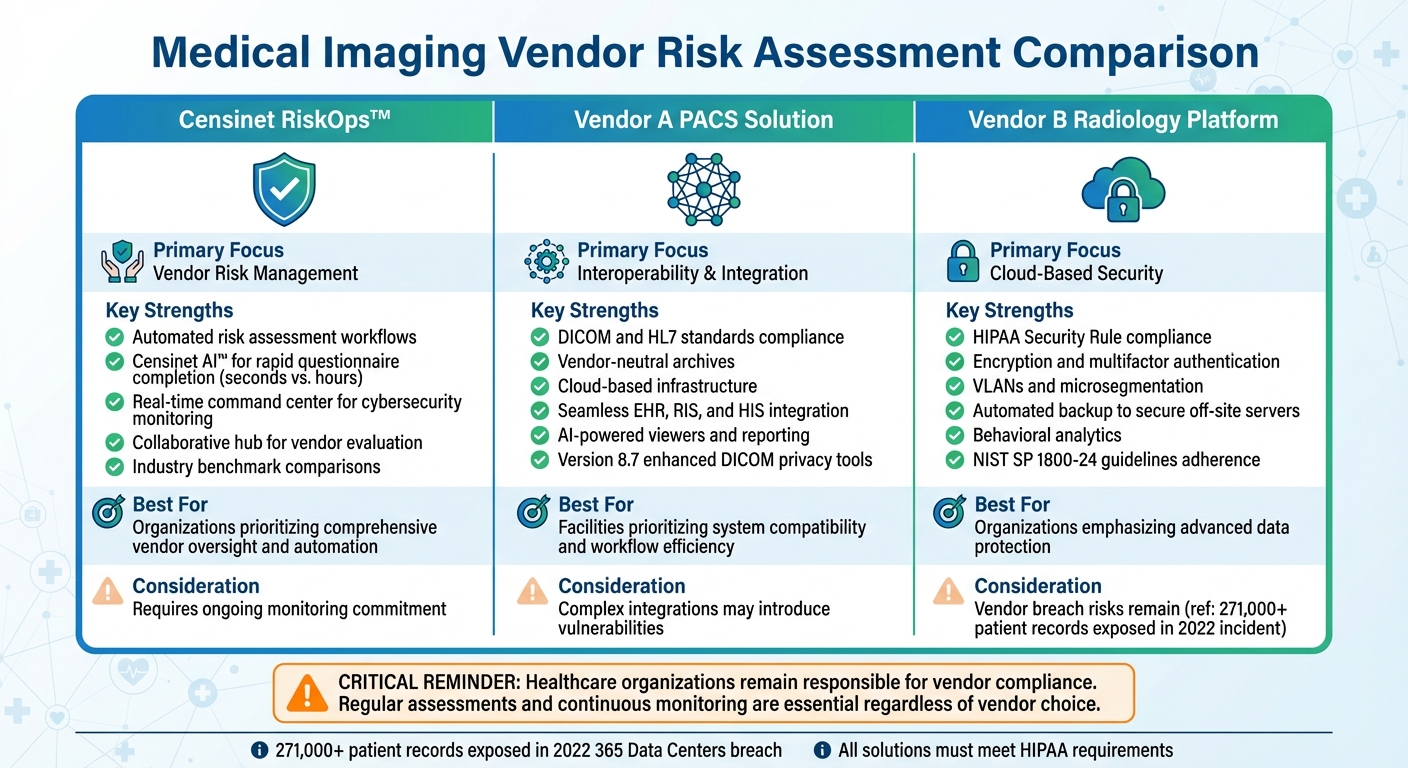
Medical Imaging Vendor Comparison: Security, Integration, and Compliance Features
1. Censinet RiskOps™
Censinet RiskOps™ is designed to centralize cybersecurity and vendor risk management for PACS and radiology systems. It tackles the complex task of evaluating third-party vendors responsible for handling sensitive diagnostic data. Here’s how Censinet RiskOps™ helps mitigate these risks effectively.
Architecture and Connectivity
The platform acts as a collaborative hub, linking healthcare delivery organizations with their medical imaging vendors. This setup simplifies the evaluation of PACS integrations, data flow processes, and the risks posed by fourth-party providers (external service providers). With automated workflows, healthcare organizations can assess vendor connectivity risks more efficiently, ensuring diagnostic data remains secure and patient safety is prioritized.
Cybersecurity and Threat Management
Beyond its connectivity framework, the platform enhances threat management by leveraging Censinet AI™ to speed up risk assessments. This includes automating questionnaire completion and summarizing evidence for quicker insights. A real-time command center provides a clear view of cybersecurity risks, enabling early identification of vulnerabilities. Organizations can also compare their security measures to industry benchmarks while maintaining control through tailored oversight protocols. This proactive strategy safeguards diagnostic systems from potential threats that could jeopardize patient safety.
Data Protection and Privacy
Censinet RiskOps™ also reinforces data security by ensuring compliance with regulatory standards for patient data and protected health information (PHI). By centralizing risk assessment findings, the platform helps healthcare organizations maintain the confidentiality of diagnostic images and patient records, which are critical for protecting both diagnostic workflows and patient privacy.
2. Vendor A PACS Solution
Architecture and Connectivity
Vendor A’s PACS solution tackles the challenges of DICOM variability and proprietary storage by using vendor-neutral archives and a cloud-based infrastructure. This approach ensures smooth data exchange and easy access across different systems. The result? A connected network that also strengthens cybersecurity by design.
Cybersecurity and Threat Management
With its standardized connectivity, the platform incorporates advanced threat management tools to safeguard imaging data. It features AI-powered viewers and AI-assisted reporting to improve diagnostic accuracy while maintaining secure workflows. Consistent data transmission protocols further minimize risks during image transfer and storage.
Data Protection and Privacy
The latest DICOM viewers in Version 8.7 prioritize patient privacy throughout the imaging process. These enhanced privacy tools help protect sensitive information from the moment it’s captured to when it’s stored, aiding healthcare organizations in meeting HIPAA requirements [2].
Clinical Safety and Diagnostic Integrity
Vendor A ensures diagnostic accuracy by combining strict quality control measures with radiologist oversight. This blend of human expertise and technical safeguards helps preserve the integrity of diagnostic images, supporting reliable clinical decisions and prioritizing patient safety.
3. Vendor B Radiology Platform
Architecture and Connectivity
Vendor B's radiology platform is designed to establish secure connections with clinical systems and medical devices. It employs VLANs, microsegmentation, strict firewall rules, and secure remote access to ensure that only authorized data flows within its network and to connected systems [4]. The platform also supports DICOM standards, enabling efficient management and transfer of medical images. This compatibility ensures smooth data exchange with other healthcare organizations [5]. Together, these measures create a solid framework for maintaining data security.
Data Protection and Privacy
To protect sensitive medical imaging data, the platform uses cloud-based storage, backing up information on secure off-site servers in compliance with the HIPAA Security Rule [5]. Automated digitization of records ensures the confidentiality, integrity, and availability of data [3]. Additional security measures - such as encryption, multifactor authentication, privileged account management, and behavioral analytics - further protect against unauthorized access [3]. These features help healthcare organizations meet demanding HIPAA standards [5].
Clinical Safety and Diagnostic Integrity
The platform follows the NIST SP 1800-24 guidelines for securing PACS, incorporating cybersecurity best practices to minimize risks. This approach maintains system performance, supports smooth clinical workflows, and prioritizes patient safety [3].
sbb-itb-535baee
Advantages and Disadvantages
After examining system architectures and security protocols, let’s dive into the strengths and weaknesses of each vendor solution. Every platform comes with its own set of trade-offs, especially when it comes to imaging workflows, data security, and compliance. These factors are crucial for making informed decisions about vendor selection and risk management. Below, we break down the key benefits and challenges of each option.
Censinet RiskOps™ stands out for simplifying vendor risk assessments in complex healthcare settings. Its standout feature is the ability to streamline collaborative risk management through automated workflows, significantly reducing the workload on compliance teams. With Censinet AI™, security questionnaires can be completed in seconds, while configurable review processes ensure human oversight is maintained. However, ongoing monitoring remains a critical component to ensure long-term security.
Vendor A's PACS Solution is highly effective at adhering to DICOM and HL7 standards, which ensures smooth integration with existing systems like EHRs, Radiology Information Systems (RIS), and Hospital Information Systems (HIS) [6]. This compatibility helps minimize integration costs and maintains data integrity [3]. The downside? Managing these intricate healthcare integrations can sometimes expose vulnerabilities [3].
On the other hand, Vendor B's Radiology Platform takes a strong approach to cloud-based data protection. It employs encryption and multifactor authentication that align with HIPAA Security Rule requirements [5]. Additionally, features like microsegmentation and strict firewall rules bolster network security. However, the risk of vendor breaches remains a pressing concern. A stark example is the December 2022 incident involving Avem Health Partners, where a breach at their vendor, 365 Data Centers, exposed the medical information of over 271,000 patients [1].
"If one of your vendors fails to comply with a regulation (such as data privacy or safety standards), your company will face consequences, too." - Case IQ
Conclusion
Choosing the right medical imaging vendor means weighing factors like cybersecurity, interoperability, and clinical safety based on your facility's unique needs. Each solution discussed here shines in different areas, making the decision largely dependent on your healthcare organization's priorities.
Censinet RiskOps™ is a strong choice for those focusing on vendor risk management. Its automated workflows and Censinet AI™ help address staffing shortages while enabling in-depth security risk assessments. The platform also supports human oversight with customizable review processes, which is critical since healthcare organizations are responsible for ensuring vendor compliance.
Vendor A's PACS Solution excels in interoperability. Its compliance with DICOM and HL7 standards allows for smooth integration with EHR, RIS, and HIS systems. This reduces integration costs while ensuring data integrity - ideal for facilities prioritizing efficient workflows and system compatibility.
Vendor B's Radiology Platform emphasizes cloud-based security. It incorporates features like encryption and multifactor authentication, aligning with HIPAA Security Rule requirements. This makes it a solid option for organizations focusing on advanced data protection.
Regardless of the vendor you choose, regular assessments and continuous monitoring of all vendors are essential. Tools like the HHS Security Risk Assessment Tool [7] can help establish baseline security and compliance standards. Whether your focus is automation, seamless integration, or advanced security, maintaining vigilant oversight is key to long-term success.
FAQs
What are the main risks associated with medical imaging systems like PACS and radiology platforms?
Medical imaging systems, including PACS and radiology platforms, face a range of risks that can affect both their functionality and patient safety. Among the most pressing concerns are cybersecurity threats, such as ransomware, malware, phishing attacks, insider breaches, and zero-day vulnerabilities. These threats have the potential to disrupt workflows, delay critical diagnoses, and expose sensitive patient information.
Another major risk comes from DDoS (Distributed Denial-of-Service) attacks, which can overwhelm systems and cause outages. Such disruptions can lead to delays in delivering vital imaging services, directly impacting patient care. To safeguard these systems, implementing strong security measures and conducting regular risk assessments is essential for ensuring uninterrupted operations and protecting patient data.
How does Censinet RiskOps™ improve cybersecurity and protect healthcare data?
Censinet RiskOps™ enhances cybersecurity and protects healthcare data by using a proactive, risk-focused approach. It integrates advanced security measures, governance structures, and resilience strategies to pinpoint vulnerabilities, enforce critical policies, and align with industry regulations.
By simplifying reporting and optimizing risk management workflows, Censinet RiskOps™ enables healthcare organizations to minimize cyber risks, safeguard sensitive patient data, and operate securely with peace of mind.
What should healthcare providers look for when choosing a medical imaging vendor?
When choosing a medical imaging vendor, healthcare providers need to put cybersecurity at the top of their checklist. Look for vendors that offer strong data encryption and enforce strict access controls. It's equally important to confirm that they adhere to industry standards such as HIPAA and NIST, which are designed to safeguard patient information.
Another key consideration is the system's compatibility with your current technologies. Make sure the vendor is committed to providing regular updates and has effective security monitoring in place. These elements are essential for smooth day-to-day operations and the long-term protection of sensitive medical data.
Related Blog Posts
- Building Vendor Risk Frameworks for Healthcare IT
- EHR Vendor Risk Assessment: Protecting Clinical Data and Ensuring System Reliability
- Medical Imaging Vendor Risk Assessment: PACS, Radiology, and Diagnostic Safety
- Insurance and Benefits Administration Vendor Risk for Healthcare Organizations
{"@context":"https://schema.org","@type":"FAQPage","mainEntity":[{"@type":"Question","name":"What are the main risks associated with medical imaging systems like PACS and radiology platforms?","acceptedAnswer":{"@type":"Answer","text":"<p>Medical imaging systems, including PACS and radiology platforms, face a range of risks that can affect both their functionality and patient safety. Among the most pressing concerns are <strong>cybersecurity threats</strong>, such as ransomware, malware, phishing attacks, insider breaches, and zero-day vulnerabilities. These threats have the potential to disrupt workflows, delay critical diagnoses, and expose sensitive patient information.</p> <p>Another major risk comes from <strong>DDoS (Distributed Denial-of-Service) attacks</strong>, which can overwhelm systems and cause outages. Such disruptions can lead to delays in delivering vital imaging services, directly impacting patient care. To safeguard these systems, implementing strong security measures and conducting regular risk assessments is essential for ensuring uninterrupted operations and protecting patient data.</p>"}},{"@type":"Question","name":"How does Censinet RiskOps™ improve cybersecurity and protect healthcare data?","acceptedAnswer":{"@type":"Answer","text":"<p>Censinet RiskOps™ enhances cybersecurity and protects healthcare data by using a <strong>proactive, risk-focused approach</strong>. It integrates advanced security measures, governance structures, and resilience strategies to pinpoint vulnerabilities, enforce critical policies, and align with industry regulations.</p> <p>By simplifying reporting and optimizing risk management workflows, Censinet RiskOps™ enables healthcare organizations to minimize cyber risks, safeguard sensitive patient data, and operate securely with peace of mind.</p>"}},{"@type":"Question","name":"What should healthcare providers look for when choosing a medical imaging vendor?","acceptedAnswer":{"@type":"Answer","text":"<p>When choosing a medical imaging vendor, healthcare providers need to put <strong>cybersecurity</strong> at the top of their checklist. Look for vendors that offer strong data encryption and enforce strict access controls. It's equally important to confirm that they adhere to industry standards such as HIPAA and NIST, which are designed to safeguard patient information.</p> <p>Another key consideration is the system's <strong>compatibility</strong> with your current technologies. Make sure the vendor is committed to providing regular updates and has effective security monitoring in place. These elements are essential for smooth day-to-day operations and the long-term protection of sensitive medical data.</p>"}}]}
Key Points:
What are the four primary vendor risk categories in medical imaging systems and why do they matter for patient safety?
- Cybersecurity threats are the most immediate and frequently occurring risk category — ransomware, malware, phishing attacks, insider breaches, zero-day vulnerabilities, and DDoS attacks can disrupt imaging workflows, delay critical diagnoses, and expose sensitive patient information in ways that affect care delivery directly rather than only creating compliance exposure
- IoMT connectivity risks arise from the integration of PACS with networked medical imaging equipment — the connection between imaging platforms and the devices that generate diagnostic data creates attack surfaces that require dedicated network security measures including segmentation and access controls specifically designed for medical device connectivity
- AI integration risks in AI-driven diagnostic tools introduce algorithmic vulnerabilities that standard cybersecurity assessment frameworks may not adequately evaluate — as AI-powered viewers and AI-assisted reporting become standard features in PACS and radiology platforms, the accuracy, bias, and security of these AI components require assessment alongside traditional security controls
- Regulatory compliance risks extend beyond HIPAA to include NIST SP 1800-24 guidelines specifically for PACS security — vendors who fail to maintain current compliance with these sector-specific standards expose their healthcare organization clients to regulatory consequences that arise from vendor failures rather than organizational failures, reinforcing the need for contractual compliance requirements
- The compounding nature of these four risk categories means that a PACS vendor with strong cybersecurity but inadequate IoMT connectivity controls, or strong compliance documentation but poor AI integration oversight, presents patient safety risks that single-category assessments will miss — requiring evaluation frameworks that address all four categories systematically
How does Censinet RiskOps™ address medical imaging vendor risk management?
- The platform functions as a collaborative hub linking healthcare delivery organizations with their medical imaging vendors — centralizing the evaluation of PACS integrations, data flow processes, and fourth-party provider risks in a unified system that provides the comprehensive vendor visibility that disconnected manual assessments cannot produce
- Censinet AI™ accelerates security questionnaire completion and evidence summarization for medical imaging vendor assessments — dramatically reducing the time required to evaluate vendors whose technical complexity and regulatory requirements generate extensive documentation, while maintaining the configurable human review processes that ensure accuracy and accountability
- A real-time command center provides early vulnerability identification for diagnostic system vendor relationships — enabling organizations to detect emerging risks in PACS and radiology platform vendors before they affect diagnostic workflows or patient data security, rather than discovering vulnerabilities during scheduled reviews that may follow incidents by months
- Industry benchmark comparisons enable healthcare organizations to evaluate their medical imaging vendor security posture against peer organizations — providing the contextual reference point that single-organization assessments cannot produce and enabling informed vendor selection and remediation prioritization decisions
- Tailored oversight protocols that maintain human control over automated findings ensure that the speed advantages of automation do not compromise the clinical accountability that diagnostic system vendor governance requires — risk teams review AI-generated summaries before final decisions are made, preserving expert judgment in a domain where errors affect patient diagnostic outcomes
What architecture and security requirements should healthcare organizations evaluate in PACS vendor assessments?
- Vendor-neutral archives and cloud-based infrastructure that ensure smooth DICOM data exchange across different systems address the DICOM variability and proprietary storage challenges that create integration vulnerabilities — vendors whose architecture forces proprietary data formats introduce both interoperability risk and vendor lock-in that limits the organization's ability to respond to vendor failures
- Standardized connectivity combined with advanced threat management tools represents the security architecture baseline for PACS assessments — AI-powered viewers and AI-assisted reporting that improve diagnostic accuracy must be accompanied by consistent data transmission protocols that minimize risks during image transfer and storage between systems
- Enhanced DICOM viewer privacy controls that protect patient information throughout the imaging process address the HIPAA requirements that apply specifically to diagnostic imaging workflows — from initial image capture through storage and authorized access, each stage of the imaging workflow must maintain the confidentiality and integrity of patient data
- VLANs, microsegmentation, strict firewall rules, and secure remote access are the network security controls that NIST SP 1800-24 identifies for securing PACS infrastructure — vendors who cannot demonstrate implementation of these specific controls present network security gaps that clinical imaging environments cannot accept given the sensitivity of diagnostic data and the regulatory standards that apply to its protection
- Cloud-based storage with HIPAA-compliant backup on secure off-site servers combined with automated digitization of records addresses both the availability and the integrity requirements of HIPAA's Security Rule — ensuring that diagnostic images remain accessible for clinical use while maintaining the security controls that protect them from unauthorized access or modification
What data protection and privacy requirements apply specifically to medical imaging vendor relationships?
- HIPAA Security Rule compliance for PHI in diagnostic images and patient records is the regulatory baseline — PACS and radiology platforms handle some of the most sensitive patient information in the healthcare ecosystem, and vendors must demonstrate not only that they meet current HIPAA requirements but that they maintain compliance through ongoing security updates and audit processes
- Encryption for data at rest and in transit is a non-negotiable technical safeguard for medical imaging vendor systems — diagnostic images and associated patient records must be encrypted throughout their lifecycle, from initial capture through storage, transmission to clinical users, and long-term archival, with encryption key management practices that prevent unauthorized access even if storage infrastructure is compromised
- Multifactor authentication and privileged account management address the credential-based attack vectors that most commonly enable unauthorized access to healthcare systems — PACS and radiology platforms that store high-value diagnostic data are attractive targets for credential theft, making strong authentication a patient safety control as well as a compliance requirement
- Behavioral analytics that detect anomalous access patterns provide the continuous monitoring layer that point-in-time access controls cannot — identifying unusual activity including unauthorized access attempts, abnormal data export patterns, and potential insider threats before they result in the large-scale data compromises that the Avem Health Partners and 365 Data Centers incident illustrates
- NIST SP 1800-24 guidelines for securing PACS provide the sector-specific security framework that general HIPAA compliance guidance does not fully address — vendors who can demonstrate alignment with NIST SP 1800-24 provide evidence of security maturity specifically calibrated to the PACS threat environment rather than general healthcare IT security practices
What integration risks do PACS and radiology platforms introduce and how should they be assessed?
- DICOM and HL7 standard compliance enables smooth EHR, RIS, and HIS integration but creates connection points that require dedicated security assessment — the same interoperability that makes PACS valuable in clinical workflows creates integration interfaces that can be exploited if security controls at each connection point are not evaluated and maintained
- DICOM variability between systems and proprietary storage approaches introduce data exchange risks during image transfer that standardized DICOM implementations reduce but do not eliminate — assessments must evaluate not only whether vendors support DICOM but how they handle DICOM variability across the specific clinical systems they will integrate with in the organization's environment
- Complex EHR, RIS, and HIS integrations can expose vulnerabilities that are not apparent from individual system security assessments — the interaction between systems creates attack surfaces that exist only at integration points, requiring assessment approaches that evaluate the security of data flows between systems rather than only the security of each system in isolation
- Fourth-party risks from the vendors serving PACS and radiology platform providers represent an often-overlooked exposure category — the Avem Health Partners and 365 Data Centers breach involved a fourth-party data center vendor, illustrating that the imaging vendor's own supply chain introduces risks that healthcare organizations must account for in their vendor risk assessment frameworks
- Ongoing monitoring of integration security is particularly important for PACS environments because software updates from any integrated vendor can alter the security profile of existing integrations — changes to EHR systems, RIS platforms, or PACS software can introduce new vulnerabilities at integration points that were secure before the update, making continuous rather than periodic integration security monitoring a clinical safety requirement
What selection criteria should healthcare providers apply when evaluating medical imaging vendors?
- Cybersecurity credentials must be verified through independent attestation rather than vendor self-representation — SOC 2 Type 2 reports, HITRUST certifications, or NIST SP 1800-24 alignment documentation provide the third-party validation that vendor-supplied security claims cannot, and current certifications that have not lapsed represent the baseline evidence that organizations should require before contracting
- HIPAA and NIST compliance demonstration must be current and verifiable — vendors who cannot provide documentation of ongoing compliance including audit results, penetration testing records, and vulnerability management processes present regulatory risk that the healthcare organization cannot offset through contractual language alone, since HIPAA compliance responsibility ultimately rests with the covered entity
- Compatibility with existing clinical technologies assessed through technical due diligence' rather than vendor representations — understanding how the proposed PACS or radiology platform will integrate with the organization's specific EHR, RIS, and HIS systems requires evaluation of actual integration architecture rather than vendor compatibility claims
- Commitment to regular security updates verified through update history and patch management documentation ensures that the vendor will maintain the security of their platform against emerging vulnerabilities rather than allowing the security posture to degrade between assessment cycles
- Continuous vendor risk assessment capability through platforms like Censinet RiskOps™ transforms vendor selection from a one-time decision into an ongoing governance relationship — recognizing that the security posture of a selected vendor at contract signing will evolve over the contract period and requires systematic monitoring to maintain the patient safety and regulatory standards that medical imaging vendor relationships demand
