
Managing cybersecurity risks for FDA-approved devices is now a continuous responsibility. Here's what you need to know:
- Post-market cybersecurity involves monitoring vulnerabilities, deploying patches, and maintaining records throughout a device's lifecycle.
- The FDA requires manufacturers to actively manage cybersecurity risks under Section 524B of the FD&C Act and the Quality Management System Regulation (QMSR), effective February 2026.
- Non-compliance can lead to legal actions, fines, and risks to patient safety.
Key Takeaways:
- Governance: Build a multi-team approach with clear roles for engineering, compliance, regulatory, and patient safety teams.
- Vulnerability Management: Maintain an up-to-date Software Bill of Materials (SBOM) and monitor trusted sources like FDA safety communications and CISA alerts.
- Incident Response: Develop playbooks with defined responsibilities, timelines, and regulatory reporting triggers.
- Patching: Test patches rigorously and document compensating controls when patches aren’t immediately available.
- Metrics: Track KPIs like Mean Time to Remediate (MTTR) and unresolved high-risk vulnerabilities to measure program effectiveness.
Quick Overview:
| Requirement | Key Action | Timeline |
|---|---|---|
| FDA 21 CFR Part 806 | Report health-risk corrections/removals | 10 working days |
| CISA (CIRCIA) Cyber Incident | Notify CISA | 72 hours |
| CISA (CIRCIA) Ransomware | Report payment | 24 hours |
| HIPAA Breach of PHI | Notify affected parties | 60 days |
Effective post-market cybersecurity ensures patient safety and regulatory compliance. Keep your systems secure by integrating these practices into your quality management processes.
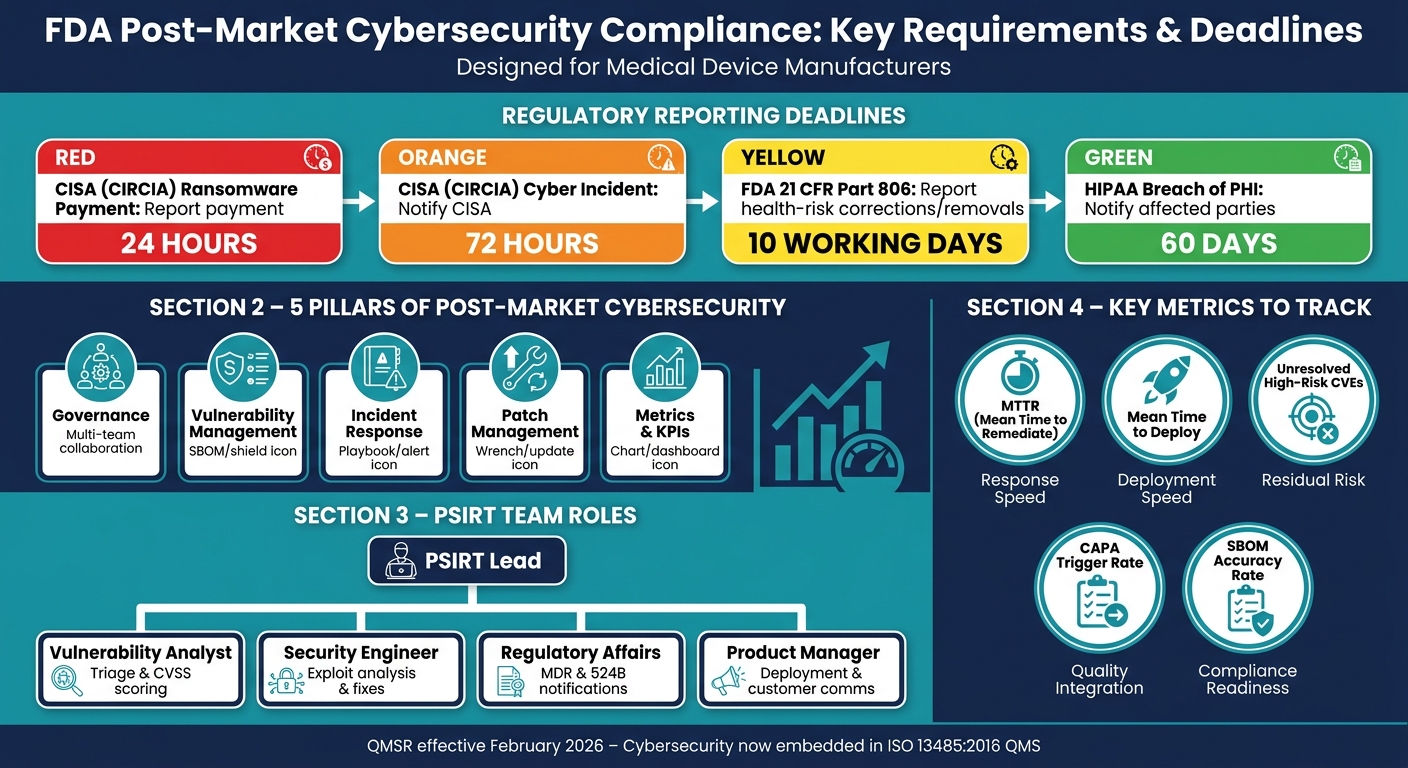
FDA Post-Market Cybersecurity Compliance: Key Requirements & Deadlines
Establishing Governance and Responsibility
Building a Multi-Disciplinary Governance Model
Post-market cybersecurity thrives when multiple teams collaborate effectively. As Qualysec explains [2]:
"Postmarket cybersecurity is most effective when engineering, quality, regulatory, and support teams are working out of common processes and documentation."
To achieve this, organizations need to bring together diverse teams - engineering (including PSIRT), quality/compliance, regulatory affairs, clinical/patient safety, and support/field service - under a unified governance model. Each team must clearly understand its role. A dedicated Product Security Incident Response Team (PSIRT), operating separately from new product development, is essential for staying focused on tracking vulnerabilities and responding to them.
Here’s a breakdown of team responsibilities:
| Role/Team | Key Responsibility |
|---|---|
| Engineering/PSIRT | Monitoring vulnerabilities, developing patches, and handling technical triage [3][4] |
| Quality/Compliance | Incorporating security into CAPA, internal audits, and Quality Management System (QMS) documentation [5][3] |
| Regulatory Affairs | Managing 510(k) triggers, 21 CFR Part 806 reporting, and Notified Body communications [3] |
| Clinical/Patient Safety | Assessing the clinical impact and potential patient harm of vulnerabilities [3][2] |
| Support/Field Service | Communicating with customers and assisting with patch deployment [5][4] |
Assigning Roles and Responsibilities
Define clear ownership for each area of cybersecurity, such as managing device inventories, monitoring vulnerabilities, and coordinating incident responses. It’s crucial to establish a documented escalation path to ensure swift action.
Kevin Henry, a cybersecurity expert at Accountable, emphasizes the importance of this approach [4]:
"The FDA treats cybersecurity as a component of safety and effectiveness that spans design, submission, clearance/approval, deployment, and postmarket support."
Set up a dedicated channel for reporting vulnerabilities - like a security email alias or a web form - to ensure all reports are consistent and traceable. Having a well-defined escalation process ensures that critical findings quickly reach leadership and regulatory teams, enabling timely decisions about risk acceptance or remediation [2]. Additionally, provide tailored training for all team members involved in cybersecurity. Trained and accountable personnel are key to maintaining an effective cybersecurity program [4][5].
Once roles are assigned, documented policies help reinforce the governance framework.
Documenting Policies and Procedures
All cybersecurity governance procedures must be thoroughly documented. This includes processes for monitoring vulnerabilities, handling Coordinated Vulnerability Disclosure (CVD), classifying patches, and integrating these activities into the broader risk management framework.
These policies should be housed within your Quality Management System (QMS), not treated as a separate cybersecurity initiative. Under 21 CFR Part 820.35, cybersecurity is subject to the same corrective action and management review processes as other quality issues. Every vulnerability assessment should connect to risk analysis, change control, verification, and deployment records [5][3].
One important but often overlooked policy is establishing pre-approved patch protocols with Notified Bodies. These protocols determine in advance which types of security patches can be deployed under the QMS without requiring prior regulatory approval. This approach minimizes delays when a critical vulnerability requires immediate attention [3].
Managing Vulnerabilities and Risk Assessments
Maintaining Device and SBOM Inventory
The first step in managing vulnerabilities is knowing exactly what software is running on every device you oversee. A Software Bill of Materials (SBOM) provides a detailed list of all software components - proprietary, third-party, and open-source - along with their version numbers. As Qualysec explains [2]:
"Software Bills of Materials now form a foundation for postmarket risk management."
Kevin Henry from Accountable HQ adds [4]:
"Maintain SBOM integrity across variants and releases so customers can assess exposure quickly."
Keeping your SBOM up-to-date with every new release or variant is crucial. This includes mapping each component to its known vulnerabilities and licensing requirements. Automating vulnerability intelligence feeds to directly integrate with your SBOM can save time and reduce errors that often come with manual database checks.
Once your inventory is in order, the next focus is identifying potential threats proactively.
Sources for Vulnerability Monitoring
Having an accurate inventory is only half the battle; knowing where to monitor for emerging threats is equally critical. The FDA regularly issues safety communications when vulnerabilities are identified that could affect patient safety or device performance [8]. Additionally, the Cybersecurity & Infrastructure Security Agency (CISA) collaborates with the FDA to monitor medical device cybersecurity risks, providing early-warning alerts.
Registering devices directly with manufacturers ensures you'll receive timely advisories. The FDA's MedWatch program is another valuable resource, tracking adverse events related to device issues. Combining these tools with a Coordinated Vulnerability Disclosure (CVD) program is highly recommended. Manufacturers are required to include CVD plans as part of their postmarket monitoring responsibilities [7]. The FDA emphasizes the shared nature of this responsibility [8]:
"The FDA shares this responsibility with device manufacturers, hospitals, health care providers, patients, security researchers, and other government agencies, including the U.S. Department of Homeland Security's Cybersecurity & Infrastructure Security Agency (CISA) and U.S. Department of Commerce."
Conducting Risk Assessments
With an accurate inventory and reliable monitoring in place, the next step is assessing vulnerabilities based on their potential impact on patients. It's essential to remember that a high CVSS score doesn’t always equate to a high risk for patients. For instance, a lower-rated vulnerability in a life-sustaining device could pose far greater danger. As Qualysec points out [2]:
"In postmarket decision-making, patient harm potential remains the primary consideration."
Effective risk assessments consider the real-world exploitability of vulnerabilities, including whether they could be combined in a clinical setting. Each vulnerability should be thoroughly documented, with a clear traceability trail linking its discovery, evaluation, and remediation to risk analysis, change control, and remediation records. This documentation is critical for audits and FDA inspections.
Platforms like Censinet RiskOps™ can simplify this process by enabling structured and repeatable risk assessments. These tools help healthcare organizations manage exposure more consistently and efficiently, especially when dealing with medical devices and third-party components.
Risk assessments also feed directly into quality system updates and incident response plans. Under frameworks like ISO 14971 and QSR, findings must tie back to risk analysis and change control processes, ensuring they’re not treated as isolated cybersecurity issues but as part of the broader safety and compliance strategy.
Patch Management and Incident Response
Setting Up a Patch Management Process
After identifying vulnerabilities, the next step is to implement a structured patch management process. This involves monitoring, evaluating, testing, deploying, and documenting patches while ensuring they maintain clinical functionality. Testing patches in a clinical network environment that replicates real-world hospital settings is crucial before deployment [9]. Once applied, confirm that the patch does not disrupt clinical operations.
Not all vulnerabilities require the same level of urgency. As Qualysec emphasizes [9]:
"Postmarket management does not consist of just the response to the events. It also involves the active prevention of risks with updates of threat modeling, dependency tracking and real time threat monitoring of medical devices."
Focus on addressing vulnerabilities that pose the greatest clinical and operational risks first.
Applying Compensating Controls
Sometimes, patches aren’t immediately available. Developing, testing, and releasing fixes for complex embedded systems can take weeks or even months. During such delays, compensating controls become vital. These measures might include network segmentation, enhanced monitoring, logging, or even modifying workflows [2]. The FDA expects manufacturers to provide clear guidance to healthcare delivery organizations (HDOs) during these periods. This includes secure configuration baselines and any necessary operational restrictions [4].
Every compensating control must be thoroughly documented. Record what was implemented, when, why, and how it addresses the specific vulnerability. This level of detail supports compliance with FDA inspections and internal Corrective and Preventive Actions (CAPA) aligned with ISO 14971 [2]. Starting in 2026, the FDA will evaluate how effectively organizations manage vulnerabilities over time, treating cybersecurity as an ongoing responsibility rather than a one-time task [2].
While these controls help mitigate risks in the short term, having a strong incident response plan is essential for handling unexpected events.
Developing Incident Response Playbooks
A well-constructed incident response playbook removes uncertainty during cybersecurity events by clearly defining roles, responsibilities, and timelines. These playbooks are essential to ensure a swift and organized response.
Central to this process is the Product Security Incident Response Team (PSIRT), with specific roles assigned to team members [10]:
| PSIRT Role | Primary Responsibility |
|---|---|
| PSIRT Lead | Coordinates responses, manages escalation, and notifies regulators |
| Vulnerability Analyst | Handles triage, CVSS scoring, and correlates SBOM data |
| Security Engineer | Conducts reproducibility testing, exploit analysis, and develops fixes |
| Regulatory Affairs | Oversees notification decisions (e.g., MDR, 524B) and field safety notices |
| Product Manager | Manages deployment scheduling and customer communication |
The playbook should also define response time expectations based on severity. For instance, critical vulnerabilities that pose immediate patient safety risks should be addressed within 24–72 hours. High-severity issues without direct safety impacts may have a 1–2 week timeline, while less urgent vulnerabilities can be resolved within 30–90 days [10].
Another critical aspect is the regulatory notification decision tree. This outlines clear criteria for determining when cybersecurity incidents require an FDA Medical Device Report (MDR) or a Section 524B disclosure for "cyber devices" [10]. Including this decision-making process in the playbook ensures timely and accurate reporting without unnecessary delays.
sbb-itb-535baee
Webinar: Postmarket Cybersecurity Management
Maintaining Program Effectiveness Over Time
To ensure long-term cybersecurity resilience, it’s not enough to have strong governance and risk assessment strategies in place. You also need to continuously measure your program’s effectiveness and adapt as needed.
Tracking Metrics and Key Performance Indicators (KPIs)
A post-market cybersecurity program is only as effective as your ability to measure it. Without clear metrics, it’s impossible to gauge whether your processes are truly working.
Here are some of the most important metrics to monitor:
| Metric Category | Key Performance Indicator (KPI) | Why It Matters |
|---|---|---|
| Response Speed | Mean Time to Remediate (MTTR) | Tracks how quickly engineering teams deliver fixes. |
| Deployment | Mean Time to Deploy | Measures the speed at which fixes reach devices in the field. |
| Vulnerability | Unresolved High-Risk CVEs | Highlights the residual risk across your active device fleet. |
| Quality | CAPA Trigger Rate | Indicates how well security is integrated into quality management systems. |
| Compliance | SBOM Accuracy Rate | Ensures monitoring efforts are based on up-to-date component data. |
In addition to these, process efficiency metrics can help identify bottlenecks in the timeline from vulnerability detection to resolution. For compliance, manufacturers must report corrections to the FDA within 10 working days if a vulnerability could potentially prevent death or serious injury [6]. Monitoring your team’s ability to meet this deadline is a critical KPI.
"The gap between a cleared device and a defensible postmarket program is real and measurable." - Christian Espinosa, Founder & CEO, Blue Goat Cyber [6]
By focusing on these metrics, you can better integrate cybersecurity into your overall quality processes.
Integrating Cybersecurity with Quality Systems
Since February 2, 2026, the Quality Management System Regulation (QMSR) has formally incorporated ISO 13485:2016, embedding cybersecurity into the Quality Management System (QMS). This change has tangible implications: inspectors now issue cybersecurity-related observations under QMSR during facility inspections.
To maintain effectiveness, continuous monitoring and precise metrics are key. For example, cybersecurity findings - whether it’s a spike in CVEs or recurring security complaints from customers - must feed into your Corrective and Preventive Action (CAPA) process, just like clinical quality issues [1]. Patches are treated as design changes, requiring thorough design verification, validation, and risk reassessment before deployment [6].
"CAPA is where the FDA looks for evidence that you're learning from postmarket signal." - Christian Espinosa, Founder & CEO, Blue Goat Cyber [1]
Your ISO 14971 risk management files should also reflect current cybersecurity threats, including potential exploit paths and threat actors that could pose risks to patient safety [1]. Stale or outdated documentation is a frequent cause of FDA Form 483 observations, so it’s crucial to regularly audit your Design History File (DHF) to ensure your SBOM and threat models align with the actual software configuration [1]. This proactive approach creates a solid foundation for leveraging automation to simplify compliance.
Using Automation and Technology Platforms
In today’s environment, manual processes can’t keep up with the sheer volume of vulnerabilities, SBOM updates, and regulatory requirements. Automation has become essential for maintaining post-market compliance. Automated tools can continuously match vulnerability feeds with your SBOM, ensuring your team focuses only on threats that impact deployed devices [6].
Platforms like Censinet RiskOps™ go a step further by centralizing risk management data, automating assessment workflows, and maintaining audit-ready documentation for FDA inspections. AI-powered features speed up risk assessments by summarizing evidence, detailing integrations, and generating reports while still allowing for human oversight. This technology enables teams to handle the complexities of compliance at scale.
Key capabilities to prioritize include:
- SBOM-CVE correlation: Automatically links new vulnerabilities to specific device components.
- QMS integration: Ensures security events are incorporated into CAPA and complaint processes.
- Automated audit trails: Provides the traceability evidence inspectors require.
By combining metrics tracking, cybersecurity integration into quality systems, and automation, you can build a comprehensive post-market program that supports ongoing compliance.
"You are expected to manage security risks just as you manage clinical and usability risks throughout the device's lifecycle." - Kevin Henry, Accountable HQ [4]
Conclusion and Key Takeaways
Post-market cybersecurity isn't a one-and-done task - it’s a continuous responsibility that spans the entire lifecycle of a medical device. As outlined in Section 524B of the FD&C Act, manufacturers are legally obligated to maintain robust post-market practices. Ignoring these obligations isn't just risky; it’s considered a prohibited act under Section 301(q) of the same law [11].
"Cybersecurity risk does not end when a device receives FDA clearance or approval." - Qualysec [2]
To recap the essentials, several pillars are critical for a strong cybersecurity program. First, a living, machine-readable SBOM (Software Bill of Materials) is essential for monitoring vulnerabilities in third-party and open-source components. Second, risk assessments should focus on clinical impact rather than just technical risk scores. Finally, having a well-prepared incident response plan is vital - not only to ensure compliance with Section 524B but also to safeguard patient safety.
The regulatory framework also enforces strict deadlines that manufacturers cannot afford to overlook. Missing these deadlines doesn’t just result in compliance issues - it directly impacts patient safety.
FAQs
What counts as a “cyber device” under FDA Section 524B?
A cyber device, as outlined in Section 524B of the FD&C Act, refers to a medical device that meets the following criteria:
- It incorporates software that has been validated, installed, or authorized by the device sponsor.
- It has the capability to connect to the internet.
- It includes technological elements that could be exposed to cybersecurity threats.
Manufacturers are required to maintain a plan to continuously monitor and manage cybersecurity risks throughout the device's entire lifecycle.
When does a cybersecurity fix require FDA reporting or a new 510(k)?
Under 21 CFR Part 806, the FDA mandates reporting if a cybersecurity vulnerability has the potential to cause death, serious injury, or poses a notable health risk. However, routine security updates are generally not subject to this requirement unless they directly affect the device's safety or effectiveness. As for a new 510(k) submission, it’s only necessary if the fix changes the device's performance in a way that impacts its safety or efficacy.
How should we prioritize vulnerabilities based on patient safety?
Healthcare organizations should adopt a risk-based approach to vulnerability management, with patient safety as the top priority. Instead of focusing solely on technical severity, it's essential to evaluate how a vulnerability affects a device's functionality, clinical performance, and, most importantly, patient health. Risks should be categorized as either controlled or uncontrolled, ensuring clear action plans.
While tools like CVSS (Common Vulnerability Scoring System) can provide technical insights, the clinical impact of a vulnerability should always take precedence. For example, a technical flaw that disrupts a critical medical device could pose immediate risks to patient care.
To simplify the process, platforms like Censinet RiskOps™ can streamline risk assessments. This tool helps healthcare organizations quickly address uncontrolled risks by implementing patches or mitigations, ensuring patient safety remains uncompromised.
