
If you only ask vendors for an SBOM, you will miss part of the AI risk. In healthcare, an SBOM can list software pieces and versions, but it does not tell me enough about the model, training data, hosting setup, drift, bias checks, or who owns each part of the AI supply chain.
Here’s the short version:
- SBOM helps with software risk like CVEs, patching, procurement checks, incident scoping, and audit support.
- SBOM falls short for AI-enabled products because it does not show model lineage, fine-tuning history, data sources, runtime setup, or model-specific failure paths.
- AIBOM builds on SBOM by adding the AI details healthcare teams need for patient safety, privacy, vendor review, and post-go-live review.
- Procurement and production need different evidence: one set for buying decisions, another for watching drift, bias, incidents, and rollback status after launch.
- This is now a supply chain issue, not just a software inventory issue. The HSCC’s April 2026 guide spans 109 pages and lays out a seven-phase AI third-party risk process, which shows how much larger the problem has become.
If I had to reduce the article to one takeaway, it would be this: healthcare should treat SBOM as the floor and AIBOM as the next layer for AI products.
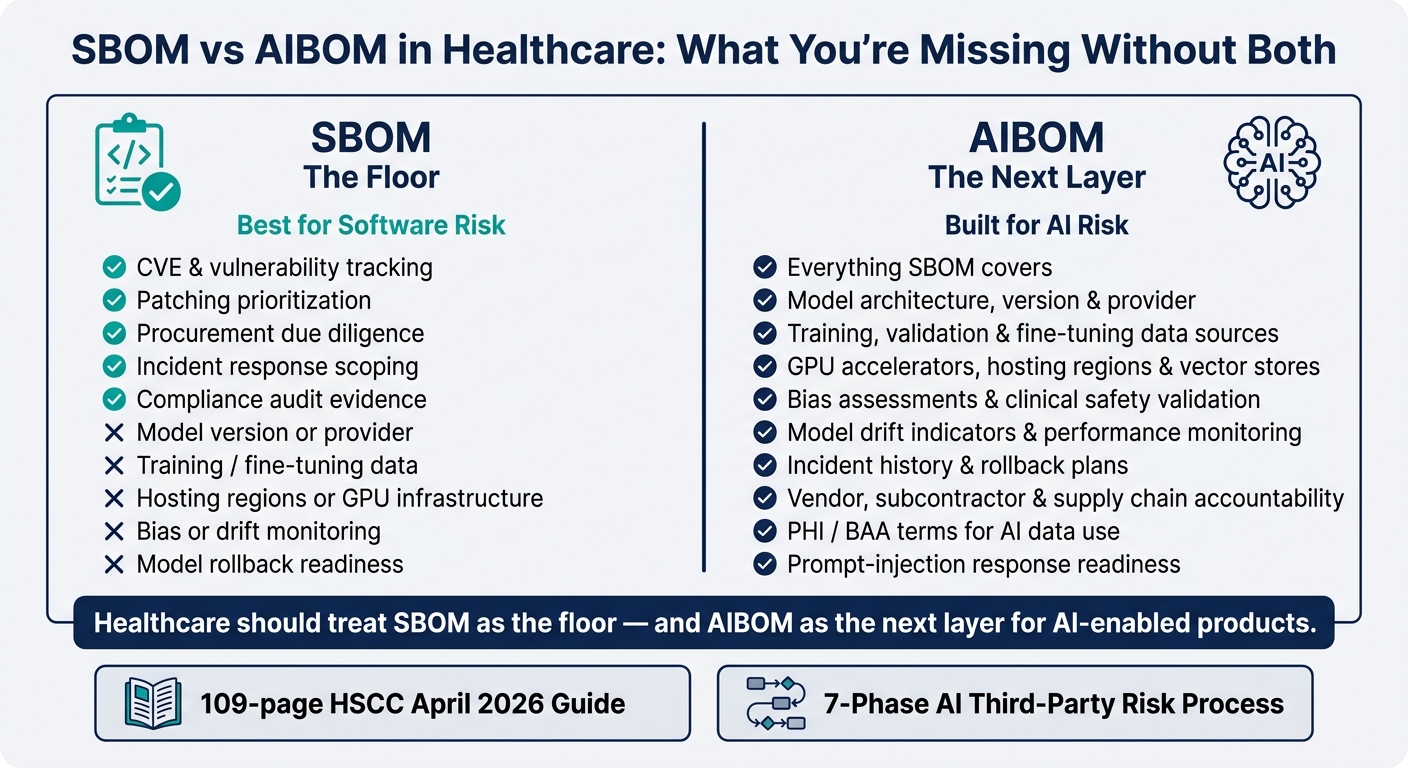
SBOM vs AIBOM: What Healthcare AI Risk Management Actually Requires
AIBOM: Powering Transparency and Security in AI and Software Supply Chains
sbb-itb-535baee
Quick comparison
| Topic | SBOM | AIBOM |
|---|---|---|
| Main focus | Software components | Software plus AI model and data chain |
| Best for | CVEs, patching, audits, vendor software disclosure | AI vendor review, model review, drift checks, clinical risk review |
| Shows model version/provider | No | Yes |
| Shows training/fine-tuning data | No | Yes |
| Shows hosting regions, GPUs, vector stores | Limited | Yes |
| Shows bias/drift checks | No | Yes |
| Helps with rollback after model issues | Limited | Yes |
| Fits AI healthcare risk by itself | No | More closely |
What I take from the article: healthcare teams do not just need a parts list. They need a living record tied to deployed assets, care workflows, vendor updates, subcontractors, and model changes. That shift - from SBOM to AIBOM - is the main point of the piece.
Healthcare's SBOM visibility problem
In healthcare, software risk doesn't sit out in the open. It lives inside the tools clinicians use every day, and that blind spot shows up in different ways across medical devices, EHR-connected applications, and vendor-hosted services.
Where software risk hides across care delivery and vendor ecosystems
Risk is woven into connected medical devices, EHR-integrated applications, and remote patient monitoring platforms. And it often sits deep inside layered supply chains that involve subcontractors, offshore development teams, and open source code.
That makes the problem hard to spot. One hidden dependency can set off a chain reaction across systems and workflows. HSCC notes that healthcare often cannot see the full set of AI components embedded in third-party products and services [1].
Why provider visibility breaks down in practice
Even when SBOMs are available, they often don't give healthcare organizations the view they need. Many clinical tools are vendor-hosted, so providers can't easily check what is actually running in production. On top of that, software inventories shift often, and a static SBOM may be out of date soon after a vendor patch or configuration change [2].
AI-enabled products make this even harder. A system's behavior can drift without any software update at all. Older risk tools weren't built for that kind of moving target, and third-party vendor risk management processes don't account for systems that learn, drift, and depend on opaque supply chains [2].
The result is a fragmented inventory. Vendor records may be incomplete. Supplier disclosure can be inconsistent. And teams often have no solid way to tie a specific component back to the clinical asset or workflow it supports.
During an incident, that mess slows impact assessment and isolation.
That leaves a clear limit on what SBOMs can do in day-to-day healthcare settings.
How healthcare uses SBOMs today and where they fall short
Even with those visibility gaps, SBOMs still help across healthcare operations. The issue isn't that SBOMs don't matter. It's that teams sometimes expect them to answer questions they were never built to answer.
4 ways healthcare teams use SBOMs: vulnerability management, procurement, incident response, and compliance
One common use is vulnerability management. Security and clinical engineering teams map component names and versions to vulnerability databases to spot known risks inside medical devices and EHR-integrated tools. When a critical CVE drops, an SBOM shows whether that component is present in your environment. That's useful for known software risk, but it still doesn't give the kind of context healthcare teams need for AI.
Procurement and third-party risk teams also ask for SBOMs during due diligence for vendor-hosted applications and other third-party products. The goal is simple: surface open-source and subcontracted components. An SBOM confirms component exposure, which helps narrow risk.
Incident response teams use SBOMs to identify which products are affected and to estimate impact when a zero-day hits.
Compliance evidence is another clear use case. SBOMs provide audit evidence for component disclosure and support status. [1]
Comparison table: what SBOM data supports and what decisions still require additional context
The table below shows where SBOMs help, and where they stop. That missing context is exactly why AI-enabled products need a broader inventory model.
| Use Case | Required SBOM Data | Healthcare Decision | Responsible Stakeholders | Typical Limitation |
|---|---|---|---|---|
| Vulnerability Management | Component names, versions, licenses | Patching priority and risk mitigation | Security Operations, Clinical Engineering | Does not confirm if a vulnerability is exploitable in the clinical context |
| Procurement | Full list of third-party and open-source components | Vendor selection and risk acceptance | Procurement, Risk Management, Legal | Does not verify vendor governance or model integrity for AI-enabled products |
| Incident Response | Component inventory across deployed devices | Scope of impact during a zero-day event | Incident Response Team, IT | Lacks visibility into cascading failure points in AI supply chains |
| Compliance | Attestation of components and support status | Regulatory submission and audit readiness | Compliance, Regulatory Affairs | Static component data does not reflect continuous changes in AI behavior |
The gap isn't just visibility. It's the missing clinical and operational context teams need to act on that inventory. SBOMs show what's in a product, but not where it runs, how critical it is, whether a flaw is exploitable, or how an AI component behaves in production. For AI-enabled products, component names and versions aren't enough.
Why SBOM is not enough for AI-enabled healthcare products
For healthcare leaders, SBOMs stop at code. That’s the problem.
AI products need a much broader view. You can’t judge risk with a list of libraries and version numbers alone. For AI-enabled products, the inventory has to cover the model, the data behind it, and the controls around all of it.
This gap matters because AI vendors bring security, governance, and model-integrity risk that an SBOM doesn’t show. That’s exactly why HSCC’s April 2026 guide is aimed at risk managers, compliance teams, and procurement officers [1]. The old software-only view just doesn’t go far enough.
As HSCC Co-Leads Ed Gaudet and Samantha Jacques put it:
"Healthcare organizations often lack visibility into the full scope of the AI components incorporated into third-party products and services, which are often sourced through layered supply chains, including subcontractors, offshore development, and open source assets." [1]
That quote gets to the heart of it. Hidden dependencies make AI supply chain security challenges make these inventories harder to track than standard software. In healthcare, where vendor risk can turn into patient risk, that changes the equation. It’s why healthcare needs an AIBOM, not just an SBOM.
The additional questions healthcare must answer for AI products
When a vendor ships an AI-enabled product, the risk surface goes far beyond software dependencies. To assess vendor risk and clinical safety, healthcare teams need a clear view of the model itself, the data behind it, and the runtime setup and governance around it.
They need answers to questions like these:
- Model version, provenance, and training data. Teams need to know the model architecture, version, and provider. They also need details on training, validation, and fine-tuning data sources, plus any limits on data use.
- Runtime infrastructure, oversight, and monitoring. Teams need to know whether the model relies on accelerators such as GPUs, which hosting regions it runs in, and whether it depends on vector stores. They also need clear accountability across vendors and subcontractors, including AI-specific testing for bias, drift, and clinical risk validation.
Comparison table: SBOM versus AIBOM in healthcare
This isn’t just a case of adding more fields. It’s a different type of inventory.
AIBOM extends SBOM - it doesn't replace it. The software layer still matters. But for AI-enabled products, that layer by itself is no longer enough.
| Inventory Dimension | SBOM | AIBOM |
|---|---|---|
| Software dependencies | Lists libraries, versions, and licenses | Includes software plus model-specific libraries and AI frameworks |
| Model inventory | Not typically included | Identifies model architecture, version, and provider [1] |
| Data lineage and provenance | Not applicable | Tracks training, validation, and fine-tuning data sources |
| Training and fine-tuning history | Not applicable | Documents fine-tuning history and data use constraints [1] |
| Runtime and infrastructure context | Focuses on OS and server environment | Adds accelerators such as GPUs, hosting regions, and vector stores |
| Vendor and subcontractor accountability | Focuses on the software vendor | Defines expectations for vendors, subcontractors, and the AI supply chain [1] |
| Bias, drift, and clinical safety validation | Focuses on functional bugs and CVEs | Addresses bias, drift, and clinical risk validation [1] |
| Model rollback and prompt-injection response | Focuses on patches and versioning | Includes rollback readiness for model degradation or prompt injection |
From SBOM to AIBOM: a healthcare model for safer AI adoption
An AIBOM isn't a one-and-done file. It's a living evidence record that changes when the model changes, when the data pipeline shifts, when subcontractors are added or removed, or when the hosting setup moves.
That lines up with the HSCC's April 2026 guide, which breaks AI risk management into seven phases: justification, due diligence, contract negotiation, implementation/training, ongoing monitoring, incident response, and end-of-life [2]. Put plainly, healthcare teams need one set of evidence to make the buying decision and another to watch the product after it goes live.
Minimum viable AIBOM for procurement versus continuous AIBOM for production
At the buying stage, vendors should share the basics that let healthcare teams judge fit and risk. That includes the product's purpose, its safety impact tier, model details and version, training and fine-tuning data sources, known bias assessments, security controls, and test and validation evidence from both sandbox and clinical settings. Contract terms also need to be locked down before the deal closes, including data ownership, training restrictions, and Business Associate Agreement terms for any PHI the model processes.
Once the product is in production, the focus changes. The question is no longer, Should we approve this? Now it's, How do we keep watching it? At that point, the AIBOM needs to track model drift indicators, bias monitoring results, patch validation outcomes, incident history, and rollback readiness. It also needs clear triggers for re-validation after each vendor update or system change [2].
| AIBOM Element | Procurement (Minimum Viable) | Production (Continuous) |
|---|---|---|
| Product purpose and safety impact tier | Required | Maintained and updated |
| Model details, version, and provider | Required | Updated with each model change |
| Training and fine-tuning data sources | Required | Tracked for any data pipeline changes |
| Bias and clinical validation evidence | Test and validation documentation required | Ongoing monitoring results added |
| Security controls and Business Associate Agreement terms | Required before contract | Reviewed after updates or incidents |
| Model drift and performance indicators | Not applicable | Continuously tracked |
| Incident history and rollback plans | Not applicable | Maintained and tested |
Responsibility matrix and execution with Censinet RiskOps™
All of that evidence falls apart if nobody knows who owns which part. AIBOM works only when ownership is shared across security, procurement, privacy, clinical, technical, and vendor teams.
| Role | Primary responsibility |
|---|---|
| Healthcare security and risk | Coordinate assessments, review evidence, and maintain risk records |
| Procurement | Require AI-specific disclosures and contract terms |
| Privacy and compliance | Review data ownership, training restrictions, and Business Associate Agreement terms |
| Clinical and technical leaders | Classify safety impact and confirm clinical fit |
| Suppliers and manufacturers | Provide test and validation documentation, model details, and supply chain disclosures |
A centralized workflow turns AIBOM from a static document into something teams can actually run. Censinet RiskOps™ can centralize assessments, vendor evidence, benchmarking, and risk records across the AI product portfolio. Censinet AI can also speed evidence review by summarizing documentation, logging integration details and fourth-party exposures, and routing findings to the right stakeholders.
When to use SBOM, when to require AIBOM, and what healthcare leaders should do next
SBOM still matters. For any software product, machine-readable SBOMs tied to deployed assets are a baseline requirement for vulnerability management and compliance. But with AI-enabled products like clinical decision support tools, ambient documentation platforms, imaging AI, and predictive analytics, SBOM by itself leaves major risk areas untouched.
For U.S. healthcare leaders, the next steps are pretty clear:
- Require machine-readable SBOMs from software vendors and map those artifacts to deployed assets.
- Define minimum AIBOM fields by risk tier. A low-impact scheduling tool should not face the same disclosure burden as a critical-care AI model.
- Update vendor contracts with AI-specific clauses for data ownership, training restrictions, change approval, and end-of-life support [2].
- Connect technical findings, such as model drift and bias flags, to clinical impact so security decisions reflect patient safety.
- Treat the AIBOM as a living record. Every model update, data change, or infrastructure shift should trigger a review.
"The healthcare sector's accelerating adoption of artificial intelligence has expanded its dependence on third-party tools and services, introducing complex cybersecurity challenges that traditional risk management tools and models struggle to address." - Ed Gaudet and Samantha Jacques, HSCC Co-Leads [2]
FAQs
How is an AIBOM different from an SBOM?
An SBOM tracks software components, dependencies, libraries, versions, and vulnerability data.
An AIBOM takes that idea and applies it to AI.
It covers software parts, but it also goes further into AI-specific details. That includes model lineage, training data provenance, model weights, fine-tuning details, and AI dependencies such as foundation models, API services, and hosting infrastructure.
When should a healthcare organization require an AIBOM?
A healthcare organization should require an AIBOM for any AI system classified as high or critical risk, especially if it handles PHI or has any role in clinical decisions. It gives you a technical baseline that a standard software inventory simply can’t provide.
This should come up during procurement, not after the contract is signed. Why? Because that’s the point where an organization needs to check model lineage, training data provenance, and third-party dependencies. If a vendor can’t provide an AIBOM, treat that as a serious risk flag.
What should a minimum healthcare AIBOM include?
A minimum healthcare AIBOM should document:
- Foundation model name and version
- Fine-tuning data provenance, including sources, geographic origin, and consent basis
- Third-party libraries, frameworks, SDKs, APIs, hosting/inference infrastructure, and sub-processors
- Known limitations, failure modes, contraindications, and model governance evidence, including updates and changes
It should be updated with each material release and provided to the customer.
