
Ransomware attacks are surging in healthcare, with incidents up 36% in 2026 and average breach costs exceeding $11.2 million. These attacks often lead to HIPAA violations, federal investigations, and steep penalties. Under HIPAA, ransomware encryption of electronic protected health information (ePHI) is treated as a breach unless the organization can prove a low probability of data compromise.
To stay compliant and reduce risks, healthcare organizations must:
- Conduct regular Security Risk Analyses (SRA) to identify vulnerabilities.
- Implement safeguards like multi-factor authentication, data encryption, and offline backups.
- Train staff to recognize phishing attempts, the primary delivery method for ransomware.
- Ensure vendors handling ePHI have proper Business Associate Agreements (BAAs) and undergo ongoing security assessments.
- Document incident responses and risk mitigation efforts to meet OCR audit standards.
Failing to follow these steps can result in costly settlements, as seen in recent cases where penalties reached over $1.1 million in a single month.
Ransomware and the HIPAA Security Rule
sbb-itb-535baee
How Ransomware Affects HIPAA Compliance
Ransomware doesn’t just lock files - it sets off a chain reaction of costly HIPAA-related obligations. To prepare effectively, it’s crucial to understand how these attacks intersect with federal regulations. Let’s break down the impacts and the compliance responsibilities that follow.
How Ransomware Compromises ePHI
HIPAA mandates that organizations protect the confidentiality, integrity, and availability of electronic protected health information (ePHI). Ransomware attacks hit all three areas at once.
When ransomware encrypts ePHI, the HIPAA Privacy Rule treats this as an impermissible disclosure. Why? Even if attackers don’t visibly access the data, they’ve taken control of it [1][3]. The integrity of ePHI is also compromised because the encryption alters the files, and some ransomware variants even delete the original, unencrypted versions [1]. As for availability, it’s completely lost - staff can’t access critical patient records, clinical systems, or billing information.
And here’s a key point: even if your files are encrypted beforehand, they may still be considered "unsecured" during an attack. For example, if a user is logged in, the operating system might decrypt files automatically, leaving them vulnerable. This means encryption alone doesn’t guarantee a safe harbor under HIPAA [1].
Modern ransomware also targets backup systems. Many variants are designed to locate and either encrypt or delete online backups, cutting off the quickest route to recovery [1][4].
HIPAA Rules That Apply to Ransomware
Ransomware incidents trigger specific obligations under three key HIPAA rules:
| HIPAA Rule | Application to Ransomware |
|---|---|
| Security Rule | Requires measures like risk analysis, malware defenses, and contingency plans to secure ePHI [1]. |
| Breach Notification Rule | Assumes a breach has occurred when ePHI is encrypted by ransomware. Organizations must conduct a four-factor risk assessment to determine if notification is required [1][3]. |
| Privacy Rule | Classifies unauthorized encryption or exfiltration of ePHI as an impermissible disclosure, even if the data isn’t visibly accessed [1][3]. |
Under the Breach Notification Rule, organizations must prove there’s a "low probability of compromise" to avoid notifying patients and the Department of Health and Human Services (HHS). This involves documenting a four-factor risk assessment that evaluates:
- The nature and extent of the compromised ePHI
- The identity of the unauthorized individual involved
- Whether the data was actually acquired or viewed
- How thoroughly the risks have been mitigated [1][5]
If you can’t make this case, notifications must be sent within 60 days of discovering the breach.
The Security Rule also imposes internal requirements, such as conducting risk analyses (45 C.F.R. 164.308(a)(1)), implementing incident response procedures (164.308(a)(11)), and maintaining contingency plans for data backups and disaster recovery [1].
Both covered entities and business associates are responsible for enforcing these rules.
Covered Entities and Business Associates: Who Is Responsible
When ransomware strikes, both covered entities (CEs) and business associates (BAs) share direct HIPAA responsibilities. Neither party can shift liability entirely to the other.
"The presence of ransomware (or any malware) on a covered entity's or business associate's computer systems is a security incident under the HIPAA Security Rule." - HHS Fact Sheet [1]
Business associates, in particular, are directly accountable for Security Rule compliance. If a BA’s systems are compromised, they must notify the covered entity without unreasonable delay. The 60-day notification clock starts as soon as the incident is discovered by either party [5][7].
Recent OCR settlements highlight the stakes. For example, Consociate Health, a business associate providing health plan administration services, faced a $225,000 penalty after a phishing attack in July 2020 led to ransomware encrypting ePHI for 136,539 individuals. The OCR determined that Consociate failed to conduct an accurate risk analysis of its systems [2]. Similarly, Assured Imaging paid $375,000 after a May 2020 ransomware attack affected 244,813 individuals. In this case, OCR cited deficiencies in both risk analysis and timely breach notification [2].
A well-drafted Business Associate Agreement (BAA) can make a big difference. These agreements should include strict internal reporting deadlines - like 48 hours - to give covered entities enough time to meet federal notification requirements. Without such provisions, delays from a BA can unintentionally put the CE in violation [7][3].
Building a Ransomware-Resilient HIPAA Compliance Program
This section breaks down practical steps to create a HIPAA compliance program that can stand up to ransomware attacks. While understanding how ransomware impacts HIPAA compliance is crucial, the real challenge lies in building a program that not only mitigates risks but also satisfies regulatory requirements in the event of an attack.
How to Conduct a Security Risk Analysis (SRA)
A Security Risk Analysis (SRA) is the backbone of HIPAA compliance. Every covered entity and business associate is required to perform one, and skipping this step can lead to hefty penalties. For instance, on April 23, 2026, the Office for Civil Rights (OCR) announced settlements totaling $1,165,000 with four healthcare organizations that failed to conduct proper risk analyses before experiencing ransomware breaches [8].
A well-executed SRA identifies where electronic protected health information (ePHI) resides, how it moves, and where it might be vulnerable. Below is a summary of key steps, based on NIST Special Publication 800-30 [6]:
| SRA Step | Action Steps | Ransomware Context |
|---|---|---|
| Scope Definition | Identify all ePHI across systems and storage mediums | Include cloud storage and backups, common targets for ransomware attacks |
| Data Collection | Inventory systems and data flows | Pay special attention to email servers and remote access points, frequent entryways |
| Threat Identification | Catalog human, technical, and environmental risks | Highlight phishing campaigns and malicious software uploads |
| Vulnerability Identification | Pinpoint gaps in controls and procedures | Watch for unpatched software or lack of multi-factor authentication |
| Risk Determination | Assess likelihood × impact | Consider full data unavailability and its impact on patient care |
| Documentation | Record findings and corrective measures | Create a ransomware-specific action plan with clearly defined timelines |
For smaller or mid-sized practices, the OCR’s free SRA Tool (version 3.6, released September 2025) is a useful starting point [9].
Once risks are outlined, the next step is implementing safeguards tailored to those vulnerabilities.
Administrative, Physical, and Technical Safeguards Under HIPAA
After identifying vulnerabilities, it’s time to put safeguards in place. These fall into three main categories:
- Administrative safeguards focus on training staff, establishing clear incident response protocols, and maintaining a solid contingency plan. This includes regularly testing backups and disaster recovery systems. Keeping clean system snapshots, often called "golden images", can support quick recovery after an attack.
- Physical safeguards emphasize securing devices and media that store ePHI. This includes maintaining an accurate inventory of all hardware to ensure no endpoints are overlooked.
- Technical safeguards involve limiting access to the minimum necessary (least-privilege access), adopting Zero Trust Architecture, enabling strong multi-factor authentication, and encrypting data during transmission. Practical steps like disabling outdated protocols (e.g., SMBv1) and securing remote access points (like Remote Desktop Protocol) can significantly reduce ransomware risks.
Under the HITECH Amendment, the OCR now considers whether an organization has maintained recognized security practices during the 12 months before a breach. Proactive measures, when well-documented, can help reduce financial penalties.
Regularly updating these safeguards is critical as ransomware tactics evolve.
Keeping Risk Management Programs Up to Date
A stagnant SRA is a liability. The OCR has stressed:
"Risk management is not a one-time compliance exercise or paperwork obligation. Rather, regulated entities must implement, maintain, and document security measures that actually reduce risks to electronic protected health information (ePHI)." - Office for Civil Rights (OCR) [10]
The 2026 HIPAA updates highlight the need for continuous, documented risk management rather than relying on annual reviews. Effective programs now include:
- Biannual vulnerability scans
- Annual penetration testing
- Multi-factor authentication for all access points
- Encryption of ePHI both at rest and in transit
- Backup integrity testing every six months [9]
To stay ahead of ransomware threats, organizations should treat their SRA as a living document. Updates should be triggered by events like ownership changes, new technology adoption, major staff turnover, or post-incident reviews. The difference between facing a hefty settlement and passing an audit often hinges on whether the SRA is actively maintained.
Platforms like Censinet RiskOps™ can simplify risk assessments and provide continuous oversight, helping organizations adapt quickly to new threats.
Next, we’ll explore technical controls to further enhance your defenses.
Technical Controls to Prevent and Contain Ransomware
While safeguards and risk assessments set the stage, technical controls are the real workhorses in actively blocking ransomware.
"The HIPAA Security Rule requires implementation of security measures that can help prevent the introduction of malware, including ransomware." - HHS.gov [1]
The Security Rule isn't about limiting organizations but establishing a baseline: "The Security Rule simply establishes a floor, or minimum requirements, for the security of ePHI; entities are permitted (and encouraged) to implement additional and/or more stringent security measures." [1]
Access Controls and Identity Management
Stolen credentials are a favorite entry point for ransomware attacks. To counter this, organizations should enforce strong, phishing-resistant multi-factor authentication (MFA), implement role-based access control (RBAC), and use just-in-time (JIT) privilege elevation to minimize unnecessary exposure. Assigning unique user identifiers and eliminating shared credentials is equally critical [11].
Automating account deprovisioning, especially tied to HR offboarding events, is another key step. Orphaned accounts often fly under the radar, becoming an overlooked vulnerability.
These access control measures form the first line of defense, helping to secure networks and endpoints more effectively.
Network and Endpoint Protection
Network segmentation is a powerful way to limit ransomware's reach. By isolating clinical systems, administrative networks, and medical devices into separate segments, you ensure that a breach in one area doesn’t cascade into others. On the endpoint side, Endpoint Detection and Response (EDR) tools, paired with application allowlisting (like Windows Defender Application Control), can prevent unauthorized software from running [4].
Securing remote access points is also vital. Disable RDP on internet-facing systems, and upgrade to encrypted, signed SMBv3 to close off common attack paths [4]. For organizations with mobile or remote staff, SMB over QUIC offers a modern solution, using TLS 1.3 encryption without relying on traditional VPNs [4].
Audit logging is another critical layer of protection. Monitoring login attempts, SMB traffic, and RDP sessions can alert security teams to suspicious activity before ransomware has a chance to execute.
These measures not only strengthen defenses but also ensure that backup and recovery plans remain effective.
HIPAA-Compliant Backup and Recovery Plans
Under 45 CFR § 164.308(a)(7), covered entities must maintain a contingency plan that includes a data backup plan, a disaster recovery plan, and an emergency mode operation plan [12][13]. A 3-2-1 backup strategy is often the best way to meet these requirements: keep three copies of your data, store them on two different media types, and ensure one copy is offsite or in a separate cloud region [13].
To protect backups from ransomware, make them immutable by storing data offline or in write-once storage [4][1]. Encryption is also essential - use AES-256 for data at rest and TLS 1.2 or higher for data in transit. Keep encryption keys separate from the backup infrastructure [12][13]. As HHS emphasizes: "Maintaining frequent backups and ensuring the ability to recover data from backups is crucial to recovering from a ransomware attack." [1]
Testing your backups is just as important as creating them. Conduct monthly sample restores, quarterly full application recovery drills, and annual comprehensive tests of all critical systems to ensure your recovery plans are reliable [12][13]. Before restoring any system after an incident, verify that backups are forensically clean to avoid reinfection [3].
These strategies not only help organizations bounce back quickly but also ensure compliance with HIPAA’s contingency plan requirements.
| Contingency Plan Element | HIPAA Status | Ransomware Relevance |
|---|---|---|
| Data Backup Plan | Required | Ensures ePHI can be restored without paying ransom |
| Disaster Recovery Plan | Required | Defines steps to restore lost or encrypted data |
| Emergency Mode Operation Plan | Required | Keeps critical operations running during an attack |
| Testing and Revision | Addressable | Confirms that backups and recovery procedures work |
| Criticality Analysis | Addressable | Prioritizes restoration based on patient care needs |
How to Respond to a Ransomware Incident Under HIPAA
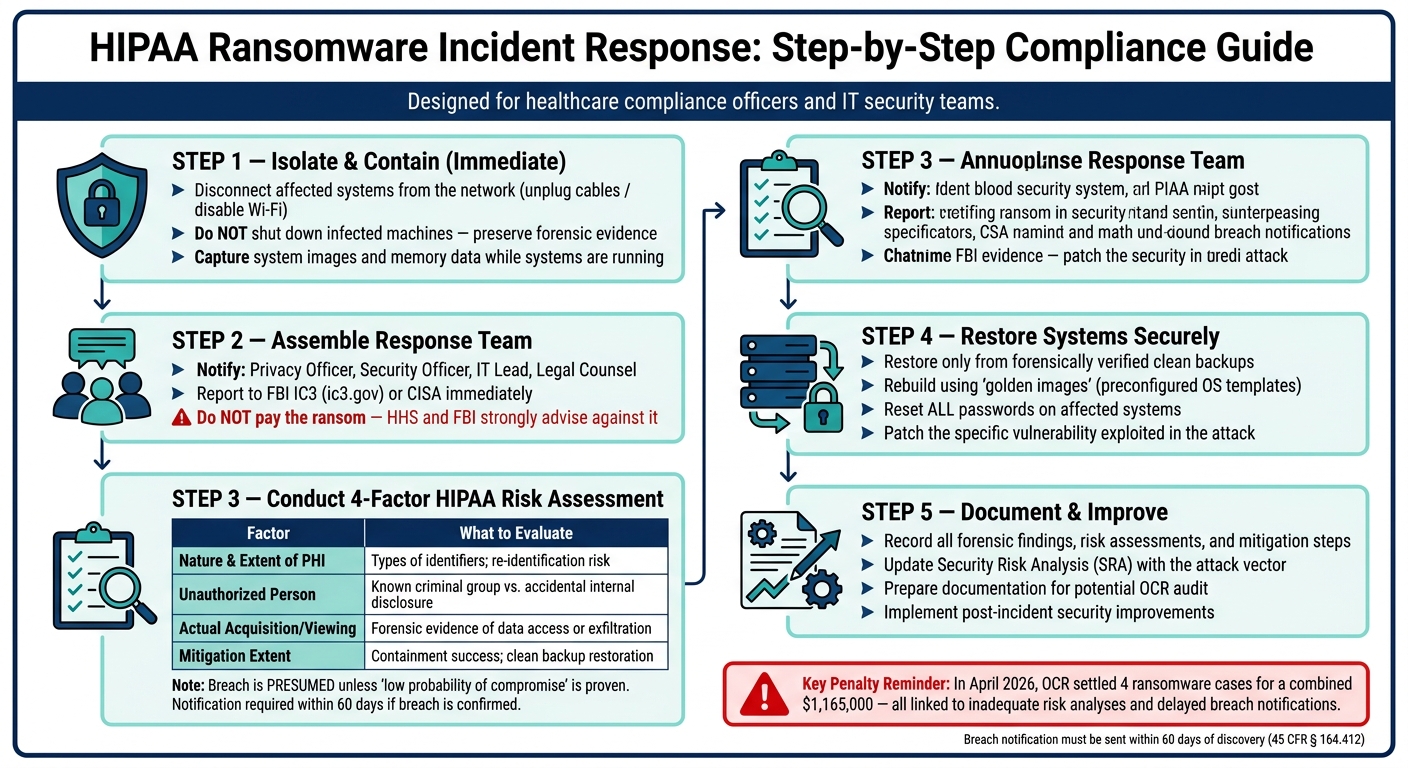
HIPAA Ransomware Incident Response: Step-by-Step Compliance Guide
When ransomware hits, swift action is non-negotiable. A delayed or poorly handled response can not only worsen the attack but also lead to HIPAA violations on top of the breach itself.
Immediate Response and Containment Steps
The first step is to isolate affected systems. Disconnect workstations and servers from the network by unplugging cables or disabling Wi-Fi to stop the ransomware from spreading. However, do not shut down the infected systems - doing so could erase critical forensic evidence. Instead, capture system images and memory data while the machines are still running [3][14].
Next, you need to assemble your incident response team. Utilizing a unified risk operations platform can help these departments collaborate more effectively during a crisis. This includes your Privacy Officer, Security Officer, IT lead, and legal counsel. Notify them immediately [3][1]. At the same time, report the attack to the FBI's Internet Crime Complaint Center (IC3) or CISA. These agencies may have tools or decryptors that can help with the specific ransomware variant you're dealing with [3][14].
Avoid paying the ransom. Both the FBI and the Department of Health and Human Services (HHS) strongly discourage it. Paying does not guarantee your data will be restored, and it does not fulfill your HIPAA breach notification requirements [3].
Once you’ve contained the threat, your next priority is to assess how the incident has impacted electronic protected health information (ePHI).
Post-Incident HIPAA Risk Assessment
Under HIPAA, any ransomware attack involving ePHI is automatically assumed to be a reportable breach unless proven otherwise.
"Unless the covered entity or business associate can demonstrate that there is a 'low probability that the PHI has been compromised,' based on the factors set forth in the Breach Notification Rule, a breach of PHI is presumed to have occurred." - HHS.gov [1]
To challenge this presumption, you’ll need to conduct and document a four-factor risk assessment. Here's a breakdown of what each factor evaluates:
| Risk Assessment Factor | What to Evaluate |
|---|---|
| Nature and Extent of PHI | Types of identifiers involved and the likelihood of patient re-identification |
| Unauthorized Person | Whether the actor was a known criminal group or an internal accidental disclosure |
| Actual Acquisition or Viewing | Forensic evidence of whether data was accessed or exfiltrated |
| Mitigation Extent | Whether the threat was contained and data integrity restored using clean backups |
Pay close attention to any evidence that data was exfiltrated before encryption. This could make it much harder to argue that there’s a low probability of compromise [3].
The consequences of mishandling this process can be severe. For example, in April 2026, Assured Imaging Affiliated Covered Entities paid $375,000 to settle an Office for Civil Rights (OCR) investigation. The case stemmed from a May 2020 ransomware breach that impacted 244,813 individuals. OCR found the organization had failed to conduct an adequate risk analysis and delayed notifying affected individuals. The settlement also required a two-year corrective action plan [2].
Your risk assessment findings will guide the next steps in system restoration and security improvements.
System Restoration and Post-Incident Improvements
Once containment and the risk assessment are complete, focus on restoring systems securely and strengthening your defenses. Start by restoring data only from forensically verified clean backups, and do this in an isolated environment to prevent reinfection [3][1]. Use "golden images" - preconfigured templates for operating systems - to rebuild systems efficiently and securely [15]. Additionally, reset all passwords for affected systems and address the specific vulnerabilities that allowed the attack to occur [15].
After recovery, document the attack vector in your Security Risk Analysis (SRA). Use this information to refine your security processes moving forward [3][1]. As OCR Director Paula M. Stannard emphasized:
"Proactively implementing the HIPAA Security Rule before a breach or an OCR investigation not only is the law but also is a regulated entity's best opportunity to prevent or mitigate the harmful effects of a successful cyberattack." [2]
Throughout every stage of the response - from containment to restoration - document everything. Detailed records of your forensic findings, risk assessments, and mitigation steps are essential during an OCR audit [1][7].
Managing Vendor and Workforce Risks Under HIPAA
Ransomware often takes advantage of third-party vendors and untrained employees. These two areas are among the most common weak points, requiring constant attention to safeguard ePHI and meet HIPAA compliance requirements.
Vendor Risk Management and BAAs
Vendors that handle ePHI are potential entry points for ransomware attacks. HIPAA mandates that you have a signed Business Associate Agreement (BAA) with each of these vendors. However, a BAA alone isn’t enough - it’s just the starting point. Ongoing third-party vendor risk management and security assessments are critical to keeping risks in check.
Traditional third-party risk management (TPRM) often relies on spreadsheets and occasional assessments, which can leave gaps. A vendor that passed a security check a year ago might now have vulnerabilities you’re unaware of. This approach tends to document risks rather than actively reduce them.
A better solution involves using a centralized Risk Register. This tool assigns responsibility for each risk - both internally and on the vendor’s side - along with a clear timeline for addressing it. This way, the focus shifts from just tracking risks to actively mitigating them. Keeping an up-to-date inventory of vendors and the products they provide also helps prevent anything from slipping through the cracks.
Quickly identifying vendor breaches is another key element. Generic security news feeds won’t cut it - you need ransomware alerts tailored to your vendor list. Setting up a formal process to review and resolve vendor breach notifications ensures you can act quickly and effectively when incidents occur.
Strong vendor oversight is the foundation for building a secure workforce.
Workforce Training on Ransomware and Phishing
The HIPAA Security Rule requires covered entities and business associates to implement a security awareness and training program for all employees, which includes teaching them how to detect and report malicious software [1].
"HIPAA's requirement that an entity's workforce receive appropriate security training, including training for detecting and reporting instances of malicious software, can thus assist entities in preparing their staff to detect and respond to ransomware." - HHS.gov [1]
Since phishing is the most common method for delivering ransomware, training must go beyond basic cybersecurity advice. Employees should learn how to identify malicious links, suspicious attachments, and fake websites. They also need to practice good password habits, such as avoiding reuse, not storing passwords in browsers, and using unique passwords with at least 15 characters [4].
Employees should also know how to spot early signs of ransomware, like unexplained increases in CPU or disk activity, renamed files, or being unable to open documents [1].
Equally important is teaching employees how to report incidents. According to HHS, out-of-band communication - like a phone call - should be used instead of email or internal messaging, which attackers might be monitoring [15]. This is a detail often overlooked in training programs but can make a big difference.
Training shouldn’t be a one-time event. Ransomware tactics are always changing, so regular sessions help employees stay prepared for new threats [4].
Using Continuous Oversight Tools
To manage vendor and workforce risks effectively, modern oversight platforms bring everything together. Here’s how they compare to traditional TPRM methods:
| Capability | Traditional TPRM | Modern Risk Operations |
|---|---|---|
| Tracking Method | Disconnected spreadsheets | Centralized Risk Register |
| Assessment Speed | Manual, prone to backlogs | Automated (up to 66% faster) [16] |
| Visibility | Point-in-time reviews | Continuous, live vendor profiles |
| Incident Alerts | General security news | Targeted ransomware notifications |
| Focus | Documenting risk | Prioritized remediation and action |
Censinet RiskOps™ is built for healthcare organizations, offering tools like live vendor profiles, automated risk scoring, and streamlined assessment workflows. According to Censinet, their AI-driven risk assessor agents can cut time spent on assessments by 66% [16], automating tasks like evidence reviews and report creation.
The platform also integrates findings into a centralized Risk Register, assigning ownership and timelines for remediation. This replaces outdated spreadsheets with coordinated action plans. For HIPAA audits, it keeps a complete, automated record of corrective actions and remediation progress, ensuring your documentation is always up to date. For organizations with limited resources, managed risk services provide continuous vendor oversight without adding to internal workloads.
Key Takeaways: Ransomware and HIPAA Compliance
Ransomware incidents account for a significant portion of OCR breach reports. In April 2026, OCR resolved four cases involving a total settlement of $1,165,000 and impacting over 427,000 individuals [2]. Each case revealed a critical failure: the lack of a proper, enterprise-wide security risk analysis.
"Hacking and ransomware are the most frequent type of large breach reported to OCR. Proactively implementing the HIPAA Security Rule before a breach or an OCR investigation not only is the law but also is a regulated entity's best opportunity to prevent or mitigate the harmful effects of a successful cyberattack." - Paula M. Stannard, OCR Director [2]
To combat ransomware effectively, organizations must implement both technical and administrative safeguards. These include multi-factor authentication (MFA), encryption, offline backups, access controls, and audit logging. However, these measures are only effective when built on a solid, documented, and regularly updated risk analysis. Encrypting electronic protected health information (ePHI) both in transit and at rest can even provide a "safe harbor" under the Breach Notification Rule [8]. While technical defenses are crucial, organizations must also address external and internal vulnerabilities.
Vendor and workforce risks require constant attention. For instance, the Consociate Health case revealed a phishing attack that went undetected for 16 months before ransomware was deployed [2][17]. With 93% of malicious activity in hospitals originating from email-based threats [17], it’s clear that robust phishing awareness, ongoing monitoring, and targeted training for specific roles are vital.
Lastly, thorough documentation cannot be overstated. OCR audits demand written proof of risk assessments, corrective actions, and decisions regarding breach notifications. A well-documented risk analysis process supports both proactive and reactive efforts. Every action - like isolating compromised systems and notifying affected individuals within the required 60-day window - should be recorded to enhance defenses and ensure compliance with regulatory standards.
FAQs
Does ransomware encryption always count as a HIPAA breach?
A ransomware attack isn’t automatically classified as a HIPAA breach, but it’s typically assumed to be one. Under the HIPAA Privacy Rule, unauthorized access to electronic protected health information (ePHI) is treated as an impermissible disclosure.
If you want to avoid sending breach notifications, you’ll need to document a thorough risk assessment that demonstrates a low probability of compromise. Without this documentation, you’re required to notify affected individuals, the Department of Health and Human Services (HHS), and, in some cases, the media. Tools like Censinet RiskOps™ can assist in managing and mitigating these risks effectively.
What evidence supports a “low probability of compromise” finding?
To show a low probability of compromise, start with a formal, documented risk analysis. This should evaluate specific threats and vulnerabilities, assigning a probability rating - like low, medium, or high - based on your organization's criteria. Factors such as remote access levels and infrastructure play a key role in this assessment. Back this up with a detailed inventory of threats and vulnerabilities, ensuring it’s part of a larger risk management program. Tools like Censinet RiskOps can simplify and automate these steps, making the process more efficient.
What should a BAA specify for ransomware reporting timelines?
Under HIPAA, a Business Associate (BA) is required to notify the covered entity if a breach occurs. Although HIPAA permits up to 60 days for this notification, such a lengthy timeline can hinder an effective response. To mitigate this, Business Associate Agreements (BAAs) should include stricter reporting requirements, like notifying the covered entity within 24 to 48 hours of identifying a potential breach. Tools like Censinet RiskOps simplify third-party risk management by improving visibility and aiding compliance efforts.
