
Managing vendor risks in healthcare is critical to protecting patient care and data. With thousands of vendors, prioritizing compliance based on risk is essential. Here's how to simplify the process:
- Why it matters: Vendors handling sensitive data or critical systems pose higher risks. For example, the February 2024 ransomware attack on Change Healthcare disrupted pharmacy and billing operations nationwide.
- Key challenges: Limited resources, evolving threats, and complex vendor ecosystems make compliance difficult.
- The solution: A risk-based approach using tiered classifications (Critical, High, Medium, Low) ensures focus on high-impact vendors.
- Steps to take:
- Build a complete vendor inventory, including fourth-party risks and dependencies.
- Map data flows to identify vulnerabilities.
- Establish a governance framework with cross-functional teams.
- Use healthcare-specific threat intelligence to update risk assessments.
- Automate workflows and conduct tiered compliance checks.
- Reassess vendors regularly based on triggers like breaches or scope changes.
Key takeaway: Effective vendor compliance prioritization protects patient safety, ensures regulatory adherence, and reduces operational disruptions. Tools like Censinet RiskOps™ can streamline this process by automating assessments and tracking risks.
Vendor Compliance: The Hidden Risk Most Organizations Miss
sbb-itb-535baee
Setting Compliance Objectives and Governance for Vendor Risk
Before diving into vendor risk prioritization, it’s essential to establish clear objectives, documented policies, and a well-defined governance structure. These elements ensure your risk assessment tools and workflows deliver consistent and actionable outcomes.
Defining Risk Appetite and Vendor Tolerance
Your risk appetite represents the level of vendor-related risk your organization is prepared to accept. This must be approved by leadership and translated into specific, actionable thresholds. For vendors handling PHI (Protected Health Information), HIPAA-compliant tolerance levels are crucial. For instance:
"No critical or high unmitigated security findings may remain open for vendors with access to PHI beyond 30 days."
Vendors supporting key clinical systems, like EHRs or PACS, require additional thresholds. These might include a minimum 99.9% availability SLA, as well as defined Recovery Time Objectives (RTOs) and Recovery Point Objectives (RPOs).
These thresholds aren’t just theoretical - they guide decision-making in risk scoring workflows, appear as standard clauses in Business Associate Agreements (BAAs), and serve as criteria in your vendor risk register. This clarity ensures that procurement, legal, and security teams can act in alignment, paving the way for an effective governance framework.
Building a Cross-Functional Vendor Governance Framework
Vendor risk management impacts multiple areas of an organization, so it can’t be owned by a single team. A Vendor Risk Governance Committee - sometimes referred to as a Third-Party Risk Council - brings together key stakeholders from information security, privacy and compliance, legal, procurement, IT, finance, and clinical leadership. Each group plays a unique role:
- Security teams handle technical assessments.
- Legal ensures risk requirements are embedded in contracts.
- Clinical leaders assess patient safety implications.
- Executive sponsors (e.g., the CIO, CISO, or Chief Compliance Officer) make decisions on high-risk exceptions.
The committee should operate under a formal charter that outlines its scope, decision-making authority, meeting frequency, and escalation procedures. For example, high-risk acceptances might require full committee approval and documentation, while lower-risk decisions can be delegated to security or compliance leads. To streamline the process, low-risk vendors can follow an automated review path, while critical and high-risk vendors undergo a full cross-functional review. Tools like Censinet RiskOps™ can simplify this by centralizing vendor data and routing assessments to the appropriate stakeholders, reducing reliance on email and manual follow-ups. Standardizing risk classifications further enhances the efficiency of this approach.
Standardizing Vendor Risk Classification
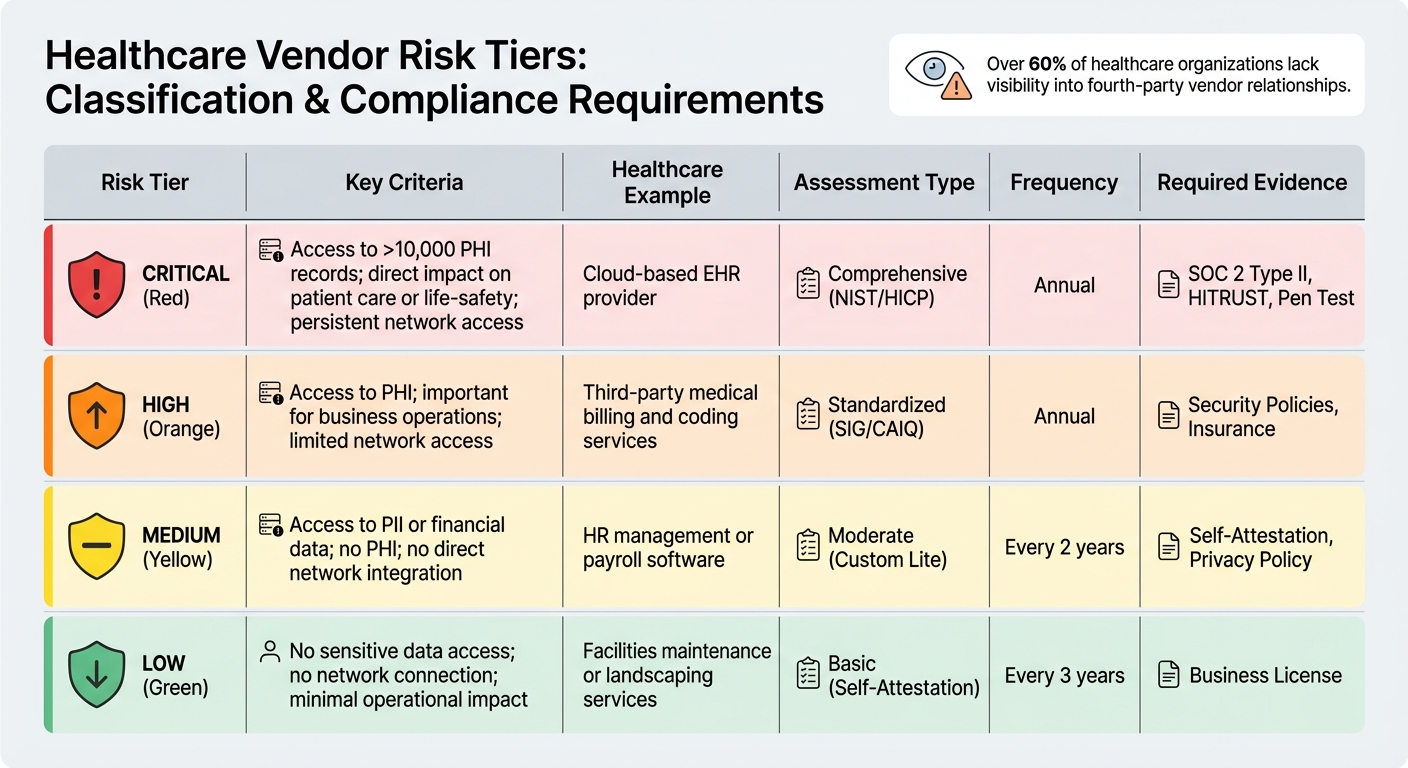
A consistent classification system is the backbone of a risk-based approach. Without it, different departments might evaluate the same vendor inconsistently, leading to gaps in oversight. A four-tier model - Critical, High, Medium, and Low - provides a shared framework and clear action thresholds.
| Risk Tier | Key Criteria | Healthcare Example |
|---|---|---|
| Critical | Access to >10,000 PHI records; direct impact on patient care or life-safety; persistent network access | Cloud-based EHR provider |
| High | Access to PHI; important for business operations; limited network access | Third-party medical billing and coding services |
| Medium | Access to PII or financial data; no PHI; no direct network integration | HR management or payroll software |
| Low | No sensitive data access; no network connection; minimal operational impact | Facilities maintenance or landscaping services |
Classification should occur during vendor intake using a standardized risk questionnaire. This assessment evaluates factors like data type, data volume, system connectivity, and clinical impact. Vendors should be automatically reclassified when their scope changes - such as when a marketing vendor gains access to patient data through new integrations. Regularly reviewing and updating the classification model, at least annually, helps ensure it keeps pace with new technologies, increased cloud adoption, and shifting regulatory requirements.
Building a Vendor Inventory and Segmentation Model
Healthcare Vendor Risk Tiers: Classification Framework & Compliance Requirements
Once you’ve established your governance framework and classification model, the next step is to identify your vendors and understand the risks they pose. Proper documentation is critical for organizing and prioritizing effectively.
Maintaining a Detailed Vendor Inventory
Start by creating a comprehensive list of all third parties and key subcontractors involved in your operations - this includes everything from EHR providers and telehealth platforms to supply chain partners. For each vendor, focus on capturing the details that directly influence risk decisions:
| Attribute | Details |
|---|---|
| Data Profile | PHI/PII access, record volume, data location |
| Operational Impact | Patient safety dependency, RTO/RPO, clinical workflow reliance |
| Technical Access | Network connection type (VPN, API, SFTP), EHR integration, privileged accounts |
| Compliance Status | BAA execution date, HITRUST/SOC 2 certifications, last assessment date |
| Fourth-Party Dependencies | Key subcontractors, cloud sub-processors, offshore support partners |
Pay close attention to fourth-party relationships. A vendor may seem low-risk at first glance, but hidden dependencies - like a cloud hosting provider or offshore development team with access to PHI - can introduce significant vulnerabilities. In fact, research shows that over 60% of healthcare organizations lack visibility into these critical fourth-party relationships, a gap that regulators and auditors are increasingly scrutinizing. This lack of visibility is a primary reason why many healthcare risk assessments fail to secure the broader ecosystem.
To keep your inventory up-to-date, integrate it with procurement and legal workflows. Make a vendor intake review mandatory before signing new contracts, and require re-reviews whenever a vendor’s scope changes - for instance, if they add a new API integration or switch subcontractors. Assign a clear internal owner to each vendor record to ensure accountability, and schedule periodic re-attestations to prevent lapses.
With a detailed inventory in place, the next step is to map how data moves across your vendor ecosystem.
Mapping Data Flows and Dependencies
After building your inventory, create a data-flow diagram to visualize how information moves between your organization and each vendor. This diagram should trace PHI from its origin - often the EHR - through every interface, API, file transfer, or cloud storage location it encounters. For example, a telehealth vendor might involve the video platform it uses (a fourth party), where session metadata is stored, and how it integrates back into your scheduling system.
Look for single points of failure. If several critical vendors rely on the same cloud region, identity provider, or integration engine, a disruption at that shared layer could ripple across your entire vendor network. Identifying these vulnerabilities is key to understanding where risks may compound. The HHS 405(d) guidance highlights data-flow diagrams and asset inventories as essential tools for managing cyber risks, particularly for organizations with complex vendor ecosystems.
Segmenting Vendors by Risk Tiers
Once your data flows and dependencies are mapped, classify vendors into risk tiers to guide your third-party risk assessment strategy. The four-tier model - Critical, High, Medium, and Low - introduced earlier works well here, but the effectiveness of your segmentation depends on the criteria you use. Focus on factors like:
- PHI sensitivity and volume
- Impact on patient safety
- System criticality
- Network exposure
- Regulatory obligations, such as HIPAA business associate status
For example, a cloud-hosted patient portal provider, a revenue cycle vendor handling large volumes of PHI, and a medical device software supplier are likely to fall into higher-risk tiers compared to a facilities vendor or office supply company. This classification reflects exposure and potential impact rather than contract value.
Tools like Censinet RiskOps™ can simplify this process by centralizing vendor records, automating risk scoring, and ensuring your inventory stays current. The assigned tier should dictate how often a vendor is assessed, what evidence they must provide, and how closely they’re monitored - topics that will be explored in the next section.
Aligning Vendor Compliance with Emerging Threats and Regulatory Changes
Once you've segmented your vendor inventory and assigned risk tiers, the real challenge begins: keeping those risk levels accurate over time. Threat landscapes shift, regulations tighten, and a vendor once considered low-risk could now pose significant concerns. A single assessment can quickly become outdated, so it’s critical to ensure your compliance efforts evolve alongside emerging threats and regulatory updates.
Using Healthcare-Specific Threat Intelligence
General cybersecurity feeds often miss the mark when it comes to healthcare-specific risks. For example, they might not highlight which ransomware groups are targeting hospital supply chains or which VPN appliances are being exploited to access electronic health record (EHR) systems. That’s why healthcare-specific threat intelligence is essential.
In the U.S., some of the most actionable insights come from the Health Information Sharing and Analysis Center (Health-ISAC). This organization provides threat briefings and indicators of compromise (IOCs) tailored to healthcare, drawing from incidents experienced by peers. Other critical sources include CISA's Known Exploited Vulnerabilities catalog, HHS/OCR cybersecurity advisories, and joint FBI/CISA alerts on ransomware campaigns specifically targeting healthcare. For connected medical devices, the FDA offers safety communications and post-market cybersecurity guidance, often identifying vulnerabilities in third-party software components.
To stay proactive, map these intelligence sources to your vendor inventory. For instance, if CISA issues an alert about an exploited remote access tool, you can quickly identify vendors using that technology, assess their role in clinical operations, and decide on next steps. Platforms like Censinet RiskOps™ streamline this process by linking threat signals and CVE data directly to vendor records, enabling faster and more focused follow-ups.
Updating Risk Scores Based on Threats and Regulations
Once you’ve gathered targeted threat intelligence, the next step is to adjust risk scores as new vulnerabilities and regulations emerge. Using your existing risk tiers, update scores promptly when new threats are identified. For example, if ransomware groups are increasingly targeting vendors offering remote access services, vendors relying on RDP or unprotected VPNs without multi-factor authentication should see their risk scores rise until they address these issues. Similarly, if OCR emphasizes stricter oversight of Business Associates, your scoring model should reflect this heightened regulatory focus.
Regulatory changes require a similar approach. The FDA has begun treating cybersecurity as a patient safety issue for connected medical devices, requiring manufacturers to maintain vulnerability management programs and provide a software bill of materials. If a device vendor can’t meet these expectations, their risk score should reflect that gap, prompting a compliance review. Updates to the NIST Cybersecurity Framework, HHS 405(d) HICP practices, and state-level privacy laws also carry weight. Risk teams should recalibrate scoring models annually - or sooner if major regulatory updates or significant sector incidents occur.
Setting Up a Continuous Threat Review Process
Static assessments won’t cut it. Reports from Health-ISAC and other industry sources consistently show that third-party and supply chain breaches are among the top entry points for healthcare cyber incidents. The time between a new threat emerging and a vendor being exploited can be alarmingly short.
To address this, establish a cross-functional cyber risk committee. This team - comprising representatives from security, compliance, legal, procurement, and clinical operations - should meet monthly to review new threats and regulatory updates, identify affected vendors, and decide on next steps, such as requesting additional evidence or updating contracts. This committee builds on the governance framework you’ve already established, extending its scope to include ongoing threat responses. A documented playbook should guide how new intelligence feeds into vendor questionnaires, monitoring workflows, and incident response plans. When a significant threat or regulatory change arises, the playbook ensures everyone knows their role and the timeline for action.
Automated tools can also help by integrating external security signals - such as vulnerability disclosures and incident reports - and flagging vendors whose risk profiles have changed since their last assessment. This approach keeps your compliance program proactive, ensuring your risk tiers remain aligned with the ever-changing threat landscape.
Running Tiered Compliance Assessments and Monitoring Workflows
Vendor segmentation lays the groundwork for effective compliance assessments. By aligning resources with vendor risk levels and incorporating threat intelligence, you can ensure compliance efforts are proportionate and targeted.
Designing Tier-Specific Compliance Questionnaires
The depth of your assessments should match the risk level of each vendor. For example, a cloud-hosted EHR system managing millions of records demands a much deeper evaluation than an office supply vendor with no access to sensitive data.
For critical and high-risk vendors, assessments should follow robust frameworks like NIST or HITRUST CSF. These evaluations should cover key areas such as access controls, encryption, logging, vulnerability management, patching schedules, incident response, and backup and recovery plans. Supporting evidence is essential - think SOC 2 Type II reports, HITRUST certifications, penetration test results, and relevant policy documents. If the vendor supports clinical operations, include questions about patient safety, downtime procedures, and expectations for recovery time objectives (RTO) and recovery point objectives (RPO).
Medium-risk vendors can complete a more streamlined assessment that focuses on essential security and privacy controls. Evidence requests might include a security policy or basic access management documentation. Low-risk vendors, with no access to protected health information (PHI) and minimal operational impact, may only need to provide a short attestation covering basic security practices and contractual assurances. Here's a summary:
| Vendor Tier | Assessment Type | Frequency | Required Evidence |
|---|---|---|---|
| Critical | Comprehensive (NIST/HICP) | Annual | SOC 2 Type II, HITRUST, Pen Test |
| High | Standardized (SIG/CAIQ) | Annual | Security Policies, Insurance |
| Medium | Moderate (Custom Lite) | Every 2 years | Self-Attestation, Privacy Policy |
| Low | Basic (Self-Attestation) | Every 3 years | Business License |
Using conditional logic in questionnaires can simplify the process. Vendors only see questions relevant to their risk tier and service type, which helps avoid unnecessary fatigue while maintaining thorough assessments.
Automating Risk-Based Compliance Workflows
Relying on manual processes for compliance management can be inefficient and impractical. Automation steps in to handle repetitive tasks, allowing your team to focus on critical decision-making.
Tools like Censinet RiskOps™ streamline the distribution and tracking of tier-specific questionnaires. They automatically route findings to the appropriate internal teams - such as security, privacy, legal, or clinical operations - and score responses against baseline controls. Gaps are flagged, and preliminary risk levels are generated. By centralizing task tracking, automation provides a clear view of pending and completed assessments. Research indicates that automation can cut cycle times by 30–50% and increase assessment throughput threefold [1].
Additionally, Censinet RiskOps™ enables cybersecurity benchmarking, allowing healthcare organizations to compare vendor risk profiles against industry peers. This comparison helps determine if a vendor's security measures align with reasonable expectations for their service type.
Including Vendors in Incident Response Plans
Vendor incident response is critical, especially considering that over 50% of major healthcare breaches involve third-party vendors [1]. This makes integrating vendors into your incident response strategy an absolute necessity.
For critical and high-risk vendors, maintain detailed documentation of vendor-specific incident response (IR) contacts, escalation paths, and on-call procedures within your IR runbooks. Contracts and business associate agreements (BAAs) should establish clear notification SLAs, typically ranging from 24 to 72 hours depending on the sensitivity of the data involved. These agreements should also outline cooperation requirements, such as granting forensic access and coordinating communications. Joint playbooks for scenarios like ransomware attacks, cloud outages, or vulnerabilities in networked medical devices are essential.
Critical vendors should also maintain their own business continuity and disaster recovery (BC/DR) plans, which should be tested periodically. Include these vendors in annual tabletop exercises to ensure both sides are prepared and understand their roles before an incident occurs. Tools like Censinet RiskOps™ can automate updates to vendor IR documentation and compliance tracking, significantly reducing the manual effort required to keep these records current [1].
Reprioritizing Vendor Compliance as Risks Change
Vendor risks don’t stay static after onboarding. A vendor that starts as low risk might become high risk over time - especially if it begins handling sensitive data like PHI, integrates with clinical systems, or undergoes major corporate changes like an acquisition. Because of this, regular evaluations are crucial to keep compliance efforts in sync with evolving risks.
Identifying Triggers for Reassessment
The best way to stay ahead is to base reassessments on events, not just the calendar. Some key triggers to include in your policies are:
- Reported breaches or suspicious activity involving the vendor, such as OCR notices or dark web exposure.
- New integrations with clinical workflows, EHR systems, or medical devices that increase data access.
- Changes in data handling scope, like transitioning from de-identified to identifiable patient data.
- Mergers, acquisitions, or leadership shifts that could impact security practices or introduce new sub-processors.
- Major software or hosting changes that alter the vendor’s technical setup.
- New regulatory guidance or changes in HIPAA enforcement priorities that affect vendor compliance requirements.
- Critical vulnerability disclosures tied to the vendor’s platform.
To manage these, create a formal trigger matrix - a documented list of events that dictate when an immediate review is required versus when it can wait until the next scheduled assessment. Without this, decisions can become inconsistent, making audits harder to defend. These triggers also lay the groundwork for using advanced analytics to keep vendor risk profiles up to date.
Using AI and Analytics for Dynamic Compliance Management
Responding quickly to these triggers requires the right tools. Advanced platforms like Censinet AI™, part of the Censinet RiskOps™ suite, enable healthcare organizations to shift from static, third-party risk assessment questions to a dynamic, always-updated risk model.
Censinet AI accelerates the process by letting vendors complete security questionnaires in seconds. It automatically summarizes evidence, compiles documentation, and generates risk reports based on all relevant data [1]. This allows risk teams to focus on meaningful findings instead of getting bogged down in administrative work.
What’s more, Censinet AI uses a human-in-the-loop approach. While automation handles evidence validation, policy generation, and mitigation steps, risk teams maintain control through customizable rules and review processes. This ensures speed doesn’t compromise accuracy - an essential balance in healthcare, where misjudging a vendor’s risk could directly affect patient care.
Keeping Compliance Aligned with Patient Safety and Organizational Goals
Dynamic reassessments and AI tools are only part of the equation. Vendor prioritization also needs to consider the impact on patient care. Not all vendor risks are created equal - even if two vendors have similar security scores. For instance, a vendor supporting bedside monitoring devices or EHR-integrated medication workflows poses a much higher risk than one managing office supplies, even if their technical vulnerabilities appear similar.
Patient safety should be a key factor in risk scoring. Ask yourself: If this vendor experienced a breach or downtime today, how would it impact patient care? Vendors tied to diagnostics, clinical communication, surgical scheduling, or life-critical devices should move to the top of the review list whenever new risks arise, regardless of their baseline scores.
Finally, ensure compliance decisions align with your organization’s broader goals by involving the right stakeholders. A cross-functional risk committee - including representatives from security, privacy, legal, clinical operations, and IT - should regularly review vendor risks alongside patient safety metrics and business continuity plans. This approach keeps compliance efforts focused on protecting what matters most, rather than just ticking boxes.
Conclusion: Key Takeaways for Healthcare Organizations
Managing vendor compliance is a continuous effort that directly affects patient safety, regulatory compliance, and operational stability. The checklist outlined here provides security, compliance, and procurement teams with a practical framework to shift from reactive, checkbox-style vendor reviews to a more scalable, risk-focused approach.
By adopting a risk-based strategy, organizations can prioritize oversight where it matters most. Vendors handling large volumes of PHI or those integrated into clinical workflows require much stricter scrutiny compared to those supplying non-critical items like office equipment. Segmenting vendors into risk tiers, clearly defining governance roles, mapping data flows, and staying aligned with emerging threats allow healthcare organizations to allocate resources effectively, focusing on areas that have the greatest impact on reducing risks and ensuring patient safety.
Statistics reveal that over 30% of major healthcare breaches stem from third-party incidents, with vendor-related ransomware continuing to pose a significant threat. A structured, proactive approach ensures that when disruptions occur, the organization is prepared with predefined playbooks, clear escalation procedures, and well-tested continuity plans.
Tools like Censinet RiskOps™ offer a centralized solution to streamline this process. This platform simplifies vendor inventory management, provides healthcare-specific assessments aligned with standards like HIPAA, NIST CSF, and HICP, automates remediation tracking, and delivers real-time dashboards. These features help translate vendor risks into actionable insights for clinical and executive teams. Additionally, its collaborative model allows vendors to share completed assessments with multiple healthcare organizations, reducing redundant efforts for everyone involved. Learn more about it here.
Organizations that excel in vendor compliance view it not as a financial burden but as a critical component of delivering safe and dependable care. By embedding these practices into their operations, healthcare organizations can move beyond basic compliance and embrace a proactive, patient-first approach to vendor risk management - setting apart mature programs from those that merely tick boxes.
FAQs
What’s the fastest way to tier vendors by risk?
The fastest way to sort vendors by risk is by implementing a standardized scoring system. This involves evaluating key factors such as their access to Protected Health Information (PHI), their operational importance to your organization, and their level of network connectivity. By assigning numerical weights - like a 1–100 scale - you can group vendors into risk tiers (critical, high, medium, or low). Tools like Censinet RiskOps™ simplify this process by automating the scoring, offering real-time dashboards, and streamlining assessments to help you focus on your most critical vendors.
How can we identify hidden fourth-party PHI exposure?
To uncover hidden fourth-party PHI exposure, relying on static annual audits isn't enough - they simply can't keep up with the ever-changing web of subcontractor relationships. Instead, leverage continuous monitoring tools like those offered by the Censinet RiskOps™ platform. These tools help you stay on top of risks posed by fourth-party providers, including cloud service vendors.
Additionally, make sure your contracts require vendors to disclose their subcontractors. It's equally important to ensure those subcontractors adhere to the same security standards and Business Associate Agreement (BAA) terms as your primary vendors. This proactive approach helps safeguard sensitive information across the entire supply chain.
What events should trigger an immediate vendor reassessment?
Immediate vendor reassessment is crucial when events arise that significantly alter a vendor's risk profile. Examples include cybersecurity breaches, security incidents, or previously unreported issues that come to light. Other key triggers might involve major regulatory changes, expired compliance certifications, or shifts in the vendor’s ownership, leadership, or financial stability. Tools like Censinet RiskOps™ empower healthcare organizations to keep tabs on these changes in real time, allowing them to respond quickly to potential threats or compliance gaps.
