
Supply chain breaches in healthcare can disrupt operations, especially given the supply chain security challenges facing the industry, compromise patient data, and lead to regulatory penalties if not handled properly. Here's what you need to know:
- Key Reporting Rules: Under HIPAA, breaches involving Protected Health Information (PHI) must be reported to affected individuals and the Department of Health and Human Services (HHS) within 60 days. Additional state and contractual deadlines may apply.
- Steps to Take:
- Confirm the breach and assess its impact using HIPAA’s four-factor risk assessment.
- Activate internal response protocols by involving security, legal, privacy, and clinical teams.
- Map out all reporting obligations, including federal, state, and vendor-specific requirements.
- Notify affected parties, regulators, and media (if required) with clear, compliant communication.
- Conduct a post-breach review to address vulnerabilities and strengthen controls.
Why it matters: Failing to act quickly can harm patient trust, disrupt care, and invite penalties. Following a structured response plan ensures compliance and minimizes risks.
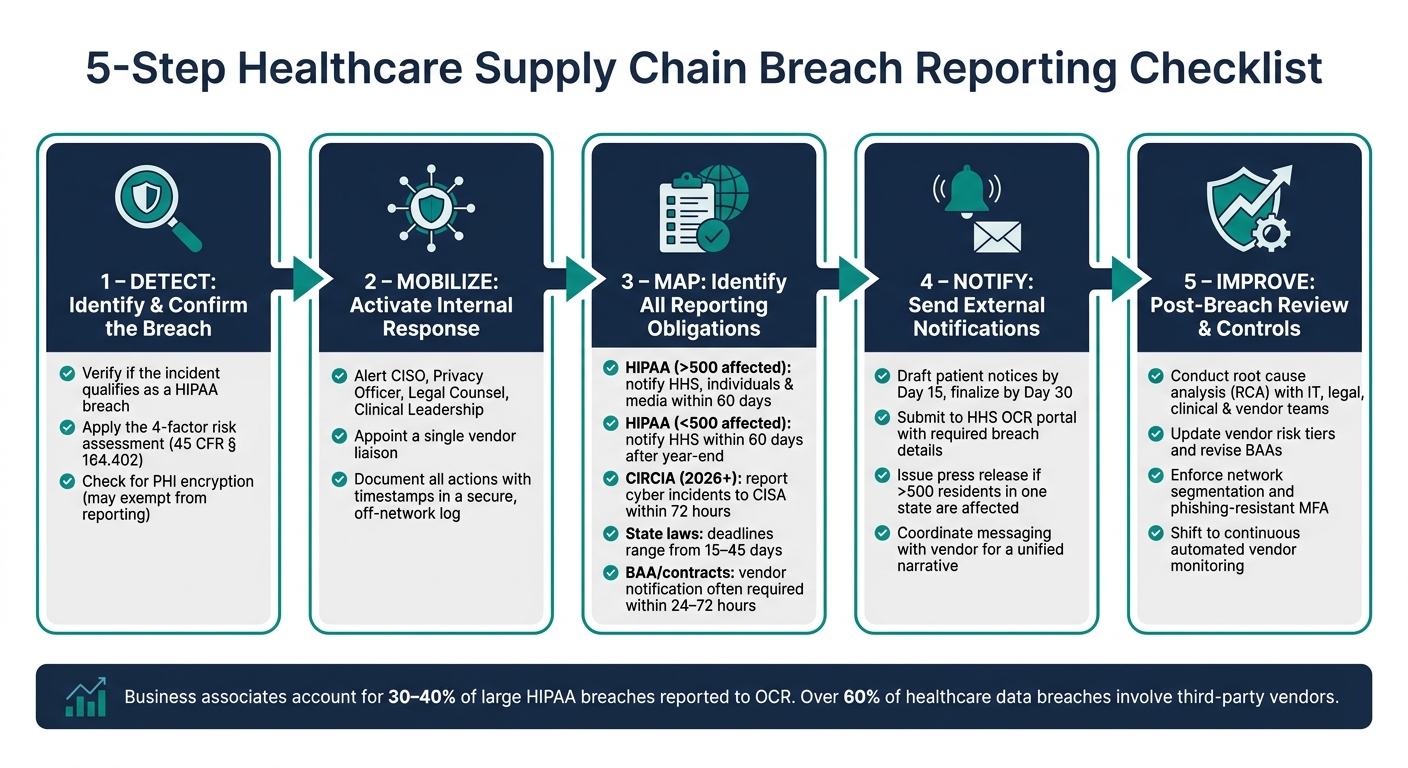
5-Step Healthcare Supply Chain Breach Reporting Checklist
2 Minute Drill: Supply Chain Breaches and Patient Safety Risks with Drex DeFord
sbb-itb-535baee
Step 1: Identifying and Confirming a Supply Chain Breach
Before taking action, it’s crucial to confirm whether an incident qualifies as a breach and understand its extent. This involves verifying the situation and assessing its impact.
Define What Counts as a Supply Chain Breach
A supply chain breach happens when a third-party incident exposes protected health information (PHI) or clinical data. Examples include ransomware attacks on a vendor’s systems, compromised vendor credentials used to access your electronic health records (EHR), or vulnerabilities in third-party tools that expose patient records.
Some early warning signs to watch for include:
- Unusual login activity from vendor-managed accounts, such as access during odd hours or from unexpected IP addresses.
- Changes in third-party application behavior, like unexpected interactions with internal systems.
- Outbound traffic spikes originating from a vendor’s network.
If you notice any of these, investigate right away. Once a breach is suspected, it’s time to determine its scope and impact.
Assess the Scope and Impact
Start by mapping out the affected clinical workflows - such as pharmacy, radiology, billing, or scheduling - since disruptions in these areas can directly impact patient care.
To measure the severity of the breach, use HIPAA’s four-factor risk assessment framework (45 CFR § 164.402):
- Nature and extent of PHI involved: Assess whether sensitive data, like Social Security numbers, was exposed or if it was limited to less critical information, such as appointment dates.
- Who accessed the PHI: Identify whether the data was accessed by internal employees, external attackers, or unknown parties.
- Whether PHI was acquired or viewed: Use digital forensics to confirm unauthorized access or data theft.
- Extent of mitigation: Determine if the vendor has successfully contained the incident and whether any exposed data has been recovered or secured.
Understanding whether the breach involved data at rest (stored in vendor databases) or data in transit (e.g., APIs or integrations) is also critical, as this affects the potential number of compromised records. Take, for example, the February 2024 ransomware attack on Change Healthcare. This breach, originating from a remote access server without multi-factor authentication (MFA), impacted approximately one-third of Americans’ health data and disrupted half of U.S. medical claims processing.
"The Change Healthcare incident is the most significant and consequential cyberattack on the U.S. healthcare system in history." - American Hospital Association (AHA)
Check Regulatory Definitions
Make sure the incident meets regulatory breach criteria before proceeding. Under HIPAA, only impermissible uses or disclosures of PHI that meet specific criteria require reporting. Refer to HIPAA’s breach definitions (45 CFR §§ 164.400–414).
"An impermissible use or disclosure of protected health information is presumed to be a breach unless the covered entity or business associate... demonstrates that there is a low probability that the protected health information has been compromised." - HHS.gov [2]
There are three exceptions to this rule:
- Unintentional access by a workforce member acting in good faith.
- Inadvertent disclosure between authorized personnel within the same organization.
- Low retention risk where the unauthorized party is unlikely to have kept the information.
If the PHI was encrypted in compliance with HHS guidelines, reporting may not be required. Additionally, be mindful of other obligations, such as those under 42 CFR Part 2, when handling sensitive data.
| Regulatory Framework | Applicable Entities | Key Reporting Requirement |
|---|---|---|
| HIPAA Breach Notification Rule | Covered Entities & Business Associates | Notify individuals, HHS, and media (if >500 affected) [2] |
| FTC Health Breach Notification Rule | PHR Vendors & Third-Party Service Providers | Notify individuals and FTC following a breach of PHR identifiable health information [2] |
| 42 CFR Part 2 | Substance Use Disorder Programs | Notify the Secretary of breaches of unsecured Part 2 records [3] |
Step 2: Activating Internal Response Protocols
Once a breach is confirmed, the next step is to focus on internal coordination. The goal here is to promptly involve the right teams, establish communication with your vendor, and meticulously document every action before making any external notifications.
Notify the Right Internal Teams
Start by alerting the CISO or information security lead to handle technical containment, the privacy officer to conduct the HIPAA breach risk assessment, and your legal counsel to ensure attorney-client privilege and review contractual obligations. If patient care workflows are affected, notify clinical leadership - such as the CMO, CNO, or pharmacy director.
Don't overlook the supply chain and procurement teams, as they manage vendor risk management protocols and Business Associate Agreements (BAAs), which outline vendor responsibilities. To prevent delays, especially outside regular hours, maintain a documented 24/7 escalation protocol. After notifying internal teams, coordinate directly with the vendor's incident response team.
| Internal Stakeholder | Key Role in Response |
|---|---|
| CISO / Security Operations | Technical triage, containment, vendor coordination |
| Privacy / HIPAA Officer | Breach determination and PHI exposure analysis |
| Legal / General Counsel | Securing privilege, regulatory strategy, contract review |
| Clinical Leadership | Assessing patient safety and ensuring care continuity |
| Supply Chain / Procurement | Reviewing BAAs, managing vendor obligations |
| Risk Management | Coordinating insurance notifications and documentation |
Work with Vendor Incident Teams
Appoint a single vendor liaison to streamline communication with the affected vendor. This prevents inconsistent messages and ensures your team receives accurate, timely updates.
Request critical information from the vendor, including the incident timeline, systems and data impacted, whether PHI was accessed or exfiltrated, indicators of compromise, and their remediation plan. Organizations that have pre-established communication protocols with vendors often handle these situations more effectively, ensuring better contingency planning and keeping clinical staff informed. Always use encrypted, out-of-band channels for these communications to safeguard sensitive response details.
Once you've aligned with the vendor, ensure every step of the response is thoroughly documented.
Document All Internal Actions
Assign a dedicated scribe to log every action in real time. This allows the response team to focus on containment while maintaining a detailed record of events.
Include timestamps, the rationale behind decisions, and any legal communications in your log. Mark documentation involving legal counsel as "Attorney-Client Privileged" when necessary, and store all records in a secure, off-network location to ensure accessibility in case primary systems fail. A comprehensive record is invaluable for OCR audits, insurance claims, and accreditation reviews. Tools like Censinet RiskOps™ can help centralize vendor risk data, incident logs, and remediation tracking, providing an organized and auditable history of your response[1].
Step 3: Mapping Regulatory and Contractual Reporting Obligations
Now it’s time to figure out the specifics: who needs to be notified, when, and what they need to know. In healthcare, supply chain breaches activate a maze of federal, state, and contractual obligations, each with its own deadlines. Mapping these responsibilities ensures you can meet every requirement on time, building on the internal actions you’ve already documented.
Regulatory Reporting Requirements
Under HIPAA, reporting obligations depend on the scale of the breach:
- For breaches affecting 500 or more individuals in a state or jurisdiction, you must notify affected individuals, the HHS Secretary, and even prominent media outlets within 60 days of discovery.
- For smaller breaches (fewer than 500 individuals), HHS notification can be delayed, but it must be filed annually, no later than 60 days after the end of the calendar year [2].
The HITECH Act extends similar rules to vendors of personal health records, enforced by the FTC [2]. And there’s more: starting in 2026, CIRCIA will require healthcare organizations - classified as critical infrastructure - to report cyber incidents to CISA within 72 hours and ransom payments within 24 hours.
State laws often have stricter timelines, with deadlines ranging from 15 to 45 days, depending on the jurisdiction [5]. If a breach affects individuals in multiple states, you’ll need to address overlapping state-level obligations, as these are determined by where the affected individuals reside.
One key factor to check is whether the PHI involved was encrypted. If it was encrypted using HHS-approved methods, it’s not considered “unsecured,” and notification requirements may not apply [2].
Vendor and Contractual Obligations
Federal regulations aren’t the only rules in play - your contracts with vendors are just as critical. Business Associate Agreements (BAAs) under HIPAA require business associates to notify covered entities of breaches without unreasonable delay, but no later than 60 days after discovery [2]. However, many BAAs and service level agreements (SLAs) are stricter, requiring notification within 24 to 72 hours [5].
BAAs should go beyond confirmed breaches, requiring vendors to report all security incidents.
"Business Associate Agreements must stipulate that all security incidents must be reported by a business associate to a covered entity whether they result in a data breach or not." - HIPAA Journal [5]
Failing to meet contractual deadlines can lead to steep penalties. For example, in 2017, Presense Health was fined $475,000 by the HHS Office for Civil Rights for taking nearly three months - well beyond the 60-day HIPAA deadline - to notify affected parties [5]. When reviewing vendor contracts, pay close attention to clauses that outline who is responsible for notifying affected individuals. Ambiguities here can cause harmful delays [5].
Build a Reporting Matrix
Once you’ve identified all the regulatory and contractual timelines, organize them in a reporting matrix. This tool will help ensure nothing slips through the cracks. Your matrix should include:
- The specific reporting obligation
- The event that triggers the obligation
- The deadline for notification
- The recipient of the report
- The internal person responsible for handling it
Here’s an example of how your matrix might look:
| Reporting Obligation | Triggering Event | Deadline | Recipient | Owner |
|---|---|---|---|---|
| HIPAA Breach Rule (>500) | Discovery of PHI breach | Max 60 days | HHS/OCR, Individuals, Media | Privacy Officer |
| HIPAA Breach Rule (<500) | Discovery of PHI breach | 60 days after year-end | HHS Secretary | Privacy Officer |
| CIRCIA (CISA) | Cyber incident | 72 hours | CISA | CISO |
| State Breach Laws | Discovery of PII breach | Varies (15–45 days) | State Attorney(s) General | Legal Counsel |
| Contractual (BAA) | Discovery of incident | Per contract (24–72 hrs) | Covered Entity / Client | Supply Chain Lead |
| SEC Cyber Disclosure | Determination of materiality | 4 business days | SEC | Legal / CFO |
Set internal deadlines that are at least 10 to 15 days earlier than the legal deadlines to allow time for legal and executive review. Include links to reporting portals and contact details for quick access during a crisis.
To simplify this process, platforms like Censinet RiskOps™ can centralize vendor contract data, BAA terms, and risk assessment records. This makes it easier to maintain an up-to-date reporting matrix and pull the details you need when it matters most.
Step 4: Preparing and Sending External Notifications
Once your reporting matrix is in place, the next step is to handle external notifications. Prompt and accurate communication not only protects patients but also reinforces your organization's commitment to security.
Draft Notices for Patients and Regulators
When drafting notices, include the following key elements: a concise description of the breach, the types of PHI involved, steps individuals can take to protect themselves, a summary of your investigation and mitigation efforts, and contact information for further assistance [2].
For individual notifications, first-class mail is the default method. If a patient has previously consented to email communication, that can also be used. If contact details for 10 or more individuals are unavailable, post a notice on your website's homepage for 90 days and provide a toll-free number for inquiries [2]. For fewer than 10 individuals, a phone call or another written form of communication is acceptable.
When submitting information to the HHS Office for Civil Rights (OCR) through their electronic portal, you’ll need to provide specific details, including your organization's legal name, breach dates, the number of affected individuals, the breach type (e.g., hacking or theft), where the data was stored (like an EHR system or email), and the security measures in place at the time, such as encryption or multi-factor authentication [6]. Aim to draft these notices within 15 days and finalize them by day 30, allowing your legal and compliance teams ample time before the 60-day deadline [6].
Keep your OCR submission concise by uploading only the required documentation, such as a risk assessment summary, to avoid including unnecessary PHI [6].
After completing these steps, turn your attention to public disclosures and media communication to finalize the external notification process.
Manage Public and Media Communications
If the breach affects more than 500 residents in a single state, you must issue a press release to major media outlets [7]. The press release should closely mirror the notices sent to affected individuals, including the breach description, PHI types involved, and protective measures.
Crafting clear and factual media statements is critical. Poorly worded releases can heighten public concern and draw unwanted regulatory attention. Ensure that all public statements are reviewed by legal counsel and avoid speculating on the breach's causes or impact until your investigation is complete.
In cases where law enforcement determines that notifications could interfere with a criminal investigation or compromise national security, they may request a delay. Such requests, whether written or oral, should be documented to demonstrate compliance if regulators question the timing of your notifications [6].
Finally, work closely with your vendor to ensure all external messaging is consistent and aligned.
Align with Vendor Communications
With over 60% of healthcare data breaches involving third-party vendors [4], it's essential to coordinate public messaging with your vendor's incident response team. This ensures a unified narrative that complements the internal processes you’ve already established. To maintain this readiness, organizations should regularly train incident response teams on these specific communication protocols.
Confirm in writing any notification responsibilities assigned to your vendor under your Business Associate Agreement [2]. Require them to provide complete details about affected individuals and any supporting information your organization needs to fulfill its reporting obligations [7]. Missing or incomplete information from vendors can cause delays, which may have costly repercussions.
Using a risk management platform like Censinet RiskOps™ can streamline vendor coordination and help you maintain compliance across both internal and external communications. This ensures your organization stays aligned with regulatory expectations while managing the notification process efficiently.
Step 5: Conducting Post-Breach Reviews and Strengthening Controls
After notifying external parties and coordinating with vendors, it’s crucial to conduct a detailed post-breach review. Supply chain breaches expose vulnerabilities that, once addressed, can significantly improve your organization’s defenses.
Perform a Root Cause Analysis
Start with assembling the right team for a thorough root cause analysis (RCA). This team should include experts from IT security, legal counsel, clinical operations, and vendor management. Each brings a unique perspective to ensure the investigation is comprehensive.
Preserve all evidence immediately - SIEM logs, firewall records, and access logs from both your systems and the affected vendor. These records can be overwritten or lost if not secured quickly. Use this data to create a detailed timeline, tracking the breach from its entry point at the vendor to any lateral movement within your network. The goal is to uncover both the immediate cause (e.g., a compromised API or unpatched system) and the deeper root cause (e.g., inadequate vendor oversight or lack of multi-factor authentication). Map these findings to the CIS Critical Security Controls to prioritize necessary fixes.
This analysis not only identifies what went wrong but also informs updates to risk assessments and vendor contracts.
Update Risk Assessments and Contracts
Using the findings from your root cause analysis, reassess the risk profiles of vendors involved in the breach. Reevaluate the risk tier of the affected vendor and scrutinize similar vendors across your supply chain. For example, if a breach occurs at a cloud provider or EHR system, it may signal the need for closer monitoring of other vendors offering comparable services.
Revise your Business Associate Agreements (BAAs) to reflect lessons learned. Include specific incident notification timelines (e.g., within 24 hours of discovery), clear liability and indemnification clauses, and technical requirements like mandatory multi-factor authentication. Additionally, update contracts to grant expanded audit and monitoring rights to your organization.
| Vendor Risk Category | Examples | Oversight Priority |
|---|---|---|
| High-Risk | Cloud providers, EHR systems, connected medical devices | Intensive monitoring, regular assessments, and detailed incident response planning |
| Medium-Risk | Billing companies, transcription services, pharmacy benefit managers | Periodic reviews and standardized security requirements |
| Lower-Risk | Legal services, consulting firms with limited PHI access | Basic contractual protections and initial risk assessment |
Strengthen Supply Chain Cybersecurity Controls
Take the lessons from your internal and vendor reviews and use them to bolster cybersecurity measures across the board. Annual vendor assessments are no longer sufficient - shift toward continuous, automated monitoring of vendor security postures. This allows you to identify vulnerabilities in real time rather than waiting for scheduled reviews.
Focus on two critical technical controls after a breach. First, enforce network segmentation. Systems managed by third parties, like pharmacy robots or imaging machines, should be isolated in restricted network segments that cannot directly interact with your EHR. Second, require phishing-resistant multi-factor authentication (such as hardware security keys or biometrics) for all vendor and contractor remote access. Also, insist that vendors provide a Software Bill of Materials (SBOM) to uncover hidden dependencies.
Platforms like Censinet RiskOps™ can help by centralizing vendor risk data, streamlining risk tiering, and automating workflows for better oversight. Additionally, conducting joint tabletop exercises with your vendor’s incident response team can refine communication protocols and technical handoffs. These actions not only improve security but also demonstrate good-faith efforts, which can be a mitigating factor in HIPAA enforcement under HR 7898.
Conclusion: Staying Compliant and Building Resilience
By following the structured steps outlined earlier, effective breach reporting not only satisfies regulatory requirements but also strengthens your organization's ability to handle future challenges. Supply chain breaches remain a persistent issue in healthcare, with business associates accounting for approximately 30–40% of large HIPAA breaches reported to the OCR in recent years. These incidents carry significant financial and operational risks, making rigorous reporting a necessity. The checklist serves as a practical tool for turning crisis response into a strategy for long-term resilience.
The five steps - detect, mobilize, map, notify, and improve - offer a clear framework for addressing these risks. Each time your organization completes this cycle, whether during an actual event or a simulated exercise, you gain faster response times, more organized documentation, and better coordination with vendors. This consistency aligns with what regulators like the OCR expect and, more importantly, safeguards patients.
Taking proactive steps is essential. Understanding vendor roles regarding PHI, reviewing BAAs, and being familiar with state-specific laws can prevent last-minute scrambling. Tight notification deadlines set by federal and state regulations leave little room for error, so laying this groundwork ensures that each step of detection, mobilization, mapping, notification, and improvement happens efficiently and accurately.
Tracking metrics like the average time from detection to internal notification, the percentage of critical vendors with documented breach timelines, and the closure rate for post-breach corrective actions helps leadership see where the program is thriving and where it needs more focus. Tools like Censinet RiskOps™ can simplify this process by centralizing vendor data, mapping PHI flows, and identifying contractual obligations as soon as an incident occurs.
Ultimately, supply chain breach reporting should be integrated into broader enterprise risk, cybersecurity, and patient safety programs. When incidents lead to stronger vendor contracts, better risk assessments, and refined response plans, the checklist transitions from a reactive tool to a key element of resilience. Incorporating these lessons into daily practices shifts breach reporting from a compliance exercise to a cornerstone of organizational strength and security.
FAQs
When does a vendor incident become a reportable HIPAA breach?
A vendor incident qualifies as a reportable HIPAA breach if unsecured Protected Health Information (PHI) is accessed or disclosed without proper authorization, and a risk assessment determines there’s a greater than low probability of compromise. For breaches impacting 500 or more individuals, notifications must be issued within 60 days of discovery to meet HIPAA requirements.
What deadlines apply if multiple states are impacted?
If a breach impacts 500 or more people across several states, notifications must be issued within 60 days of discovering the breach. This also involves informing media outlets in the affected state(s) to meet reporting obligations.
Who should notify patients - us or the vendor?
Healthcare organizations, not vendors, bear the responsibility of notifying affected patients in the event of a breach. According to HIPAA regulations, these entities must directly inform individuals impacted by such incidents within 60 days of discovering the breach. This requirement helps ensure compliance with the law while safeguarding patients' rights.
