
If one key vendor stalls, your recovery can stall too. In U.S. healthcare, getting back after ransomware, outages, or disasters often depends on outside partners just as much as internal IT.
Here’s the short version:
- You can’t recover what you can’t map. Many teams know direct vendors but miss fourth-party links, PHI exposure, and which suppliers support patient care first.
- Separate recovery plans slow everyone down. IT, procurement, business continuity, and vendors often work from different steps, timelines, and priorities.
- Late warning makes recovery worse. 17% of organizations only watch vendors when something breaks, 25% have little or no formal vendor monitoring, and only 13% keep central dashboards with alerts and SLAs.
- Weak contracts limit your options. If terms don’t set notification deadlines, testing duties, and recovery targets, vendors have less duty to act fast when service fails.
- Governance is the missing link. Only 43% of healthcare groups report clear decision rights and escalation paths for this work.
What I take from this is simple: vendor risk is also recovery risk. To cut delays, I’d focus on three things:
- One shared supplier inventory with vendor criticality, RTOs, RPOs, PHI exposure, integrations, and fourth-party links
- One joint recovery playbook across internal teams and vendors, backed by testing and vendor tiering
- Year-round monitoring and contract terms that set notice windows, proof of recovery readiness, and joint exercise rules
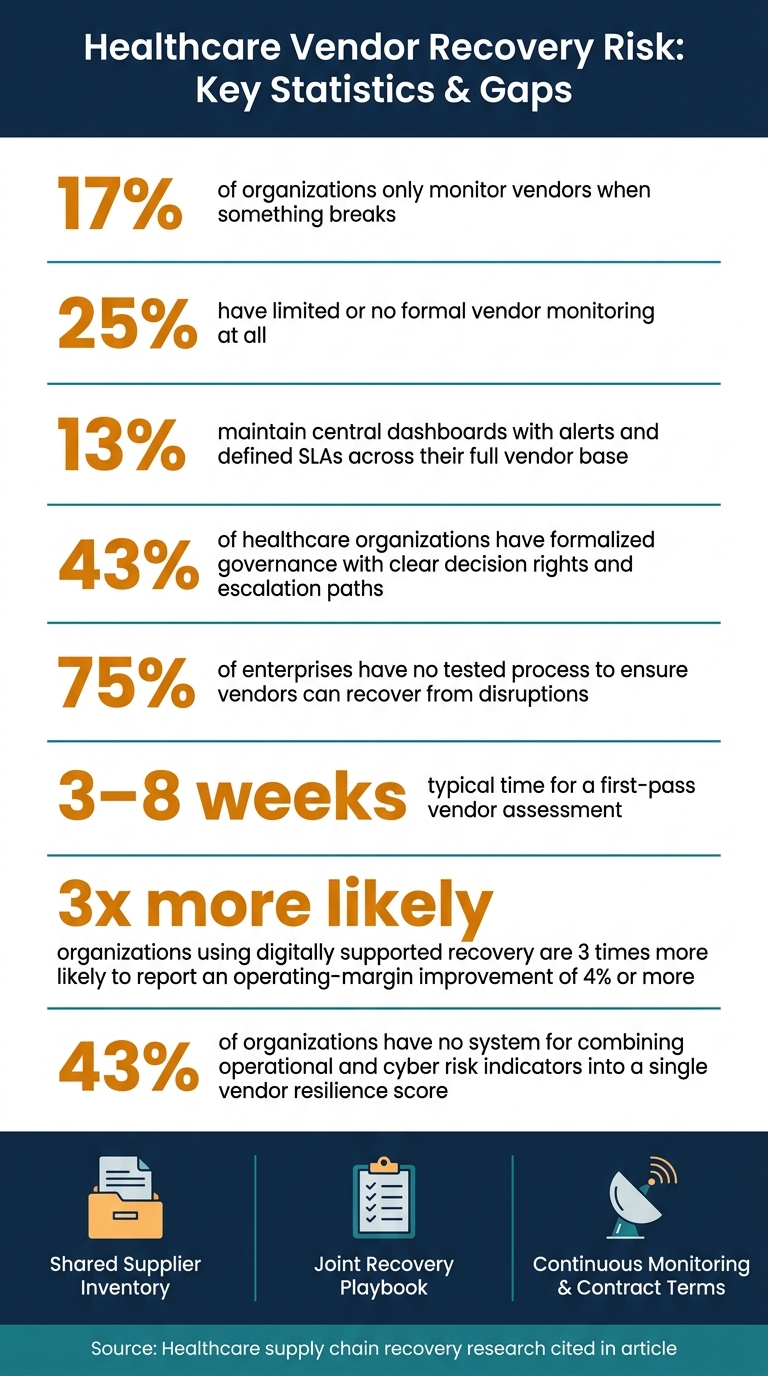
Healthcare Vendor Recovery Risk: Key Statistics & Gaps
Healthcare Supply Chain Risk Management Webinar
sbb-itb-535baee
Quick comparison
| Risk area | What goes wrong | What to put in place |
|---|---|---|
| Visibility | Hidden dependencies slow impact review and restore order | Shared supplier inventory |
| Coordination | Teams and vendors work from different plans | Joint playbooks and vendor tiering |
| Detection and contracts | Vendor trouble appears late, with weak accountability | Continuous monitoring and recovery terms |
Bottom line: if you treat supply chain risk as only a procurement issue, recovery will drag when a vendor fails. If you treat it as part of recovery planning, you have a much better shot at getting care and business services back in order.
Problem 1: Limited visibility into third-party and fourth-party dependencies
The first recovery bottleneck is visibility into who actually supports critical services.
Healthcare organizations usually know their primary vendors. But many still can't map the subcontractors and upstream dependencies behind them. That's where recovery starts to break down. The moment an incident hits, that blind spot slows impact analysis and makes it harder to set restoration priorities across every organization tied to the recovery effort.
How visibility gaps disrupt impact analysis and restoration priorities
When recovery begins, the first question is simple: what's affected?
Without a full view of vendor relationships, that answer can take hours or even days. Unmapped subcontractors create blind spots. Missing data flow maps make it tough to trace where Protected Health Information (PHI) is exposed. And if no one has a clear record showing which vendors support life-sustaining services versus elective ones, teams are left guessing about restoration order instead of working from facts.
That guesswork slows every next step. Teams struggle to decide when to activate downtime procedures, how to segment the network, and which systems should come back first. In many cases, the root issue is plain: fragmented spreadsheets and one-time onboarding reviews leave behind stale data.
The risk gets worse when fourth-party risk creates hidden failure points. A subcontractor can bring in hidden failure points through its own upstream dependencies, and those weak spots may stay hidden until recovery is already in motion.
Solution: Shared supplier inventories and coordinated assessments
The fix starts with one shared supplier inventory that stays up to date and is built around three essentials: required risk fields, standard ownership, and joint workflows.
This inventory should track:
- Vendor criticality ratings
- Recovery Time Objectives (RTOs)
- Recovery Point Objectives (RPOs)
- Integration points with clinical systems
- PHI exposure details
- Fourth-party exposures
The key point is this: treat the inventory as a recovery tool, not just a risk register.
Censinet RiskOps™ supports shared third-party and enterprise risk visibility, collaborative assessments between HDOs and vendors, and the capture of fourth-party risk exposures through AI-assisted assessment workflows.
| Approach | Recovery speed | Impact accuracy | Coordination quality |
|---|---|---|---|
| Ad hoc spreadsheets | Slow due to manual updates and fragmented ownership | Low to moderate; dependencies are often incomplete | Weak across teams and vendors |
| Centralized supplier inventory | Faster because critical data is current and accessible | Higher; dependencies and critical services are easier to map | Stronger with shared visibility and standard workflows |
Standard workflows help HDOs and vendors stay aligned after onboarding, not just during it. That shared visibility makes vendor recovery faster and better coordinated.
Problem 2: Siloed Incident Response and Weak Vendor Recovery Readiness
Shared visibility helps. But recovery still breaks down when internal teams and vendors aren't working from the same plan.
Even when dependencies are mapped, progress can stall fast if each group follows a different playbook. Cyber incident response, business continuity, procurement, and supply chain operations often run as separate functions. During a recovery event, that split creates friction across healthcare, IT, and suppliers.
"When a critical vendor goes down, your business continuity plan is only as strong as theirs." - Rochelle Clarke, Founder and CEO, Continuity Strength [2]
The issue gets worse when vendors aren't ready to recover on their side. Research shows that most enterprises still don't have a meaningful way to verify vendor recovery readiness. Many also reuse old plans or skip follow-up action altogether [2].
Where Misalignment Appears During a Real Recovery Event
Misalignment shows up in the details that matter most under pressure: hardware lead times, software licensing, certificates, and restoration priorities [1]. If procurement, IT, and vendors don't coordinate those items, recovery slows down.
And the timing problem is no small thing. Critical server components now take weeks or even months to replace, not 48 hours [1]. That's why supply-aware RTOs matter. A recovery target that ignores supply delays can fall apart the moment a part isn't available.
As Jordan Hale, Senior Editor & Cloud Resilience Strategist at Prepared.cloud, put it:
"Supply chain decisions now shape RTOs, RPOs, and recovery runbooks." [1]
Solution: Joint Playbooks, Vendor Tiering, and Collaborative Hardening
The fix is simple in concept, even if it takes work in practice: stop treating recovery like a set of separate tasks and run it as one shared operating model.
Use a single cross-organizational recovery playbook with shared triggers, communication paths, reconnection criteria, and validation steps. That gives everyone one map instead of four half-matching ones.
Risk-based vendor tiering adds structure to that playbook. Vendors should be grouped based on:
- Clinical criticality
- PHI exposure
- Dependency on patient care workflows
Those factors shape restoration order, testing depth, and the level of evidence needed to validate recovery readiness.
Testing also has to be shared, not assumed. Joint tabletop exercises, failover tests, and independent evidence such as SOC 2 or HITRUST help verify whether a vendor can actually recover when it counts. Censinet RiskOps™ supports third-party vendor risk management between HDOs and vendors, helping teams capture and validate vendor recovery evidence in a shared workflow.
The contrast below shows why integrated governance helps restore services with less delay.
| Recovery Model | Decision-Making | Clinical Alignment | Vendor Coordination | Downtime Risk |
|---|---|---|---|---|
| Siloed Response | Fragmented across IT, operations, and procurement | Inconsistent; technical actions may not match care priorities | Reactive; relies on static questionnaires | Higher due to lead-time gaps and licensing hurdles |
| Integrated Governance | Shared across defined roles and escalation paths | Strong alignment to patient care and service criticality | Proactive with shared playbooks and joint testing | Lower due to supply-aware RTOs and reserved allocations |
Problem 3: Slow Detection and Weak Contract Terms for Recovery Collaboration
Even when teams share the same playbook, things can still go sideways if vendor trouble shows up too late. Tiering suppliers helps, but only when people can spot early signs that a critical vendor is slipping.
For most healthcare organizations, that visibility just isn’t there. Many don’t realize a vendor is in trouble until daily operations are already taking a hit. 17% of organizations only monitor their vendors when something breaks, and 25% admit to having limited or no formal vendor monitoring at all [2]. On top of that, only 13% keep central dashboards with alerts and defined SLAs across their full vendor base [2].
Why Manual Monitoring and Vague Contracts Increase Recovery Risk
Manual reviews make a slow situation even slower. A first-pass vendor assessment usually takes three to eight weeks, and only 5% of organizations can wrap one up in less than a week [2]. That leaves a long stretch where teams are flying blind, especially during onboarding and contract renewal, when vendor risk is often least clear.
There’s another issue: data lives in silos. 43% of organizations have no system for combining operational and cyber risk indicators into a single vendor resilience score [2]. Procurement may track contract performance. InfoSec may watch scan results. Business continuity may collect attestations. But the full story never comes together in one place.
Then the contract itself becomes a problem. If an agreement doesn’t spell out incident notification deadlines, recovery time targets, or rules for joint testing, an organization loses much of its leverage the minute a disruption starts. 75% of enterprises have no tested process to ensure their vendors can actually recover from disruptions, and many rely on vague attestations or copy-and-paste templates instead of tested, evidence-based recovery plans [2].
The Blue Yonder disruption in November 2024 showed what that can look like in practice: without checked recovery plans and RTOs, retailers lost inventory and scheduling during peak season [2].
Solution: Continuous Monitoring and Recovery-Focused Contract Terms
The fix is simple in concept, even if it takes work in practice: pair early warning with contract terms you can enforce. Detection alone isn’t enough. If the contract has no teeth, recovery still depends on goodwill and improvisation.
Continuous monitoring gives teams a year-round view of vendor posture, critical vulnerabilities, service outages, and fourth-party risk. That helps close the detection gap and gives staff something they can act on before disruptions start showing up in clinical operations.
Contracts also need to do more than sit in a folder. They should define notification timelines, require tested recovery plans and joint exercises, and set baseline cybersecurity requirements.
| Contract model | Incident notification | Recovery accountability | Joint testing expectations |
|---|---|---|---|
| Contracts without explicit recovery terms | Often vague or delayed | Weak leverage during disruptions | Usually absent |
| Contracts with cyber and continuity obligations | Defined timelines and escalation paths | Clearer vendor responsibilities | Built into governance and review cycles |
Censinet RiskOps™ helps HDOs move this work along by streamlining assessments, summarizing evidence, logging fourth-party exposures, and routing mitigation tasks across risk, compliance, procurement, and operations.
Conclusion: Build Recovery Resilience Through Shared Visibility, Governance, and Accountability
Vendor, supplier, and contract failures all point to the same lesson: recovery is a supply chain issue, not just an IT issue. And supply chain risk isn’t just a procurement problem either. When a critical vendor goes down, recovery slows across hospitals, suppliers, and patients.
These controls only work when they function as one recovery system: visibility, governance, monitoring, and enforceable contract terms. Visibility and coordination matter. But governance is what decides whether recovery actually moves.
Shared tools can still fall apart without clear decision rights and escalation paths. Governance is the gap between awareness and recovery. Right now, only 43% of healthcare organizations report having formalized governance with clear decision rights and escalation paths [3]. Without that clarity, shared recovery plans can stall across organizations.
There’s also a clear business case. Organizations using digitally supported recovery are 3 times more likely to report an operating-margin improvement of 4% or more than those relying on ad hoc methods [3].
"Visibility alone may not accelerate recovery without decision-ready data and governance." [3]
For U.S. healthcare leaders, the takeaway is simple: stop treating supply chain risk as a procurement problem and start treating it as a core recovery capability. Build it into governance structures. Fund it as an operational priority. Test it the same way you’d test any other part of your continuity plan.
Censinet RiskOps™ supports shared vendor-risk visibility and coordinated response.
FAQs
How do we identify hidden fourth-party risks?
Start with a central inventory of vendors and suppliers. It should track services, data access, system dependencies, contract terms, and security posture, not just for IT vendors.
From there, keep a living register of subcontractors and upstream suppliers. Map each one to the data and services they touch. Then tier high-impact fourth parties based on risk, so your team knows where to look first.
For the suppliers that matter most, go deeper. Check their controls through tighter due diligence and continuous monitoring instead of treating every fourth party the same.
Which vendors should be prioritized for recovery planning?
Prioritize vendors based on how much they matter to core clinical services and whether they could become a single point of failure. This kind of risk-based tiering helps teams spend limited time and budget on the vendors that could do the most harm to patient care and daily operations if something goes wrong.
For example, a vendor that supplies sterile implants should sit far above one that delivers office supplies. Censinet RiskOps™ can help centralize vendor inventories, spot dependencies, and automate risk monitoring.
What contract terms matter most during a disruption?
During a disruption, contracts should focus on keeping operations running, not rushing to terminate the deal.
The key clauses are business continuity and disaster recovery terms. These should spell out who is responsible for restoring service, what each party needs to do, and who is accountable if things go off track.
It also helps to include rights around substitution and cooperation, room for volume shifts, and terms that deal with legal or tariff changes. On top of that, audit rights and access to information matter because they let you check compliance and confirm that data security standards are being met.
