
If you want to cut healthcare vendor risk, start by cutting vendor sprawl. When 90% of breaches involve a third party, when health systems may work with 1,000+ vendors, and when the Change Healthcare attack exposed PHI for 1 in 3 Americans, the main problem is no longer just inside your network.
I’d boil the article down to this:
- Find every vendor - including shadow tools, old contractors, and subcontractors
- Map who can touch PHI and how data moves
- Rank vendors by risk, not by contract size or name recognition
- Cut duplicate tools and shut down stale access
- Lock in clear contract terms for breach notice, subcontractors, encryption, and PHI return or destruction
- Make offboarding provable, not informal
- Use one system to track inventory, reviews, fixes, and closeout
Here’s the core idea in plain English: a signed BAA does not mean a vendor is safe. It only sets legal duties. If you don’t know which vendors exist, what access they have, where data sits, or whether access was removed at contract end, your risk stays high.
A few points stand out:
- Hidden vendors often show up through accounts payable, SSO logs, firewall traffic, and endpoint records
- Health systems often find 30% to 50% more vendors than internal lists show
- Fourth parties matter because your vendor’s subcontractor can still expose your PHI
- The damage is not small: the average healthcare vendor-related breach cost is $4.88 million
If I were putting the article into one simple action plan, it would be:
- Build one usable vendor inventory
- Add data, access, owner, contract, and offboarding details
- Tier vendors by PHI exposure, care impact, access level, and recovery dependency
- Review high-risk vendors with proof, not just questionnaires
- Remove overlap and old access
- Standardize intake and contract rules
- Track fixes and offboarding in one place
| Focus Area | What to Do | Why It Matters |
|---|---|---|
| Inventory | List vendors, tools, integrations, and data flows | You can’t control what you don’t know about |
| Shadow Vendor Search | Check AP, SSO, network, and endpoint data | Hidden vendors often have the weakest review |
| Risk Tiering | Rank vendors by PHI, access, and care impact | Not every vendor needs the same depth of review |
| Access Control | Limit vendor access and remove stale credentials | Old access is a common path to breaches |
| Contracts | Standardize BAA and security terms | Mixed terms create gaps across the vendor base |
| Offboarding | Verify PHI return/destruction and revoke access | Contract end is a common failure point |
Bottom line: I’d treat vendor reduction as a direct way to lower breach exposure, lower chaos, and protect patient care. The article’s message is simple: fewer vendors, less access, better proof, tighter follow-through.
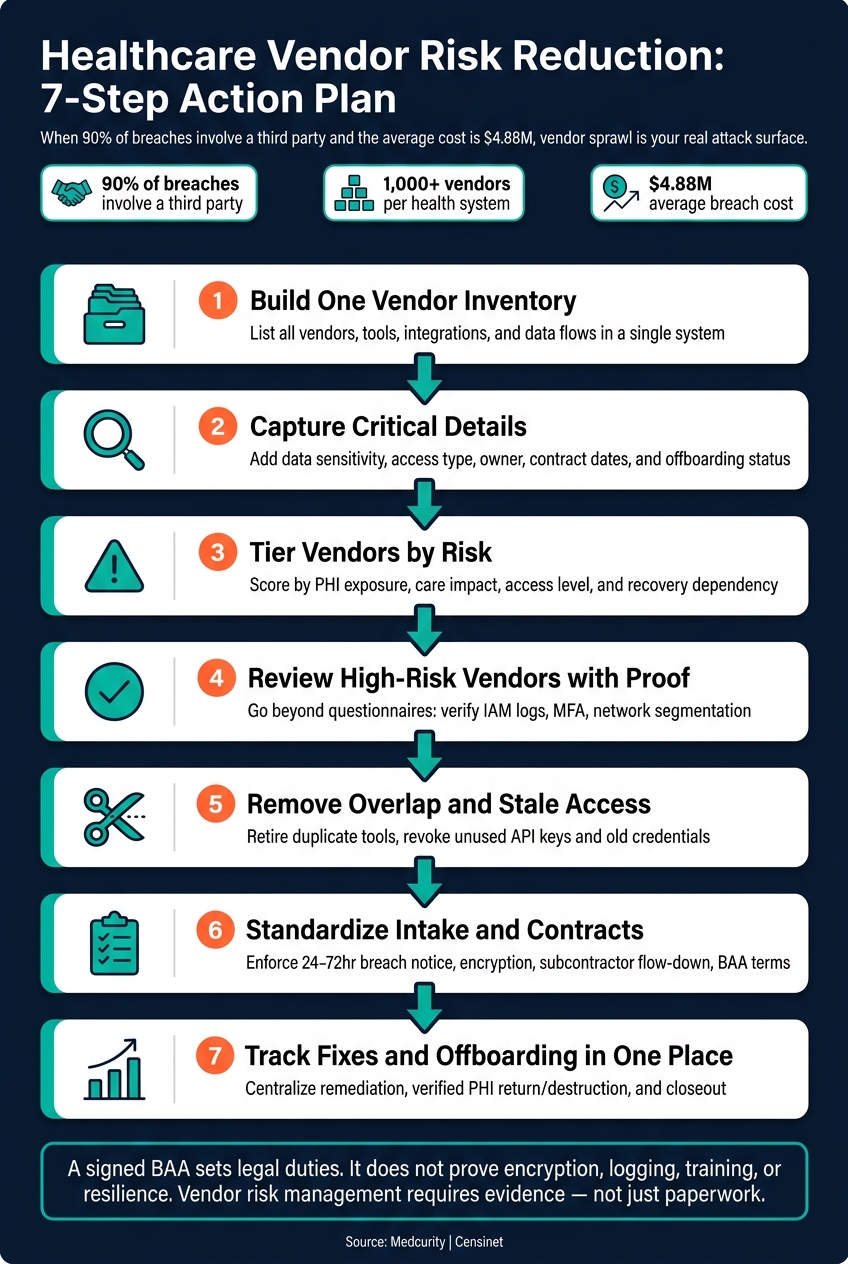
Healthcare Vendor Risk Reduction: 7-Step Action Plan
Build a usable inventory of vendors, tools, integrations, and data flows
Build a vendor inventory that shows external attack paths, not just a list of contract names. A basic vendor list might tell you who signed a BAA. It usually won't tell you where exposure sits.
Before you touch consolidation or access controls, you need an inventory you can actually use for risk decisions.
Capture the details that reveal real exposure
| Field Category | Key Data Points to Capture |
|---|---|
| Identity & Ownership | Vendor name, product name, business owner, department, beneficial ownership / parent company |
| Data & Privacy | PHI sensitivity level, volume of records, data residency, active BAA status, subcontractors |
| Technical Access | Integration type (API, HL7), remote access method, MFA enforcement, SSO integration status |
| Clinical & Ops | Business owner / service dependency, SLA requirements, disaster recovery/contingency plan status, SBOM/MDS2 for devices |
| Lifecycle Status | Contract renewal date, last assessment date, status (Active, Legacy, Duplicative, Offboarding) |
Two fields get missed all the time, and they matter a lot.
Data residency matters because where data is stored can affect compliance with state and international privacy laws. You also need to track PHI disposition at contract end. Whether data is returned or destroyed is a HIPAA requirement, not a courtesy [2].
If you're dealing with connected medical devices, track MDS2 and SBOM records too. That helps surface supply-chain weaknesses that questionnaires often miss [2].
Once the inventory is in place, you can start separating routine vendors from the ones that carry more risk.
Find shadow vendors through finance, identity, and network signals
The gap between your approved vendor list and your actual vendor footprint is where trouble tends to hide. Hidden vendors are often the least reviewed, the least controlled, and the hardest to offboard.
To find them, check four sources:
- Accounts payable records to spot vendors getting paid without going through security review
- SSO app catalogs and workforce access logs to see which SaaS tools people are using, even if IT never approved them
- Firewall and proxy logs to find outbound connections to services that never showed up in procurement
- Endpoint inventories to surface more unmanaged tools [2]
Then cross-reference what you find. If a vendor appears in AP but is missing from SSO, procurement, or security review records, treat it as a top-priority shadow vendor.
Table: Known vendors vs. shadow vendors
| Feature | Known (Inventoried) Vendors | Shadow (Unmanaged) Vendors |
|---|---|---|
| Data Visibility | Full mapping of PHI and data flows | Unknown data types and volumes |
| Security Review | Documented safeguards and assessment evidence | No formal security or privacy assessment |
| Access Oversight | Managed via SSO and MFA enforcement | Often accessed via legacy remote access portals |
| Contract Coverage | Active BAA and defined breach timelines | No BAA; high regulatory liability |
| Remediation | Structured path for fixing gaps | Difficult to identify or enforce fixes |
Shadow vendors aren't just unknown risk. They're risk with no clear fix. You can't offboard a vendor you don't know exists. And you can't enforce security terms on a contract that was never signed.
"A BAA is a legal instrument. Vendor risk management is an evidence instrument. They answer different questions." - Medcurity [1]
Use the inventory to tier vendors by criticality and decide how much oversight each one needs.
Tier vendor criticality and identify where sprawl creates real risk
Once you have the inventory, the next step is simple: rank vendors by the damage they could cause.
Not every vendor carries the same weight. A billing partner with PHI access, an EHR vendor, and a shredding service should not go through the same review path. Treating them the same wastes time and hides the vendors that can do the most harm.
Apply a healthcare-specific criticality model
Score vendors based on the factors that matter in healthcare: PHI exposure, patient-care impact, access level, regulatory scope, recovery dependency, and concentration risk. Include fourth-party dependencies in that score too. If a subcontractor is weak, that can push the vendor into a higher tier.
Assess controls beyond questionnaires alone
Questionnaires show what a vendor says. They don't show what the vendor can prove.
The February 2024 Change Healthcare breach showed the cost of weak remote access controls: national claims disruption and PHI exposure at scale. [2]
For critical vendors - EHR platforms, connected medical devices, and core cloud platforms - go past self-reported answers. Review actual IAM logs, evidence of network segmentation, and privileged access documents. For medical devices, ask for an MDS2 and SBOM so you can spot component-level vulnerabilities that a questionnaire may miss.
Match the review depth to the risk tier:
- Critical vendors: full evidence reviews
- High-risk vendors: targeted verification
- Moderate- and low-risk vendors: questionnaires and BAA checks
Table: Risk tiers and required oversight levels
| Risk Tier | Vendor Examples | Review Depth | Reassessment Cadence |
|---|---|---|---|
| Critical | EHR (Epic/Cerner), connected medical devices, core cloud platforms | Full architecture review, SBOM/MDS2, IAM log review, public-source screening | Continuous monitoring + annual deep-dive |
| High-Risk | Revenue cycle/billing, diagnostic labs, IT managed services | SOC 2 Type II review, BAA verification, MFA/encryption evidence | Annual + continuous monitoring |
| Moderate | Telehealth platforms, clinical staffing agencies, transcription tools | Standard questionnaire, BAA verification | Every 18–24 months |
| Low-Risk | Shredding services, non-clinical supplies, basic SaaS utilities | Basic self-certification, BAA if PHI is involved | At contract renewal |
Use these tiers to cut duplicate tools, restrict access, and standardize contract terms.
sbb-itb-535baee
Reduce vendor sprawl through consolidation, access control, and standard requirements
Tiering shows you where the risk sits. The next step is simpler: cut duplicate tools, trim access, and set firm vendor terms so the mess doesn’t creep back in.
Remove duplicate tools and retire legacy vendors
Use your tiering model to go after duplicate tools, stale access, and mismatched contract terms. Start by mapping vendors by function. Then weigh each one’s security posture against its clinical or business value. If two vendors do the same job, keep the lower-risk option and retire the other.
Business associates are still a leading source of reportable healthcare breaches. That’s why old billing partners and IT contractors deserve a hard look. If their access no longer fits what they do, end the relationship or cut access down to the minimum needed. Fewer overlapping vendors means a smaller attack surface and less chaos to manage.
Once duplicate tools are gone, tighten access for the vendors that stay.
Limit vendor access and make offboarding verifiable
Least-privilege access is a must. Vendors should only be able to see the PHI they need to do their job.
For active vendors, switch from always-on VPN access to time-limited remote support sessions. Remove shared accounts. Review API keys on a set schedule, and revoke any that are unused or tied to expired contracts. For critical and high-risk vendors, don’t just take their word on MFA. Verify that it’s in place.
Offboarding is where access control often falls apart. Residual PHI access after offboarding is one of the easiest ways sprawl turns into breach risk [2]. A documented shutdown workflow should cover:
- VPN and remote desktop revocation
- API key termination
- BAA closeout
- Verified PHI return or destruction certification
Verbal assurance does not meet HIPAA requirements.
Those revocation steps should live in the contract itself, so offboarding is enforceable instead of ad hoc.
Standardize contracts, security requirements, and intake rules
Inconsistent contracts are one of the main ways new sprawl shows up with extra risk. When each department negotiates its own vendor terms, the result is all over the map: different breach notification timelines, fuzzy subcontractor duties, and uneven encryption or logging rules across the vendor base.
Standardize BAA terms so every vendor works from the same baseline. That should include a clear breach notification window - ideally 24 to 72 hours - plus explicit permitted PHI uses, subcontractor flow-down duties under HITECH, and required encryption at rest and in transit [2].
A BAA defines obligations; it does not prove encryption, logging, staff training, or resilience.
Standardized intake rules also stop departments from bringing in vendors before review.
Build a repeatable reduction program with Censinet
After inventory cleanup, tiering, and access cuts, the job shifts from cleanup to control. The challenge is simple: as your vendor base grows, you still need inventory, assessments, and remediation to keep moving without getting stuck.
Use Censinet to centralize inventory, assessments, and remediation
Use Censinet RiskOps™ to bring vendor inventory, assessments, and remediation into one workflow. You can map clinical, operational, medical-device, AI, and fourth-party relationships, then run standardized assessments and assign findings to the right owners. Once shadow vendors are identified and tiers are in place, the program needs a single path for reassessment, remediation, and offboarding.
Censinet AI™ cuts manual effort by helping vendors complete questionnaires faster, summarizing evidence, flagging missing HIPAA clauses or safeguards, and routing findings to reviewers. Your team still makes the final call. Findings are assigned to owners and tracked through closure.
Table: Spreadsheet-based vendor risk management vs. Censinet-enabled operations
The difference comes down to this: spreadsheets can log vendor risk, but they don't push it toward closure.
| Capability | Spreadsheet-Based VRM | Censinet RiskOps™ |
|---|---|---|
| Inventory Completeness | Manual; often missing 30–50% of vendors [2] | Centralized catalog with automated discovery signals |
| Assessment Speed | Weeks or months of back-and-forth | Days or hours via AI-assisted completion and routing |
| Fourth-Party Visibility | Limited or nonexistent | Explicit mapping of subcontractor dependencies |
| Remediation Tracking | Static spreadsheets with no assigned ownership | Real-time tracking with automated escalation and owners |
| Scalability | Breaks down as vendor count grows | Built for enterprise scale |
| Ongoing Oversight | Annual, point-in-time reviews | Continuous monitoring and risk comparison by tier |
Conclusion: Shrink exposure by cutting risky external relationships
A reduction program only works if you can run it again and again without it falling apart.
Vendor sprawl is a security problem. Most serious healthcare breaches involve third parties, and many hospitals are tied to 1,000+ vendors. That means a big share of the attack surface sits outside your walls.
A complete inventory shows what's connected. Criticality tiering shows where the risk is. Consolidation, access minimization, standardized contracts, and verifiable offboarding reduce that risk in ways you can track. And a program that automates evidence collection, tracks remediation, and keeps watch over time is far less likely to buckle as the vendor base changes.
The average cost of a healthcare vendor-related breach is $4.88 million [2]. Cutting sprawl isn't just about compliance. It's one of the most direct ways security and risk leaders can protect patient care and bring that number down.
FAQs
How do I find shadow vendors fast?
Look past procurement records. They often miss active third-party relationships, especially when teams buy and run tools on their own.
A better approach is to cross-check a few sources side by side:
- IT access logs to see which outside tools people are signing into
- Accounts payable records to catch nonstandard payments
- Interviews with department heads to find SaaS tools managed outside IT
Then add network traffic analysis and application discovery tools to spot unauthorized software or devices. That gives you a clearer picture of what’s in use today, not just what was bought through the usual process.
It also helps to set up a centralized request hub. That way, future tools go through a formal security review before they’re used across the business.
Which vendors should be reviewed first?
Start with critical vendors that have a direct link to patient care or broad access to PHI. That usually includes EHR and clinical software vendors, main cloud or SaaS platforms that host EHR or imaging workloads, connected medical device and remote monitoring providers, and telehealth platforms.
You should also move revenue-cycle, billing, and claims vendors near the top of the list if they process PHI or support clinical operations and payments. The same goes for clinical staffing agencies with privileged access.
A simple way to sort this is vendor tiering based on:
- PHI exposure
- Access level
- Clinical criticality
What should vendor offboarding include?
Vendor offboarding needs to be proactive, automated, and time-bound so former vendors don’t keep access longer than they should.
Set a clear SLA for access removal. In most cases, that means within 24 hours for standard offboarding and within 2 hours for emergency revocations. That kind of speed matters. If access lingers, even for a day or two, it can leave the door open to unauthorized access.
At a minimum, the offboarding process should cover a few core actions:
- Deprovision accounts, rotate secrets, and revoke API keys
- Validate removal through logs or audits and keep evidence
- Ensure secure return or destruction of protected health information
- Maintain offboarding records for at least six years
This work shouldn’t rely on memory or a last-minute email chain. It should run through a set process that leaves a paper trail and makes it easy to prove that access was removed on time.
