
If your health system can’t show who owns each connected system, what data moves where, which controls are in place, and which gaps are due by when, you’re not ready for 2800.
I read this article as a simple message: 2800 is not just a device or IT standard. It’s a system-wide way to manage connected care over time. The work comes down to four things:
- Ownership: who is accountable
- Controls: what protections are in place
- Evidence: what records prove it
- Remediation: what gets fixed, by whom, and by what date
The article also makes the risk plain. Connected tools like EHRs, infusion pumps, ventilators, middleware, cloud apps, and healthcare supply chain security challenges can fail in chains, not in isolation. And with about half of healthcare breaches and ransomware events tied to third parties, vendor access has to be near the top of the list.
If I had to boil the article down into a short action plan, it would be this:
- Build an inventory of systems, apps, devices, interfaces, vendors, and ePHI flows
- Assess controls like MFA, segmentation, patching, logging, backups, encryption, and access rights
- Rank gaps by patient-safety impact and likelihood of exploitation
- Assign owners and due dates across IT, security, clinical engineering, privacy, compliance, and business leaders
- Keep proof such as risk registers, diagrams, contracts, exceptions, tickets, logs, and review records
- Review it on a set cycle: daily or weekly for dashboards, monthly for leaders, and quarterly for the board
A few details stand out. The article says many health systems still have incomplete asset lists, undocumented data flows, uneven patching, and fuzzy ownership. It also points to a short list of common high-risk gaps: vendor remote access without MFA, unsegmented interface engines, old device firmware, missing log ownership, and systems left out of backup testing.
Here’s the plain-English takeaway: 2800 means treating interoperability like a living risk program, not a one-time setup. You need a scoped inventory, a mapped ePHI flow, a risk register with named owners, contract terms for vendors, a governance path for risk acceptance, and a stored record of what changed, when, and who approved it.
That’s the job the full article walks through.
Risk Management Under the HIPAA Security Rule
sbb-itb-535baee
The Core Problem: Most Health Systems Lack a Complete Interoperability Risk Picture
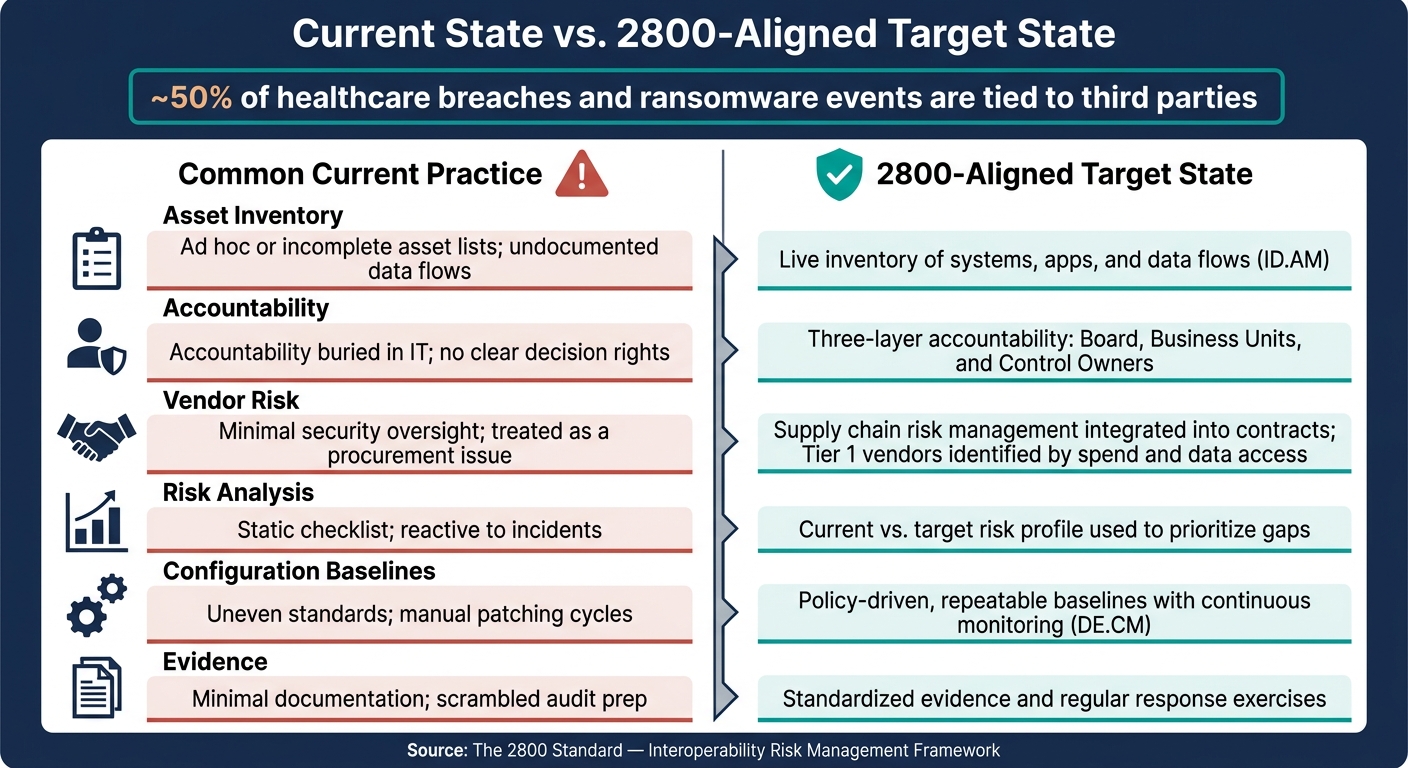
Current State vs. 2800-Aligned Target State: Interoperability Risk Management
Before a health system can line up with 2800, it needs a clear view of current interoperability risk. For many organizations, that starting point is far more fragmented than leaders expect.
Asset inventories are often incomplete. Data flows between systems may never be documented. Security baselines can vary from one department to the next. And when something fails, no one is quite sure who owns the issue. Put all of that together, and the actual risk picture gets buried.
Where Current Practice Usually Breaks Down
The weak spots usually show up in the same places.
Integrations and vendor access are often added without a formal risk review. As a result, teams lose sight of what connected systems can access and who is on the hook for that risk.
Patch and configuration standards are another common problem. One department may follow a strict patching schedule, while another relies on manual cycles with no enforcement. IT, security, and clinical engineering teams may each keep their own records, with no shared source of truth when an incident or audit hits. Ownership across integrated environments also gets fuzzy, and the work is pushed into IT instead of being treated as a shared operating duty.
Here is what that gap looks like in practice.
Current State vs. 2800 Target State
| Area | Common Current Practice | 2800-Aligned Target State |
|---|---|---|
| Asset Inventory | Ad hoc or incomplete asset lists; undocumented data flows | Live inventory of systems, apps, and data flows (ID.AM) |
| Accountability | Accountability buried in IT; no clear decision rights | Three-layer accountability: Board, Business Units, and Control Owners |
| Vendor Risk | Minimal security oversight; treated as a procurement issue | Supply chain risk management integrated into contracts; Tier 1 vendors identified by spend and data access |
| Risk Analysis | Static checklist; reactive to incidents | Current vs. target risk profile used to prioritize gaps |
| Configuration Baselines | Uneven standards; manual patching cycles | Policy-driven, repeatable baselines with continuous monitoring (DE.CM) |
| Evidence | Minimal documentation; scrambled audit prep | Standardized evidence and regular response exercises |
This comparison frames the assessment work ahead. Next comes the hard but necessary part: mapping systems, data flows, and owners before any remediation begins.
Step 1: Assess Your Controls, Risks, and Gaps
A structured assessment should give leadership three clear outputs they can act on:
- A scoped inventory
- A documented electronic protected health information (ePHI) flow map
- A prioritized risk register with named owners
By the end of this step, leaders should be looking at named owners, clear gaps, and deadlines they can use.
Build the Interoperability Inventory and Data Flow Map
Start with scope. List every environment where ePHI is created, received, transmitted, or stored. That includes EHRs, connected devices, interface engines, portals, cloud apps, identity systems, and vendor connections. Include batch transfers, failover paths, remote support sessions, and third-party hosting too.
For each asset in scope, document:
- The owner
- The function
- The data types handled
- The connectivity path
- The vendor or internal support model
- Whether it is internet-facing or internal-only
Then turn that inventory into a data flow map. Trace ePHI from its origin through each transfer, transformation, storage location, and exit point. Mark every handoff between internal networks, cloud providers, and vendor access paths. Those handoffs are the spots where controls need to be checked, not just taken for granted.
Assess Security Baselines and Known Exposure Areas
Once you have the inventory and data flow map, review each system against a defined control baseline. The review should cover identity and access management, least privilege, multi-factor authentication, patching cadence, network segmentation, encryption in transit and at rest, audit logging, backup testing, endpoint protection, and vulnerability management.
Use a standard format that records threats, vulnerabilities, likelihood of exploitation, impact, existing controls, and residual risk.
Be specific about control status. Note whether controls are fully implemented, partly implemented, inconsistent across sites, or missing. Partial coverage can hide risk in plain sight. A vendor connection may support clinical work just fine but still lack MFA. A cloud-based clinical app may be running with no clear logging owner. Those issues often stay quiet until something breaks.
Put extra focus on vulnerabilities with the highest operational effect: externally reachable interfaces, weak segmentation between clinical and administrative networks, unpatched middleware, unsupported operating systems, and single points of failure in interface engines.
Following FDA guidance, use likelihood of exploitation - not just technical severity - as a scoring factor, paired with patient-safety impact. [1][3] In plain terms, a flaw in a lab interface that could delay critical results should rank above a similar gap in a low-use administrative integration, even if both look the same on a standard severity scale.
Document and Prioritize Gaps
The assessment should end with a risk register. Each entry needs to be specific enough that a compliance officer, a clinical operations lead, and a technical owner all know what part belongs to them.
| Asset or Workflow | Observed Gap | Clinical or Operational Impact | Risk Owner | Target Remediation Timing |
|---|---|---|---|---|
| Vendor remote access | Lacks MFA | Unauthorized access to clinical systems | CISO / Vendor Management | Immediate |
| Interface engine | Not isolated from the administrative network | Ransomware lateral movement risk | IT Security | Near term |
| Connected device | Running outdated firmware | Device manipulation; patient safety risk | Clinical Engineering | Near term |
| Cloud clinical app | No clear logging owner | Delayed incident detection | IT / App Owner | Next planning cycle |
| Interoperability systems | Excluded from backup testing | Extended downtime during an incident | IT Operations | Next planning cycle |
The register should also include the threat scenario, current control state, residual risk rating, evidence references, dependencies, and whether the risk can be accepted for a short period, mitigated, or escalated right away.
It helps to separate urgent fixes from longer-term work. That way, leadership can assign deadlines and set a clear remediation path.
Once the gaps are documented, Step 2 turns them into governance, vendor, and remediation action.
Step 2: Put 2800 Into Practice Through Third-Party Risk, Governance, and Remediation
With the risk register done, it's time to move. A gap list with no owners and no due dates isn't a plan. Step 2 turns documented risks into work people can actually execute across IT, security, clinical engineering, privacy, compliance, and operations. The first place to act is vendor and supply chain risk, because that's where one weak link can hit a lot of systems at once.
Close Third-Party and Supply Chain Gaps
Third parties are often the shortest path from an interoperability gap to a patient-safety event. That's why vendor exposure should be first on the list.
Every vendor that touches ePHI needs a current record in one central inventory. That record should include data types, key integration points, hosting model, fourth-party dependencies, and the security evidence already on file. Fourth-party exposure needs its own spotlight. If one cloud platform sits underneath dozens of clinical apps, that concentration risk should be easy to see in the inventory, not buried across separate vendor files.
BAAs and contracts should be checked against the gaps found in Step 1. For critical vendors, agreements should require:
- Incident notification within 24–48 hours of discovery
- MFA and session logging for all remote access
- Advance notice of any material interface or API changes
- Defined recovery expectations for critical services
Remote access is a common weak point. Each vendor connection should use a unique identity, time-limited access windows, and logs tied to a specific session and change ticket. In plain terms, that means no shared vendor account with always-on VPN access and no MFA.
A centralized risk workflow helps keep vendor records, integrations, ownership, and reviews in one place.
Once vendor exposure is visible, the next move is clear: decide who has the authority to act on it.
Assign Ownership and Decision Rights
2800 alignment is an enterprise operating model. It needs a governance model with named owners across teams. A practical setup usually includes an executive sponsor, often the CIO, CISO, or Chief Risk Officer, backed by a multidisciplinary risk governance committee.
From there, ownership should be plain:
- The CISO owns the security control environment
- The clinical engineering lead owns networked medical devices and device gateways
- The CMIO or service line leader owns clinical applications and integrations
- IT operations owns technical control implementation and remediation execution
- Privacy and compliance leads track BAA obligations and make sure exceptions don't create regulatory exposure
Two decisions need to be written down: who can accept risk, and who must fix it. For high and critical risks, acceptance authority should sit with the executive sponsor or a formal risk governance committee, not with individual system owners. Exceptions should be time-bound, tied to compensating controls, and stored in a central register with a scheduled re-review date. That way, risk decisions stay traceable.
Set a Remediation Plan With Measurable Timelines
Each gap now needs three things: an owner, a control action, and a deadline. Here's how common issue types map to an owned remediation plan:
| Issue Type | Recommended Owner | Priority | Interim Control | Timeline |
|---|---|---|---|---|
| Unsupported device OS or firmware | Clinical Engineering | Critical | Network isolation, enhanced monitoring | Immediate |
| Vendor remote access without MFA | CISO / Vendor Management | Critical | Suspend or restrict access until MFA is enabled | Immediate |
| Missing audit logs on clinical app | IT / Application Owner | High | Manual review cadence until logging is active | Near term |
| Undocumented interface or API change | IT Security / Change Management | High | Freeze undocumented changes until reviewed and documented | Near term |
| BAA missing incident reporting clause | Privacy / Legal | High | Interim notification agreement in writing | Next contract cycle |
| No DR plan for critical integrated vendor | IT Operations / Vendor Management | Medium | Manual downtime procedures documented | Next planning cycle |
Prioritize based on impact on patient safety and exploitability, not just technical severity. A missing log owner on a high-volume lab interface may need more attention than a patch issue on a low-use administrative system, even if the raw vulnerability scores point the other way.
Step 3: Build the Evidence and Monitoring Needed for Compliance
A remediation plan gets you only halfway there. Health systems also need dated proof, traceable decisions, and steady oversight that show the work happened - and that it still stands up.
Once owners and deadlines are in place, the next job is proving three things: what changed, when it changed, and who reviewed it.
Maintain the Evidence Health Systems Will Actually Need
OCR's Phase 2 audits have repeatedly flagged weak risk-analysis documentation. In many cases, the issue isn't that teams skipped the work. It's that they couldn't pull the proof fast enough during an audit or incident review.
For 2800-aligned programs, a practical evidence library should cover ten core categories:
| Evidence Category | What to Retain |
|---|---|
| Risk analyses and risk registers | Threat/vulnerability assessments, likelihood and impact scores, treatment decisions |
| Asset inventories | Interoperable systems, APIs, medical devices, third-party platforms, data classifications |
| Integration and data flow diagrams | How PHI moves across systems, vendors, and networks |
| Control baselines | Implemented controls per system, mapped to 2800, HIPAA Security Rule, and NIST |
| Vendor and third-party assessments | third-party risk assessment questions, SOC 2/HITRUST reports, BAAs, penetration test summaries |
| Remediation records | Tickets, project plans, closure evidence, owners, and timelines |
| Policy and standard approvals | Governance minutes and sign-offs showing formal adoption and review |
| Exception decisions | Rationale, compensating controls, expiration dates, and re-review schedules |
| Incident logs and post-incident reviews | Events tied to affected interoperable systems, lessons learned, control improvements |
| Monitoring outputs and dashboards | Alerts, trend reports, compliance scores showing continuous oversight |
HIPAA requires keeping compliance documentation - including risk analyses, policies, procedures, and BAAs - for six years from creation or last effective date, whichever is later. [2][5][6][7][8][9][10][11] That six-year retention rule covers cybersecurity and interoperability records, not only clinical records. So set retention rules and version history in the system that stores this evidence from day one.
Use Dashboards and Review Cycles to Keep 2800 Active
Use the same risk register from remediation as the source for ongoing review and reporting.
Check operational dashboards daily or weekly. Review executive summaries monthly. Bring updates to the board quarterly. The focus should stay on overdue remediation, new integrations, third-party findings, patient-safety impact, and regulatory exposure. [4]
A centralized risk platform helps keep each risk assigned, dated, and logged. When a governance committee reviews a dashboard and makes a decision, that decision should be recorded. That's what creates the audit trail behind compliance. [12][13]
The 2800 Action Plan in Five Steps
In practice, 2800 comes down to one operating model: scope, assess, govern, remediate, and keep evidence current.
This is bigger than a compliance checkbox. The point is to protect patients by making sure the people, systems, and vendors involved in care don't become the weak link in an interconnected environment.
FAQs
What does 2800 require first?
First, health systems should treat AI governance as an enterprise risk issue, not just a technical task. In plain terms, this belongs with board and executive leadership, not only the IT team. That means giving specific leaders ownership and writing down how decisions get made, how work moves through the system, and where issues get escalated for both clinical and operational AI use cases.
Then start with the basics that tend to cause the biggest headaches if they're skipped: third-party risk, supply chain security, and IT governance. After that, build an inventory of AI use cases so you can map controls across the full lifecycle, from procurement to deployment to monitoring.
Who should own 2800 work?
2800 work should be owned as an enterprise risk, not just an IT responsibility. The Board should provide strategic oversight and approve risk appetite, while executive leadership is responsible for putting that direction into action.
Ownership also needs to be clear across security, procurement, legal, compliance, privacy, clinical operations, and clinical engineering. Each group should have defined duties, along with clear escalation paths for issues that need attention fast.
How do we prove 2800 compliance?
To prove 2800 compliance, you need to show that your cybersecurity controls are active, traceable, and applied the same way over time. This isn’t a one-and-done exercise. Compliance is continuous, so keep your records in one central, audit-ready place.
Your evidence should include:
- executive approvals and sign-offs
- consent, privacy, and bias-mitigation records
- remediation tracking with owners and due dates
- monitoring logs, audit trails, contracts, risk tiering, and version history
The goal is simple: if an auditor asks how a control was approved, monitored, updated, or fixed, you should be able to point to the record right away.
