
Cybersecurity becomes a COO issue the moment care slows down. When ransomware or a vendor outage hits, hospitals can lose 17% to 24% of volume in the first week, revenue can drop by about 40%, and care can shift to paper for days.
If I were summarizing the article in one plain idea, it would be this: the goal is not just to restore systems - it is to keep care and cash moving while systems are down.
Here’s the short version:
- Clinical continuity means keeping patients moving through the ED, OR, ICU, clinics, and discharge even during system outages.
- Cyber events hurt more than IT. They can lead to ambulance diversion, canceled procedures, delayed medication workflows, and billing slowdowns.
- The COO needs a different view than the CISO or CIO. I would focus on:
- maximum tolerable downtime
- canceled cases per day
- backlog growth
- manual work error risk
- time to restore key workflows
- Main failure points usually show up first in:
- EHR access
- scheduling and admissions
- connected devices
- third-party vendors
- claims and charge capture
- The article’s main fix is simple:
- set clear downtime limits
- build unit-level downtime playbooks
- define COO escalation triggers
- map vendor and device dependencies
- use shared governance across IT, clinical, finance, and compliance
A few numbers make the case fast:
- 44.4% of ransomware attacks on U.S. healthcare groups disrupted care delivery
- 41.7% caused electronic system downtime
- 10.2% led to canceled scheduled care
- 4.3% triggered ambulance diversion
- Downtime has averaged 17 to 19 days per incident in U.S. healthcare
- Estimated downtime cost can reach about $1.9 million per day
What I take from this article is clear: COOs should treat cyber risk as a care-delivery and revenue problem first, and a tech problem second. That shift changes what gets measured, who makes decisions, and when incident command starts.
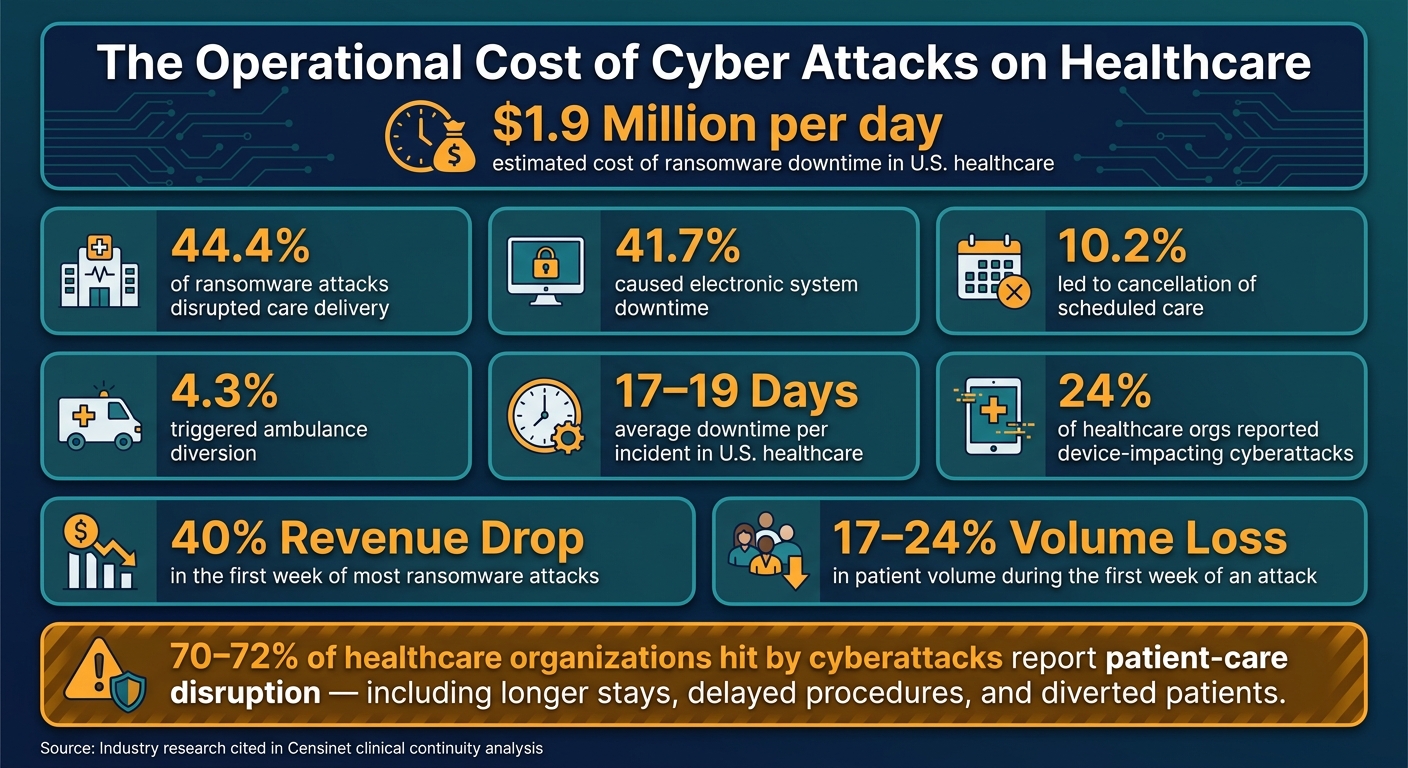
Cyber Attack Impact on Healthcare Operations: Key Statistics
Tips for Health Care Facilities: Cybersecurity Incident Preparedness and Response
sbb-itb-535baee
The problem: an IT-centric cyber model misses the operational impact
A COO does not need a security scorecard. The COO needs to know which workflows break first, how long care can keep moving, and when to escalate. Most cybersecurity programs focus on whether systems are secure and compliant. For continuity, that misses the mark.
When a cyber event lands, the COO needs operational answers fast. Technical dashboards rarely give them.
That disconnect shows up in three places: ownership, metrics, and escalation.
The table below shows the decision gap:
| Dimension | IT-Centric View | Clinical Continuity View |
|---|---|---|
| Ownership | CIO/CISO; security and compliance teams | COO jointly with CIO/CISO and clinical leaders |
| Primary metrics | Patch compliance, vulnerability counts, phishing rates, endpoint coverage | Canceled cases, patient backlog, max tolerable downtime per service line, days in accounts receivable |
| Investment logic | Reduce breach likelihood; meet regulatory requirements | Protect throughput, preserve revenue, enable rapid workflow recovery |
| Escalation triggers | Severity scores, compromised endpoints, threat indicators | OR capacity offline, ED boarding time, AR days exceeding target thresholds |
| Recovery priorities | Restore systems by technical architecture or security risk | Restore workflows by clinical and financial criticality |
Where cyber failures hit operations first
Cyber failures do not hit every part of a hospital at the same pace. They usually strike the most dependent workflows first, especially where care relies on a single system or vendor.
EHR downtime is often the first operational blow. Orders stop. Charting shifts to paper. Medication administration loses automated checks. Discharge documentation slows down. Then the pileup starts: coding and billing fall behind, and days in accounts receivable climb.
The same thing happens when ransomware hits scheduling and admissions systems. Surgical schedules, clinic templates, and bed management get thrown off, forcing leaders to decide in real time which procedures to cancel or delay by service line. The Change Healthcare cyberattack showed how a third-party claims clearinghouse outage can affect millions of claims per day, strain revenue cycle teams, and disrupt revenue for weeks [5][11].
Containment steps can create their own operating strain. When medical devices are isolated, infusion pumps can lose drug library integration, bedside monitors can lose alarm connectivity, and imaging can slow down. At that point, leaders are no longer dealing with a security issue alone. They are making staffing choices and care-priority calls on the fly.
These failures turn into operating problems when security metrics are not translated into workflow impact.
What gets missed when metrics stay technical
About 70% to 72% of healthcare organizations hit by common cyberattacks report patient-care disruption, including longer stays, delayed procedures, and diverted patients [7][8][9]. Yet in many of those cases, cyber dashboards showed nothing that made the operational risk visible before or during the event.
Technical indicators measure likelihood and detection quality. They do not measure operational tolerability.
A system can be fully patched and still leave an organization exposed. Maybe downtime procedures were never tested. Maybe no one set a threshold for diverting patients. Maybe there is no clear view of how many days staff can safely work on paper. That is the blind spot.
Ransomware downtime in U.S. healthcare has averaged 17 to 19 days per incident, with some years reaching 24 to 27 days, at an estimated cost of $1.9 million per day [3][1][10][12]. A clean compliance report can hide that kind of exposure.
The metrics COOs need are much more direct:
- Maximum tolerable EHR downtime by service line
- Canceled procedures per day of outage
- Patient backlog growth rate
- Manual documentation error risk as downtime stretches on
- Time to recover high-dependency workflows once systems return
Those are the numbers that set escalation thresholds and recovery priorities.
Translate cyber risk into clinical and financial operating impact
The COO does not need more risk data. The COO needs to know what breaks first in patient flow, staffing, and cash. The key issue is not whether cyber risk is out there. It is which workflows fail first, and what that does to daily operations. Once you map that link, risk turns into a ranked action list.
| Incident Type | Patient Flow | EHR & Ancillary Systems | Devices | Supply Chain | Revenue Continuity | COO Levers |
|---|---|---|---|---|---|---|
| Ransomware | ED diversion; canceled electives; manual triage | EHR offline; paper orders; lab and pharmacy delays; imaging halted | Device integration lost; medication libraries and alarms disrupted | Automated ordering and inventory tracking down | Charge capture stops; coding delayed; A/R rises | Incident command; diversion; elective suspension; downtime workflows |
| Third-party vendor outage | Scheduling delays; appointment backlogs | Hosted EHR, clearinghouses, or cloud imaging offline; lab reporting slows | Indirect impact if device connectivity depends on vendor | Procurement and ordering platforms unavailable | Claims halt; cash flow stalls | Invoke SLA terms; contingency billing; cash impact to finance |
| Medical device failure or lockout | Procedure delays; reduced ICU or OR throughput | Diagnostic data from affected devices interrupted | Infusion pumps, monitors, imaging offline or isolated | Supply tracking disrupted if device-linked | Delayed procedures reduce billable volume; extended stays raise costs | Reroute patients; adjust block scheduling; device downtime protocols; reassign staff |
The pattern is simple: when access, scheduling, or devices fail, clinical flow slows right away.
Patient flow, scheduling, and care delivery disruption
The first signal for a COO is slower throughput. If ED registration goes down, staff move to manual intake. That slows triage and pushes up door-to-provider time. In some ransomware events, hospitals have had to divert ambulances because they could not safely handle incoming volume without electronic support. Across the industry, 4.3% of ransomware attacks on U.S. healthcare organizations have resulted in ambulance diversion events [1].
Elective surgery gets hit in much the same way. OR schedules can freeze when perioperative documentation, imaging, or anesthesia systems go offline. Discharge slows too. If medication reconciliation and post-acute referrals cannot be completed in the system, beds stay full longer and capacity tightens for new admissions. Data shows that 10.2% of ransomware attacks have caused cancellations of scheduled care [1]. And once those cases are canceled, the problem does not just disappear when systems come back. The backlog stacks up.
Things get worse when vendor, device, and ancillary failures pile on at the same time. That is when a bad day turns into an operating mess.
Clinical systems, devices, vendors, and supply dependencies
The bigger risk sits in the web around the EHR: pharmacy, lab, imaging, vendors, and connected devices. If one piece goes down, care decisions slow across the ED, OR, lab, and pharmacy. A clearinghouse outage, hosted imaging issue, lab platform failure, or revenue cycle vendor disruption can ripple into claims, scheduling, and reporting. That means clinical delays on one side and cash-flow strain on the other.
Medical devices add another weak point, and many COOs underrate it. About 24% of U.S. healthcare organizations reported device-impacting cyberattacks in the prior year [16][17][18][19]. Of those, 75% experienced disruptions to patient care, 44% saw delayed diagnoses or procedures, and 46% had to shift to manual processes to maintain operations [16]. When devices are locked out, leaders often have to change staffing plans and re-prioritize care on the fly.
Once those workflows stall, revenue feels it next.
Revenue continuity and recovery pressure
Cyber incidents hit revenue as soon as charge capture stops. If coding teams cannot access clinical notes, claims cannot be prepared. If clearinghouses or revenue cycle vendors go offline, submission can stop altogether.
Industry analyses put average healthcare downtime costs at about $1.865 million per day after ransomware incidents, with total downtime losses reaching roughly $21.9 billion over six years [6][13][14][4]. During the first week of most ransomware attacks, hospitals have seen about a 40% drop in revenue and a 20% drop in patient volume [3].
And that is only part of the picture. Recovery also costs money in labor. Staff may need overtime to re-enter data, rebuild paper records, and work through backlogs after systems come back. Those labor costs should sit squarely in the COO's continuity plan.
The solution: continuity metrics, playbooks, and escalation criteria the COO can use
Those failure points need to turn into metrics, playbooks, and clear escalation rules. In plain terms, the COO needs thresholds, workflows, and triggers that lead to action fast.
Use continuity-focused risk metrics instead of security dashboards
Security dashboards are useful, but they mostly show threats blocked and vulnerabilities fixed. They do not show how long care can keep going or how fast operations can come back. For a COO, those are the numbers that matter.
The table below ties continuity metrics to the outcomes they protect. It connects straight to the patient flow, EHR access, vendor dependency, and revenue recovery risks covered earlier:
| Metric | What it measures | Outcome protected |
|---|---|---|
| Maximum tolerable downtime (MTD) by care setting | How long the ED, OR, ICU, or clinic can function safely under disruption without a core system | Patient access and safety |
| Recovery time for core workflows | Time to restore order entry, medication documentation, OR scheduling, or radiology reporting to safe, verified operation | Procedure volume and care quality |
| Critical vendor count per service line | Number of external partners whose failure would halt a department, such as cloud imaging, specialty pharmacy, or lab platforms | Service-line resilience |
| % of devices without manual fallback | Share of critical devices such as infusion pumps, ventilators, imaging systems, or surgical robots that cannot operate safely offline | Safe medication workflows and bedside care |
| Paper-to-digital reconciliation time | Hours needed to re-enter orders, meds, documentation, and charges after systems are restored | Revenue recovery and clinical accuracy |
Use MTD as the main escalation anchor. Set warning points before the limit, not after it. If a unit can only function safely for a set window, the alert should come well before that clock runs out.
Build downtime playbooks around real clinical workflows
Metrics show where the risk sits. Playbooks tell people what to do when things go sideways.
IT-only recovery steps won't help a nurse document care at 2:00 a.m. or help a registrar move patients through intake during an outage. Downtime playbooks need to follow the work as it happens in each unit: ED intake, medication administration, OR scheduling, discharge, and billing. They should not be built around what IT can restore first.
Frontline staff should lead this work. Nurses, pharmacists, registrars, and OR coordinators know where breakdowns happen and what has to keep moving. IT should support them with the technical steps. That means unit-specific downtime packets with paper order sets, MARs, patient ID steps, and manual scheduling. ONC's SAFER Contingency Planning guidance calls for paper tools that support at least 8 hours of care in each area. [21]
Each scenario - EHR outage, ransomware on core systems, vendor interruption, or device compromise - also needs a recovery validation checklist. A system being back online does not mean it is ready for clinical use. Orders, medications, and charges all need a structured review and sign-off before full operations restart.
Run drills every quarter, and fold them into annual competencies so the procedures stay current.
Define escalation criteria that trigger COO action
The last piece is deciding the exact point where the COO steps in.
Without set thresholds, escalation during a cyber event turns into guesswork under pressure. That's a bad time to debate who owns what. The COO's job is to set those lines ahead of time.
Triggers that should automatically escalate to the COO include: [22] [23]
- EHR downtime lasting more than 60 minutes in the ED or 90 minutes in the OR complex
- Any event affecting two or more high-acuity departments at the same time
- Inability to safely verify medication orders because pharmacy system or MAR access is unavailable
- Outage of a critical external service that stops a service line
- ED and OR backlogs crossing set thresholds, such as door-to-provider times running more than double the target or OR start delays of more than two hours across multiple rooms
Each trigger should map to a set action. Multi-department impact should activate incident command. Medication verification failure should bring in the CMO and CNO right away. Backlog thresholds should trigger diversion or elective case suspension decisions.
Keep it simple: one trigger, one action, one owner, and one backup.
Governance and execution: how to operationalize resilience with Censinet
Once the COO has metrics, playbooks, and escalation triggers, governance needs to take the wheel. Governance sets the rules, dependency mapping shows where those rules matter, and the platform keeps work moving.
Create shared governance for continuity decisions
Metrics and playbooks only work when the right people own them. That starts with a continuity steering committee with clear roles, not one more meeting where everyone looks at IT and waits.
The COO owns continuity decisions. The CISO turns cyber risk into operational impact. The CIO leads recovery. Clinical leaders define manual processes that staff can actually use when systems go down. Compliance and risk management make sure HIPAA, CMS, and Joint Commission obligations stay built into each continuity decision.
Review third-party vendor security risks, high-risk device exposure, and drill results every month. During an incident, convene right away. The standing agenda should include approval of downtime limits, such as ED registration downtime of ≤ 2 hours and OR scheduling of ≤ 4 hours [25][20][15], along with remediation tracking for vendors or devices marked high-risk [2][24][26].
Those thresholds should feed a live map of the services, vendors, and devices that create operational risk.
Map vendor and technology dependencies before they fail
Map the points that would stop patient flow, delay care, or slow revenue. For each core area - ED, OR, ICU, ambulatory clinics, pharmacy, and revenue cycle - trace dependencies outward to find single points of failure hidden in routine operations.
Some systems support many services at once. A core EHR or enterprise imaging platform, for example, can turn into a chokepoint fast. Once those links are clear, teams can rank backup workflows based on how many services are affected, what the patient safety risk looks like, and how much revenue is at stake if that link breaks.
Tag each asset by:
- Service line
- Criticality
- Location
- Failure mode
Keep the map current as vendors, systems, and incidents change.
The map starts to do real work when risk data, remediation status, and ownership all sit in one operational view.
Use Censinet RiskOps™ to support resilience at scale
Censinet RiskOps™ pulls vendor, device, incident, and remediation data into one place and shows continuity risk by service line. For the COO and clinical leaders, that means faster ownership, a clearer view of service-line impact, and quicker recovery coordination, not just a raw vulnerability count.
Censinet Connect™, Censinet One™, and Censinet AI™ help teams move through assessments faster, bring vendor risk views together, and automate review so owners can act with less delay.
Each high-risk vendor or system can include a continuity playbook stored in, or linked through, the platform. That playbook can cover activation steps, communication plans, escalation criteria, and task routing. When an incident hits, the platform routes tasks to operations, IT, clinical, and compliance owners.
FAQs
How should a COO define maximum tolerable downtime?
A COO should set the maximum tolerable downtime based on patient care, not the IT stack. That way, recovery targets match what an outage does to clinical work on the ground.
This shouldn’t be decided by one team in a silo. It needs input from clinical, operations, security, and IT leaders so the target reflects how care is delivered day to day.
Classify services by their clinical impact:
- Life-critical: minutes to hours
- Mission-critical: 4 to 24 hours
- Business-critical: 24 to 72 hours or longer
For third-party vendors, continuity plans should assume the service could be down for four weeks or longer.
Which hospital workflows should be prioritized first during a cyber outage?
Put the highest priority on services linked to life-or-death decisions: emergency care, ICU, surgery, pharmacy, laboratory, and imaging. Ambulatory care and telehealth also need early attention because they help with patient communication and long-term disease management.
Use the criticality rankings from your enterprise risk assessments to decide the recovery order. Then map each critical asset to the clinical service it supports, so recovery lines up with patient safety, not just IT systems.
What should a clinical downtime playbook include?
A clinical downtime playbook should be service-specific, not a generic enterprise document. The main goal is simple: keep patient care moving during extended outages.
That means the playbook should set clear recovery priorities based on clinical criticality. In most settings, that starts with areas like emergency care, surgery, and pharmacy. If everything is marked urgent, nothing is. Teams need a clear order of operations they can use when systems are down and time is tight.
At a minimum, the playbook should include:
- Manual fallback procedures so staff know how to keep work moving without digital systems
- Defined operational roles so each team knows who is leading, documenting, approving, and escalating
- Reconciliation steps after restoration to make sure paper records, orders, and actions are entered back into the system correctly
- Escalation criteria for diversion, cancellation, or transfer so leaders know when care limits have been reached
- Communication plans for staff, clinicians, leadership, and outside partners
- Vendor contacts and fallback steps so teams can reach the right people fast and use backup processes if a third-party tool is unavailable
A good playbook should read less like a policy binder and more like a field guide. In a long outage, people do not need vague language. They need direct instructions they can use on the spot.
