
If you use AI in a U.S. hospital, you need records that show what was used, who approved it, what changed, and what happened after each output. That is the short version.
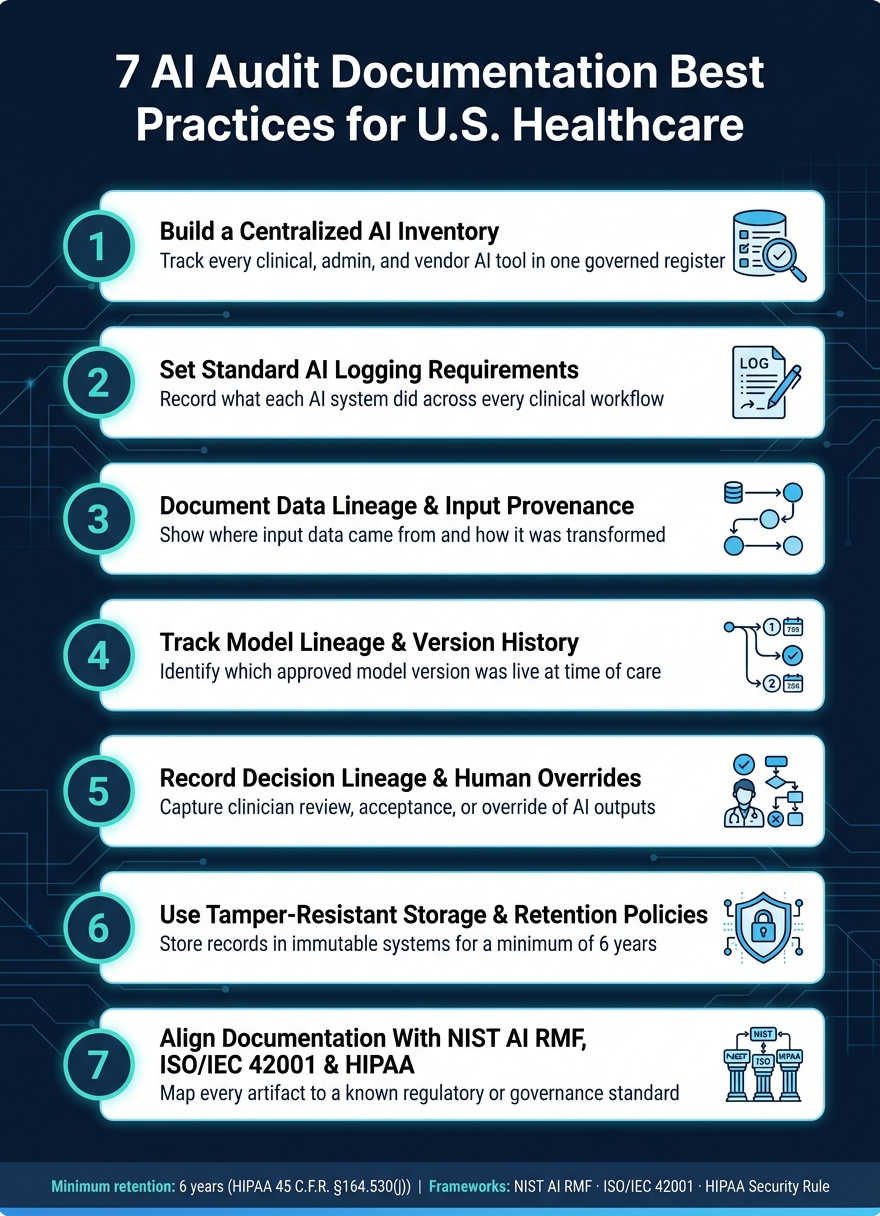
I’d boil the article down to seven must-have practices:
- Build one AI inventory for internal tools, vendor tools, and AI features inside other software
- Set fixed logging rules for every clinical workflow that uses AI
- Track data lineage so you can show where inputs came from and how they changed
- Track model lineage so you know which version was live at any point in time
- Record human review and overrides for each AI-assisted decision
- Store records in tamper-resistant systems and keep them for at least 6 years
- Map each record to NIST AI RMF, ISO/IEC 42001, and HIPAA evidence needs
Why does this matter? Because when an incident, audit, or OCR review happens, informal notes are not enough for portfolio risk management. You need logs, approvals, version history, vendor records, and incident links that can be checked later. Vendor AI does not shift your responsibility, especially when PHI is involved.
Quick comparison
| Practice | What it answers | Main record |
|---|---|---|
| AI inventory | What tools exist? | System and vendor register |
| Logging | What did the system do? | Event logs |
| Data lineage | What data fed it? | Provenance records |
| Model lineage | Which version ran? | Version and change history |
| Decision lineage | What did staff do next? | Review and override logs |
| Storage/retention | Can records be trusted later? | Immutable archived records |
| Framework mapping | How does this fit audit rules? | Control-to-evidence crosswalk |
If I were setting this up, I’d treat these seven items as one record system, not seven separate tasks.
7 AI Audit Documentation Best Practices for U.S. Healthcare
Why AI Audit Documentation Matters in U.S. Healthcare
When AI shapes clinical decisions, hospitals need records that show what the system did, why it did it, and who signed off on it. If those records are missing, even one adverse event or security issue can turn into a mess. It becomes harder to investigate what happened, defend the care decision, or learn from the problem.
In day-to-day clinical work, logs and provenance records give reviewers a way to trace decisions step by step. That makes it easier to spot unsafe patterns early, before they lead to harm.
The same idea applies when a vendor-hosted AI tool is tied to an incident. Access logs, version history, and configuration records help teams scope the issue faster and respond with less guesswork. That’s why standardizing what gets logged matters so much.
Documentation also connects each AI tool back to an approved inventory entry, a risk review, and a governance decision. The Health Sector Council's managing third-party AI risk in healthcare guide says this plainly. Covered entities should require vendors to provide:
"documentation, system logs, audit trails, and access to technical personnel" to verify PHI handling and security safeguards[5]
Regulators are asking for proof, not informal promises.
The table below shows how documentation needs change across clinical settings.
| Clinical Environment | Primary Documentation Need |
|---|---|
| Radiology | Post-deployment safety monitoring, discrepancy review, and adverse event reporting |
| Pathology | Input provenance and model versioning when outputs influence diagnosis |
| Telehealth | Escalation verification and clinician oversight of AI triage decisions |
| Vendor-hosted AI | Vendor accountability, audit rights, and PHI protection records |
| EHR decision support | Alert logic, override rates, and near-miss event tracking |
sbb-itb-535baee
1. Build a Centralized AI System and Vendor Inventory
You can't audit what you can't find. Before you get into logging, version control, or compliance checks, your organization needs one governed list of every AI system in use: clinical tools, admin platforms, vendor-hosted models, and AI features built into software you already use, like EHRs, billing systems, and scheduling tools.
One healthcare AI governance case study found some glaring gaps at the start: no centralized AI inventory, no formal pre-implementation approval process, and no source attribute documentation for predictive systems already running inside a certified EHR.[8]
Traceability Across Data, Model, and Decisions
A centralized inventory gives you a clear chain of evidence. It ties together the input data an AI tool used, the model version that processed it, and the recommendation or decision that came next.
That matters more than it may seem at first. Say a vendor updates a model and clinical outputs start to shift. Your inventory should show which version was live, which workflow it affected, and which departments used it. Without that record, tracing errors or reproducing results turns into guesswork.
Support for HIPAA and U.S. Healthcare Audit Expectations
Every AI system that touches PHI should be tracked for documented risk review, access controls, and BAA status when a vendor receives or processes protected data.
A centralized inventory makes this much easier. It helps you spot:
- Which tools handle protected data
- Which vendors need BAAs
- Which systems were approved, reviewed, and monitored
That last point is big. It shows your AI tools aren't running as unmanaged shadow AI. The NIST AI RMF Playbook directly recommends inventory policies that spell out what gets inventoried, who maintains it, and which attributes are recorded for each system.[7]
Evidence Quality for Internal and External Reviews
Each inventory entry should link straight to the proof behind it: vendor due diligence reports, security questionnaires, validation test results, change approvals, and periodic review notes.
Auditors don't just want to hear that a system was reviewed. They want records that show it was checked before use and watched after deployment. When that evidence is tied to the inventory record, teams can rebuild past decisions much faster during an OCR inquiry or an internal review.
Integrity, Retention, and Accountability of Records
The inventory itself should be treated as a controlled record. That means role-based access, audit trails, backups, and retention rules.
Each entry also needs a named owner and a set review cadence. That makes accountability plain. You can show who accepted risk, who monitored the system, and who owns remediation if something goes wrong.
For healthcare organizations managing third-party risk across many systems, Censinet RiskOps™ can help by centralizing third-party risk assessments, vendor documentation, and shared risk workflows in one governed environment.
2. Set Standard AI Logging Requirements for Clinical Workflows
Once you've finished the inventory, the next step is to standardize what each AI event needs to record. Partial logs create thin audit evidence. And in clinical settings, that’s a problem. Logs are proof of control, review, and accountability - not just a system diary. The inventory tells you which system is in use; logging shows what it actually did.
Traceability Across Data, Model, and Decisions
Each AI event should record the full decision trail: patient context, input data, model name and version, timestamp, triggering user, output, confidence or risk score, and the clinician’s action.
That last part matters more than teams sometimes expect. The record should show whether the clinician accepted the recommendation, overrode it, or escalated the case based on factors outside the structured data. That’s what turns a raw log into an audit trail you can use later for provenance checks and override review.
Support for HIPAA and U.S. Healthcare Audit Expectations
HIPAA’s audit controls standard under 45 C.F.R. §164.312(b) requires covered entities and business associates to implement mechanisms to record and examine activity in systems that contain or use ePHI.[11][13][14]
For AI workflows, that means audit records should show:
- who accessed ePHI
- when the access happened
- which system was used
- what the model produced
The logs themselves also need protection. Audit trails often hold operating details that can create privacy risk if exposed, so treating them like low-priority back-office data is a bad idea.
Evidence Quality for Internal and External Reviews
Good audit evidence depends on consistency. Use standard field names, consistent timestamps, and clear links between outputs, encounters, and model versions.
Free-text notes can muddy the picture. So can mismatched timestamps. A simple test helps: run a mock audit using only the logs. If your team can’t rebuild the timeline from those records alone, the logs aren’t ready.
Integrity, Retention, and Accountability of Records
Store logs separately in encrypted, append-only, tamper-evident storage. This is also where segregation of duties comes into play. The people who run AI systems should not be able to quietly change the audit records those systems produce.[12]
Retention schedules should line up with HIPAA’s six-year retention requirement under 45 C.F.R. §164.530(j)[12] and also reflect litigation holds and quality review cycles. 45 C.F.R. §164.308(a)(1)(ii)(C) requires organizations to regularly review records of information system activity, including audit logs and access reports.[10][11]
Set a defined review schedule. Logging by itself doesn’t prove much if no one ever checks the records.
These logs support the data lineage and version history documented next.
3. Document Data Lineage and Input Provenance
Once logging is in place, the next audit question is simple: what data fed the model? Logs show activity. Lineage shows evidence. Provenance shows where the data came from, how it moved, and what happened to it before the model used it. That difference matters when an auditor asks how a clinical decision was reached.
Say an AI tool triggers a sepsis risk alert. Your audit record should show the exact clinical inputs behind that alert, including vitals, lab results, medication history, the model version, and the clinician’s final action. That end-to-end record helps your team figure out where something went wrong. Was the input data flawed? Did the model fail? Or did the issue happen in the workflow itself?
Data lineage tracks the technical path of data across systems and transformations. Input provenance adds the source, ownership, and authorization behind that data. Put together, they create a traceable chain from source data to model output and final decision. [20][21]
A solid lineage record should capture:
- Data source
- Data owner
- Collection date and time
- Ingestion method
- Transformation steps
- Validation checks
- Version or batch ID
- Downstream model usage [22]
For example, you should be able to show when an admission note was extracted, how it was transformed, which model version used it, and what threshold applied. That record connects directly to model versioning and change control.
| Documentation element | What to capture |
|---|---|
| Source identity | Original dataset, system, vendor, or document source; owner; acquisition date; authorization basis |
| Transformation history | Cleaning, labeling, augmentation, merging, feature engineering, redaction, and script/version IDs |
| Access and control | Who accessed or changed data, when, and under what approval or role |
| Model reference | Dataset version, model version, deployment date, and output references |
Support for HIPAA and U.S. Healthcare Audit Expectations
In healthcare audits, the main issue is PHI traceability. HIPAA does not set a required lineage format, but provenance records help show how PHI moved, who accessed it, and how it was transformed. [9][16][18] If an AI vendor handles clinical data for a hospital, the hospital still needs to explain how PHI moved through that system and who owned each step.
NIST's AI RMF playbook goes a step further. It asks whether the organization has documented AI data provenance, including sources, origins, transformations, augmentations, labels, dependencies, constraints, and metadata. [22] In U.S. healthcare AI governance, there is also growing pressure for field-level lineage so teams can prove how specific PHI fields were handled. [18][19]
Evidence Quality for Internal and External Reviews
Good provenance records help auditors answer four plain questions:
- What data fed the model on a given date?
- Was any source data missing, changed, or manually corrected?
- Which preprocessing pipeline was used?
- Did the model rely on a vendor dataset, local EHR extracts, or both? [18][4][22]
Human intervention matters too. If someone changes, approves, or rejects an input before the model uses it, that action should be recorded with the reviewer’s role, timestamp, reason for the change, and the original value versus the edited one. [21] Without that, it becomes much harder to tell whether the result came from clinical judgment or a data problem.
Integrity, Retention, and Accountability of Records
Lineage and provenance records should live in tamper-evident systems with access controls, immutable logs where feasible, and set retention periods. [9][16] Retention should line up with HIPAA’s six-year documentation window, and go longer when state law or internal policy requires it. [9][15][17]
It also helps to give one team clear ownership of these records, whether that’s compliance, data governance, or the AI risk team. If the records are split across clinical, IT, and vendor systems, gaps show up fast. Provenance should be treated as a governance record so it can support risk reviews, vendor due diligence, and incident response.
4. Track Model Lineage, Versioning, and Change History
Data lineage shows what went into the model. Model lineage shows which approved model version was live when the recommendation was made. That distinction matters.
Every AI model used in clinical care should have a version record tied to the training snapshot, code version, key parameters, and validation results.[1][2][24] When a new version goes live, treat that deployment as a controlled change, not a casual update. This is the layer that proves the right model was in use at the time of care.
Traceability Across Data, Model, and Decisions
Model lineage closes the loop by identifying the exact model artifact that produced an output. To make audits less messy, use the same fields for every model record so teams can compare versions side by side.
| Documentation element | Recommended content |
|---|---|
| Model version record | Version ID, release date, owner, approval status, deployment target |
| Training provenance | Dataset snapshot, data hash or commit ID, preprocessing pipeline version, hyperparameters |
| Change history | What changed, why, reviewer/approver, validation results, rollback plan |
| Audit linkage | Prediction ID, model version used, linked downstream record, timestamp |
Support for HIPAA and U.S. Healthcare Audit Expectations
Version changes should show who approved the change and what risk review came after it. The change history needs to spell out what changed, why it changed, who signed off, and what validation was run.
Each change record should also document:
- how PHI was accessed or used during retraining
- what privacy and security controls applied
- whether a risk assessment was updated
If a model change was triggered by an incident - a misclassification, a near miss, or a patient complaint - the change record should link straight to the incident report and corrective action plan. That link matters. It shows regulators a systematic, risk-based process instead of reactive patching.
Use governed RiskOps workflows to connect each version update with the risk review, vendor notice, and approval records.
Evidence Quality for Internal and External Reviews
Detailed version records let quality and safety committees reconstruct exactly what model was running, and with what configuration, at the time of an adverse event. In root cause analysis, that level of detail helps teams sort out whether the issue came from data quality, model behavior, or workflow failure.
For external reviews, tamper-resistant records that show validated models, known limitations, and approved changes help demonstrate due diligence.[23][24]
Integrity, Retention, and Accountability of Records
Model lineage records should live in tamper-evident systems with access controls and immutable logs where feasible.[23] Every update, configuration change, and deployment should be time-stamped.
NIST's AI RMF playbook specifically recommends maintaining a database of system changes and version history information and metadata to support continuous improvement and audit readiness.[25]
5. Record Decision Lineage and Human Overrides
Model lineage shows which model was in use. Decision lineage shows what the model said and what a person did after that. In clinical AI, that second piece is where accountability starts to feel concrete, especially when the output is informational, advisory, or meant to kick off a workflow.
Every AI-assisted clinical decision needs a record that shows the full path: a link to the provenance record, the model version that produced the recommendation, the output and confidence score, who reviewed it, and what final action was taken.[26][30][31] If a clinician overrode the recommendation, the record should also show who made that override, when it happened, and why. Use the provenance and version records you already have as links, not duplicates.
Traceability Across Data, Model, and Decisions
A complete decision record ties together the source data, the model, and the human action that followed. In plain terms, it should let you trace the chain from input to recommendation to final outcome.
A practical decision record should include these core fields:
| Field | What to capture |
|---|---|
| Patient or case identifier | Patient or case reference |
| Timestamp | Date and time of AI output and human review |
| System name | AI application or workflow that generated the decision |
| Model version | Version ID linked to the model lineage record |
| Linked provenance record | Reference to the provenance record for this decision |
| AI output | Recommendation, risk score, or alert generated |
| Confidence score | Probability if available |
| Reviewer identity and role | Who reviewed or acted on the recommendation |
| Override status | Accepted, partially accepted, or rejected |
| Override reason | Structured code plus optional free text |
| Final action taken | What actually happened after review |
Each field should point back to the provenance and model-version records already created.
Require a structured override reason. Without it, you're left guessing whether the override made sense or whether the alert itself missed the mark.
Support for HIPAA and U.S. Healthcare Audit Expectations
HIPAA's audit controls standard under 45 CFR 164.312(b) requires covered entities to implement mechanisms that record and examine activity in systems containing ePHI.[28][29] Decision lineage records help meet that expectation by showing who reviewed the AI output and what happened next. Retain decision logs for at least six years to match HIPAA documentation requirements.[27][32][31]
Evidence Quality for Internal and External Reviews
Review override patterns to spot alert fatigue, outdated rules, or model bias.[35][36]
Integrity, Retention, and Accountability of Records
Use append-only, tamper-evident storage with role-based access and synchronized timestamps.[33][34] Add each override as a new record linked to the original event. That way, the first event stays untouched and the full history remains available for later review.
6. Use Tamper-Resistant Storage and Clear Retention Policies
Decision logs and override logs matter. But they don't help much if someone can edit or delete them later. That's where tamper-resistant storage comes in. It turns AI records into audit evidence you can actually stand behind.
Once you have logs, lineage, and override records in place, storage controls help keep those records admissible during a review. Use append-only or WORM storage, cryptographic hashing, and role-based access control with separation of duties. When a log entry is written and hashed, any later change breaks the integrity check [37][38][39][40][41].
For retention, use six years as the baseline for audit logs and AI governance records [9]. A tiered storage setup helps here. Keep newer records easy to search, and move older ones into immutable storage.
Traceability Across Data, Model, and Decisions
Use hot, warm, and cold storage tiers so current incidents stay easy to investigate while older records remain locked down. In plain English: your team can find what it needs fast, and older evidence stays intact for audits or incident response.
| Storage tier | Timeframe | Primary use |
|---|---|---|
| Hot (searchable) | 90–180 days | Active incident response and investigations |
| Warm | 12–24 months | Recent audits and quality reviews |
| Cold (immutable archive) | 6+ years | Regulatory compliance and long-term accountability |
Support for HIPAA and U.S. Healthcare Audit Expectations
Tamper-resistant logs also support HIPAA's audit controls standard under 45 CFR 164.312(b). That rule requires covered entities to record and examine activity in systems that contain ePHI. If the Office for Civil Rights (OCR) or an accreditation body like The Joint Commission asks for proof, you want logs that can stand on their own as audit evidence [38][39].
Evidence Quality for Internal and External Reviews
For both internal and external review, intact logs help avoid fights over whether a record was changed after the fact. Write the retention policy in plain language, get sign-off from compliance, legal, and clinical teams, and enforce it with lifecycle rules [39].
These controls keep the record set intact so teams can map documentation to formal governance standards.
7. Align Documentation With NIST AI RMF, ISO/IEC 42001, and Governance Records
Once your records are stored in a secure place, the next step is to map them to the frameworks auditors already know. The inventory, logs, lineage, change history, and override records from Sections 1–6 get a lot stronger when each item is tied to a known framework. That link turns everyday logs and reports into audit evidence you can trace back and verify.
Traceability Across Data, Model, and Decisions
Tag each artifact to the right NIST AI RMF function. Data quality reviews and lineage records fit under Map and Measure. Deployment approvals and model change logs fit under Manage. Governance charters and risk committee minutes fit under Govern [2][3].
ISO/IEC 42001:2023, the AI management system standard, adds required documentation for risk assessments, impact assessments, internal audits, and management reviews [42][43][44][46]. If you map what you already have to its clauses - for instance, your risk register to clause 6.1.2 or your internal audit reports to clause 9.2 - you show that the AI program follows a set process instead of being pieced together case by case.
That mapping should live in a simple crosswalk table.
Support for HIPAA and U.S. Healthcare Audit Expectations
These same records also help with HIPAA audit evidence. Risk assessments, access logs, incident records, and audit trails support both AI governance and HIPAA evidence needs [2][47].
Use a crosswalk table that links each requirement to a single artifact.
| Requirement | Framework | Documentation artifact |
|---|---|---|
| Risk assessment results | NIST AI RMF (Map/Measure) + ISO/IEC 42001 §6.1.2 | enterprise risk register entries |
| Access control logs | HIPAA Security Rule + ISO/IEC 42001 Annex A.6.2 | AI system user access logs |
| Model governance records | NIST AI RMF (Manage) + ISO/IEC 42001 governance clauses | Model version history, validation reports |
| Incident and corrective actions | ISO/IEC 42001 §10.2 + HIPAA incident response | Incident logs, corrective action plans |
Evidence Quality for Internal and External Reviews
Audit evidence needs to be complete, current, and verifiable. ISO/IEC 42001 clause 7.5 gives you a practical checklist: every document should have a clear owner, version number, approval record, and change history [44][46]. Apply that rule to every AI artifact - validation reports, bias assessments, deployment approvals - so internal audit and compliance teams can review models side by side and spot gaps fast.
If you're using vendor-supplied AI tools, ask for documentation with those same fields. That should include data sources, PHI handling, validation method, and governance approvals.
Integrity, Retention, and Accountability of Records
ISO/IEC 42001 does not set a fixed retention period, but it does require each organization to define one that fits its context [44]. In U.S. healthcare, that usually means lining it up with HIPAA and any state medical record rules, then recording who made that call and when.
Accountability also means naming the people behind the decisions. Committee approvals for AI deployment, named model owners, and clinical champions in charge of monitoring should all be recorded with signatures or electronic approvals in an auditable system. When a reviewer asks who approved a model and what evidence supported that approval, your governance records should answer that plainly and in full [42][43][44][45].
Use this crosswalk to standardize the audit packet and record format.
How to Format Audit-Ready Documentation
Once the core records are in place, the next step is to package them so auditors can move through them fast. Audit records should be easy to locate, check, and defend.
Start With Standardized Templates
Use one template for every AI system. That template should cover the system overview, use case, data sources, PHI categories, security controls, risk summary, owners, approvals, monitoring history, and evidence links. When every record set follows the same layout, missing pieces are much easier to spot. [48][50][51]
Version every document too. Each one needs a unique ID, version number, owner, change summary, and effective date. If a model is updated or a configuration changes, that should trigger a documentation review. The changelog should connect document versions to deployment dates and environments. [48][50][53][54]
Use the same structure across every AI system so the evidence pack stays consistent.
Build a Control-to-Evidence Map
Link each control to one named artifact. In plain terms, every control should point to a specific piece of proof, like a lineage document or a change ticket. Each evidence item should also have its own unique ID, storage location, owner, and last-updated date. [56][58][61][64][65]
This map makes it much easier to pull together an evidence pack without digging through multiple systems.
Organize Evidence Packs by System, Version, and Period
Package records into evidence packs based on model version and audit period. Each pack should include:
- The standardized system template
- A security-focused model card
- The control-to-evidence map
- The risk summary
- Validation and bias testing reports
- Change history
- Monitoring exports
- Any incident records from that time window
That way, an internal auditor or external regulator can see exactly what was true for a given AI system at a specific point in time. [51][49]
Use a security-focused model card that adds PHI data flows, encryption and access control details, a threat modeling summary covering risks like data poisoning or prompt injection, dependency and vendor information, and a monitoring and incident history section. Censinet RiskOps™ can centralize these records and support vendor uploads, approvals, and audit trails in one controlled repository. [57][62][50][63]
Keep the repository searchable, but lock down edits and exports.
Apply role-based access control across the full repository:
- Limit editing rights to system owners and the AI governance team
- Give compliance and privacy officers read access
- Grant external auditors time-bound, read-only access to specific evidence packs
Use a consistent naming convention such as AI_<SystemName>_<ModelName>_<ModelVersion>_<DocType>_<AuditPeriod>_v<DocVersion>.pdf so people can find the right file fast. [52][55][59][60]
Tables to Clarify Key Documentation Areas
These tables turn the seven practices into the records auditors usually ask for. Think of them as a quick lookup for record type, framework fit, and retention.
Lineage Type Comparison
Start by separating the three lineage types. Each one serves a different audit job. When teams lump them together - or treat them like the same record - that often creates audit trouble.
| Lineage Type | Purpose | Key Fields | Primary Owner | Audit Use Case |
|---|---|---|---|---|
| Data Lineage | Trace raw inputs from source systems to training sets or inference inputs. | Source system; data owner/steward; PHI classification; acquisition date; transformation summary; dataset version and storage location | Data Steward / Privacy Officer | Verify source integrity; support deletion or correction requests under applicable policy; defend data quality in bias audits |
| Model Lineage | Track model identity, training snapshot, and change control. | Unique model ID; model type; training dataset IDs and versions; training dates; validation metrics; responsible team and lead; approver name and approval date; deployment environment; change history with effective dates | AI/ML Engineering Lead | Reproduce model state at any point in time; support incident investigations; demonstrate change control |
| Decision Lineage | Link each AI output to the clinician action that followed. | Recommendation ID; model version; reviewer identity and role; outcome; override rationale; downstream clinical action | Clinical Informatics / Compliance Lead | Demonstrate human oversight; support patient safety reviews and malpractice defense |
NIST AI RMF and ISO/IEC 42001 Artifact Mapping
Next, tie each record to the framework requirement it covers. This is the part that helps an audit trail make sense on paper, not just in practice.
| Framework / Function | Key Requirement | Audit Artifact | Format / Maintenance |
|---|---|---|---|
| NIST AI RMF - Govern | AI oversight structure; role accountability | AI governance charter; RACI matrix; board or quality committee minutes documenting AI risk oversight; AI risk register | Versioned PDF and meeting records |
| NIST AI RMF - Map | Understand AI context, data sources, and clinical impact | AI system inventory with risk tiering; data use catalog; data protection impact assessments; clinical workflow diagrams showing AI touchpoints | Machine-readable inventory (CSV/JSON) |
| NIST AI RMF - Measure | Evaluate performance, bias, and security | Bias and performance evaluation reports (broken down by patient subgroup); monitoring dashboards; vulnerability assessment and penetration test reports for AI components; incident logs | PDF reports and exported CSV logs |
| NIST AI RMF - Manage | Respond to risk; control model changes | Change management records for model updates; rollback plans; corrective action plans after incidents; documented procedures for taking an AI system offline | PDF and workflow records |
| ISO/IEC 42001 - AI Policy & Scope | Formal AI management system documentation | AI policy document; AIMS scope statement; competence and training records | Versioned PDF and training records |
| ISO/IEC 42001 - Risk & Impact Assessment | Documented risk methodology and results | AI risk assessment methodology; AI impact assessments per system; training data control records; data change logs and quality reports | Versioned PDF per system |
| ISO/IEC 42001 - Monitoring & Improvement | Continuous oversight and corrective action | Internal audit program and reports; management review minutes; nonconformity and corrective action records; periodic AI safety review reports | PDF and meeting records |
| Censinet RiskOps™ (healthcare-specific) | Third-party AI vendor risk and benchmarking | Standardized third-party risk assessment reports for AI vendors; cybersecurity benchmarking outputs; collaborative risk remediation plans tied to specific clinical AI solutions | PDF or platform report; generated per vendor assessment cycle |
Storage Tiers and Retention Expectations
The last table connects each record type to the storage tier that keeps it available for review. In plain terms: what stays close at hand, what moves back, and what must remain locked down for years.
| Storage Tier | Typical Content | Retention Period | Access Latency | Key Compliance Notes |
|---|---|---|---|---|
| Hot | Real-time AI inference logs; access logs for AI services; active monitoring data; current incident records | 0–90 days | Seconds | High-performance storage; supports rapid triage and day-to-day security monitoring |
| Warm | AI alert logs; operational audit trails; trend analysis data; extended investigation records | 3–12 months | Seconds to minutes | Supports quality improvement reviews and investigations spanning up to 1 year |
| Cold | Historical AI audit logs; model change records; data lineage snapshots; documentation supporting regulatory reviews | 1–7 years (365–2,555 days) | Minutes to hours | Aligned with HIPAA documentation requirements and state-level medical record retention policies |
| Archival | Final audit reports; governance decisions; signed annual AI governance audit reports; critical lineage snapshots | 7–10+ years | Hours | Write-once-read-many (WORM) configuration; cryptographic integrity checks; supports evidentiary integrity |
Apply encryption and integrity checks at every tier.
Common Documentation Gaps to Avoid
A lot of audit failures come back to the same handful of issues: missing timestamps, weak identity records, incomplete version history, undocumented overrides, scattered vendor evidence, and retention rules that don’t line up. In practice, these problems usually show up as missing fields, missing approvals, or records spread across different systems. The gaps below line up with the controls already covered above.
Missing or inconsistent timestamps and shared or free-text user IDs make traceability fall apart. If timestamps aren’t consistent across time zones, and if user IDs aren’t unique, role-based, and tied to an authoritative identity source, you can’t show when a model output, override, or approval happened - or who did it.
Incomplete version history leaves holes in the audit trail. Teams often can’t show which training data, prompt template, configuration, policy, code version, justification, approver, or risk assessment applied to an output generated weeks earlier. That makes it hard to compare pre-change and post-change performance and harder to pin down the source of unsafe outputs.
Undocumented overrides and unsigned approvals weaken accountability. Every override and approval should be logged with the reviewer, time, reason, and supporting audit trail. Don’t depend on email or chat.
Vendor evidence that is not centralized, indexed, or searchable makes due diligence tough to verify. Keep vendor evidence indexed by vendor, product, version, review date, and risk owner in one governed repository. Censinet RiskOps™ can help centralize that evidence.
Retention policies that don't match artifact class create compliance risk. Use one retention schedule by artifact class, anchored to HIPAA's six-year baseline [66][67], and protect records with RBAC, least privilege, MFA, separation of duties, and immutable storage.
Conclusion
AI audit documentation sits at the center of healthcare AI governance. That matters even more now, since ECRI ranked AI among the No. 2 patient safety threats for 2025 [68].
These seven controls don't stand alone. They work as one system. If one gets weak, audit readiness slips with it. When the full set is in place, the record shows what the system did, who signed off, and how the evidence was kept.
That’s why traceability matters most. End-to-end traceability lets you show exactly which model ran, what changed, and who overrode it - without piecing the story together by hand.
Mapping documentation to NIST AI RMF and ISO/IEC 42001 also makes evidence easier to review and defend. HHS has explicitly modeled its internal AI risk-management guidance on the NIST AI RMF [6], which makes that alignment more relevant for U.S. healthcare organizations.
For healthcare organizations dealing with many AI tools and vendors, Censinet RiskOps™ can centralize evidence, streamline assessments, and help keep documentation current. The aim is simple: make every AI record fast to find, easy to verify, and ready for audit.
FAQs
Who should own AI audit documentation?
Ownership needs to be clear. If no one owns a task, things slip through the cracks fast.
A cross-functional AI governance committee should hold primary authority over reporting. That includes reviewing escalations and approving risk tier assignments.
Each team has a clear role here:
- Security, privacy, legal, and compliance teams confirm controls
- Clinical leaders check patient safety impacts
- Data science teams provide technical performance data
Every AI system and every finding should also have one specific, named owner.
How do we document vendor AI tools that handle PHI?
Document vendor AI tools that handle PHI under a formal governance process. That should include a signed HIPAA-compliant BAA that spells out data usage, logging, and breach notification terms. Keep an inventory of AI assets too, with the owner, data sources, and intended use for each one.
Collect core records such as model cards, data flow diagrams, SBOMs, and security certifications. Store records on data elements, safeguards like encryption, PHI access, model updates, and approvals in one centralized, audit-ready system.
What records should be reviewed first after an AI incident?
Start with KPI trends, KRI breaches, and audit log patterns. These records help you rank the investigation by showing incident trends, override rates, and open remediation items.
Then review the full decision chain: model version, specific inputs, clinical context, and the human reviewer’s identity. Compare these logs with established baselines to spot data drift, performance decline, or behavior that doesn’t match the norm.
