
AI can speed up care for some patients and block care for others. If you run, buy, or approve AI in healthcare, your job is not just model review. It is making sure people have the same shot at triage, referrals, care management, and follow-up no matter their race, language, income, age, disability, or ZIP code.
Here’s the short version: equity belongs inside AI governance from day one. That means I would treat it as part of intake, vendor review, risk tiering, data checks, testing, go-live controls, and post-launch review. The article shows why this matters with hard numbers: a 2024 review of 30 studies linked AI use with worse racial gaps in outcomes, and one well-known risk model would have identified 46.5% of Black patients for extra care instead of 17.7% after its bias issue was fixed.
If I had to boil the whole piece down, it says you need to do seven things:
- Set clear rules for how AI is approved and who owns each system
- Classify risk so triage, diagnosis, and treatment tools get the toughest review
- Check data for who is in it, who is missing, and whether proxies like cost distort need
- Test by subgroup instead of trusting one average score
- Require human review for higher-risk use cases
- Monitor for disparate impact after launch, with drift checks and rollback triggers
- Look past the model at medical device access, internet access, language, and patient trust
A few points stand out fast:
- HHS OCR said in 2024 that AI-driven discrimination under Section 1557 can be enforced like other discrimination claims
- A scoping review found 84% of global AI model studies did not report race in training data, and 31% did not report gender
- In one external review, the Epic Sepsis Model identified only 7% of sepsis cases missed by clinicians at a common threshold
- Documented pre-implementation approval is still missing in 59% of healthcare organizations
Bottom line: I wouldn’t treat healthcare AI equity as a side ethics task. I’d treat it as a governance rule with named owners, written controls, and audit-ready proof.
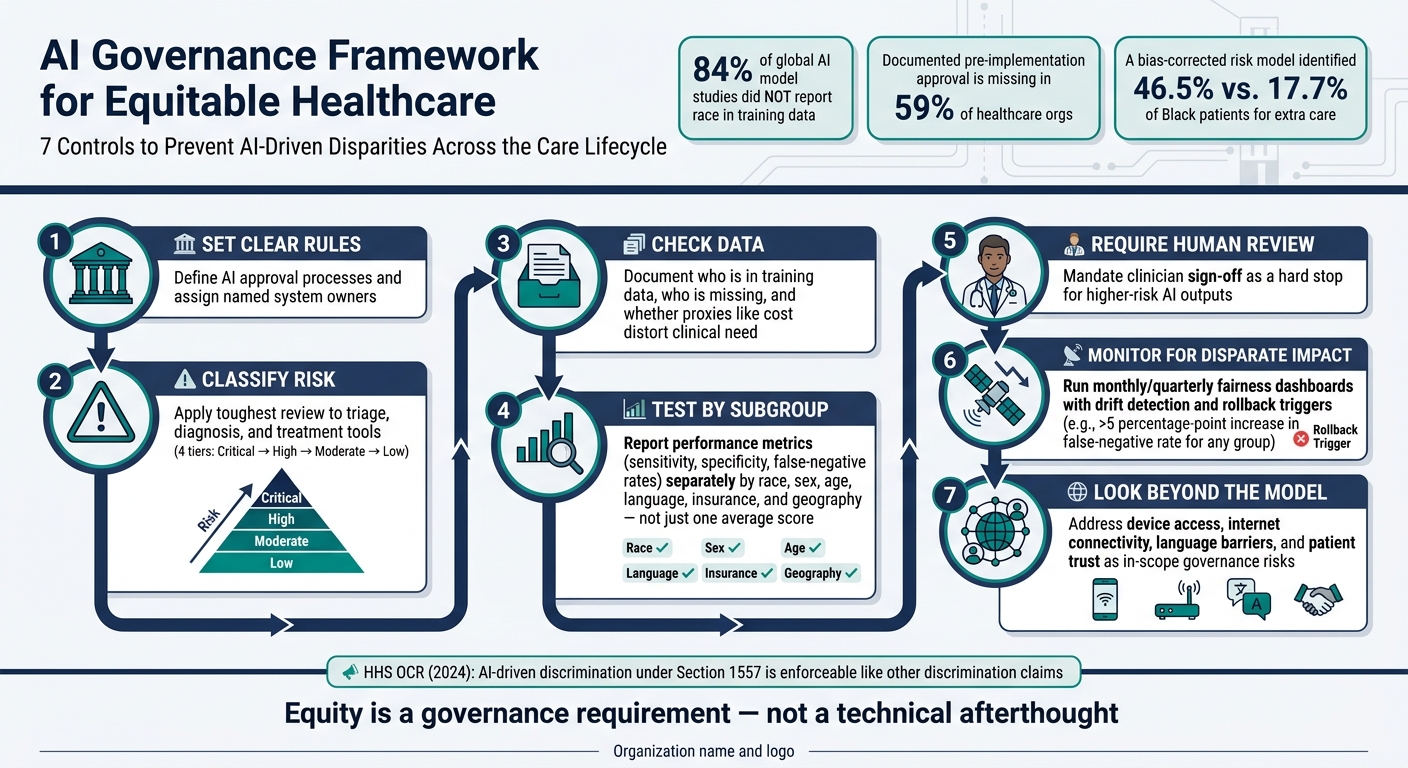
AI Governance Framework for Equitable Healthcare: 7 Core Controls
1. Core Principles and Governance Structure
Principles That Should Anchor Every Healthcare AI Policy
The WHO points to six core principles for health AI: protect patient autonomy, promote human well-being and safety, ensure transparency and understandability, foster responsibility and accountability, ensure inclusiveness and equity, and promote responsive and sustainable AI. [3] Those principles can't just sit in a policy binder. They need to show up in day-to-day decisions.
They shape who gets help from AI-supported care, who gets left waiting, and who may face harm. That means they should guide every AI approval decision.
In practice, transparency means each AI system needs a model card before clinical use. That card should spell out the system's purpose, key performance metrics, training data traits, and known limits. Accountability means one person is clearly named as the owner of the system, not just a group. Inclusiveness means clinical staff and community representatives take part in the review directly. Equity means disparity checks are built into the approval process from the start, not tacked on at the end.
A recent scoping review found that 84% of global AI model studies did not report the racial makeup of their training data, and 31% did not include gender data. [2] That kind of documentation gap is exactly what governance policy should address.
Roles, Responsibilities, and Approval Authority Across the Organization
Clear cross-functional ownership is what makes AI governance stick. The AI Governance Committee has final approval authority for high-risk systems and acts as the escalation point when equity or safety concerns come up. Based on the use case, ad hoc clinical members such as pharmacy, radiology, and behavioral health may also join the review.
| Function | Core Responsibility |
|---|---|
| Clinical Leadership | Approves clinical deployment, sets clinical performance thresholds, and oversees training and change management. |
| Legal & Compliance | Reviews policy and compliance requirements. |
| Security & Privacy | Approves technical integration from a security standpoint and monitors data flows, access logs, and vulnerabilities. |
| Data Science / Analytics | Develops models, validates them, monitors performance, and performs bias analysis and representativeness checks. |
| Procurement & Vendor Management | Ensures vendor tools undergo third-party risk assessment, security questionnaires, and subgroup performance data disclosure. |
| Operations & IT | Manages change control, rollback readiness, and operational monitoring. |
| Equity / Community Reps | Lead review of access and disparity risk. |
| AI Governance Committee | Serves as the escalation point and final approval body for high-risk systems. |
The committee should work on a set review cadence, with a documented expedited path for urgent deployments. Even then, equity checks still need to stay in place. Time pressure isn't a good reason to skip them.
For high-risk systems, approval should include a documented disparity analysis and a mitigation plan before sign-off.
How to Review Vendor and Internal AI Systems
One of the most common governance gaps is simple: teams may scrutinize internal models more than vendor tools, or do the opposite. Either way, that's a problem. The same bar should apply to both.
Whether a model is built in-house or bought from a vendor, the review should cover model documentation, training data representativeness, PHI handling, local clinical validation where feasible, and a plan for ongoing monitoring. Each of those checks should tie back to patient access outcomes, not just technical testing.
- Vendor tools: require subgroup performance data, third-party risk review, and local validation. If a vendor can't show how a model performs across racial, age, or socioeconomic groups, that's a red flag, not something to sort out later.
- Internal models: require the same documentation, representativeness checks, and local validation.
The intake process should begin with a standard form that captures the use case, affected populations, expected benefits, and possible equity risks before any development work starts. That intake should then feed the equity impact assessment and risk tiering that come next.
sbb-itb-535baee
2. Equity Impact Assessment and Risk Classification
What to Evaluate Before Approving an AI Use Case
Once ownership and approval authority are clear, the next step is to score each use case for equity risk before it goes live.
That score should come from a close look at the use case itself: what it’s meant to do, which groups it affects, how it changes decisions, whether staff can override it, how well the model’s reasoning can be explained, whether the training data reflect the people being served, and which failure modes could do harm. That includes false positives, false negatives, missing data, and overreliance. Any of those can exclude, delay, or redirect care for certain groups.
Cost and utilization proxies deserve extra scrutiny. When those proxies reflect structural inequity, they can carry that bias straight into the model.
Frameworks can help with this kind of tiering. HEAAL (Health Equity Across the AI Lifecycle) looks at AI tools across five domains - accountability, fairness, fit for use, reliability/validity, and transparency - at key points in the AI adoption lifecycle. [4][5] HEAL (from Google) uses a quantitative method: identify factors tied to health inequities, quantify pre-existing disparities, measure performance by subpopulation, and check whether the tool reduces those disparities. [6][7]
Risk Tiers for Common Healthcare AI Use Cases
Not every AI tool carries the same level of equity risk. A note-writing assistant and a sepsis model are not in the same ballpark. Risk tiering helps match the depth of review to the level of risk.
Risk classification should rest on four factors:
- How severe the harm would be if the model is wrong
- How much the output affects access to care
- How much of the decision is automated
- Whether a human review step exists before the output affects a patient
The external validation of the Epic Sepsis Model shows why this matters. At a commonly recommended threshold, the model identified only 7% of the sepsis patients missed by clinicians. [8][9] That kind of gap is exactly what tiered validation rules are meant to catch.
| AI Use Case | Equity Risk | Risk Tier | Required Controls | Approval Level |
|---|---|---|---|---|
| Diagnostic imaging AI, sepsis prediction, treatment recommendation engines | Critical - directly influences diagnosis or treatment | Tier 1 (Critical) | Local population validation, subgroup performance data, full audit trail, human override required, fairness audit, patient appeal pathway | AI Governance Committee with clinical, operational, legal, and equity review |
| Triage prioritization, readmission risk, referral prioritization, utilization management | High - influences care timing, access, and service eligibility | Tier 2 (High) | Subgroup performance testing, documented disparity analysis, clinician review step, escalation path, rollback criteria | AI Governance Committee |
| Scheduling optimization, care gap outreach, staffing support | Moderate - operational impact, indirect effect on access | Tier 3 (Moderate) | Equity review, representativeness check, monitoring plan | Clinical and operations review |
| Administrative automation, documentation support, internal productivity tools | Low - minimal direct patient impact | Tier 4 (Low) | Standard intake review, basic documentation review | Department-level review |
Any use case that affects timing, eligibility, access, or allocation should move up one tier when appeal or correction is limited.
High-risk systems need tighter data controls and closer monitoring, which the next section covers.
3. Data Governance, Bias Controls, and Validation
Data Requirements for Equitable Model Development and Procurement
Data governance starts before training begins. Every dataset - whether it comes from your own team or from a vendor - should include a structured dataset profile. In plain English, that means a clear summary of who is represented in the data, and who is not. That matters because dataset quality shapes who gets seen, who gets missed, and who may be misclassified in AI-supported care.
At a bare minimum, the documentation should show population breakdowns by race and ethnicity, sex, age bands, insurance type (Medicaid, Medicare, commercial, uninsured), geography (urban, rural, frontier), disability status, language preference, and income proxies such as Area Deprivation Index scores. It should also spell out known gaps. For example, maybe social determinants of health fields are missing for a large share of encounters. Or maybe Native American patients or non-English-speaking patients appear too rarely in the data. Those gaps can distort results from day one.
Coding consistency matters too. If ICD or CPT codes are used one way in community clinics and another way in academic medical centers, the model may learn from noise instead of signal. That kind of measurement error can quietly push model behavior off course.
For vendor-supplied models, contracts should require the same level of documentation, plus subgroup performance metrics and proof of an equity review. Censinet RiskOps™ can centralize third-party documentation so equity, cybersecurity, and PHI risks are reviewed together.
Proxy variables such as cost and visit frequency should be used only when they reflect clinical need directly. If those variables mirror structural inequity instead, the model will carry that bias forward.
Once a use case has been risk-tiered, the next question is simple: Can the data support fair performance across groups?
Bias Sources Across the AI Lifecycle and How to Reduce Them
Bias builds across the full lifecycle, from problem framing to deployment. A large review of 100 health-related AI bias cases found repeated patterns of representation, selection, historical, measurement, deployment, and automation bias. The harm fell hardest on racial and ethnic minorities, Indigenous peoples, women, older adults, children, LGBTQIA+ patients, low-income communities, and rural populations. [13] One broad review is not enough here. Governance teams need controls tied to each stage.
The table below maps common bias types to their equity risk and the matching mitigation control. Each one can delay care, deny care, or send patients down the wrong path.
| Bias Type | Where It Appears | Equity Risk | Mitigation Control |
|---|---|---|---|
| Design bias | Problem framing, objective setting | Model optimizes for utilization or revenue rather than health need | Require equity impact statements at scoping; involve patient and community representatives |
| Sampling bias | Training data collection | Model trained on commercially insured, urban populations performs poorly elsewhere | Stratified sampling; include data from FQHCs, rural clinics, and safety-net hospitals |
| Historical bias | Labels derived from past care patterns | Underdiagnosis in women or Black patients encoded as ground truth | Use guideline-concordant targets; avoid spending or visit counts as proxies for need |
| Measurement bias | Lab values, vitals, diagnostic coding | Systematic differences across sites and populations distort inputs | Standardized coding dictionaries; audit for known measurement differences by group |
| Labeling bias | Clinician-assigned labels | Subjective labels such as non-compliant reflect provider bias | Use objective outcomes where possible; clinician consensus reviews; re-labeling workflows |
| Deployment-context bias | Alert design, workflow placement | Alert fatigue leads to selective override for Medicaid or rural patients | Human factors testing; pilot rollouts with equity monitoring; role-specific alert design |
Governance committees should keep a bias-control matrix that links each bias type to at least one required mitigation and builds those checks into model approval workflows. [14][15] And those controls shouldn't stop at launch. They need to carry into deployment and monitoring too.
Validation and Monitoring Methods That Show Whether Access Is Truly Equitable
After bias controls are set, the next step is to test whether performance stays even across groups. Overall metrics can hide a lot. A model may look strong on paper while missing the mark for specific populations again and again. Equity-focused validation starts with pre-specified subgroup hypotheses defined before testing begins. For example, a team might require that the false-negative rate for Black patients not exceed the rate for White patients by more than 3 percentage points. That kind of rule helps protect each patient's chance of timely care, referral, or follow-up. [10][11]
Subgroup analysis should cover the standard panel:
- race and ethnicity
- sex
- age bands, including pediatric patients and adults age 65+
- primary language
- disability status
- insurance type
- rural versus urban designation
Performance metrics - sensitivity, specificity, AUROC, calibration, and false-negative and false-positive rates - should be reported for each group separately, not just rolled into one average. If a subgroup is too small to support sound statistics, governance policy should require one of three responses: targeted data augmentation, restricted deployment, or an explicit not-for-use label for that population. [10][12]
Post-deployment, equity monitoring should be continuous, not a one-time checkpoint. Fairness dashboards updated monthly or quarterly, drift detection stratified by subgroup, and trigger thresholds - such as a more than 5 percentage-point increase in false-negative rate for any group - can give teams early warning before disparities pile up. Deeper audits should happen at least once a year and should combine data analysis with chart review and frontline clinician feedback. Extra attention belongs in high-risk areas like critical care, oncology, mental health, and pediatrics. [16][17] If average performance looks high but subgroup gaps remain, that should trigger redesign or constrained deployment.
4. Deployment, Monitoring, and Operational Controls
Deployment Controls That Prevent Inequitable Outcomes
Once a model clears validation, the next issue is simple: how does it act in live clinical work?
For high-risk systems, that means putting hard controls in place before go-live. Require pre-go-live workflow simulation, named clinical sign-off, and clear rollback criteria. Texas SB 1188 requires licensed practitioner review of AI-generated clinical content. Governance policy should spell out which decision types need that sign-off and treat it as a hard stop in the approval process.
A strong deployment should also include an Incident Response Playbook for AI-related failures or unsafe outputs, along with a Software Bill of Materials (SBOM) for the AI-enabled workflow. [18] That kind of paperwork can sound dry, but it matters when something goes wrong and teams need to know what was used, who approved it, and how to pull it back fast.
Right now, many organizations still haven’t locked this down. Documented pre-implementation approval is missing in 59% of healthcare organizations. [18] That gap needs to close before any clinical or administrative AI use case is rolled out at scale. Otherwise, a system that looked fine on paper can still lead to delayed, denied, or misrouted care.
Monitoring for Disparate Impact After Go-Live
Go-live is not the finish line. It’s where the hard part starts.
After launch, track subgroup outcomes against the same equity thresholds used during validation. Run periodic statistical audits so disparity drift shows up early, not months later after harm has already spread. These audits also help address OCR scrutiny under Section 1557 tied to algorithmic bias. [18]
For adaptive models, require a PCCP that sets limits on approved retraining, parameter changes, and rollback triggers. Without that, the model can drift bit by bit until the version in use no longer matches what was first reviewed. As of 2025, only 10% of cleared AI/ML devices - 30 out of 295 - had authorized PCCPs in place, which shows how much governance work is still left for adaptive models. [18]
Censinet RiskOps™ can support this work by centralizing AI-related policies, risks, and tasks, routing findings to the right governance stakeholders, and keeping one audit trail in place.
Access Barriers Beyond the Model: Connectivity, Devices, Language, and Trust
Even when a model is accurate, patients can still be left out.
A model can pass validation and still fail in practice if patients can’t get online, don’t have the right device, face language barriers, or simply don’t trust the tool. Governance should treat these barriers as in-scope operational risks, not as side issues to sort out later. They lead to missed appointments, unusable tools, lower trust, and weaker uptake.
Two policy points matter here. California AB 489 bars chatbot impersonation, and ONC HTI-1 requires disclosure of training-data demographics, exclusions, and known limits. [18]
AI Explained: Lessons from a Physician-CIO on AI Governance
Conclusion: A Practical Framework for Safe and Equitable Healthcare AI
Safe and equitable healthcare AI needs governance across the full lifecycle: proposal, procurement, validation, deployment, and monitoring. The evidence points to a plain truth: equity is a governance requirement, not a technical afterthought. That’s why governance has to tie together risk tiering, bias control, validation, and monitoring.
The framework above works because each control addresses a specific failure point. The seven controls in this guide - principles, oversight, impact assessment, data controls, validation, deployment safeguards, and surveillance - form a repeatable process for equity. UW Health's multidisciplinary AI steering committee shows what that looks like in day-to-day practice.[1]
Tools that shape triage, diagnosis, or resource allocation need the toughest review. That means equity testing, plus senior clinical and compliance approval before go-live.[19][20][21] Lower-risk back-office tools still need a documented review. Even if a tool seems harmless on the surface, paper trails matter when teams need to explain why a system was approved and how its risks were checked.
Managing third-party AI risk is not just a fairness issue. It also affects access and continuity of care. Third-party AI tools bring the same equity and safety risks as systems built in-house. Procurement due diligence should cover bias testing, training-data representativeness, and local validation against the patient population served.[22][23] If a vendor has a breach, outage, or product failure, patient access can be disrupted fast, and trust can erode just as fast.[23]
Censinet RiskOps™ can centralize AI policies, risks, tasks, and audit trails so governance actions stay assigned, documented, and reviewable.
FAQs
How do we start building equity into AI governance?
Start by moving beyond passive compliance and toward oversight tied to outcomes. Set up a multidisciplinary AI governance committee that includes clinicians, data scientists, legal counsel, and patient advocates. Their job is to spot access barriers early, including language, geography, and transportation.
Before deployment, test performance across subgroups to find gaps tied to race, ethnicity, age, and insurance status. After launch, keep tracking allocation results over time. If a system shows major demographic bias, pause it and retrain or replace it before it keeps doing harm.
Which healthcare AI tools need the strictest review?
Tools need the strictest review when they influence access to limited resources, like ICU beds or care management slots. In those cases, mistakes can have a major effect on patient outcomes.
That same high-priority review should apply to tools used for clinical documentation, diagnostic support, patient communications, and any application that handles PHI or affects triage, referrals, or program eligibility.
Review should also include performance testing across demographic subgroups. That helps check whether the tool works as expected for different groups and supports equitable access.
How can we monitor AI for bias after launch?
Look past top-line metrics. Review AI performance across demographic and clinical subgroups like race, ethnicity, age, language, and payer status. Track error rates, clinical outcomes, and indicators tied to equitable performance so you can spot uneven impact early.
It also helps to set clear escalation thresholds in advance. That way, teams know when to step in with a review or an intervention, such as recalibration or retraining, if subgroup gaps or adverse outcomes go past acceptable limits.
