
If I review vendors once a year, I’m too late. In healthcare, vendor risk can shift in days, and the fallout can hit care delivery, HIPAA timelines, claims, and revenue fast.
Here’s the short version:
- Third-party risk is now a patient care issue.
- Static reviews miss fast changes like exposed remote access, leaked credentials, and new breach activity.
- Live monitoring helps me spot vendor trouble earlier and act before it spreads into EHR, pharmacy, imaging, or billing workflows.
- Vendor triage should match clinical impact, PHI exposure, and business dependence.
- Response works better when alerts route at the same time to security, privacy, legal, procurement, and clinical teams.
- Downtime planning matters most for Tier 1 vendors tied to care delivery.
A few numbers make the case clear:
- In 2023, 58% of the 77.3 million people affected by healthcare breaches were tied to business associate attacks.
- The average U.S. healthcare breach cost $9.77 million.
- In U.S. hospitals, 44.4% of ransomware attacks disrupted care delivery.
- Average ransomware downtime reached 18.71 days in 2023.
- 56% of healthcare groups said one or more third parties played a role in a data breach over the last two years.
What this means for me is simple: vendor risk cannot sit in questionnaires, BAAs, SOC 2 reports, and annual reviews alone. Those items give a baseline, but they do not show what changed today. I need a live view that ties outside signals to incident response, vendor tiering, access controls, and downtime plans.
A simple way to think about it:
| Area | Static review model | Live monitoring model |
|---|---|---|
| Visibility | Old documents and self-reported answers | Current breach, exposure, and reputation signals |
| Detection | Days, weeks, or review-cycle lag | Near real-time alerting |
| Priorities | Often based on review date | Based on current risk and vendor criticality |
| Response | Slower, broad actions | More targeted actions |
| Care impact | More workflow disruption | Better support for continuity planning |
So the core takeaway is this: the job is not just to assess vendors. The job is to watch for change, rank what matters most, and move fast when a clinical or PHI-linked vendor shows signs of trouble.
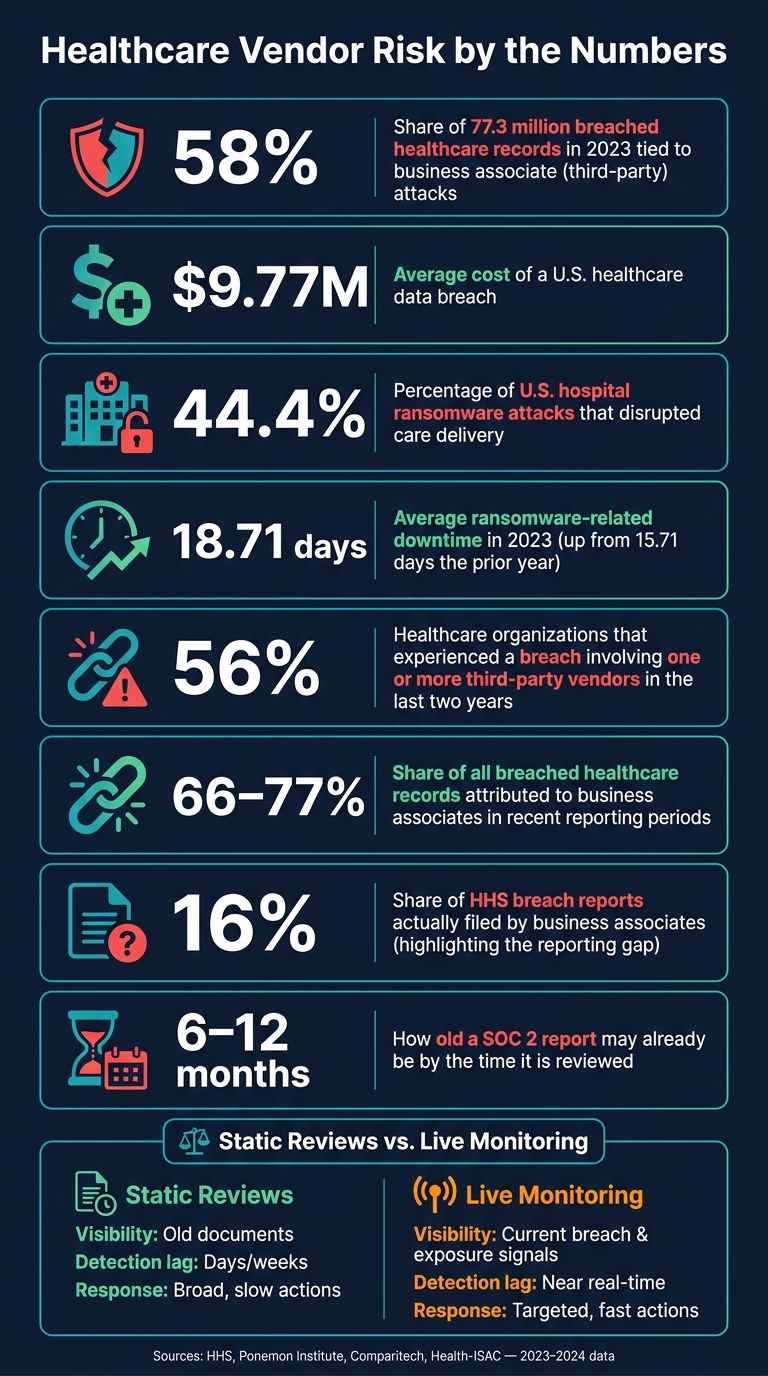
Healthcare Vendor Risk by the Numbers: Why Real-Time Monitoring Matters
Where Legacy Vendor Risk Assessments Fall Short in Healthcare
Static Assessments Miss Fast-Moving Vendor Exposure
Most healthcare organizations still lean on questionnaires, annual reassessments, BAAs, SOC 2 reports, and cyber insurance checks. The problem is simple: these tools show a vendor at one moment in time, not what changed months later.
By the time a SOC 2 report gets reviewed, it may already be 6–12 months old. Cyber insurance shows that a vendor has coverage. It does not confirm that security controls are active today. And annual questionnaires only reflect what the vendor says about its own setup, not what an attacker might see right now.
In the gap between reviews, a lot can change. Vendors may update configurations, add new integrations, or take on new vulnerabilities long before the next review cycle starts.[1][2]
There’s another blind spot too: these tools don’t show what’s visible from the outside.
Limited Outside-In Visibility Delays Breach Awareness
Questionnaires and vendor documents are self-reported. They don’t expose open ports, exposed services, misconfigured apps, stolen credentials, leaked API keys, or compromised VPN accounts.[3]
Without outside-in monitoring, teams often find out about a compromise only after a formal breach notice arrives. By then, EHR access, claims processing, or care workflows may already be at risk. That kind of delay pushes response into reaction mode.[6]
The numbers make the gap hard to ignore:
- Business associate breaches made up 66–77% of all breached healthcare records in recent reporting periods.
- Yet business associates filed only 16% of HHS breach reports in 2024.[6]
A signed BAA shows there’s a legal duty in place. It doesn’t show whether that duty is being carried out in day-to-day operations right now.[7]
In healthcare, that lag doesn’t stay on a spreadsheet for long. It can turn into a patient-care issue fast.
Healthcare Supply Chains Amplify the Impact of Slow Detection
When a critical vendor goes down, the damage rarely stays contained. In U.S. hospitals, 44.4% of ransomware attacks disrupted care delivery.[4] Average ransomware-related downtime hit 18.71 days in 2023, up from 15.71 days the year before.[5]
And once systems stall, the ripple effects hit hard. EHR access can disappear. Imaging and PACS workflows can freeze. Billing platforms can go offline. Staff may have to fall back to manual downtime procedures like paper charts, handwritten orders, and offline medication tracking.
Slow detection stretches out both disruption and recovery. Real-time visibility is what helps close that gap.
That’s why live threat intelligence needs to be part of vendor response workflows.
sbb-itb-535baee
How Real-Time Threat Intelligence Strengthens Vendor Risk Insights
Continuous Monitoring Replaces Annual Snapshots
Once teams see that legacy reviews miss fast-moving exposure, the next move is simple: use live signals and act on them.
Continuous monitoring swaps annual snapshots for live vendor risk profiles. That means watching for signals like newly disclosed breaches, exposed remote access ports, misconfigured cloud storage, expired TLS certificates, and leaked credentials. Any one of those issues can shift a vendor’s risk level between reviews. In healthcare, that kind of shift doesn’t just change a security rating. It can hit clinical continuity. For Tier 1 vendors tied to EHRs, PACS, or medication management, any change should trigger an immediate review.
Dynamic Risk Scoring Helps Teams Focus on Critical Vendors First
Dynamic risk scoring helps teams decide where to look first by combining vendor criticality with current threat signals. For example, a cloud-based scheduling platform with a new credential leak and prior incidents should rank above a low-access administrative vendor with no known exposure. That’s the difference between a vendor that can wait and one that could disrupt care today.
When scores change, priorities change too. Dynamic scoring moves Tier 1 vendors to the top of the queue, especially when their scores jump. And the case for this is hard to ignore: 56% of healthcare organizations reported a data breach introduced by one or more third-party vendors in the last two years [8]. A scoring model based on current conditions - not third-party risk assessments based on last year’s questionnaire answers - is no longer optional.
Once a score shifts, teams need automated routing so they can respond before the risk spreads.
Automated Alerts Support Faster Cross-Functional Response
Detection only matters if it leads to action. Automated alerts should route issues to security operations, third-party risk, privacy, legal, and clinical operations at the same time. If a Tier 1 alert goes unacknowledged within 2 to 4 hours, it should escalate to senior leadership or the on-call risk committee. That setup keeps response from getting stuck and turns detection into coordinated action.
Those alerts should also feed straight into incident response priorities for vendors that support patient care.
Applying Live Intelligence to Healthcare Supply Chain Incident Response
Map Vendor Intelligence to the Incident Response Lifecycle
When an alert fires, it needs to move straight into the incident response playbook.
Live vendor intelligence should shape every stage of response, but not in the same way each time. In preparation, teams need a central vendor inventory that stays current. That inventory should sort suppliers by patient care impact, PHI exposure, and operational dependence. From there, those categories should connect to monitoring feeds and prebuilt playbooks.
During detection and analysis, live signals like dark web chatter, exploit activity, vulnerability disclosures, and vendor breach reports should kick off an investigation. Teams can then match those alerts with internal logs from EHRs, VPN gateways, and vendor APIs to see whether the threat is just possible or already active.
Containment gets much easier when response actions are approved ahead of time and tied to vendor criticality. Instead of stopping to debate the next move, teams can carry out preset actions such as suspending interfaces, enforcing network segmentation, or restricting elevated accounts. Live intelligence helps narrow the scope, so teams can decide whether to act broadly or target one part of the environment.
Recovery also moves faster when teams can check patch status and remediation progress in near real time. After the incident, intelligence should feed back into vendor tiering, alert thresholds, and procurement rules, including vendor SOC reports and continuous monitoring obligations. This process often begins by standardizing third-party risk assessment questions to ensure baseline security across the supply chain.
Procurement guidance also says organizations should keep an up-to-date directory of critical suppliers, maintain a supplier incident-reporting portal, and treat supplier-reported incidents with the same level of seriousness as internal ones[11]. That point matters. A vendor incident is an operational event, not something to toss over the wall.
Prioritize Actions for Vendors That Support Patient Care
Once the lifecycle is mapped, the next move is triage based on clinical impact.
A marketing platform can wait. An EHR, medication, or device vendor cannot.
When live intelligence shows higher risk for a high-priority clinical vendor, the response needs to move faster and pull in more people. This is not just an IT security issue. Clinical operations, biomedical engineering, privacy, and supply chain leadership all need visibility. Health Industry Cybersecurity Supply Chain Risk Management guidance also recommends giving suppliers primary and backup contacts, and notifying employees who work with the affected vendor during an incident[12].
For vendors connected to EHR access, PHI storage, imaging platforms, or high-dependence supply chain services like pharmacy distribution or blood products, teams should have downtime procedures ready to go. That includes paper-based documentation, alternate lab result delivery, and backup imaging workflows. Those workarounds should be tested before an incident happens, not made up on the fly.
If intelligence points to credential compromise or malicious activity, suspend access and revoke API keys fast. Clinical leaders should coordinate the change so care teams can shift to manual workflows in an orderly way[9][10][12].
Contain only the compromised component. Keep the rest online when the intelligence supports that call.
Comparison Table: Point-in-Time Vendor Response vs. Intelligence-Driven Response
The gap becomes easiest to see during an active incident. At that point, speed and precision are tied directly to patient safety.
| Dimension | Point-in-Time Vendor Response | Intelligence-Driven Response |
|---|---|---|
| Detection speed | Relies on scheduled reviews or vendor self-reporting; incidents may surface days or weeks after onset | Continuous monitoring and live risk scoring surface vendor issues within hours or in near real time |
| Visibility into vendor exposure | Limited to questionnaire answers and prior attestations; blind to new vulnerabilities or shifting attack patterns | Ongoing visibility into vulnerabilities, exploit activity, breach reports, and configuration changes |
| Prioritization of critical suppliers | Vendors often treated broadly or by assessment date, with little differentiation for clinical impact | EHR, PHI, clinical app, connected device, and key supply chain vendors are tiered and monitored with higher alert sensitivity |
| Containment support | Containment decisions based on outdated risk data, often requiring broad shutdowns to stay safe | Targeted containment guided by current intelligence - selective segmentation or feature suspension reduces disruption |
| Patient care continuity | Higher likelihood of unplanned outages or overly broad restrictions that disrupt clinical workflows | Informed decisions preserve core patient care functions; tested workarounds activate faster |
| HIPAA readiness | Retrospective documentation, often incomplete or delayed due to late detection | Timely, well-documented responses with richer context support HIPAA-compliant vendor risk management and breach notification timelines |
Putting Real-Time Threat Intelligence for Vendor Risk into Practice with Censinet
How Censinet RiskOps Supports Continuous Healthcare Vendor Oversight
Censinet RiskOps™ is built for healthcare. It helps teams keep watch over vendors that handle PHI, clinical applications, medical devices, and supply chain operations.
When a vendor signal changes, that alert needs to land inside the same workflow teams already use to respond. Censinet RiskOps pushes those signals into one workflow shared by procurement, security, and clinical stakeholders. So if a vendor’s exposure changes because of a newly disclosed vulnerability, a service disruption, or a shift in a fourth-party dependency, triage and response can move in sync instead of on separate tracks.
Speed only helps if teams can get through assessment data fast enough to do something with it.
How Censinet AI and Censinet AI™ Speed Assessment Workflows
Censinet AI™ helps speed assessments by pre-filling questionnaires, summarizing evidence, capturing integration details, flagging fourth-party exposures, and drafting risk summaries. Security and compliance teams still keep final approval, and evidence validation and mitigation still move through controlled workflows.
That matters even more for vendors tied to an active incident response. In those moments, the governance layer helps keep AI-assisted workflows with human approval lined up with the speed and precision patient care decisions require.
The goal isn’t just a faster review. It’s faster decision-making and the future of GRC in healthcare.
Conclusion: Moving from Static Reviews to Resilient Vendor Risk Operations
Point-in-time reviews give teams a baseline. Real-time threat intelligence shows what changed, helps teams focus on critical vendors, and speeds a coordinated response before issues disrupt care.
When Attackers Choose Your Vendors: Dark Web Intelligence for Third-Party Risk | Bitsight
FAQs
How is real-time vendor monitoring different from annual reviews?
Annual vendor reviews give you a fixed snapshot in time. That snapshot can help, but it doesn't stay current for long. Ownership can change. Hosting can shift. A vendor's security posture can look different a few weeks or months later.
Real-time monitoring works differently. It gives healthcare organizations continuous oversight by tracking incidents, vulnerabilities, and day-to-day operational changes as they happen. That means teams can spot risk sooner, act sooner, and keep an up-to-date view of security.
Which vendors should I monitor most closely first?
Prioritize vendors by clinical criticality, not just IT importance. With Censinet RiskOps™, you can rank suppliers based on how much an outage could disrupt patient care.
Tier 1 vendors that support life-critical systems, such as EHRs, imaging, pharmacy, and emergency department workflows, should be watched first. If a new threat shows up, these vendors need immediate triage and remediation. Lower-tier vendors can wait for a scheduled review.
What should I do when a high-risk vendor alert appears?
Move fast to protect patient care and sensitive data. Start by ranking the response based on the vendor’s clinical criticality and the effect on PHI, then use pre-defined playbooks for triage, leadership notification, and remediation.
The level of severity should guide what happens next. You may need to reassess the vendor, review contracts, update your risk register, or step up monitoring. Censinet RiskOps™ can help by bringing risk data into one place and automating workflows.
