
If you use AI with EU or UK patient data, GDPR is the base rule set - but it is not enough by itself. I’d treat this as a 6-part stack: GDPR for law, ICO for AI-specific data protection guidance, NHS England for clinical governance, WHO for ethics, OECD for policy and data governance, and ENISA for security controls.
A few facts make this urgent. The article cites 265 healthcare and life sciences fines across 27 countries, totaling about €32.3 million, and says 100 fines were tied to weak technical and organizational measures. It also notes that healthcare fines in 2025 were 26% higher than the prior reporting period.
If I had to reduce the whole article to a short checklist, it would be this:
- Map Article 6 and Article 9 separately for each AI use case
- Run a DPIA before high-risk processing
- Keep human oversight for patient-facing or clinical decisions
- Review third-party risk for vendors as processors, with tight contract terms
- Use security controls like encryption, MFA, logging, segmentation, and testing
- Update reviews after model changes, retraining, or new features
- Track model performance by patient group and keep records you can show to regulators
This article compares all six frameworks across the same core questions:
- How specific is it to healthcare?
- Does it cover the full AI lifecycle?
- How strong is it on DPIA and accountability?
- How useful is it for security and vendor risk?
Quick Comparison
| Framework | Main role | Best use |
|---|---|---|
| GDPR | Legal baseline | Lawful basis, Article 9, DPIA, controller duties |
| ICO | AI data protection guidance | Explanations, human review, bias checks, vendor review |
| NHS England | Clinical governance | Clinical safety, named oversight roles, procurement checks |
| WHO | Ethics for health AI | Autonomy, equity, transparency, safety |
| OECD | Policy and health data governance | Secondary use rules, governance councils, named owners |
| ENISA | Cybersecurity and privacy controls | Procurement, cloud controls, segmentation, backups, deletion |
My short take: if you’re a U.S. hospital, vendor, research group, or digital health company touching EU patient data, start with GDPR + ICO, borrow NHS England for clinical process, and use ENISA for the security layer. WHO and OECD help shape governance where the law is less specific.
That gives you a simple way to read the rest of the article: each framework solves a different part of the same AI compliance problem.
sbb-itb-535baee
1. GDPR Core Compliance Framework
GDPR is the legal baseline. Under Article 9, it treats health data as special-category personal data, which means healthcare AI needs tighter controls.
Healthcare specificity
For each AI use case, map Article 6 and Article 9 separately. That applies whether the system is a triage algorithm, a risk prediction model, or an imaging tool.[8][6] This matters because the legal basis for using data and the extra conditions for handling health data are not the same thing.
Also, pseudonymized training data is still personal data under GDPR. So even if names and direct identifiers are stripped out, GDPR still applies.[17][25]
AI lifecycle coverage
GDPR’s core principles apply across the full AI lifecycle: lawfulness, fairness, transparency, purpose limitation, data minimization, accuracy, storage limitation, integrity and confidentiality, and accountability.[6][21][24]
In practice, that means the rules follow the system from start to finish.
- During design, set a clear and limited purpose.
- During training, use only the data features the model actually needs and apply de-identification or pseudonymization where feasible.
- During deployment, tell people when AI supports care and what role it plays.[11][8]
- During monitoring, log outputs, track performance by patient group, and review retention periods.[6][11]
If that sounds broad, it is. GDPR doesn’t just look at data collection. It reaches into how the model is built, used, checked, and kept under review.
DPIA and accountability
A Data Protection Impact Assessment (DPIA) is required under Article 35 before high-risk processing, and AI that uses health data at scale will usually meet that bar.[8][10]
A compliant DPIA must:
- describe the processing and its purposes
- assess necessity and proportionality
- evaluate risks to individuals’ rights and freedoms
- document the measures planned to address those risks[15][16]
For healthcare AI, that usually means dealing with bias in training data, explainability issues, model drift, and security weaknesses.[6][8][11]
The accountability principle in Article 5(2) goes a step further. It makes the healthcare organization, acting as the data controller, responsible for showing compliance, not just saying the right controls are in place.[4][6][19][20][21] In other words, the burden sits with the hospital or health system to prove its homework is done.
DPIAs also are not one-and-done documents. They should be reviewed and updated when the AI system changes in a major way, such as after retraining or a feature expansion.[7][5]
Security and vendor risk
When a hospital or health system uses a third-party AI platform, the vendor is usually the data processor. The healthcare organization remains the data controller and keeps responsibility for the lawfulness and security of the processing.[8][12][13][19][23]
Article 32 requires technical and organizational measures that fit the risk. That includes encryption, access controls, MFA, logging, and penetration testing.[8][9][18][22][24][25]
Data Processing Agreements should spell out:
- processing instructions
- security duties
- breach notification timelines
- subprocessor lists
- audit rights
GDPR also requires breach notification within 72 hours of becoming aware of a breach.[12][13][22]
For AI programs that rely heavily on vendors, third-party risk management assessments and shared risk management can help cut exposure.
The next framework turns these GDPR duties into regulator guidance for AI use in day-to-day practice.
2. ICO AI and Data Protection Guidance
The ICO turns UK GDPR into practical rules for AI, with a sharp focus on fairness, transparency, and accountability. In healthcare, that matters most when patient data, automated decisions, and third-party AI tools all meet in the same workflow.
For U.S. healthcare organizations, this guidance matters when they process UK patient data or provide AI-powered services to UK patients.
Healthcare specificity
The guidance is not written just for healthcare. Even so, NHS bodies use it for AI that handles patient data, and it treats large-scale health-data processing, automated clinical decisions, and risk stratification as high risk. One point from the ICO stands out here: organizations need to assess whether an AI method is more or less risky than a non-AI option, then document why a lower-risk option was not selected.[29]
That changes the conversation. It’s not enough to say, “We used AI because we could.” You need a clear reason for using it in the first place.
AI lifecycle coverage
The ICO goes past the basic GDPR starting point and adds checks across the AI lifecycle.
- Design and training: Training data needs to reflect the patient groups the model will affect, and models need testing for discriminatory impacts.[2][27][29]
- Deployment: Organizations need to give clear explanations of AI-assisted decisions and keep a way for patients to challenge automated outcomes.[4][28]
- Post-deployment: The ICO expects regular risk reviews, updated DPIAs after major changes, and active monitoring for discriminatory impacts.[4][29]
NHS England takes these ICO principles and pushes them into day-to-day governance for providers.
DPIA and accountability
The ICO says most healthcare AI requires a DPIA.[4][29] If high residual risk cannot be lowered, the organization must consult the ICO before processing starts, and the ICO aims to respond within six weeks.[31][32] Organizations also need to record the DPO’s view, state whether each risk was eliminated, reduced, or accepted, and note whether ICO consultation is needed.[4]
In plain English, the paper trail matters. If a regulator asks, “What did you know, when did you know it, and what did you do about it?” the record should answer that.
Security and vendor risk
For AI, the ICO pays close attention to controls that guard against re-identification, model inversion, and unauthorized inference.[4][29] On the vendor side, healthcare organizations need to review how AI vendors design and train their models, which data sources they use, how they handle security, and how they support patient rights.[2][3][26][27]
Contracts should clearly define controller and processor roles, spell out data-processing details, and include sub-processor controls plus incident response commitments.[1][30]
The next framework takes these ICO rules and turns them into working NHS governance.
3. NHS England AI and Data Protection Governance
Building on ICO guidance, NHS England turns UK GDPR and the Data Protection Act 2018 into day-to-day governance rules for clinical settings. It also adds NHS-specific requirements, including the Data Security and Protection Toolkit (DSPT), the clinical safety standards DCB0129 and DCB0160, and the Digital Technology Assessment Criteria (DTAC). Compliance with DCB0129 and DCB0160 is a legal requirement under the Health and Social Care Act 2012, not just a matter of best practice.[40][41]
Healthcare specificity
This is where NHS governance becomes much more tied to clinical work. It assigns named people to AI oversight, instead of leaving accountability vague.
Caldicott Guardians advise on the proper use of health data, while clinical safety officers oversee hazard analysis and safety cases for AI used in diagnosis or treatment.[44][40] Every NHS organization must appoint a Caldicott Guardian, which puts data-governance oversight inside AI governance from the start.[44]
For AI tools that directly support clinical decisions, such as imaging triage and clinical decision support, NHS England expects a DTAC assessment before go-live. That assessment covers:
- Clinical safety
- Data protection
- technical security
- Interoperability
- Usability[43][42]
AI lifecycle coverage
In practice, NHS governance applies across the full AI lifecycle: procurement, deployment, and monitoring.
During design and procurement, organizations need to map data flows, assign controller and processor roles, and write those duties into contracts. Before deployment, DPIAs, cybersecurity assessments, and clinical safety reviews must be finished.[1][34][35][36] After go-live, AI risk should be tracked in existing risk registers and reviewed on a regular basis.
DPIA and accountability
NHS policy is direct on this point: any AI system that processes patient data must have a DPIA completed before implementation.[3][38]
What NHS England adds beyond the GDPR and ICO baseline is board-level sign-off and a requirement to keep the DPIA under review over time.[45][47] NHS England also backs the publication of DPIA summaries for major deployments as a way to show transparency.[37][39]
Security and vendor risk
Every supplier, data processor, and joint controller that handles NHS patient data, including AI vendors, must complete the DSPT.[2][30]
Contracts must include clear security and data protection duties. NHS organizations are also expected to check that third-party connections and hosted data meet NHS security and information governance rules.[46]
That operational layer sets up the broader ethics and governance view in the WHO framework.
4. WHO Ethics and Governance of AI for Health
NHS England is centered on clinical operations inside one national health system. The WHO framework steps back and looks at the bigger picture: global health ethics, not one country’s rulebook. It is the broadest and least legally specific framework in this set. GDPR sets legal duties. WHO sets the ethical bar for using AI in health in a responsible way.
Published in 2021 and later extended for large multimodal models (LMMs), the WHO Ethics and Governance of Artificial Intelligence for Health framework is built on six core principles: protect autonomy; promote human well-being, safety, and the public interest; ensure transparency, explainability, and intelligibility; assign responsibility and accountability; ensure inclusiveness and equity; and promote adaptable, sustainable AI.[49][51][52] For GDPR teams, WHO adds an ethical governance layer. It does not replace legal compliance.
Healthcare specificity
The WHO framework is built for clinical care, public health, and health system operations, not general AI use.[52] It ties its principles to clear health use cases such as diagnostic decision support, triage, and population-level surveillance.[49][51][52]
Protecting autonomy means keeping clinicians in control, getting valid consent, and guarding privacy and confidentiality.[50][51] Promoting human well-being and safety is linked to clinical safety, accuracy, and efficacy for AI used in diagnosis, treatment selection, or care allocation.[50][49]
WHO also puts a strong focus on global health equity. It calls for access that reaches both lower-resourced countries and vulnerable groups.[49][52] That matters for U.S. health systems too, especially those serving mixed and varied patient communities. In day-to-day terms, this points to subgroup testing, bias review, and fair deployment across patient populations.
AI lifecycle coverage
WHO expects ethics, human rights, safety, and data protection to be built into the full AI lifecycle: design, validation, deployment, and monitoring.[48][51] That idea is simple but easy to miss. You can’t bolt this on at the end.
For large multimodal models, WHO also recommends mandatory post-release auditing and impact assessments, often carried out by independent third parties, with reporting broken out by age, race, and disability.[53][55]
Security and vendor risk
WHO treats health data as sensitive and expects strong access controls, encryption, logging, and continued vendor privacy review.[48][50][54] Its governance guidance also says public and private stakeholders should secure AI systems across clinical applications, medical devices, and vendor ecosystems.
Censinet RiskOps™ can help put these expectations into practice through third-party risk assessments, cybersecurity benchmarking, and shared risk management across clinical applications, medical devices, and vendor ecosystems.
The OECD framework narrows this ethical lens into policy-level health data governance and cross-border principles.
5. OECD Health Data Governance and AI Principles
Where WHO sets the ethical bar, OECD brings those ideas into policy and risk management. It offers two main tools for health data and AI governance: the Recommendation on Health Data Governance from 2016 and the OECD AI Principles. They aren't legally binding, but they turn GDPR duties into something teams can actually work with day to day. That includes lawful use, transparency, data minimization, security, and accountability across health data governance and AI lifecycle management. For U.S. healthcare organizations handling data from EU data subjects, these tools are especially handy when mapping DPIAs, privacy by design, and vendor oversight.[56][59][60]
Healthcare specificity
The Health Data Governance Recommendation is built for health data systems in particular. That's what makes it a useful middle layer between GDPR on paper and what staff need to do in practice. It supports the availability and use of personal health data for health-related public interest purposes while still protecting privacy and data security. It applies to personal health data used in care delivery, public health, research, statistics, and health system management.[56][57][64][62]
Its 12 principles focus on:
- stakeholder engagement
- lawful use
- transparent review
- public communication
- monitoring
- privacy and security safeguards[56][64]
For U.S. healthcare organizations, this points to a few concrete steps: set up a formal health data governance council, write clear rules for secondary use of clinical data in AI training, and create patient communication channels that explain how data is used in AI tools.[56][58][61]
AI lifecycle coverage
The OECD AI Principles apply across the full AI lifecycle, from data collection and model development to deployment and ongoing monitoring.[60][63] Their five core values are inclusive growth and well-being; respect for rule of law, human rights, and privacy; transparency and explainability; robustness, security, and safety; and accountability.[60]
OECD risk management follows the same full-lifecycle logic: define scope, assess risks, treat them with controls, and govern through ongoing monitoring and documentation.[58][65] In plain English, it treats AI governance as a living process, not a box you check once and forget. That lines up well with GDPR records of processing activities and DPIA outputs, so compliance work can feed straight into day-to-day AI oversight.[60][61]
DPIA and accountability
The Recommendation works a lot like a DPIA framework. It calls for transparent project review, clear information, and ongoing monitoring. The OECD AI Principles make accountability direct: AI actors must be responsible for the proper functioning of AI systems and for respecting human rights and privacy through the full lifecycle.[56][64][60][63]
In practice, that means giving every AI system that affects patients a named human owner. That includes diagnosis support, triage, and resource allocation tools. It also means keeping logs of model versions and decisions.[66][67]
A multidisciplinary review committee can help do this in a structured way. Think clinicians, data scientists, privacy officers, and patient representatives at the same table. Before any high-risk AI project goes live, that group can review lawful bases, data minimization, fairness, explainability, and security.[56][61][63]
Security and vendor risk
The Recommendation calls on governments and health systems to support strong technical, physical, and organizational safeguards for personal health data. That includes accreditation or certification of health data processors, plus risk assessments for data linkages and possible breaches. The OECD AI Principles back this up with a clear focus on robustness, security, and safety: AI systems should be resilient against attacks, errors, and misuse.[71][70][60][63]
Under GDPR, controllers still carry responsibility for their processors' compliance. So vendor oversight isn't optional. OECD guidance expects vendors of AI and digital health tools to show alignment with health data governance frameworks and AI principles, including transparency, robustness, and accountability. Healthcare organizations should build those checks straight into procurement and contracting.[72][68][69]
ENISA then turns these governance expectations into healthcare cybersecurity and privacy controls.
6. ENISA Cybersecurity and Privacy Guidance for Healthcare AI
ENISA turns governance expectations into technical and purchasing controls for healthcare AI. It draws from publications such as Cybersecurity and Privacy in AI – Medical Imaging Diagnosis, Cyber Hygiene in the Health Sector, Cybersecurity and Resilience for Smart Hospitals, and Procurement Guidelines for Cybersecurity in Hospitals. This section breaks those controls into lifecycle, accountability, and vendor-risk duties.[83][86][87]
Healthcare specificity
ENISA treats healthcare as a high-risk sector and shapes its controls around electronic health records, imaging systems, clinical workflows, and hospital infrastructure.[75][77][81]
Its baseline is pretty clear: regular patching, secure backups, multi-factor authentication, network segmentation, and staff awareness training. Those controls also support GDPR security duties.[75][77][78]
AI lifecycle coverage
ENISA uses a three-layer model: core IT and cloud security, AI-specific controls, and healthcare-specific requirements.[79][88] That setup matters because AI risk shifts as the system moves from one stage to the next. A hospital can start with basic cyber hygiene, then add AI protections such as data poisoning prevention and model theft controls, and then add clinical safety oversight plus protection for health data and medical devices.[79][83]
Lifecycle coverage runs from data acquisition through decommissioning. During training, ENISA recommends confidential computing techniques, tight pipeline governance to prevent poisoning or leakage, and strict access controls for training datasets. At deployment, it puts weight on secure integration with legacy systems and continuous monitoring for unusual model behavior. When a system is retired, the data return and deletion steps should be documented.[78][80][82]
DPIA and accountability
ENISA explicitly calls for privacy and data protection assessments in healthcare AI projects, lining up closely with GDPR Article 35's DPIA requirement for high-risk processing.[76][78] Its medical imaging AI guidance also recommends justifying each data field in the privacy policy, setting retention policies that fit clinical needs, and identifying all processors involved in medical data handling.[78]
Accountability is built through documentation of data flows and processing decisions.[76][78]
Security and vendor risk
ENISA treats procurement as part of compliance, not a separate task. Its procurement guidance says healthcare organizations should ask vendors whether and how AI is used in their products, the intended purpose and scope, what data flows are involved, and where data is stored.[73]
Contracts should map GDPR, NIS2, and medical device requirements. Vendors should also provide evidence of controls such as tenant isolation, logical segmentation, and approved data localization.[73][76] Keeping an up-to-date critical supplier inventory covering cloud providers, imaging device manufacturers, and AI software vendors is a core expectation.[73][84]
For U.S. healthcare organizations using cloud-based AI that processes EU patient data, ENISA's cloud guidance adds contract terms for incident reporting, data location, and secure deletion.[14][85] Censinet RiskOps™ can centralize vendor evidence and benchmark risk across AI systems and suppliers, which helps third-party AI oversight across the supply chain.[73][76]
How the Frameworks Compare
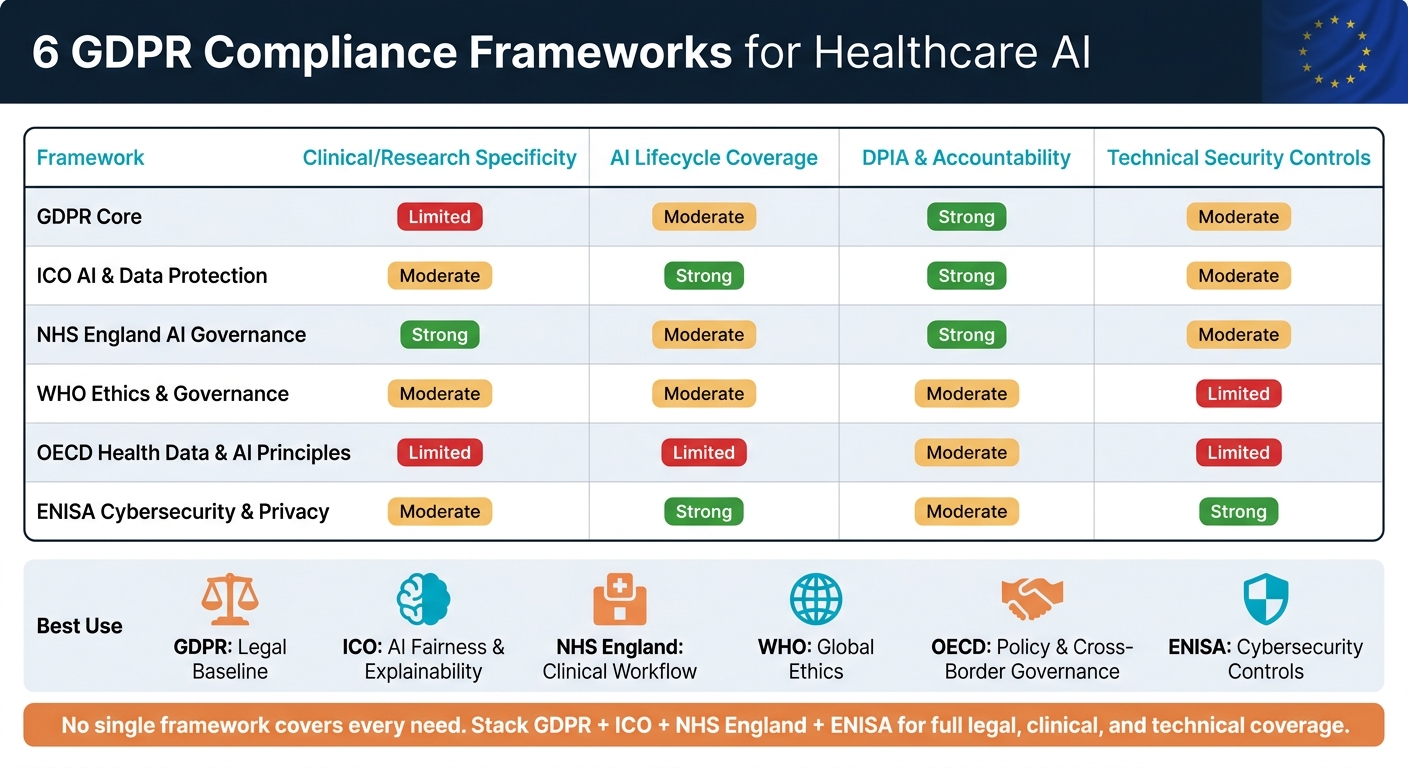
6 GDPR Compliance Frameworks for Healthcare AI: Side-by-Side Comparison
No single framework covers every healthcare AI compliance need. Each one does a different job. That’s why a side-by-side view helps: you can see where a framework fits, and where your own internal policy has to step in.
For healthcare AI teams, the main issue is pretty simple: does a framework help with legal basis, clinical workflow, technical controls, or governance oversight? The comparison below shows which framework is strongest for legal baseline, workflow execution, ethics, and security.
| Framework | Clinical/Research Specificity | AI Lifecycle Coverage | DPIA & Accountability | Technical Security Controls |
|---|---|---|---|---|
| GDPR Core | Limited | Moderate | Strong | Moderate |
| ICO AI & Data Protection | Moderate | Strong | Strong | Moderate |
| NHS England AI Governance | Strong | Moderate | Strong | Moderate |
| WHO Ethics & Governance of AI for Health | Moderate | Moderate | Moderate | Limited |
| OECD Health Data Governance & AI Principles | Limited | Limited | Moderate | Limited |
| ENISA Cybersecurity & Privacy Guidance | Moderate | Strong | Moderate | Strong |
In day-to-day use, GDPR and ICO set the legal base. NHS England turns that into clinical workflow. ENISA is the go-to for technical security. WHO and OECD help shape ethics and policy. That split matters because compliance often breaks down in the space between law, workflow, and security.
One detail stands out: ICO says organizations need to document whether an AI system is more or less risky than available alternatives[89]. That goes a step past what GDPR on its own asks for.
For U.S. healthcare organizations handling EU patient data, the practical move is to anchor on GDPR and ICO, use NHS England as an operations reference, and apply ENISA controls for technical and vendor risk assessment processes.
The next section weighs these strengths against their practical limits.
Pros and Cons of Each Framework
The table below lays out the tradeoffs. The goal is simple: match the framework to the compliance job it can actually handle.
| Framework | Pros | Cons | Best Fit |
|---|---|---|---|
| GDPR Core | Legally binding; strong DPIA and accountability requirements; directly enforceable | Not AI-specific; broad principles are hard to turn into concrete AI controls; a heavy lift for teams managing hundreds of processing activities [90] | Any U.S. entity processing EU patient data - hospitals, telehealth platforms, AI vendors |
| ICO AI & Data Protection | AI-focused guidance on fairness, explainability, and human oversight; includes usable checklists and governance tools | Built around UK GDPR and UK regulatory structures, so U.S. groups need to map it with care to their own legal and operating setup | U.S. AI vendors and health systems deploying high-risk models |
| NHS England AI Governance | Clinical AI playbooks; validation and safety checks; vendor-contract detail | Assumes NHS-specific roles such as Caldicott Guardians and more centralized governance; needs heavy tailoring for fragmented U.S. health systems | Large integrated delivery networks and academic medical centers building AI oversight committees |
| WHO Ethics & Governance | Global ethics framework; clear principles for autonomy, safety, transparency, accountability, equity, and sustainability | Not legally binding; high-level principles can be hard to turn into measurable controls or audit criteria | Multinational research networks, global telehealth platforms, and public health AI programs |
| OECD Health Data & AI Principles | Useful for cross-border governance and privacy-safe secondary use in research | Soft law only; no operational checklists or DPIA guidance; organizations must build their own controls | Life sciences companies and research collaborations using EU-sourced data for AI training |
| ENISA Cybersecurity & Privacy Guidance | Strong technical controls for encryption, access management, segmentation, incident response, and monitoring | Highly technical; some recommendations may be beyond the budget of many U.S. hospitals; needs expert interpretation to line up with U.S. regulatory programs | Large hospitals, health systems, and clinical SaaS vendors securing AI infrastructure that processes EU health data |
The hard part isn't the theory. It's the day-to-day work of putting these frameworks into practice.
Most teams don't get to run six separate compliance programs. They have to turn all of this into one internal control set that privacy, security, legal, procurement, and model governance teams can all use. That's where things get messy. Healthcare privacy teams often manage hundreds of processing activities [90], and DPIAs should be updated after material model changes [25][90][91][92].
In plain terms, a framework may look solid on paper, but if your team can't map it to vendor reviews, model updates, access controls, and audit steps, it won't help much. Censinet RiskOps™ can centralize third-party and enterprise risk assessments, vendor controls, and cybersecurity benchmarks.
Conclusion
GDPR sets the legal baseline. But in healthcare AI, legal compliance alone isn't enough. You also need clear governance for model oversight, secure data pipelines, and vendor risk.
The goal is simple: use the lightest framework stack that still covers legal, clinical, and technical risk. For a small clinic, that may mean basic GDPR controls. For a large health system, it usually means formal AI governance. And for vendors, it means product-level governance tied to how the tool is built, tested, and monitored.
For U.S. healthcare organizations that process EU patient data, the main priorities are pretty clear. Document data flows. Build privacy by design into the AI architecture from day one. Assign cross-functional ownership. And keep managing vendor risk over time.
That matters even more when EU patient data moves through third-party AI tools or cloud services. Any vendor handling that data needs a legally binding data processing agreement, a completed DPIA, and documented security controls.[1][33] Censinet RiskOps™ can centralize third-party risk assessments, cybersecurity benchmarking, and collaborative risk workflows.
Used together, GDPR, ICO, NHS England, WHO, OECD, and ENISA create a complementary control stack. In practice, these frameworks help turn GDPR duties into day-to-day governance, security, and accountability controls.[51][57][74]
FAQs
Which framework should we start with first?
Start with Scope & Map. Figure out where GDPR touches your AI use case by auditing and inventorying every system, vendor, and device that handles EU personal data. That includes looking closely at how your workflows take in, process, and share health data.
Once that picture is clear, move to Align & Document. Match each processing activity to the right lawful basis under Article 6 and the right health-data condition under Article 9, then document those decisions in a way your team can actually use.
When does a healthcare AI project need a DPIA?
Under GDPR, a Data Protection Impact Assessment (DPIA) is required before any processing that is likely to create a high risk to people’s rights and freedoms.
In healthcare AI, that often means new tools like AI-driven clinical decision support, remote patient monitoring, large-scale processing of sensitive health data, or apps that could have a major effect on patient privacy.
The timing matters. You need to complete the DPIA before processing begins, then update it if the technology, the risks, or the processing changes.
How do we apply these rules to AI vendors?
Apply GDPR to AI vendors as part of your own compliance exposure. In plain terms, you still carry the responsibility for checking that vendors have solid security and handle data the right way. If a vendor manages processing on your behalf, record that work in your Records of Processing Activities.
Before you use high-risk AI tools, run a Data Protection Impact Assessment. Your contracts should spell things out with a Business Associate Agreement or Data Processing Agreement. It also helps to look beyond the vendor itself:
- Review fourth-party risk
- Monitor security on a steady basis
- Track performance over time
- Stay ready for audits
This isn’t just paperwork. If an AI vendor mishandles data, regulators won’t shrug and say, “Well, that was the vendor.” They’ll look at your oversight too.
