
AI can help you track, explain, update, and enforce patient consent at scale - but only if legal rules, human review, and security controls are built in from day one.
If I had to sum up the article in a few lines, I’d put it this way: patient consent is no longer just a signed form. It now covers notice, choice, version control, withdrawal, downstream use, retention, and proof. And once health data moves through EHRs, analytics tools, vendors, and model pipelines, manual tracking starts to break down fast.
Here’s the short version of what matters:
- Consent is only one legal path. Under HIPAA, many treatment, payment, and health care operations uses do not need authorization. Under GDPR/UK GDPR, some AI uses may need explicit consent or another legal basis.
- AI helps most with explanation and tracking. It can simplify forms, answer patient questions, flag when re-consent may be needed, and check logs for missing or mismatched records.
- Withdrawal is where many programs fail. One review found 44.7% of AI-related clinical trial consent forms did not explain what happens to data after withdrawal, and only 3.5% gave participants any choice.
- Human review still matters. AI can suggest, route, and flag. People should still review high-risk cases, especially when consent status changes affect research, data sharing, or notice updates.
- Vendor and security controls matter just as much as the consent screen. Prompt logs, embeddings, weak access settings, and outside AI tools can put PHI at risk if controls are weak.
- The best setup maps each duty to a control and an owner. That includes logging, access limits, revocation flow, vendor terms, and review dashboards.
A few numbers stand out:
- A 2025 scoping review found AI-supported tools can improve patient understanding and workflow speed when the consent setup is built correctly.
- A 2024 study found GPT-4 lowered surgical consent form reading level from about grade 13 to grade 8 while keeping the clinical meaning.
- In one genomic research program, a chat-based consent tool cut median time from referral to consent from 16 days to 5 days.
Bottom line: if you use AI in consent management, I’d treat it as a governance system, not just a form tool. The article shows that the hard part is not asking for consent. It’s making sure that choice stays accurate and enforceable everywhere the data goes.
Informed Consent and AI in Healthcare
sbb-itb-535baee
International consent rules that shape AI use
Healthcare teams need to map AI consent workflows to the rules that apply in each jurisdiction. And that matters because AI consent rules are not the same everywhere. Each use case needs its own legal basis.
The main issue isn't simply whether AI is involved. It's which consent action the AI controls.
GDPR, UK GDPR, HIPAA, OECD, and WHO requirements
Under GDPR and UK GDPR, health data is treated as special category data. That means the bar for valid consent is high. Consent must be freely given, specific, informed, and unambiguous. For many AI-driven health data uses, it also needs to be explicit. Patients must be able to withdraw consent just as easily as they gave it.
There is another limit too. Article 22 adds another constraint: solely automated decisions are allowed only in narrow GDPR exceptions, and extra safeguards apply.
HIPAA works differently. It does not usually depend on consent as the main mechanism for most health data use. Covered entities can use protected health information (PHI) for treatment, payment, and health care operations (TPO) without individual authorization. Written authorization is required for many uses outside that setup, including most marketing uses and some research or data-sharing activities, depending on the facts.
So a workflow that works under HIPAA for clinical triage may still need explicit consent under GDPR if the same data involves EU residents.
OECD privacy guidelines still shape health data governance. Their core principles include:
- purpose limitation
- transparency
- data quality
- security safeguards
- accountability
Those principles directly shape how consent records should be built and how downstream AI processing should be handled.
WHO guidance on AI in health puts special weight on transparency to patients and meaningful human oversight. WHO stresses transparency and meaningful human oversight.
Those rules shape when consent is needed and when another legal basis applies.
Consent versus other lawful bases for health data processing
Consent should not be the default legal basis for every AI use. If patients can withdraw consent at any time, organizations that depend on it for core clinical workflows can run into trouble when that happens. Some processing has to continue no matter what the patient prefers, such as billing, legally required reporting, or clinical record retention.
Direct care AI - like clinical decision support, prescription review, and diagnostic tools - usually relies on GDPR Article 9(2)(h) for health care under professional secrecy, rather than consent. Why? Because treatment-related processing usually doesn't need it.
Secondary analytics, model training, and cross-border transfers fall into a different bucket. The original collection purpose often does not cover later reuse. So organizations may need a new legal basis before that data is used in an AI model. That basis could be explicit consent, a scientific research basis with safeguards, or substantial public interest. Under HIPAA, TPO uses do not need authorization, but many outside analytics, marketing, research, or data-sharing uses do.
Use case and jurisdiction decide which basis is required.
| AI Use Case | GDPR/UK GDPR Basis | HIPAA Requirement |
|---|---|---|
| Clinical decision support | Article 9(2)(h) or another applicable health-care basis | No authorization needed for treatment-related uses |
| Secondary analytics / model training | Explicit consent or another lawful basis such as scientific research, with safeguards | Authorization or de-identification required |
| Marketing or external data sharing | Explicit consent | Written authorization required |
Cross-border transfers may call for separate notice, consent, or transfer controls. That's because transfer mechanisms, local health-data rules, and vendor roles can change whether a transfer is lawful, even when the original collection was compliant. That mapping shapes how AI can record consent, trigger updates, and enforce withdrawal.
How AI supports each stage of the patient consent lifecycle
Once the legal basis is in place, the next issue is day-to-day execution: how does AI handle consent from start to finish? At that point, consent management stops being just a paperwork task. It becomes a workflow task.
Using NLP and conversational AI to capture and explain consent
AI can make consent materials easier to understand without changing the authorization itself. In a 2024 study, GPT-4 simplified surgical consent forms from about a grade 13 reading level to an 8th-grade level in an AI-human collaborative workflow, while preserving the clinical content [4]. That matters because the tool changes how the information is presented, not what the patient is being asked to approve.
Conversational AI can go a step further. It can guide patients through consent notices section by section, answer questions in plain language, and explain terms as they come up. In a large-scale genomic research program, a chat-based informed consent tool cut the median time from referral to consent from 16 days to 5 days [5].
The line here is pretty clear: AI should adjust presentation, not substance. Purpose, data categories, recipients, retention, rights, and automated processing should stay fixed in an approved master notice. Plain-language versions can then sit on top of that for the patient-facing experience.
Managing updates, re-consent, and audit trails with AI
Consent doesn’t stay frozen. New models, new recipients, or new purposes can make the original consent no longer fit for use. AI systems can parse policy updates, data-sharing agreements, and model documentation to flag those changes and identify when a re-consent check is needed [2].
A solid audit trail needs more than a signed form sitting in storage. It should record:
- who presented the consent
- when it was presented
- which version of the notice was used
- what the patient agreed to
- any later changes or withdrawals
All of that should be timestamped in an immutable log. AI can add another layer by spotting anomalies, such as a consent date that comes before the form version it cites, or data being processed without a matching consent record, and then alerting compliance teams for review [8][10]. Those logs also create the record needed to carry out withdrawal and apply downstream limits.
Handling withdrawal, data minimization, and downstream controls
Withdrawal is one of the least explained parts of consent. A review of AI-related clinical trial consent forms found that 44.7% of 114 consents gave no explanation of how patient data would be handled after withdrawal, and only 3.5% gave participants any choice about that handling [7][11]. That gap creates both a compliance risk and a patient trust problem.
AI-enabled workflows can help close it. When a patient revokes consent, an AI engine can query metadata catalogs and data lineage logs to find where that patient’s data sits across internal systems, external vendors, analytics pipelines, and model training sets, then generate remediation steps [2]. For trained models, AI can help analyze training histories and assess the effect of removing specific records. But people still need to make the final call on what is feasible and what should be communicated when full deletion is not possible [2][3].
AI can also flag data that goes beyond the consented scope and stop it before downstream processing. In practice, that means keeping consent-linked identifiers throughout data pipelines so each analytic artifact knows which consents it depends on. If those consents change, the artifact can be blocked or sent for review. And once data moves beyond the consent system, those same flows turn into a governance and security issue.
These controls work only if governance, oversight, and risk management keep up with the automation.
Cybersecurity, governance, and risk controls for AI-based consent systems
Key risks in AI-driven consent systems
Once AI starts enforcing consent across connected systems, security and governance become the thing that holds the whole setup together. These tools handle PHI, so they need HIPAA-aligned controls across the full data pipeline. If those controls are weak, consent decisions may not hold up once data moves into downstream systems.
The main risks are fairly direct: PHI can leak through prompt logs, telemetry, or cloud-stored embeddings. Weak RAG access controls can expose records that should stay restricted. And the models themselves bring risks like prompt injection, inversion, and poisoning [15][18].
There’s also a practical problem here. These systems sit between patients, staff, and downstream records. So if access controls are weak or audit logging is incomplete, it can become hard to show who viewed consent data, who changed it, and when that happened [13][17].
Vendor reliance adds another layer of risk. If a third-party AI platform creates, receives, maintains, or transmits PHI for a covered entity, it will usually be treated as a business associate under HIPAA. That means a BAA is required. And that agreement should spell out key points like PHI use in training data, retention and deletion, subprocessors, audit rights, and limits on secondary PHI use [19][20][21][27].
Governance controls for compliance and human oversight
Before rollout, organizations should complete a documented risk analysis. That analysis should map where PHI enters the system, which models or vendors touch it, and how AI outputs affect consent records and downstream systems. It should also cover the type and amount of ePHI accessed, who receives the outputs, and how the data is disclosed [22][23][24][25][26].
For systems that handle sensitive health data at scale, a data protection impact assessment (DPIA) should document data flows, legal bases, consent pathways, transparency measures, and the exact role AI plays in generating, explaining, or enforcing consent [13][17]. Each model used in consent workflows should also have clear documentation covering:
Human oversight should match the level of risk tied to the consent decision. Lower-risk tasks may only need sample audits. Higher-risk cases need more direct review. That includes complex research consents and cases where AI influences consent status, especially if it affects re-consent, withdrawal, or notice changes. In those situations, privacy, legal, or clinical stakeholders should review the decision before it is finalized [12][14][16].
Organizations should also draw a clear line between AI-assisted tasks and AI-determined tasks. Staff need training on escalation paths and override mechanisms so they know what to do when something looks off [12][13][14][16].
On the technical side, role-based access control should limit who can view consent records, configure AI rules, or access transcripts that contain PHI. Audit logs should be protected with tamper-evident storage, role-based access, and retention controls [13][17]. Monitoring should look for anomalous API calls, prompt injection signals, and unusual data flows, including PHI showing up in non-clinical AI contexts [15][18].
How Censinet supports consent-related AI risk management
Third-party AI platforms add one more layer of consent risk. When an external AI consent platform processes PHI, risk assessment has to go beyond the organization’s own environment.
Censinet RiskOps™ helps healthcare delivery organizations assess AI and consent-management vendors, centralize PHI-related findings, and track remediation to closure. Its GRC routing sends key findings to designated stakeholders, such as privacy, legal, compliance, and AI governance teams, for review and approval.
Choosing an AI approach and building a compliant operating model
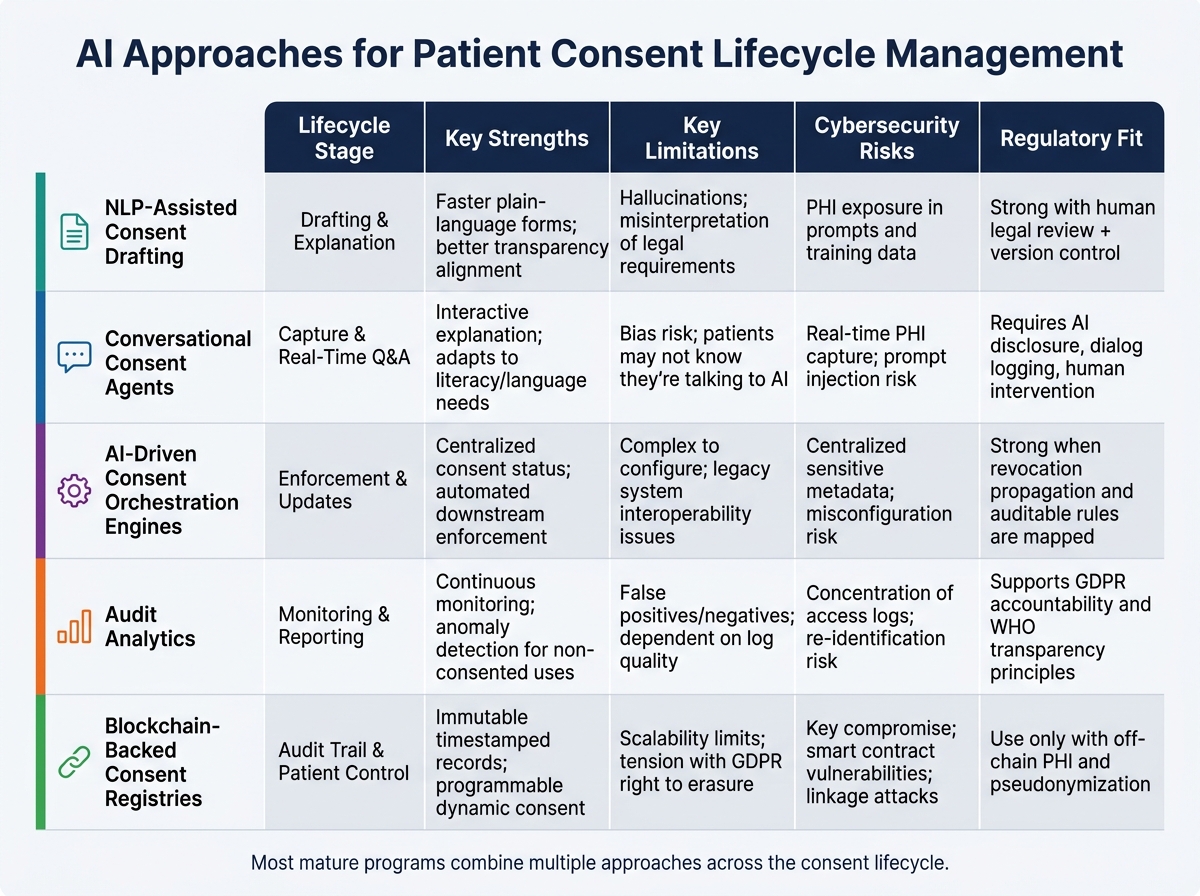
AI Approaches for Patient Consent Lifecycle Management: A Compliance Comparison
Comparing AI approaches for consent lifecycle management
No single AI approach covers the full consent lifecycle. Each one fits a different stage and comes with a different level of compliance risk. The practical move is to pick the tool based on the job it supports: capture, enforcement, monitoring, or audit.
| AI Approach | Lifecycle Stage | Strengths | Limitations | Cybersecurity Risks | Regulatory Fit |
|---|---|---|---|---|---|
| NLP-assisted consent drafting | Drafting & explanation | Faster plain-language, personalized consent forms; better alignment with transparency and understandability [29][30] | Possible misinterpretation of legal requirements; hallucinations; difficulty explaining complex data uses | PHI exposure in prompts and training data; unauthorized access to generated artifacts [28][31] | Strong with human legal review, version control, documentation, and validation against GDPR and HIPAA standards [29][34] |
| Conversational consent agents | Capture & real-time Q&A | Interactive explanation; real-time Q&A; adapts to literacy and language needs; supports WHO autonomy and inclusiveness principles [29][30] | Potential bias; inconsistent explanations; confusion if patients are not clearly informed they are interacting with AI [29] | Real-time PHI capture; authentication weaknesses; prompt injection and adversarial query risk [28] | Requires explicit disclosure of AI use, dialog logging, human intervention mechanisms, and rigorous validation to avoid misleading claims [30][31] |
| AI-driven consent orchestration engines | Enforcement & updates | Centralized consent status; automated downstream enforcement; alignment with OECD purpose specification and use limitation [34][33] | Complex to configure; depends on accurate source data; legacy system interoperability challenges [33] | Centralized sensitive metadata; integration attack surfaces; misconfiguration risk [28] | Strong when engines enforce data minimization, revocation propagation, and auditable rules mapped to specific legal frameworks [29][34] |
| Audit analytics | Monitoring & reporting | Continuous monitoring; anomaly detection for uses without valid consent; rapid identification of non-compliant patterns [28][30] | False positives/negatives; dependent on log quality [31] | Concentration of detailed access logs; re-identification risk through analytics [28] | Supports GDPR accountability and WHO transparency principles if reporting is structured, explainable, and available to oversight bodies [34][30] |
| Blockchain-backed consent registries | Audit trail & patient control | Immutable, time-stamped records; strong integrity guarantees; programmable, dynamic consent via smart contracts [9][33] | Performance and scalability limits; key management complexity; usability gaps; tension with GDPR's right to erasure [9][33] | Key compromise; smart contract vulnerabilities; linkage attacks between on-chain references and off-chain PHI [9] | Use only with off-chain PHI, pseudonymization, and revocation logic that avoids irreversible on-chain personal data [33][9][32] |
Most mature programs don’t rely on just one approach. They usually combine capture tools, orchestration, and monitoring so the whole consent flow holds together.
Mapping consent obligations to AI-enabled controls
Once the tool is chosen, the next step is simple in concept but hard in practice: map each legal duty to a specific control and a named owner. If no one owns the control, it tends to drift.
| Consent Obligation | Technical Controls | Governance Mechanisms |
|---|---|---|
| Freely given consent | Separate consent from service access; use time-stamped signatures; mark optional steps [29][34] | Legal review of templates; periodic UX testing for undue influence; patient advisory input [31] |
| Granular consent | Tag data by purpose, category, and recipient; route by consent flag [34][33] | Documented consent taxonomy; change control when new uses such as AI training are added [30] |
| Transparency of AI use | Label AI use; document the model, data sources, and purpose [28][30][31] | Dashboard reporting for governance committees; model-level information and updates for regulators and internal reviewers [28][30][31] |
| Easy withdrawal | Offer self-service revocation; propagate withdrawal to all connected systems and vendors [33] | Accountability for revocation completeness and timeliness; monitoring to verify downstream systems stop processing data beyond permitted bases [34][30] |
| Documentation & auditability | Tamper-evident logs for consent events, withdrawals, and data use [9][33][32] | Periodic audits; external assessments; alignment with WHO lifecycle documentation and OECD accountability principles [28][34][30] |
WHO warns that large AI models may use data without valid consent [1]. That means the AI use transparency control can’t stop at the consent screen. It also has to cover whether patient data flows into any downstream model.
What healthcare leaders should prioritize next
These mappings should shape the operating model. They should not sit in a binder as a one-time compliance task.
AI can make consent clearer, faster, and easier to audit, but only if governance is built into the tech from the start. Begin with an inventory of every AI system that touches consent or PHI. That inventory is the starting point for impact assessments and accountability [35][6]. Record the data types involved, the vendors in play, the training data posture, and which clinical or operational decisions depend on the output.
Then turn those assessments into owned controls for access, vendor terms, logging, and incident response. Keep those controls current as models and vendors change [35]. Tie each control back to HIPAA, GDPR/UK GDPR, and OECD/WHO principles where they apply. Consent duties also need to be written into policy rules, so AI systems ask for consent only when the law requires it. Just as important, they must not use consent as a stand-in for a lawful basis that doesn’t require it, such as HIPAA treatment, payment, and operations [29][34].
A workable model usually includes a few basics:
- Clear owners for each control
- Set review cadences
- A change management process for model and vendor updates
- Tracking for consent-related non-compliance, withdrawal SLA performance, and the share of data flows with complete consent records [30][33][28]
Put those numbers on a compliance dashboard that privacy, legal, and clinical stakeholders review on a regular basis. Then use that dashboard for what it’s meant to do: spot gaps, assign action, and monitor exceptions.
FAQs
When does AI use in healthcare require patient consent?
In the United States, patient consent is usually required when AI has a direct effect on patient safety, autonomy, or privacy. That often includes cases involving diagnosis or treatment decisions, where the stakes are high and the patient has a clear interest in knowing how decisions are being made.
For administrative or low-risk uses, clear notice may be enough. But this area is still changing, and the rules aren’t set in stone across the country. States such as California, Illinois, and Texas now require explicit disclosure and consent for AI use in clinical settings.
How can AI enforce consent when a patient withdraws it?
AI handles consent withdrawal by treating each patient’s choice as a live, versioned record. When a patient revokes consent through a portal or another intake channel, AI-driven systems can push that update across connected platforms in real time and stop data sharing right away.
They can also use cryptographic binding, such as SHA-256 document hashes, to confirm the current consent state. Censinet RiskOps™ helps healthcare organizations keep these automated controls consistent, compliant, and clear across the data network.
What safeguards should an AI consent system have?
An AI consent system should use layered safeguards built around oversight, security, and privacy.
For oversight, sensitive consent decisions shouldn’t be left to automation alone. Human review needs to stay in the loop, especially when the decision could affect patient rights, care, or data sharing. That gives teams a chance to catch edge cases and use judgment where a model may fall short.
On the security side, the basics need to be tight. That means AES-256 encryption, multi-factor authentication, and strict access controls so only the right people can view or use the system. In healthcare, weak access rules are asking for trouble.
For privacy, patients should get clear notices that explain AI’s role and how their data will be used. No vague language. People need a plain-English explanation of what’s happening and what they’re agreeing to.
The system also needs regular checks after launch. Ongoing monitoring for drift or bias, along with routine audits and named owners, helps make sure the tool stays on track over time. Without that kind of accountability, small problems can quietly grow.
Data handling matters just as much. PHI redaction, de-identification, and support for machine unlearning should all be part of the design from the start, not bolted on later.
