
If I were signing an ambient scribe deal today, I’d treat it as a PHI, safety, and third-party vendor risk management review first - and a software purchase second.
Here’s the short version: before I sign, I want clear terms for scope, consent, data use, retention, security, breach notice, subcontractors, EHR access, AI change control, and exit rights. That’s because the vendor may handle audio, transcripts, generated notes, logs, and EHR data. And each one creates a different kind of risk.
A few points stand out fast:
- A BAA is required when the vendor handles PHI.
- 31% of cyber insurance claims in 2024 were tied to insecure third-party connections.
- Bad AI notes can affect patient care, chart accuracy, and legal risk.
- Stored audio files are often the highest-risk data item.
- If a vendor uses customer data for model training, that should be blocked in writing.
If I were reviewing this contract, I’d ask:
- What data is the vendor allowed to use, and for what purpose?
- How is patient consent handled before any recording starts?
- Is customer data blocked from model training and other secondary use?
- When are audio, transcripts, logs, and backups deleted?
- Can the vendor prove encryption, MFA, access limits, and audit logs?
- How fast must the vendor report a breach or suspected compromise?
- Which subprocessors and fourth parties touch the data?
- How much EHR access does the tool get, and who reviews the note?
- How are model updates tested, logged, approved, and rolled back?
- What audit, liability, export, and deletion terms are in the contract?
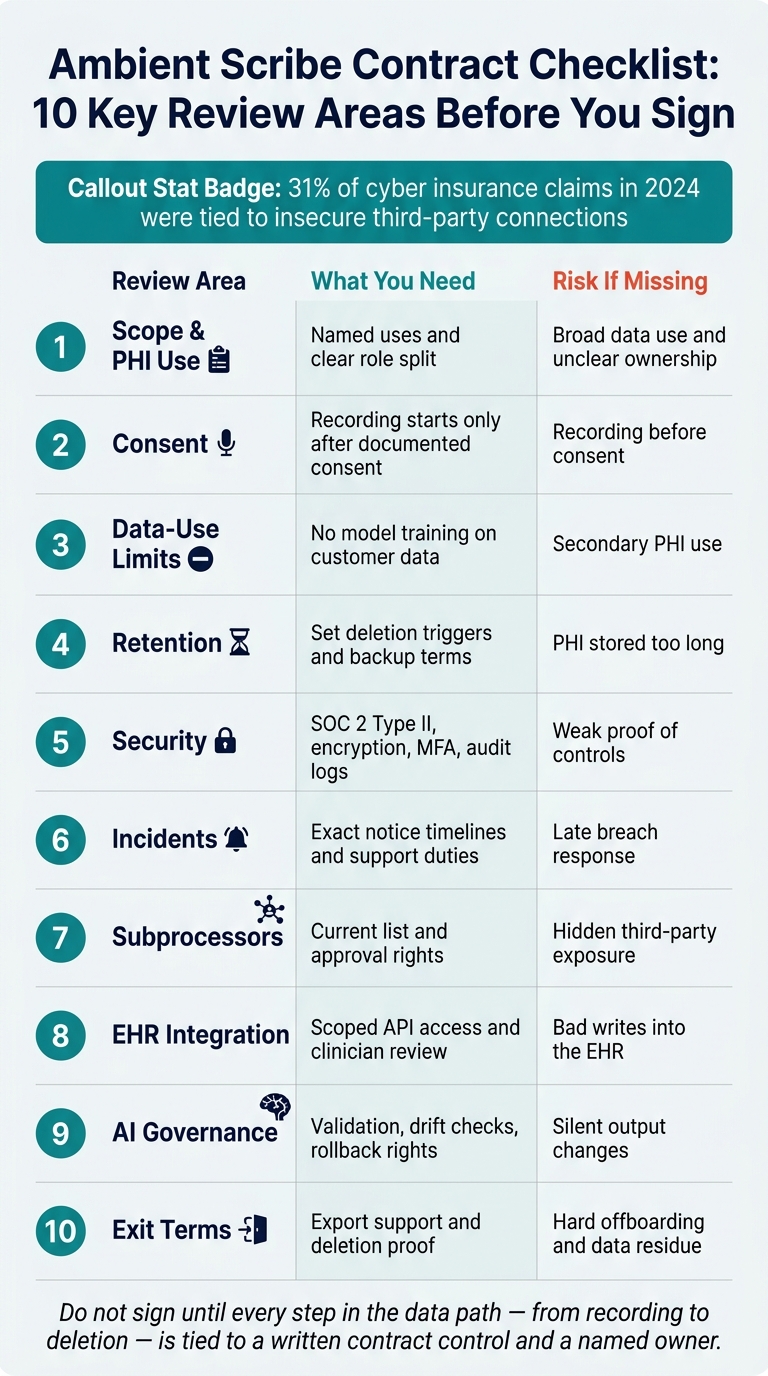
Ambient Scribe Contract Checklist: 10 Key Review Areas Before You Sign
A quick guide to Ambient AI Scribes: what they are and how they can help save clinician time
sbb-itb-535baee
Quick comparison
| Review area | What I want before signing | Main risk if missing |
|---|---|---|
| Scope and PHI use | Named uses and clear role split | Broad data use and unclear ownership |
| Consent | Recording starts only after consent | Recording before consent |
| Data-use limits | No model training on customer data | Secondary PHI use |
| Retention | Set deletion triggers and backup terms | PHI stored too long |
| Security | SOC 2 Type II, encryption, MFA, audit logs | Weak proof of controls |
| Incidents | Exact notice timelines and support duties | Late breach response |
| Subprocessors | Current list and approval rights | Hidden third-party exposure |
Managing these vendors requires a structured approach to manage third-party risk across the organization. | Integration | Scoped API access and clinician review | Bad writes into the EHR | | AI governance | Validation, drift checks, rollback rights | Silent output changes | | Exit terms | Export support and deletion proof | Hard offboarding and data residue |
So if I had to reduce the whole article to one line, it would be this: I would not sign until every step in the data path - from recording to deletion - is tied to a written contract control and a named owner.
2. Checklist 1-3: Define use, consent, and data-use rights
These checks set the legal and day-to-day limits for every control that comes after them. Start with scope, consent, and data-use rights before you move into retention and security.
1) Define intended use, PHI scope, and responsibility boundaries
Start with a plain question: what is this tool allowed to do?
Ambient scribes may turn spoken visits into written records for patient charts, research notes, or compliance documentation. Some systems also support automated triage, claim-processing automation, or updates inside EHR and clinical workflow systems.
Put the scope in writing. The contract should spell out every data element the vendor captures and state the clinical and operational purposes allowed. The agreement should also clearly assign who handles clinician review and patient access, amendment, and deletion requests.
| Question | Acceptable Answer or Safeguard | Evidence to Request | Risk Flag |
|---|---|---|---|
| What clinical and operational purposes is PHI used for? | Limited to the named workflows in the contract | Contract scope clause; BAA permitted-use definition | Vague language that allows broad secondary use |
| Who is responsible for clinician review and patient access, amendment, and deletion requests? | Responsibility is assigned by task in the workflow and contract | Workflow documentation; contract responsibility matrix | No defined owner for these tasks |
| What data elements does the vendor capture? | Audio, transcripts, metadata, prompts, and outputs | Data flow diagram; BAA data element schedule | The vendor will not provide a complete list |
2) Verify consent, recording controls, and patient notice workflows
Recording an encounter without a clear consent workflow creates legal and operational risk. The practice owns that workflow.
Your contract should answer four direct questions:
- When does recording start?
- How can a patient refuse or withdraw?
- Are other people in the room accounted for?
- How is consent documented and tied to the encounter record?
The workflow has to hold up in actual visits, not just in a polished demo.
Flag any setup where recording starts before consent is confirmed, or where the vendor can't show how refusal or withdrawal works. Those are escalation points, not small gaps.
| Question | Acceptable Answer or Safeguard | Evidence to Request | Risk Flag |
|---|---|---|---|
| When does recording start relative to consent? | Recording begins only after documented patient consent | Consent workflow diagram; sample documentation of consent exceptions | Recording starts at session launch with consent collected later |
| How is patient refusal or withdrawal handled mid-encounter? | The workflow documents how refusals or withdrawals are honored and recorded | Policy for refusal/withdrawal handling; workflow diagram | No documented process for mid-encounter refusal or withdrawal |
| Are other people in the room accounted for? | The workflow addresses other people present during the encounter | Written policy on multi-party encounters | The policy is silent on additional participants |
3) Restrict model training and secondary use of customer data
Ask the question directly: is customer data used to train or improve the vendor's AI?
The BAA must block training, fine-tuning, benchmarking, or any other secondary use of PHI, audio, transcripts, prompts, outputs, or metadata. Patient data should be used only for your account, not to improve a shared model. That limit should also flow down to subprocessors.
| Question | Acceptable Answer or Safeguard | Evidence to Request | Risk Flag |
|---|---|---|---|
| Is customer data used to train or fine-tune the vendor's model? | Unambiguous "No"; data is logically siloed for the customer only | BAA clause prohibiting secondary use; SOC 2 report on data isolation | "Opt-out" framing instead of a clear "No" |
| Does the secondary-use restriction apply to subprocessors? | Yes; the restriction flows down to all named subprocessors by contract | Subprocessor list; BAA flow-down clause | Subprocessor agreements not available for review |
| Can the customer trigger permanent deletion of all data? | Customer-directed deletion with written confirmation | Written audio deletion policy; deletion certificates or audit logs | Deletion requires a vendor-side request with no clear SLA or confirmation |
Once use and training limits are locked in, retention and deletion terms come next.
3. Checklist 4-7: Control retention, security, incidents, and subcontractors
Once you’ve set limits on use and training, the next step is simple: check how the vendor stores, sends, and shares PHI. Start with retention and deletion. Then move into security proof and third-party access.
4) Set retention, return, backup, and deletion terms
Ask for a clear retention schedule for audio, transcripts, notes, metadata, derived data, and backups. That schedule should include a maximum retention period tied to a documented business purpose. This is where the minimum necessary rule comes into play: the vendor should have a written retention policy that lines up with the reason it says it needs the data.
Two contract terms deserve close attention:
- Export rights before termination
- Written deletion certification
You need a way to pull your data before the contract ends. And after that, you need proof that the vendor deleted it. That proof can come in the form of deletion certificates or audit logs showing the purge.
| Artifact Type | What to Specify | Evidence to Request | Risk Flag |
|---|---|---|---|
| Audio buffers | Deleted immediately after transcription | Written deletion policy; deletion certificates | No defined deletion trigger |
| Transcripts and notes | Deleted on customer request or after a set period | Audit logs showing purge events | No SLA for deletion |
| Backups | Included in deletion scope, not exempt | Backup policy; confirmation backups are purged | Backups excluded from deletion terms |
| Data at contract end | Return or delete, with written confirmation | Offboarding procedure; deletion certificate | No documented offboarding process |
Once retention is spelled out, make sure the vendor can protect whatever data it keeps.
5) Verify security controls with independent evidence
A vendor saying it has SOC 2 certification is not the same as handing over the report. There’s a big difference between a claim and proof. Your contract review should confirm the exact controls in place, not just ask whether controls exist.
Treat encryption and MFA as mandatory. Request the SOC 2 Type II report and review the logical access and physical security controls. Ask for an architecture diagram that shows the encryption workflow, key management setup through HSM or cloud KMS, and key rotation schedules.
Confirm these baseline requirements:
- TLS 1.2 or 1.3 for data in transit
- AES-256 for data at rest
- MFA required for all accounts that touch PHI
- Role-based access that separates view permissions from delete permissions
- Immutable, timestamped audit trails
Multi-tenant setups can create cross-tenant exposure risk. If the vendor can’t confirm dedicated processing, treat that as an issue that needs escalation.
| Control Category | Standard Requirement | Preferred Requirement |
|---|---|---|
| Certifications | SOC 2 Type II | HITRUST CSF (r2) or ISO 27001 |
| Data residency | Multi-tenant cloud | Dedicated PHI instance |
| Monitoring | Application-level logs | Inference-level logging and drift detection |
6) Negotiate incident response and breach obligations
Swap vague notice language for exact timelines covering detection, notice, and investigation, starting from discovery.
Be clear about what triggers notice. The vendor should spell out how it handles confirmed breaches, suspected compromise, and breach investigations. The notice itself should say what happened, what data was exposed, what systems were affected, and what remediation is underway.
Forensic cooperation should be written into the contract. Don’t leave it to assumption. Those same duties should also flow down to subcontractors.
Watch for two common problems: long notice windows and narrow breach definitions. Some vendors try to exclude suspected compromise or delay notice until they finish their own internal review. That can leave you in the dark when time matters most.
Then turn to every outside party that may touch PHI.
7) Identify subprocessors and fourth-party exposure
Third-party exposure isn’t only an IT problem. It’s a contract problem too.
Ask for a current subprocessor list that shows each provider’s location, the data type involved, and its function. Require explicit approval before the vendor brings in any new subprocessor. Also confirm that the privacy and security duties in your BAA flow down by contract to every named subprocessor.
If the vendor can’t explain where PHI goes after it leaves the main system, the contract isn’t ready to sign.
4. Checklist 8-10: Assess integration, AI governance, and contract enforcement
Next, look at integration, model behavior, and contract enforcement. These are often the spots where ambient scribe risk shows up after go-live.
8) Review EHR, identity, and workflow integration risk
After retention, security, and subcontractor terms, move to integration, AI behavior, and contract enforcement.
An ambient scribe doesn’t run on its own. It reads from and writes to your EHR. That means every API connection, login step, and note-finalization workflow can become an exposure point.
Require scoped API access, SSO controls, role-based permissions, and a clear approval path for auto-finalization. Treat auto-finalization or broad EHR write access without clinician review as high risk and require written justification.
You’ll also want direct answers about ownership. Who secures the APIs? Who handles single sign-on? Who manages role-based access, downtime procedures, and data reconciliation when the note and the record don’t match?
Require a written reconciliation workflow for mismatched patients, encounters, and note IDs. Audit trails should capture detailed, timestamped actions tied to specific transcript IDs, so every edit or access event can be traced back. If the vendor can’t prove that the note, patient, and encounter match cleanly, stop the review there.
Downtime needs the same level of detail. The contract should spell out a tested recovery procedure, not just a general uptime SLA.
Once integration is mapped out, check that the model stays steady after deployment.
9) Require AI governance, validation, and change control
Require the deployed model version, specialty-specific validation, documented clinician input, hallucination and omission testing, and a clear statement on whether customer data can be used for training or fine-tuning.
You should also require:
- Inference-level logging
- Drift detection
- Automated degradation alerts
Uncontrolled model updates create contract risk. The agreement should require advance notice before any retraining or model change that could affect clinical output. It should also include rollback rights and human-review safeguards before updates reach clinicians.
After validation, the contract needs to enforce the controls you just checked.
10) Secure audit rights, BAA terms, liability, and exit protections
Every due-diligence finding needs to show up in the contract. Put each one into the MSA, BAA, security addendum, or subprocessor schedule.
The BAA must cover model-training limits, breach notice SLAs, subcontractor accountability, and audit rights. Ask for independent evidence such as SOC 2 Type II reports or HITRUST CSF certifications, and make sure the audit right is written into the agreement.
"Companies should treat AI vendor selection as a strategic partnership and not a technology purchase." - Simone Colgan Dunlap, Attorney, Quarles & Brady [3]
Before signing, define the export format, transition support, and deletion timing.
| Contract Document | What It Must Cover |
|---|---|
| Master Service Agreement | Termination rights, transition support, data export requirements |
| Business Associate Agreement | Model training restrictions, breach notification SLAs, subcontractor accountability |
| Security Addendum | Encryption standards, MFA enforcement, audit rights, incident response timelines |
| Subprocessor Schedule | Named subprocessors, data types, approval requirements, fourth-party exposure |
| Service Terms | Downtime procedures, model change notifications, rollback rights |
5. Conclusion: Turn the checklist into a contract decision record
Once the checklist is done, turn those findings into a sign-off record before the contract is signed. The idea is simple: move from notes and conversations to a formal decision record that people can stand behind.
Take each vendor answer and tie it to an artifact. For every gap, assign a control or set a deadline. And for every risk the team agrees to accept, require sign-off from a named owner. The point is to reach signature with a clear approval record that can be defended later, not a pile of verbal promises.
A signed BAA is the minimum legal requirement, not proof of safe PHI handling.
What must be approved before signature
Then send the decision record to each approval owner. Before the contract is executed, each group should confirm its part:
- Privacy: no secondary PHI use, no model training on customer data, and documented deletion timelines
- Security: SOC 2 Type II or HITRUST evidence, encryption, MFA, audit trails, and breach notification SLAs
- Legal: subcontractor terms, audit rights, liability, and exit rights
- Clinical: transcript fidelity, accuracy checks, and clinical reviewers involved from the start
- Procurement: documented deployment history and defined success metrics
- Integration/IT: HL7/FHIR compatibility, access controls, and monitoring for drift and performance degradation
If any review turns up an unresolved item, it should be handled one of two ways: negotiated into the contract or logged as an accepted exception with a named owner and a remediation date.
How to run this review with Censinet
After owners sign off, use one workflow to track evidence, remediation, and final approval. Use Censinet RiskOps™ to track assessments, evidence, findings, and remediation in one auditable workflow. Use Censinet AI™ to summarize vendor documentation and surface integration and fourth-party risks for review.[1][2]
FAQs
Who should own the ambient scribe contract review internally?
No single team should run this alone. Ambient scribe tools touch a lot of areas at once, so a cross-functional group helps make sure nothing slips through the cracks.
Bring in legal, privacy, IT, compliance, clinical leadership, and data science. That mix helps the organization handle HIPAA rules, security and EHR integration, regulatory requirements, patient safety risks, and clear accountability across the full vendor lifecycle.
What is the biggest red flag in an ambient scribe contract?
The biggest red flag is broad, vague wording that lets the vendor use patient data, prompts, or AI outputs for model training, debugging, or “service improvement” without explicit written consent.
Other major red flags include:
- Refusing to sign a BAA
- Not disclosing subcontractors
- Leaving audit rights vague or out of the contract
- Offering only self-attested compliance
- Claiming to be EHR-agnostic without sharing specific integration details
That last point matters more than it may seem. “EHR-agnostic” can sound good on paper, but if the vendor can’t explain how the integration works in practice, that’s a warning sign. You need specifics, not a sales line.
How can we verify the vendor actually deletes PHI?
Use direct contract language and back it up with proof. The BAA should set a hard deadline for deleting all PHI and make clear that this covers backups, inference logs, and subcontractors. It should also require written proof of deletion within that same period, such as a certificate of destruction.
Ask for a data-flow diagram that shows the full PHI path: where PHI enters the system, where it is stored or processed, and where deletion happens. That diagram should also cover integrations, APIs, logging, and subprocessors so there are no blind spots.
The BAA should also confirm that permitted uses of PHI are tied to deletion duties. In plain terms: if PHI is allowed in certain systems or workflows, the contract should state how and when that PHI is deleted from those same systems and workflows.
