
Your vendor list does not show your full risk. In healthcare, a breach or outage at a vendor’s cloud host, subcontractor, software supplier, or telecom provider can still hit your PHI, billing, and patient care. That’s the fourth-party problem.
Here’s the short version:
- Direct vendor reviews miss shared weak points.
- One upstream failure can hit many systems at once.
- You need to map fourth parties to PHI, systems, and care services.
- Then you need to score risk by cyber, patient care, downtime, and compliance.
- After that, turn findings into contract terms, review schedules, and monitoring.
The risk is not small. In February 2024, the Change Healthcare attack disrupted claims across the country, and the breach exposed PHI for about 1 in 3 Americans. Some hospitals reported revenue drops of up to 17%. The article also notes that healthcare organizations often manage 1,000+ vendors, while many hidden dependencies stay off the radar.
If I had to boil the article down to one point, it’s this: I can’t judge vendor risk one company at a time. I have to see the chain behind each vendor, find shared providers, and focus first on the ones tied to PHI or patient care.
A simple way to think about it:
| What I need to do | What it means |
|---|---|
| Build an inventory | List each vendor’s subcontractors, hosting, software parts, access paths, and data locations |
| Map impact | Tie each fourth party to PHI, systems, billing, labs, devices, and patient-facing services |
| Tier risk | Rank by PHI exposure, care disruption, downtime, and shared-provider risk |
| Set contract controls | Require flow-down terms, subcontractor disclosure, notice windows, and proof of security controls |
| Monitor all year | Track incidents, subcontractor changes, media reports, and exit handling for PHI |
Bottom line: if I only review the company I signed with, I’m missing the vendors behind the vendor - the ones that can still trigger HIPAA compliance issues, care delays, and multi-system outages.
That’s the core message of the article, and everything else supports that view.
Healthcare Third-Party Risk Management: Compliance & Cybersecurity
sbb-itb-535baee
Map fourth parties to PHI, systems, and clinical services
Map each fourth party to the PHI, systems, and clinical services it can affect. The first job is simple in theory, but messy in practice: connect each hidden dependency to the data, systems, and care functions behind it.
Build a fourth-party inventory tied to PHI, systems, and clinical services
Start with your current vendor list and work backward. For each direct vendor, document the services it provides, the PHI it touches, and the outside providers it depends on.
For each vendor relationship, the inventory should show the PHI access and handling scope, the clinical systems supported, the subcontractors involved, the cloud or hosting provider used, software dependencies, remote or privileged access paths, data location, incident notification contacts, and recovery dependencies. For connected medical devices, request a Software Bill of Materials (SBOM) and a Manufacturer Disclosure Statement for Medical Device Security (MDS2). Those two documents often bring hidden software components into view in a way standard questionnaires simply don't.
Then connect this information to your Configuration Management Database (CMDB), data-flow diagrams, Business Impact Analysis (BIA) results, and incident response plans. Without those links, the inventory is just a spreadsheet with names on it.
Classify dependencies by PHI access, care impact, and shared exposure
Once the inventory is in place, rank each dependency by what happens if it fails. Not every hidden dependency carries the same risk. A billing outage is one thing. A failure that interrupts patient care is something else entirely.
A practical way to sort these dependencies is to look at whether they:
- directly access or process PHI
- host systems that contain PHI
- interrupt clinical operations
- create regulatory or contractual exposure
- are shared across multiple critical vendors
| Dependency Mapping Field | Why It Matters | Evidence to Request |
|---|---|---|
| Subcontractor List | Identifies the actual fourth parties handling data | Flow-down clauses in BAAs; disclosure schedules |
| PHI Access | Defines the minimum-necessary scope under HIPAA | Data-flow diagrams; access control matrices |
| Data Location | Determines data residency and jurisdictional risk | SOC 2 Type II reports; cloud service provider agreements |
| Clinical Impact | Distinguishes IT downtime from patient safety events | Business Impact Analysis (BIA) results |
| Software Components | Identifies vulnerabilities in embedded libraries | SBOM; MDS2 forms |
| Recovery Time Objective (RTO) | Sets expectations for clinical continuity | Disaster recovery (DR) test results |
| Remote/Privileged Access | High-risk entry point for ransomware | MFA enforcement logs; architecture review |
| Concentration Risk | Reveals whether multiple vendors share one provider | Disclosure of sub-service providers |
This classification shows which dependencies need tighter contract terms and closer day-to-day oversight. Any fourth party that creates, receives, maintains, or transmits PHI must be mapped for compliance [1] - and PHI access shapes both legal exposure and patient-care risk.
Assess impact across cyber, clinical, operational, and compliance risk
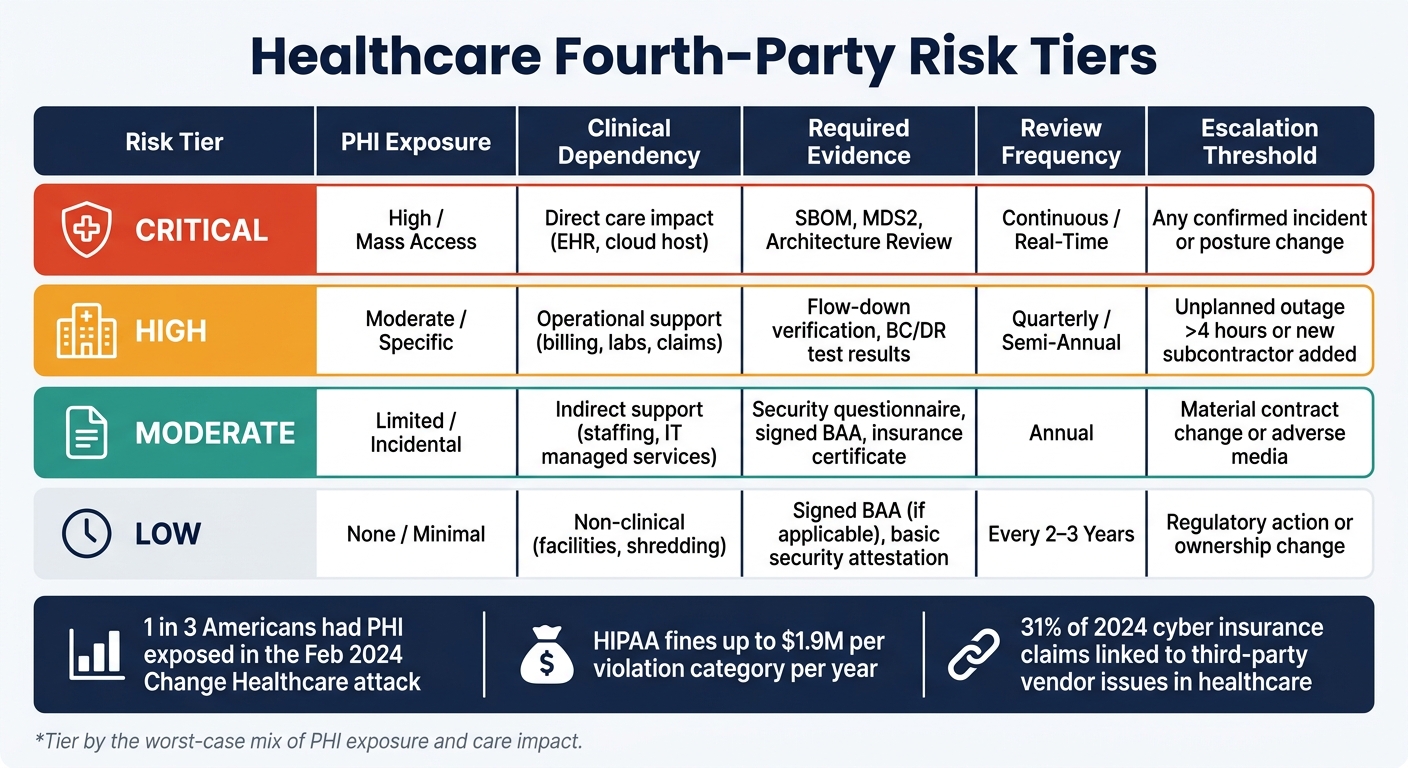
Healthcare Fourth-Party Risk Tiers: PHI Exposure vs. Clinical Impact
Once the inventory is mapped, the next step is to score which dependencies can actually harm care delivery, day-to-day operations, and compliance. The point isn't to count vendors. The point is to understand impact.
Use a healthcare-specific impact model
A generic IT risk model doesn't go far enough in healthcare. It can miss patient safety issues and regulatory exposure. Use the inventory to score what each dependency can affect, not just what it touches. That means scoring each dependency against the PHI access, system criticality, and shared-exposure fields already in the inventory.
When you review a fourth party, look at it across four dimensions:
- Cyber exposure: the attack surface and control gaps created by the dependency
- Clinical impact: whether a failure delays or disrupts care
- Downtime tolerance: how long the dependency can be unavailable before claims, scheduling, or other key workflows stop
- Compliance impact: HIPAA, HITECH, FDA, and breach-notification duties
That clinical piece matters more than many teams first assume. If a dependency delays medication access or chemotherapy, that's a patient safety event, not just an IT incident.
A fourth-party breach can still trigger covered-entity reporting duties. A signed BAA is only the starting point. HIPAA violations can carry fines of up to $1.9 million per violation category per year, and 31% of cyber insurance claims in 2024 were linked to third-party vendor issues in healthcare [1]. A BAA sets the legal floor; a risk assessment shows whether the vendor can actually meet it. In healthcare, one failure can trigger HIPAA, FDA, and CMS obligations at the same time [1].
Tier fourth parties by materiality and concentration risk
Not every dependency needs the same level of scrutiny. Tiering helps your team spend limited time where the stakes are highest. That score should determine review depth and monitoring cadence.
Concentration risk also deserves close attention. If several vendors rely on the same upstream service, one problem can spread fast. Flag any shared upstream provider. Use the table below to turn impact scores into action.
| Risk Tier | PHI Exposure | Clinical Dependency | Required Evidence | Review Frequency | Escalation Threshold |
|---|---|---|---|---|---|
| Critical | High/mass access | Direct care impact (EHR, cloud host) | SBOM, MDS2, Architecture review | Continuous / real-time | Any confirmed incident or posture change |
| High | Moderate/specific | Operational support (billing, labs, claims) | Flow-down verification, BC/DR test results | Quarterly / semi-annual | Unplanned outage >4 hours or new subcontractor added |
| Moderate | Limited/incidental | Indirect support (staffing, IT managed services) | Security questionnaire, signed BAA, insurance certificate | Annual | Material contract change or adverse media |
| Low | None/minimal | Non-clinical (facilities, shredding) | Signed BAA (if applicable), basic security attestation | Every 2–3 years | Regulatory action or ownership change |
Tier by the worst-case mix of PHI exposure and care impact.
Turn assessment results into contract controls and operating discipline
Use the tiering above to convert risk scores into contract terms and a clear monitoring cadence. A risk score sitting in a spreadsheet doesn't protect patients. It starts to matter when it turns into contract language you can enforce and a monitoring routine your team follows all year, not just at renewal.
Require disclosure, flow-down clauses, and change governance
Under the HITECH Act, HIPAA duties must flow from Business Associates to their subcontractors. That rule is the starting point, but it's only the floor. A BAA sets minimum terms. It does not prove that a subcontractor, or an upstream software provider, has the controls you need.
For critical vendors, contracts should go further. Require vendors to disclose every subcontractor that creates, receives, maintains, or transmits PHI, or that supports a critical clinical service. Your organization should have the right to object before a material subcontractor change goes live, not just get notice after the fact. Vendors and their subcontractors should also notify you within a contractually defined breach-notification window.
Those duties should feed your monitoring process too. The table below ties common risk conditions to contract terms and the evidence your team should ask for.
| Risk Condition | Contract Requirement | Required Evidence |
|---|---|---|
| PHI Access | HITECH flow-down clause | Signed subcontractor BAAs; access control logs |
| Critical Clinical Service | Advance notice of subcontractor change; right to object | Change management policy; subcontractor inventory |
| Cybersecurity Risk | Mandatory MFA; encryption at rest and in transit; vulnerability management | SOC 2 Type II; penetration test results (within 12 months) |
| Medical Device/IoT | SBOM disclosure; MDS2 attestation | Software Bill of Materials; MDS2 form |
| Operational Downtime | Aligned DR/BCP recovery time objectives | Tested disaster recovery results; SLA breach history |
| Regulatory Compliance | HHS audit cooperation; HIPAA training verification | Training records; workforce attestations; OCR investigation history |
A covered entity can be liable for a business associate's HIPAA violation if it knew, or should have known, about a pattern of noncompliance. That's why evidence collection matters so much. SOC 2 reports, penetration test results, and DR test outcomes aren't just nice to have. They can be part of what your legal and compliance teams need to show they were paying attention.
Run a continuous fourth-party monitoring lifecycle
Continuous monitoring fills the gap between formal reviews. A vendor might pass a questionnaire in January, then bring in a high-risk subcontractor in March. That's the problem. Fourth-party oversight has to work like an operating habit, not a periodic checkbox.
Between formal reviews, monitoring should cover adverse media, security researcher disclosures, and regulatory actions. At exit, require PHI return or destruction, along with certified proof of disposition.
Conclusion: Build a fourth-party view before the next outage or breach
Third-party vendor risk management matters. But they only show part of the story.
Hidden dependencies create real risk for PHI, clinical operations, and regulatory standing. And most of that risk stays out of sight until something fails. The job is simple in theory: make those hidden dependencies visible, then rank them by clinical and operational impact.
The February 2024 Change Healthcare attack made that point hard to ignore. One upstream failure disrupted claims, exposed PHI, and put pressure on hospital operations across the country. Dallas Federal Reserve research also found that questionnaire-based programs fall short for critical vendor relationships.
That points to a practical path forward. Build the view with:
- inventory
- dependency mapping
- impact-based tiering
- concentration-risk review
- flow-down contract terms
- continuous monitoring
Start with the vendors that carry the most risk, especially those with PHI access or direct clinical criticality, and expand from there. Then focus on the highest-risk dependencies first and work outward. That level of visibility gives teams a better shot at moving fast and taking action before the next outage or breach exposes a dependency no one saw coming.
FAQs
How is fourth-party risk different from vendor risk?
Vendor risk centers on the suppliers, contractors, and partners your organization works with under a contract.
Fourth-party risk goes one layer deeper. It’s the exposure that flows through those vendors to their subcontractors, cloud providers, and tech partners. Managing it means mapping indirect dependencies and spotting shared points of failure.
Under HITECH, HIPAA obligations also flow down to these subcontractors. That makes any PHI exposure a direct compliance issue, not just a vendor management problem.
Which fourth parties should we map first?
Map the fourth parties behind your clinical and business services first. The goal is simple: find the outside firms that sit underneath your third parties and could disrupt patient care or stop revenue within 72 hours if they go down.
Start with the full service chain for the areas that can hurt fastest:
- Claims processing
- EHR access
- Pharmacy transactions
- Diagnostic imaging
- Connected medical devices
Don’t stop at the direct vendor. Trace the stack underneath each one: cloud hosting, data centers, clearinghouses, identity providers, network carriers, device firmware providers, payment rails, APIs, and support subcontractors. A claims platform may look like one vendor on paper, but the live chain often runs through several hidden dependencies. That’s where the choke points usually sit.
Focus first on shared choke points. If one fourth party supports many critical services, that single failure can ripple across the enterprise. Common examples include:
- A cloud provider hosting the EHR, imaging archive, and patient portal
- An identity and access service tied to clinician logins
- A clearinghouse used for claims, eligibility, and prior authorization
- A network carrier linking clinics, hospitals, and remote device feeds
- A transaction switch used for pharmacy claim routing
Then rank each dependency using three lenses:
- Clinical criticality: Would failure delay treatment, block medication access, interrupt diagnostics, or cut off bedside workflows?
- Data sensitivity: Does the dependency handle PHI, payment data, imaging records, prescription data, or device telemetry?
- Outage impact: Would downtime stop care, freeze revenue, create manual workarounds, or trigger regulatory and patient safety issues?
A practical way to do this is to score each dependency by service, shared use, and time-to-harm. For example, an EHR hosting provider tied to medication orders and chart access will likely rank above a niche back-office tool because the blast radius is bigger and the clock to patient harm is much shorter.
Here’s the mindset: map the chain, find the common points of failure, then rank what breaks care and cash first.
A simple working table can help:
| Service | Third Party | Fourth Party / Subdependency | Shared Choke Point | Clinical Criticality | Data Sensitivity | 72-Hour Outage Impact |
|---|---|---|---|---|---|---|
| EHR access | EHR vendor | Cloud host, identity provider, network carrier | Yes | High | High | Clinicians lose chart access, order entry slows or stops |
| Claims processing | RCM platform / clearinghouse | Transaction network, cloud host, payer connectivity service | Yes | Medium | High | Claims submission halts, cash flow stalls |
| Pharmacy transactions | PBM / pharmacy switch | Transaction router, eligibility service, identity provider | Yes | High | High | Prescription processing delays, medication access risk |
| Diagnostic imaging | PACS / imaging vendor | Cloud storage, archive provider, DICOM gateway host | Yes | High | High | Image access and reads delayed, care decisions slow |
| Connected medical devices | Device maker / monitoring platform | Cellular carrier, cloud platform, firmware update service | Yes | High | Medium to High | Monitoring gaps, alert failures, device downtime |
If you want, I can turn this into a fourth-party mapping worksheet or a ranked risk matrix for these five service areas.
How can we uncover shared provider concentration risk?
Look past direct vendor contracts and map the full dependency chain behind critical clinical and business services. Start with the services that would disrupt patient care or cash flow within 72 hours. Then trace the subcontractors, cloud hosts, and shared infrastructure behind them.
Use API logs, outbound traffic, authentication activity, and SBOMs to spot shared choke points. One dependency inventory can show where multiple critical vendors depend on the same cloud region or data center.
