
A dataset is not safe just because names are gone. In U.S. healthcare data, fields like birth date, sex, and ZIP code can still point back to a person, and past research found that those three fields alone can identify more than half of U.S. residents when matched with outside data.
If I were assessing re-identification risk in PHI, I’d keep it simple:
- Map every field and sort it into direct identifiers, quasi-identifiers, and sensitive data
- Pick the HIPAA path: Safe Harbor or Expert Determination
- Test the remaining risk for singling out, matching, and inference
- Apply controls like date generalization, ZIP suppression, or small-cell suppression
- Document the decision and review it again when the data or sharing setup changes
This matters because HIPAA de-identification is not just a removal exercise. I have to ask a harder question: could someone still match this record to a patient using public records, vendor data, or other datasets?
A few risk signals stand out fast:
- Exact or near-exact dates
- Small geographic areas
- Rare diagnoses or drug use
- Small patient groups
- Linked datasets with more context
De-Identifying Healthcare Data for Research
sbb-itb-535baee
Quick comparison
| Topic | What I’d check | What it means |
|---|---|---|
| Field review | Names, dates, ZIP, IDs, rare traits | Shows where matching risk starts |
| HIPAA path | Safe Harbor vs. Expert Determination | Sets the rule set for release |
| Attack testing | Known target, registry search, many-record attack | Shows how someone might identify patients |
| Controls | Generalization, suppression, date shifting | Lowers match risk before sharing |
| Documentation | Methods, assumptions, residual risk, approvals | Shows why release was allowed |
Bottom line: I’d treat re-identification review as a repeatable risk test, not a one-time checkbox. The goal is to keep patient data useful and keep the chance of identification very low.
1. Map the dataset and identify fields that drive risk
Start with a field-by-field inventory. Label each attribute as a direct identifier, quasi-identifier, sensitive attribute, or non-sensitive attribute. That simple map tells you if HIPAA Safe Harbor will cover the dataset or if expert determination should come next.
List direct identifiers and HIPAA Safe Harbor elements
HIPAA Safe Harbor requires the removal of 18 identifier categories [1]. That list includes names, detailed geography, dates other than year, ages over 89, and other direct identifiers [1].
Go field by field and compare each one against those 18 categories. If a field matches, remove it or redact it.
Flag quasi-identifiers and high-linkage fields
After direct identifiers are gone, the less obvious risk is still there. Quasi-identifiers may not identify a patient on their own, but they can connect with outside sources, like voter rolls, social media, commercial datasets, or public registries, to tie a record back to a person. That's where linkage risk shows up.
Two patterns tend to create the most exposure: temporal uniqueness and geographic granularity. A rare event date or a short admission window can still stand out, even after you make the data less specific. The same goes for ZIP codes tied to small populations. Under Safe Harbor, you can keep ZIP3 only if the area has at least 20,000 people [1]. If it falls below that cutoff, generalize the ZIP data further or suppress it.
Use this table to spot the fields that need the tightest controls.
| Field Type | Linkage Risk | Likely Mitigation |
|---|---|---|
| Direct Identifiers (Name, SSN, MRN) | Critical | Complete removal or redaction |
| Geographic Data (ZIP code, city) | High | Generalization to ZIP3 or suppression of small-population areas |
| Temporal Data (admission/discharge dates) | High | Date shifting or year-only retention |
| Rare Clinical Data (rare diagnoses, specialty drugs) | Moderate–High | Aggregation into broader categories or suppression |
| Demographics (age, gender, ethnicity) | Moderate | Age banding (e.g., 5- or 10-year buckets) |
| Internal Metadata (device or facility IDs) | Low | Tokenization or salted hashing |
Document the data sharing context
Risk shifts based on who gets the data and how they get it. Write down the intended use, the recipients - internal staff, third-party collaborators, or vendors - the access method, such as a secure enclave, API, or raw download, and any contract terms already in place. That includes Data Use Agreements (DUAs) or Business Associate Agreements (BAAs) that block re-identification attempts, unauthorized linkage, or onward transfer. Also record retention limits and re-review triggers, like a partner breach or the release of new public datasets that could be used for linkage [2] [1].
Get these details on paper early. They shape the residual risk that carries into the next review, and that risk profile helps you choose the right de-identification method.
2. Choose Safe Harbor or Expert Determination
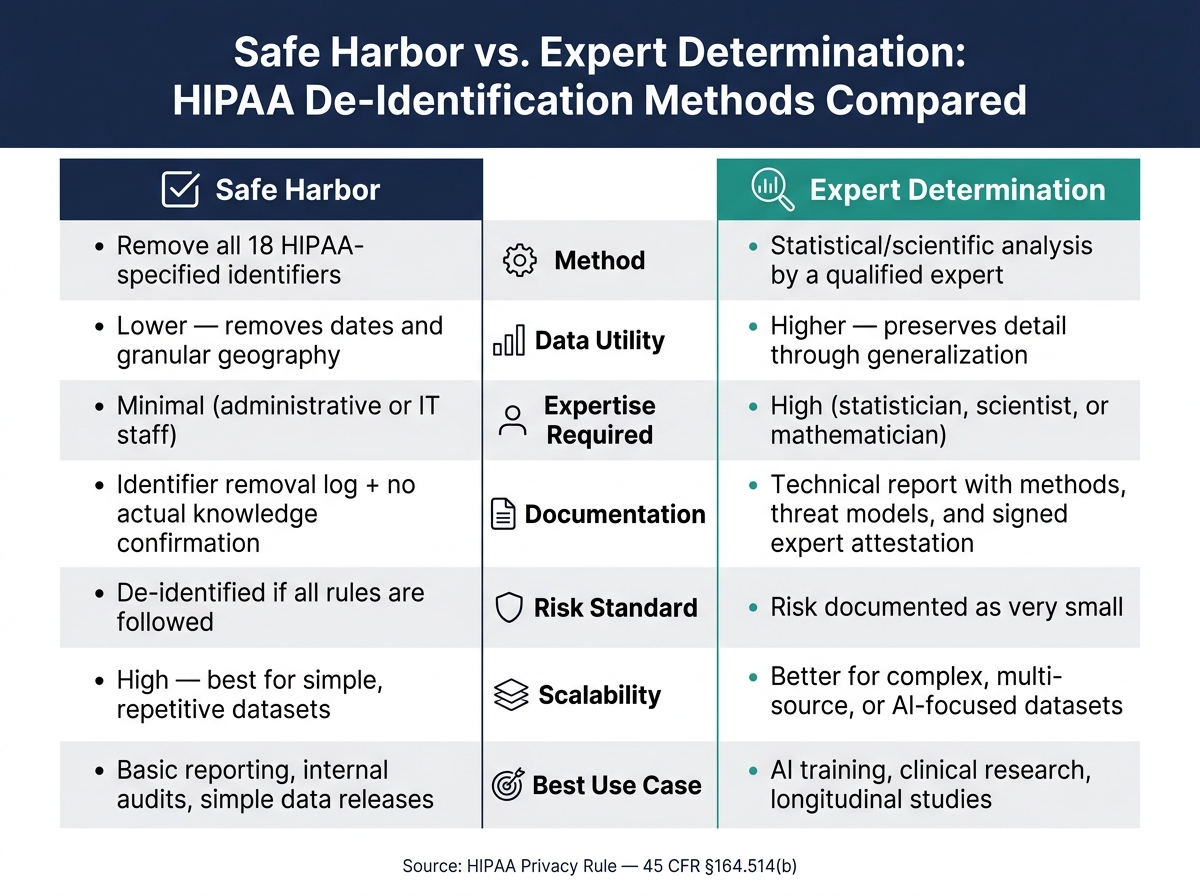
Safe Harbor vs. Expert Determination: HIPAA De-Identification Methods Compared
Once you've mapped the fields that drive enterprise risk, the next call is which HIPAA de-identification path to use. HIPAA gives you two options: Safe Harbor and Expert Determination. The goal is simple: keep re-identification risk low without gutting the dataset.
Use Safe Harbor for strict identifier removal
Safe Harbor is the checklist route. You remove all 18 identifiers, confirm your organization has no "actual knowledge" that the remaining data could identify a person, and the dataset is treated as de-identified. Because the rules are fixed, it's pretty simple to put in place and easy to audit.
The downside is lost data detail. Safe Harbor removes all date elements except the year and strips out granular geographic data. Use it when you can afford to lose dates, detailed location data, and other identifiers without hurting the use case.
Use Expert Determination for complex datasets
Expert Determination works differently. A qualified professional - often a statistician, mathematician, or scientist - uses statistical and scientific methods to show that the risk of re-identification is "very small." Instead of removing data outright, this method can keep more detail by using techniques like generalization or noise injection.
This path makes sense when your organization needs richer data for AI model training, longitudinal research, or comparative studies. It's also a good fit when data will be shared more broadly through a secure risk exchange or when the dataset includes fields like county-level geography or month-level dates that Safe Harbor would force you to remove. It does require expert review and thorough documentation, but the payoff is more analytical use. Use it when detailed data matters for research, AI training, or longitudinal analysis.
Safe Harbor vs. Expert Determination: a comparison
| Criteria | Safe Harbor | Expert Determination |
|---|---|---|
| Method | Remove 18 identifiers | Statistical/scientific risk analysis |
| Data Utility | Lower - removes dates and granular geography | Higher - preserves detail through generalization |
| Expertise Required | Minimal (administrative/IT) | High (statistician, scientist, or mathematician) |
| Documentation | Removal of identifiers and "no actual knowledge" confirmation | Technical report with methods, results, threat models, and signed expert attestation |
| Risk Standard | De-identified if all rules are followed | Risk documented as "very small" |
| Scalability | High for simple, repetitive datasets | Better suited for complex, multi-source, or AI-focused datasets |
| Best Use Case | Basic reporting, internal audits, simple data releases | AI training, clinical research, longitudinal studies |
After you pick a method, test the residual linkage risk in the resulting dataset.
3. Test re-identification likelihood and apply controls
Evaluate direct attack and linkage risk
Once you've picked a de-identification method, the next step is simple: test what is still left exposed.
Direct attack risk is about whether a single record stands out enough to point to one person. Linkage risk is different. It happens when someone combines quasi-identifiers with outside data - like voter rolls - to match a record to a real person [2][4]. Even a small set of quasi-identifiers can be enough when outside data fills in the gaps.
Start with the fields you marked as the highest risk. That gives you the clearest signal early on and helps you see which controls need to be tightened before any release.
Test against three attacker models [2][4]:
- someone confirming a known target
- someone searching a registry
- someone trying to identify many people
The release model should shape how strict this review needs to be. A public release, a controlled research enclave, and vendor processing do not carry the same risk. The same goes for trusted recipients working under DUAs. That context matters and should be part of the assessment [2][3].
When you profile the dataset, group records that share the same quasi-identifier values through equivalence class analysis. Smaller equivalence classes mean a higher chance of re-identification. Use a documented risk threshold that fits the release context and the level of residual exposure [4].
Apply dataset-specific mitigation controls
If testing shows residual risk, apply controls that fit the dataset itself. Then check whether those controls actually cut singling-out and linkage risk. If they don't, they aren't doing enough.
A few common examples:
- Generalize exact dates to month or year.
- Replace 5-digit ZIP codes with 3-digit prefixes only when the population size is large enough [2][1].
- Suppress small cells tied to rare conditions or unusual demographic combinations [2][1].
- Use date shifting for longitudinal data [2][1].
Sometimes you can't remove quasi-identifiers without gutting the dataset. In those cases, perturbation or aggregation can reduce inference risk while keeping the data useful. Administrative safeguards matter too: watermark exports, enforce least privilege, log queries, and set retention and destruction rules [1][2].
"As little data protection as possible, as much data protection as necessary" - Gadotti et al. [3]
Public releases need the strictest technical controls, including differential privacy or strong k-anonymity thresholds. Controlled-access research enclaves can lean more on administrative safeguards such as DUAs, user training, and audit logging [2][4].
Manage assessments through a governed workflow
After applying controls, record the test results in a repeatable review process. Re-run the assessment when the data changes, when recipients change, or when release conditions change. Route reviews through a governed workflow that tracks remediation and keeps the evidence on file.
4. Document the decision and revalidate over time
Record methods, assumptions, and residual risk
Once testing and controls are done, write down why the release was judged acceptable. That record should spell out the method used, the assumptions behind it, the residual risk, and the basis for approval for each release.
At a minimum, the documentation package should cover four areas:
| Documentation Category | What to Capture |
|---|---|
| Dataset Profile | Full data inventory and lineage, including how each field maps to its risk role. |
| Methodology | Rationale for choosing Safe Harbor or Expert Determination, along with the algorithms and transformation parameters used. |
| Validation and Audit Trail | Sampling plans, before-and-after risk metrics, validation results, redaction, access, and disclosure logs. |
| Governance | Signed expert certifications, DUAs, and internal approval records. |
For Expert Determination, keep a signed, dated attestation from the qualified expert for the specific dataset version and review date [5]. Store code, seeds, and parameters in version control so the release can be reproduced during an audit [2][5].
That matters for a simple reason: if someone asks, “How did you decide this release was okay?” you need more than a general answer. You need a clear record that shows what was reviewed, what changed, and what level of risk remained.
Reassess when data or context changes
Next, define when the assessment must be repeated. Reassess whenever the dataset, recipients, or release conditions change.
Reassessment is required when:
- New fields are added or the data schema changes in a major way
- The dataset is linked to an additional data source
- Recipients change or use cases expand beyond the original scope
- New publicly available datasets make linkage easier than it was at the original review date
- A security incident occurs at a partner organization , requiring updated security questionnaires
- De-identification algorithms or organizational policy are updated
Trigger-based reviews aren't enough on their own. Set a minimum annual cadence to confirm the risk posture remains very small [1][5]. Also monitor for risk drift, including changes in equivalence-class sizes, rare categories, and linkage-sensitive fields [2].
If reassessment shows risk has crossed the acceptable threshold, escalate through a defined cross-functional path involving privacy, security, legal, and data science teams [5][6].
Conclusion: a PHI re-identification risk review checklist
Handled with care, this process helps protect patient privacy without stripping the data of its use. Keep the decision, controls, risk basis, and revalidation schedule on record so the assessment stays current and defensible over time.
FAQs
When is Safe Harbor enough?
Safe Harbor works well for low-risk, routine data releases when you want a simple, deterministic, auditable process. It fits cases where you don’t need detailed time or geographic data.
There’s a tradeoff, though. You need to be okay with the loss of granularity that comes from removing 18 identifiers. And you must have no actual knowledge that the information left behind could identify a person, either on its own or when combined with other data.
Who qualifies for Expert Determination?
Under HIPAA, an individual qualifies for Expert Determination when they can show proven knowledge and hands-on experience in applying statistical and scientific principles to health data.
In plain English, that usually means advanced training in fields like statistics, biostatistics, mathematics, computer science, or epidemiology. It also means experience with de-identification, HIPAA standards, linkage threats, and statistical disclosure control.
How often should re-identification risk be reassessed?
Re-identification risk should be checked at least once a year and any time the data landscape changes in a meaningful way.
Run a formal reassessment after:
- adding new data sources
- policy updates
- vendor or tool changes
- security incidents
- the release or use of new external datasets
Certifications should also be reviewed when conditions change. And before any data is reused or shared, test again, especially after data refreshes, external joins, or AI-related use cases.
