
One vendor failure can disrupt care, claims, cash flow, and patient access across U.S. healthcare. That is the core point: concentration risk is not just a vendor issue. It is a sector issue.
I see three takeaways in this piece. First, shared dependencies matter more than long vendor lists. Second, boards need plain metrics tied to downtime, revenue exposure, and patient impact. Third, regulators need to test whether a single failure can shut down care or payment at scale.
Here’s the article in plain English:
- Concentration risk means too many groups rely on the same clearinghouse, EHR, cloud host, MSP, device maker, or AI provider.
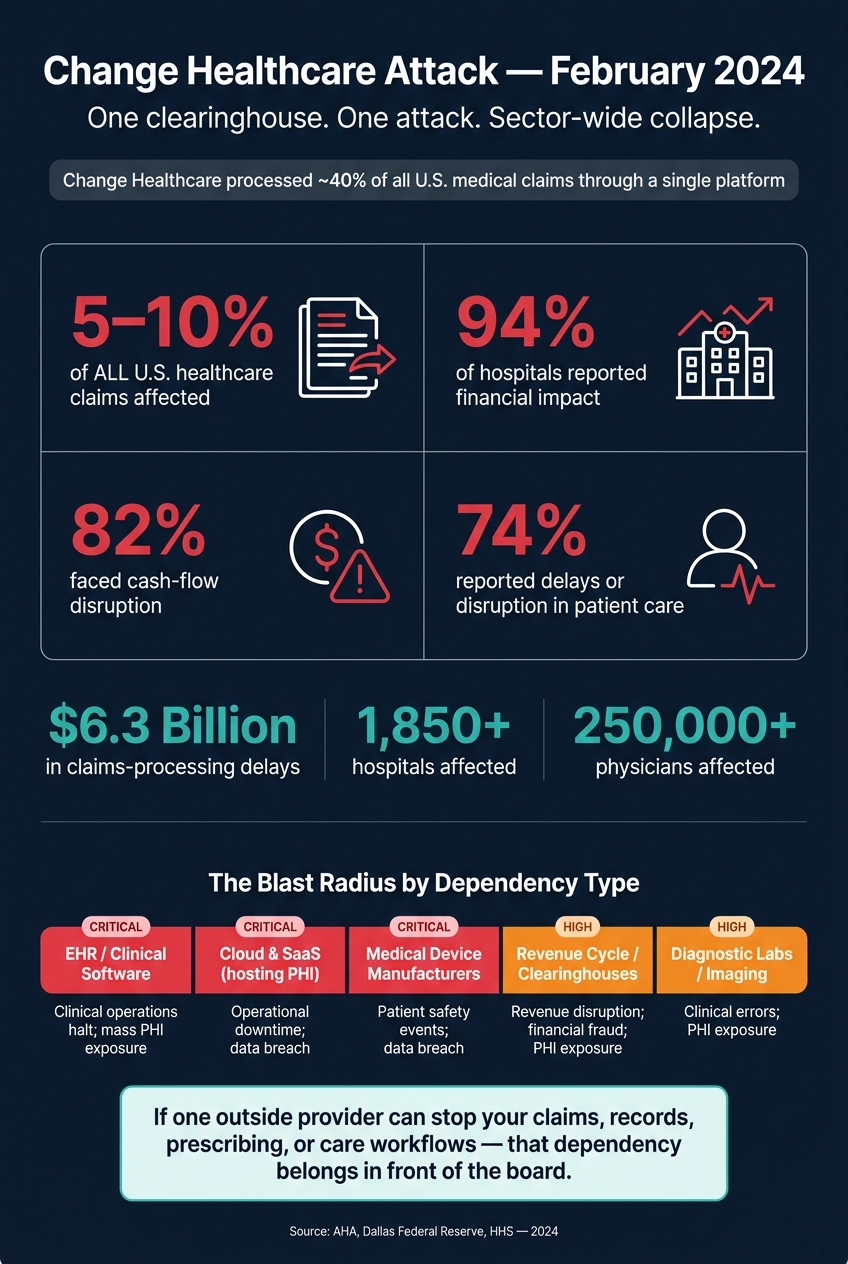
- The February 2024 Change Healthcare attack showed the scale of the problem:
- 5% to 10% of U.S. healthcare claims were affected
- 94% of hospitals reported financial impact
- 82% faced cash-flow disruption
- 74% reported delays or disruption in patient care
- An estimated $6.3 billion in claims-processing delays hit more than 1,850 hospitals and 250,000 physicians
- The article says boards should focus on:
- shared dependency maps
- single points of failure
- 24- to 72-hour incident notice terms
- tested plans for 72-hour and 4-week outages
- fourth-party risk such as cloud, remote access, and subcontractors
- It also says regulators should review:
- Main mitigation paths include:
- alternate clearinghouse routes
- multi-region cloud design
- local downtime procedures for EHR outages
- tighter MSP access control
- manual fallback for AI-driven workflows
- bridge financing and exit rights
Bottom line: if one outside provider can stop your claims, records, prescribing, or care workflows, that dependency belongs in front of the board and, in some cases, in front of regulators too.
This article is a field guide for spotting those choke points, ranking their blast radius, and choosing what to fix first.
Change Healthcare Attack 2024: The True Scale of Concentration Risk in U.S. Healthcare
Top 10 Healthcare Compliance Risk Areas Managers Need to Know
sbb-itb-535baee
How to map concentration across vendors, platforms, and critical workflows
Mapping concentration is about seeing where key work depends on the same vendor, platform, or piece of infrastructure. In a hospital system with more than 1,000 vendors, a simple vendor list won't get you there. You need to focus on the dependencies that can stop care, stall revenue, or expose PHI at scale.
The dependency categories that carry the most risk
Some vendors sit much closer to the center of the operation than others. Based on clinical criticality and regulatory exposure, these categories need the closest review:
| Vendor Category | Risk Tier | What Fails |
|---|---|---|
| EHR / Clinical Software (e.g., Epic, Cerner) | Critical | Clinical operations halt; mass PHI exposure |
| Cloud and SaaS Providers hosting PHI | Critical | Operational downtime; data breach |
| Medical Device Manufacturers | Critical | Patient safety events; data breach via connected devices |
| Revenue Cycle / Clearinghouses | High | Financial fraud; revenue disruption; PHI exposure |
| Diagnostic Labs / Imaging | High | Clinical errors; PHI exposure |
These are the dependency types that can turn one outage into a multi-organization event. Start with the critical tier. If an EHR, cloud host, or clearinghouse goes down, the impact is immediate and system-wide.
A concentration-mapping checklist for healthcare organizations
Use this checklist to build the map:
- Build a map of shared dependencies, not just suppliers
Include every vendor with PHI access, clinical system access, or a patient-critical supply role. Include Business Associates and their sub-contractors. Check that safeguards carry through downstream. For connected medical devices, ask for Manufacturer Disclosure Statement for Medical Device Security (MDS2) forms and Software Bills of Materials (SBOMs) so you can spot vulnerable or sanctioned components [1].
- Trace PHI and claims data flows
Map where PHI and claims data move, which vendors touch them, and which platforms host them. This step often reveals concentration that doesn't show up at the contract layer.
- Identify single points of dominance by function
For each critical function - claims processing, EHR, cloud hosting, and remote access - measure how much of your operation depends on one provider. Change Healthcare processed approximately 40% of all U.S. medical claims through a single platform before its February 2024 disruption [1]. That kind of dominance creates sector-level exposure.
- Quantify revenue and care-site exposure
Measure how much revenue depends on each vendor. Then measure how many sites are affected if that vendor fails. Put both figures into the map so the impact is plain to see.
- Map fourth-party infrastructure
For your highest-risk vendors, verify which cloud providers and remote-access tools they use. If two vendors rely on the same cloud infrastructure or remote-access tools, you've found a concentration point that won't show up in a standard vendor list. Questionnaire-based reviews often miss this shared infrastructure risk. Portfolio-level concentration analysis and dependency mapping are better ways to surface shared single points of failure.
The final output should rank dependencies by blast radius, recovery time, and monitoring priority. That gives the board a risk dashboard that shows where exposure is concentrated, how fast it can spread, and what breaks first.
Board oversight: questions, metrics, and reporting that matter
Use the ranked dependency map to shape board reporting around the small group of vendors that can halt care, revenue, or recovery. That gives the board a clear job: turn the map into a short list of shared failure points and review them on a set cadence.
Board questions for concentrated third-party and AI risk
Strong board oversight starts with plain, direct questions. Management should be able to name every vendor that serves as a single point of failure for a mission-critical workflow. It should also be able to state the incident-notification deadline written into each critical contract.
Set the bar at 24 to 72 hours for notification. HIPAA's 60-day outer limit should not be the working standard.
For AI providers, boards should ask a few simple things:
- Which workflows depend on a single model
- Where that model runs
- What manual fallback is in place if the model fails
If management can't answer those quickly, that's a warning sign.
What a board reporting pack should include
A good board reporting pack is short and centered on impact, not busywork. For critical vendors, it should include independent security architecture reviews and 2- to 3-year audited financial statements. It should also show whether the organization can keep operating through 72-hour and 4-week outages.
Each metric should answer one question: Can the organization keep care and cash flow moving if this vendor fails?
| Metric Category | Key Reporting Elements | Thresholds / Criteria |
|---|---|---|
| Concentration Risk | Top vendors by criticality; % of revenue/claims tied to one provider | Single points of failure identified; alternative providers mapped |
| Operational Resilience | Clinical continuity plan status; tested outage contingencies | Readiness for 72-hour and 4-week outages |
| Fourth-Party Risk | Number of critical vendors sharing cloud or subcontractor dependencies | Verification of HITECH sub-contractor safeguard flow-down |
| Security Controls | MFA, patching, and SBOMs for medical devices | 100% MFA on remote access; annual penetration tests |
| Vendor Financial Health | Vendor credit ratings; adverse credit indicators; client concentration | Audited financials for 2–3 years for all Tier 1 vendors |
Using Censinet dashboards and AI-assisted workflows for board governance
Censinet shows shared dependency risk across the vendor portfolio, so boards can see concentration in context. Instead of looking at static questionnaire outputs, they can tie risk to specific vendors, specific revenue lines, and specific patient populations.
AI-assisted workflows can flag emerging risks and help teams decide which dependencies need escalation before the next board cycle.
Regulatory review criteria and mitigation options for systemic resilience
Boards can flag concentration risk. Regulators have a different job: they need to test whether those dependencies can fail without taking down care or cash flow across the sector.
What regulators should look for in concentrated dependency models
When regulators review healthcare organizations, a simple checklist won't do much. The better approach is to ask the questions that expose system-level risk.
Start with materiality. If a vendor fails, does it stop revenue cycles, pharmacy prescription processing, or clinical operations at scale? If yes, that dependency is systemic, not routine.
From there, five criteria shape a steady review:
- Whether the function is critical to care or cash flow. Does the outsourced service support a workflow that, if it goes down, disrupts patient care or the revenue cycle?
- Market concentration and substitutability. Is there a workable substitute, or is the dependency hard to replace? If not, the risk should be treated as systemic [1].
- Fourth-party visibility. Under HITECH, HIPAA duties extend to subcontractors. Regulators should check that Business Associates pass safeguards down to subcontractors, not just say they do.
- Exit readiness. HIPAA requires documented PHI return or certified destruction when the contract ends. A verbal promise doesn't cut it.
- Business continuity and monitoring. Has the organization tested a documented outage contingency? Can it spot warning signs between review cycles, such as financial distress, news of financial distress, or shared infrastructure risk?
Dallas Federal Reserve research landed on the same point: questionnaire-based oversight misses systemic third-party risk [1].
For medical devices, regulators should also ask for a current Manufacturer Disclosure Statement for Medical Device Security (MDS2) and a Software Bill of Materials (SBOM). Those records help show whether device software depends on vulnerable or sanctioned components [1].
Mitigation strategies by dependency type: clearinghouses, EHRs, cloud, MSPs, and AI providers
Once a dependency is labeled systemic, the mitigation should fit the way it is most likely to fail.
That matters because each dependency type breaks in its own way. A single playbook won't work.
Clearinghouses sit at the tightest choke point in the revenue cycle. If a dominant clearinghouse goes down, claims can stall across the sector. Every critical payer route should have a tested alternate submission path. Outage plans should also include short-term cash controls, such as pre-arranged lines of credit, because revenue drops of up to 17% can show up within weeks [1].
EHRs need independent security architecture reviews, not self-certified questionnaires. Local downtime procedures should be current, taught to staff, and tested.
Cloud platforms bring a less obvious risk. Cloud exposure often sits inside shared regional infrastructure. Regulators should require documented multi-region redundancy and proof that those regions separate failure domains.
MSPs need tight access controls, automated revocation during offboarding, and checked HIPAA workforce training for any MSP staff with system access.
AI providers bring many of the same risks as other critical vendors: concentration, poor substitutability, and weak exit readiness. Organizations should map which workflows rely on a single model, where that model runs, and what manual fallback is in place if it stops working.
Comparing mitigation paths by cost, speed, and resilience impact
| Mitigation Path | Implementation Speed | Cost | Operational Burden | Resilience Impact | Relevance |
|---|---|---|---|---|---|
| Diversification | Slow | High | High | Very High | Hospitals, Payers |
| Alternate Clearinghouse | Medium | Medium | Medium | High | Physician Groups, Payers |
| Multi-region Architecture | Slow | High | High | Very High | EHRs, Cloud-hosted SaaS |
| Exit rights | Fast | Low | Low | Medium | All entities |
| Bridge financing | Medium | Medium | Low | High | Hospitals, Physician Groups |
A practical way to use this table is simple: assign one primary mitigation to each critical dependency, then flag the gaps that still remain. After that, pair each dependency with the least disruptive control that cuts the largest source of exposure.
Conclusion: Make shared dependency risk a board and regulatory priority
The main takeaway from the February 2024 Change Healthcare attack is simple: in healthcare, a single vendor failure is never just one organization's problem. When one major clearinghouse goes down, claims, prescriptions, and care workflows can slow or stop across the industry. That is concentration risk turning into sector risk. [1]
What fixes this is not more awareness. It’s better governance, clear dependency mapping, and plans that hold up under stress. That means five things:
- Define the risk as patient safety, operational, and financial risk.
- Map critical dependencies across clearinghouses, EHRs, cloud, MSPs, and third-party AI.
- Give boards decision-grade metrics and reporting.
- Test regulatory review for fourth-party duties and outage readiness.
- Fund redundancy and continuity plans.
Dallas Federal Reserve research landed in the same place: questionnaire-based oversight is not enough for critical vendor relationships. [1]
Those priorities also need day-to-day support. Censinet RiskOps™ gives boards and risk teams visibility into shared dependencies, supports AI-assisted assessments, and routes critical findings through dashboards and workflows.
Shared dependency risk is not going away as healthcare gets more connected. Boards and regulators that treat it as a board-level priority will be in a stronger position to protect care delivery and financial stability when the next failure hits.
FAQs
How do we spot hidden concentration risk?
Build a living dependency map, not just a vendor spreadsheet. Follow each critical workflow from start to finish across vendors, subcontractors, cloud hosts, identity and authentication layers, shared infrastructure, and fourth-party dependencies.
Use API logs, outbound traffic, and authentication activity to find undocumented integrations and shared failure paths. Then rank chokepoints by criticality and blast radius, and test outages with named fallbacks before the next disruption.
What should boards review first?
Boards should start with critical clinical and business services instead of a long vendor list. The focus is simple: which functions would disrupt patient care or cash flow within 72 hours if they went down?
That usually includes services like:
- claims processing
- EHR access
- pharmacy transactions
- diagnostic imaging
- scheduling
From there, work backward. Map the vendors, platforms, subcontractors, and shared infrastructure that support those services.
This shifts oversight to the places where failure would hit hardest first. Instead of spreading attention across every outside partner, boards can zero in on the most systemic exposure points.
How can we reduce single-vendor exposure?
Move beyond static vendor lists. Build a dependency-based map of your clinical and business workflows instead.
That map should show:
- the workflow itself
- the platforms behind it
- the cloud regions in use
- any fourth-party subcontractors involved
Then rank those dependencies based on clinical impact, recovery time, and data sensitivity.
From there, add redundancy where it matters most. That can include multi-region failover, alternate clearinghouse paths, or secondary network connections.
It also helps to rehearse the ugly scenarios before they happen. Regularly practice manual downtime procedures. Set clear backup triggers. Put contract requirements in writing. And make board oversight part of contingency planning and recovery testing.
