
A vendor issue is a patient care issue when it blocks care. I’d sum this article up like this: stop rating vendors only by compliance, contract size, or PHI volume, and start rating them by what happens to patients if the vendor fails. The article shows a direct path from a control gap to system downtime, workflow breakdown, and patient harm. It also backs that up with hard numbers, including 72% of attacked U.S. healthcare groups reporting care disruption, 87% for supply chain attacks, and 74% of hospitals reporting direct patient care impact during the Change Healthcare event.
If I were explaining the core message in plain English, it would be this:
- Map each vendor to the clinical workflow it supports
- Tier vendors by how fast downtime affects patient safety
- Score findings by likely patient harm, not just audit exposure
- Set clear escalation rules tied to care delays and safety risks
- Watch vendor, system, and clinical signals in near real time
The article’s main point is simple: a vendor can pass audits and still put care at risk if its outage plan, recovery time, access controls, device support, or supply chain fail under stress. That’s why GRC needs to speak the same language as clinical teams: delayed meds, delayed diagnoses, missed alarms, canceled procedures, and patient transfers.
What I like here is the shift in framing. Instead of asking, “Is this vendor compliant?” the better question is, “How long can this workflow be down before a patient gets hurt?” That one question changes vendor tiering, scoring, response steps, and leadership attention.
A short takeaway list:
- Tier 1 vendors support direct diagnosis, treatment, or monitoring in places like the ED, ICU, OR, oncology, and NICU
- Tier 2 vendors support care but have short-term workarounds
- Tier 3 vendors affect coordination or admin work more than bedside care
- A patient risk score should reflect likelihood, severity, detectability, and current safeguards
- Escalation should start when outages hit order entry, meds, diagnostics, monitoring, or high-acuity care
This is less about paperwork and more about decision-making. The article argues that if your vendor program cannot show bedside impact, it is missing the part that matters most. From there, the rest follows: score what can harm care, assign owners before incidents happen, and treat vendor failure as a patient safety event when clinical workflows are on the line.
Enhanced Vendor Risk Assessment | Tony Turner
sbb-itb-535baee
Where Third-Party Risk Becomes Care Delivery Risk
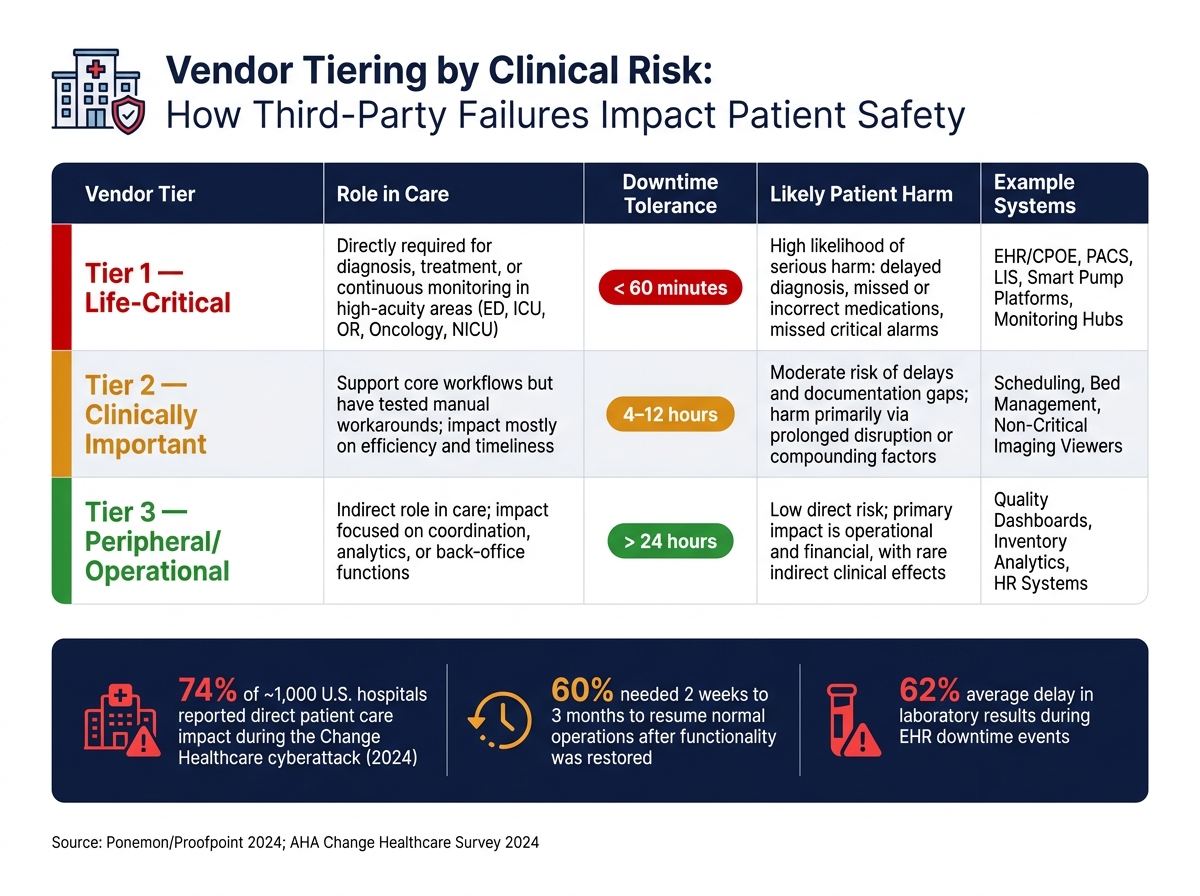
Vendor Tiering by Clinical Risk: How Third-Party Failures Impact Patient Safety
A lot of vendor programs sort suppliers by contract value or PHI volume. That sounds tidy on paper, but it misses the point that matters most: what breaks in patient care if this vendor goes down?
To get at patient risk, tie each vendor to the clinical workflow it supports.
Map Vendors to Clinical Workflows and Patient Populations
Start with a clinical impact map. List the main workflows, then note which vendor systems sit inside each one and which patient groups rely on them.
When a core system fails, the effect on care can be immediate. An EHR outage can halt ordering, allergy checks, and documentation. A PACS failure can slow stroke and trauma reads. LIS downtime can delay critical results. In one study, laboratory results were delayed by an average of 62% during EHR downtime events[1].
Focus first on patient groups where delays or workarounds get risky fast. That usually includes ICU, oncology, perinatal, and chronic disease patients. It also helps to track daily encounters moving through each system, because volume changes the size of the hit.
Once vendors are mapped to workflows, you can rank them by one simple standard: how fast does downtime turn into a patient safety issue?
Segment Vendors by Clinical Criticality and How Deeply Other Systems and Devices Depend on It
Segment vendors by clinical impact, not by compliance label. A small vendor tied to a high-stakes oncology workflow may matter far more than a large back-office vendor that holds more PHI.
The main factors are:
- Downtime tolerance: how long the organization can function before care starts to slip
- Manual workaround feasibility: whether safe paper-based backups exist, and for how long
- Device or application dependence: whether clinicians can keep working without that specific system
- Encounter volume: how many daily encounters run through the vendor's system
Use data that can back up the tiering. EHR logs, incident and change records, downtime drill results, patient safety reports, and interviews with clinical leaders all help support defensible assignments.
Tiering shapes who gets scored, watched, and escalated first.
| Vendor Tier | Role in Care | Devices/Apps | Downtime Tolerance | Likely Patient Harm |
|---|---|---|---|---|
| Tier 1 – Life-Critical Clinical Systems | Directly required for diagnosis, treatment, or continuous monitoring in high-acuity areas (ED, ICU, OR, oncology, NICU) | High; multiple devices/apps cannot safely function without this vendor (e.g., EHR CPOE, PACS, LIS, smart pump platform, monitoring hub) | Very low (e.g., <60 minutes) | High likelihood of serious harm: delayed diagnosis, missed or incorrect medications, missed critical alarms |
| Tier 2 – Clinically Important Support Systems | Support core workflows but have tested manual workarounds; impact mostly on efficiency and timeliness | Moderate; clinicians can function with workarounds for limited periods (e.g., scheduling, bed management, non-critical imaging viewers) | Moderate (e.g., 4–12 hours) | Moderate risk of delays and documentation gaps; harm primarily via prolonged disruption or compounding factors |
| Tier 3 – Peripheral Clinical/Operational Systems | Indirect role in care; impact focused on coordination, analytics, or back-office functions | Low; clinical teams can continue core care with limited disruption (e.g., quality dashboards, inventory analytics, HR systems) | High (e.g., >24 hours) | Low direct risk; primary impact is operational and financial, with rare indirect clinical effects |
The 2024 Change Healthcare cyberattack made this problem hard to ignore. One shared vendor became a single point of failure across many hospitals. A national survey found that 74% of nearly 1,000 hospitals reported direct patient care impact, and 60% needed between two weeks and three months to resume normal operations after functionality was restored[2][3].
That sets up the next move: turning GRC findings into patient impact scores.
How to Convert GRC Findings into Patient-Impact Scores
Once vendors are tiered by clinical criticality, each finding should be scored by expected patient harm, not just compliance exposure. The goal is pretty simple: make the score easy to compare across vendors, while still grounded in what could happen to patient care.
Score Control Gaps Using Clinical Severity Factors
A practical patient risk score multiplies likelihood of cyber failure (1–5) by clinical severity (1–5), then adjusts for detectability (1–3 modifier) and existing control strength (-2 to +2 modifier).
Score likelihood based on patch cadence, MFA coverage, vendor history, and threat intel. Score severity based on downtime, affected encounters, disabled safety checks, fallback reliability, and the effect on diagnosis, medication, or treatment timing.
If a finding touches a direct patient-care workflow, it should move faster than one tied to a lower-impact workflow. As a starting point:
- 16–25 = urgent clinical risk
- 8–15 = priority risk
- 7 or below = routine monitoring
Those scores should feed straight into remediation and escalation rules.
Map Common Findings to Likely Clinical Outcomes
Use the examples below as a gut check. If the score looks low but the care effect looks serious, something's off.
| GRC Finding | Operational Disruption | Patient Impact | Remediation Priority |
|---|---|---|---|
| Weak business continuity controls for core EHR | Extended downtime, delayed order entry and documentation | Missed or delayed medication orders, reduced visibility into allergies and history | Urgent – strengthen DR/BCP, test failover, drill downtime procedures, tighten SLAs |
| Unsupported connected infusion pumps on the network | Difficulty patching; potential connectivity loss | Incorrect infusion rates, interrupted medication delivery, failed device alarms | Urgent for direct-care areas – replace or isolate devices, update security and maintenance controls |
| Delayed incident notification in vendor contracts (e.g., 72+ hours) | Slow breach or outage awareness, delayed internal response activation | Prolonged PHI exposure, extended service disruption, missed window to implement workarounds | High – renegotiate notification timelines, align with internal incident response SLAs |
| MFA gaps for remote vendor access to clinical systems | Higher probability of unauthorized access and ransomware | Sudden loss of EHR, PACS, or lab platforms; data manipulation affecting clinical decisions | High to urgent depending on systems – enforce MFA, restrict access, monitor vendor sessions |
| Supply chain concentration risk for critical medications | Single or limited suppliers for essential drugs | Drug shortages forcing therapy changes, treatment delays, or cancellations | High – diversify suppliers, build inventory buffers, create clinical contingency protocols |
| Unencrypted data flows from telemetry devices to central monitoring | Risk of interception or tampering with physiologic data | Missing or inaccurate vital signs; delayed recognition of patient deterioration | High – implement encryption, validate data integrity, enhance monitoring alerts |
Use Control Mapping to Focus Remediation
Control mapping links each finding to the safeguards, downtime procedures, escalation owners, and recovery objectives that reduce actual care risk, not just audit exposure.
Security and IT define the technical scope. Clinical operations and clinical engineering define who depends on the asset. Working together, they map controls, downtime procedures, and clinical safeguards such as MFA, network segmentation, backups, double-check procedures, alternate documentation methods, and escalation pathways.
Each finding's RTO should be set by clinical need, not just IT preference. An ED monitoring system needs a shorter RTO than a nonclinical system. Vendor SLAs and internal runbooks should line up with those thresholds. When they don't, that mismatch should be treated as its own finding.
Each workflow also needs a named escalation owner. In a live incident, that cuts out delays and helps the right person act at once instead of waiting for approval to move up the chain. The same score should drive monitoring, escalation, and response ownership.
The next step is to tie those scores to escalation thresholds, owners, and response time.
Build Escalation, Monitoring, and Governance Around Clinical Thresholds
Scores only matter if they trigger action. That means escalation rules, ownership, and monitoring need to be set before anything goes wrong. Once risks are scored, you need exact triggers that move those scores into action.
Set Incident Escalation Thresholds Tied to Patient Safety
Escalation thresholds should tie back to patient safety events, care delays, and diagnostic or treatment errors - not just IT severity labels.
An outage should move up fast when it affects order entry, medication administration, diagnostics, or device monitoring. The same goes for cases where a critical vendor can't provide an ETA within 30–60 minutes, or when a disruption hits high-acuity areas or time-sensitive pathways like stroke or sepsis care. No ETA is a clinical risk signal.
These thresholds need to live in policy with clear time and scope rules. They can't depend on whoever happens to be on the call during an active incident. The Change Healthcare cyberattack in February 2024 made that plain: 74% of nearly 1,000 surveyed U.S. hospitals reported a direct patient care impact, and 60% needed two weeks to three months to get back to normal operations once full functionality was restored.[2]
Use incident response levels to show severity - not vendor status:
- Level 1: Local issues with safe workarounds
- Level 2: Facility-wide disruption that needs an Incident Management Team
- Level 3: Organization-wide or multi-site impact that needs HICS[10][11]
Those thresholds don't do much on paper if people aren't clear on who moves next.
Create a Cross-Functional Response Path
Once a threshold is crossed, the response path should already be in place - not built on the fly.
A simple timeline helps. IT and security handle triage in the first 15 minutes. The clinical lead and GRC should be notified at once when patient-impact thresholds are met. If restoration is still uncertain, incident command should activate within 30–60 minutes.
Each team needs a clear lane. Security leads containment. GRC tracks third-party vendor risk and reporting. Clinical engineering handles devices. Supply chain lines up alternates. Clinical leaders adjust bedside practice. Incident command keeps the whole response moving in one direction.[7][8][9][12]
A documented RACI matrix helps avoid the usual mess - too many people making the same call, or worse, nobody making it.
After ownership is clear, monitoring needs to keep pace so those thresholds don't go stale.
Sustain Continuous Monitoring with Automated Workflows
Continuous monitoring turns material vendor changes - breaches, sub-processor shifts, SLA misses, or financial distress - into immediate reassessment.[5][6] Those signals should update vendor scores in real time, not sit around until the next review cycle.
Good monitoring pulls from both technical and operational signals. On the technical side, that includes system uptime, interface queue depths, and transaction failure rates. On the vendor side, it includes SOC 2 report changes, incident history, and SLA performance trends.
Clinical indicators matter too. Order-to-administration timing, MAR access times, prolonged ED length of stay, and device alarm frequencies can all work as early warning signs when vendor trouble is starting to slow care.
A platform that centralizes assessments, automates routing, and tracks evidence in real time gives teams a way to act before vendor issues reach the bedside.
Conclusion: Make Patient Outcomes the Core Metric for GRC
Vendor risk turns into patient risk the moment a third-party failure slows or stops a clinical workflow. That leaves one plain, operational question: does your GRC program track that link? When it does, GRC stops being just an admin or IT task. It becomes part of patient safety.
The path is already laid out. Use the workflow map, patient-impact scores, and clinical thresholds you’ve already set. Then:
- map vendors to workflows using a HIPAA-compliant risk management framework
- score findings based on acuity, time sensitivity, and backup strength
- escalate clinical thresholds to leadership
- monitor performance through cross-functional governance
The cost of missing this link is hard to ignore. A 2024 Ponemon/Proofpoint survey found that 92% of healthcare organizations had at least one cyberattack in the previous 12 months, 69% reported disruption to patient care, 56% reported worse outcomes from delayed procedures and tests, and 28% reported increased patient mortality[4].
Strong GRC is linked to better care quality and safer patient care. Put simply, when it’s done well, GRC is clinical reliability.
Start where the stakes are highest: the ED, OR, ICU, and oncology. Prove the model there. Then scale it across the organization. When patient outcomes become the core metric, every vendor decision starts to matter in clinical terms.
FAQs
How do we measure patient impact from vendor risk?
Measure patient impact by looking past technical severity scores and focusing on care disruption.
Start by mapping core clinical workflows, like ED triage, stroke care, and pharmacy verification, to the vendors, devices, and data feeds they rely on. This gives you a plain view of what supports patient care behind the scenes.
Then pressure-test each service with a simple question: what breaks if it’s unavailable for 1 hour, 8 hours, or 24 hours? That kind of exercise helps separate a minor IT issue from a problem that can slow treatment or put patients at risk.
Prioritize based on:
- Clinical criticality
- PHI exposure
- Downtime tolerance
And track the signals that show actual patient impact, including downtime, procedure delays, diagnostic errors, and medication near-misses.
Which vendors should be treated as Tier 1 first?
Prioritize Tier 1 vendors based on how directly they affect life-critical functions and patient safety - not just whether they can access data.
That means putting top weight on vendors tied to electronic health records, connected medical devices, clinical systems, and shared infrastructure. Then rank them by:
- Clinical criticality
- Risk of downstream care delays
- How safe manual workarounds would be
A simple way to think about it: if a vendor outage could slow treatment, disrupt care decisions, or force staff into risky backup processes, that vendor belongs near the top of Tier 1.
What signals should trigger escalation during a vendor outage?
Escalate during a vendor outage when clinical continuity or patient safety is at risk.
Watch for signals like these:
- Activation of downtime procedures, including manual or paper-based workflows
- Impact on mission-critical systems like EHRs, imaging, or pharmacy automation
- Recovery time objectives at risk, or signs of clinical disruption moving past set thresholds, such as procedure delays, lab backlogs, or unit diversions
