
If I work in healthcare, I can’t treat SEC and HIPAA as the same rule. They ask different questions, have different deadlines, and go to different audiences. For a public company, SEC Form 8-K Item 1.05 is usually due within four business days after I decide an incident is material. For HIPAA, notice to affected people is usually due within 60 calendar days of discovery if unsecured PHI was involved.
Here’s the short version:
- SEC track: Is the incident material to investors?
- HIPAA/HHS track: Was there a breach of unsecured PHI?
- Vendor track: A third-party event can still become my disclosure problem.
- State and contract track: These may add faster or separate notice duties.
- Internal track: I need one record, one workflow, and one owner for decisions.
A few points stand out fast:
- OCR had logged 364 hacking incidents affecting more than 33 million Americans as of 10/3/2025
- A ransomware event can affect patient care, billing, revenue, and legal exposure before loss totals are final
- A choice not to file still needs a written record, review dates, and named decision-makers
- Vendor notice does not replace SEC, HIPAA, or state notice
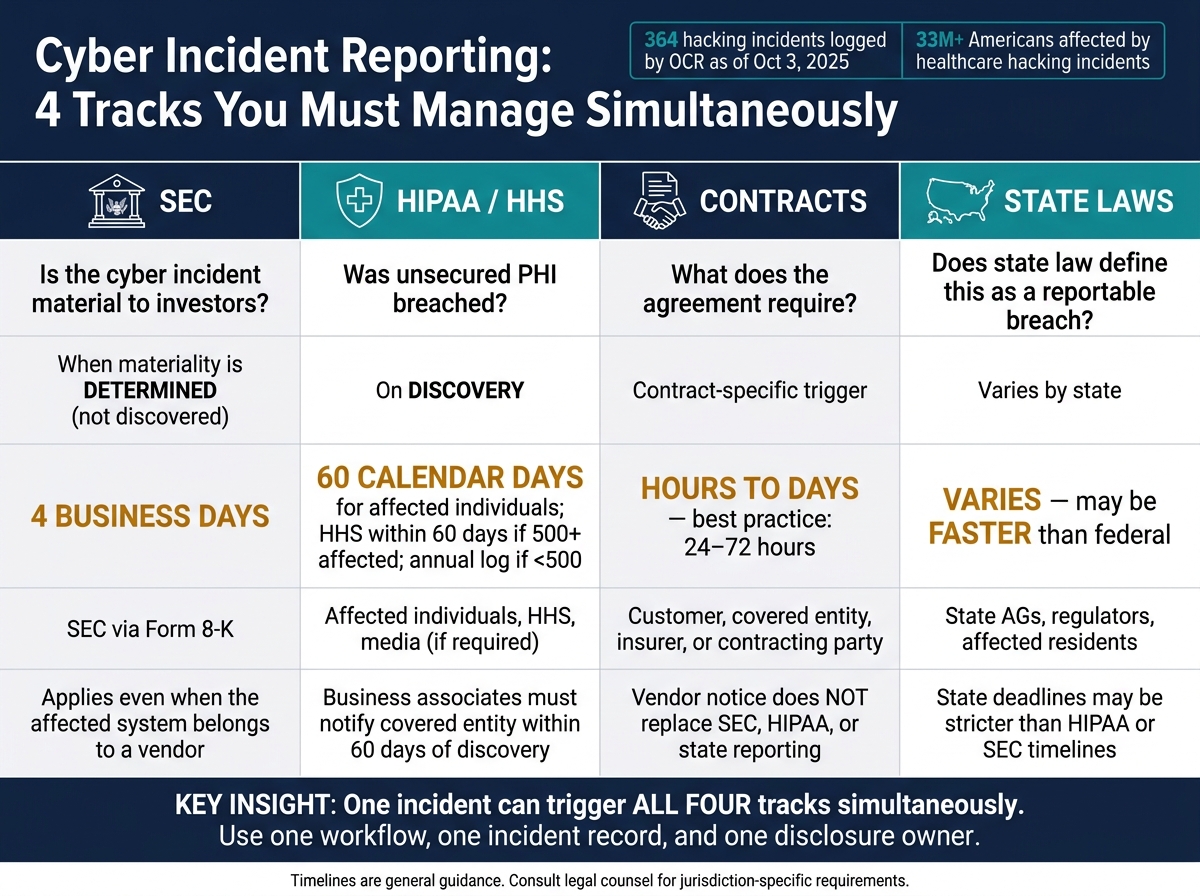
SEC vs. HIPAA vs. State vs. Contract: Cyber Incident Reporting Requirements
An Introduction to SEC Cybersecurity Disclosure Rules
sbb-itb-535baee
Quick comparison
| Track | Main question | Clock starts when | Usual deadline |
|---|---|---|---|
| SEC | Is the cyber incident material? | When materiality is determined | 4 business days |
| HIPAA/HHS | Was unsecured PHI breached? | On discovery | 60 calendar days for affected people; HHS timing depends on count |
| Contracts | What does the deal require? | Based on contract trigger | Often hours to days |
| State laws | Does state law define this as a reportable breach? | Varies by state | Varies |
My main takeaway: the hard part is not just finding the incident. It’s separating the legal tests, documenting each call, and reassessing as facts change. The article lays out how to do that with a single workflow, a decision log, and tighter vendor notice terms.
What Triggers Disclosure Under SEC and HHS Rules
Once you know which reporting path applies, the next step is figuring out what facts actually start the clock. Discovery alone does not always trigger disclosure. What matters is the underlying facts and how fast your organization can review them.
How to Assess SEC Materiality for Cyber Incidents
For the SEC, disclosure starts at determination, not at discovery. Once a registrant decides that a cybersecurity incident is material, Form 8-K Item 1.05 is generally due within four business days of that determination.[2][5]
That review should look at more than the first dollar estimate. Teams should weigh:
- remediation costs
- lost revenue
- downtime
- patient-care disruption
- litigation exposure
- reputational harm
A small early loss figure does not automatically make an incident immaterial. If extended disruption, litigation risk, or a series of related incidents makes a material impact reasonably likely, that can be enough to trigger disclosure.[2][9] Put simply, the issue is not only how much money was lost. It is whether the incident changes the organization’s operational, clinical, or governance position in a way that matters to the public.
Recurring exploitation, repeated vendor outages, or multiple events tied to the same control gap can also add up to materiality.
This materiality test is separate from the HIPAA breach analysis discussed below.
How HIPAA and HHS Breach Notification Triggers Differ
HIPAA uses a different test. The question is whether unsecured PHI was impermissibly acquired, accessed, used, or disclosed. Covered entities must notify affected individuals without unreasonable delay and no later than 60 calendar days after discovery.[1] If a breach affects 500 or more individuals in a state or jurisdiction, the covered entity must also notify HHS within that same period. Smaller breaches go to HHS within 60 days after the end of the calendar year in which they were discovered.[6][8]
Business associates have their own notice duty. They must notify the covered entity without unreasonable delay and no later than 60 calendar days after discovery.[1][7] In practice, contracts should require much faster operational notice so the covered entity has time to investigate and meet its own deadlines.
If the facts are still murky, that does not mean the issue can sit in limbo. The decision at that point still needs to be recorded and reviewed again as new facts come in.
When Choosing Not to File Is Still a Decision That Needs Documentation
If materiality is still unresolved or has been found not to exist, a voluntary Item 8.01 disclosure is the better fit than Item 1.05.[3] Item 1.05 is for incidents the registrant has determined to be material. Using it for an unresolved or immaterial event can confuse investors.[3]
A decision not to file is still a real decision. It needs the same documented, cross-functional process as a filing decision. That means recording the known facts, financial and operational estimates, patient-care effects, legal analysis, who took part, and when the matter will be reassessed. If later facts change the conclusion, an Item 1.05 filing is due within four business days of that later determination.[11] A solid decision log is often the difference between a defensible governance process and a gap no one can explain.
How to Coordinate SEC, HIPAA, HHS, and Internal Escalation
Once trigger analysis is done, the organization needs one workflow to drive every disclosure decision. The main problem is split response: legal, privacy, compliance, and security teams often run their own tracks while the clock keeps moving. The fix is simple in concept, though not always in practice: one incident record, one cross-functional workflow, and one disclosure owner managing every track at the same time.
A Unified Workflow from Detection to Disclosure Decision
When an incident is detected, the workflow should start right away, even if it’s still unclear which rules apply. The process should move through six steps: detect, contain, assess, escalate, decide, and update.
The assessment stage is where many organizations stumble. Security, Privacy, Legal, Finance, Clinical Operations, and Third-party vendor risk management should all review the same incident at the same time, not one after another. These are parallel workstreams feeding a single decision. That same incident record should also support internal reporting, board updates, and the timing of outside notices.
Initial triage should capture:
- The exact discovery date and time
- Affected systems and any clinical dependencies
- The types of data involved
- The estimated number of affected individuals
- Current operational effects, such as patient diversions or canceled procedures
- Any law-enforcement engagement
The record should also separate confirmed facts, reasonable estimates, and unknown information. That matters because SEC guidance permits a registrant to state that information is not determined or unavailable at the time of filing, with an amendment required when the information is later determined or becomes available [11].
Escalation thresholds should be set in advance, not invented in the middle of a crisis. Immediate escalation makes sense for suspected PHI exfiltration, patient-care disruption, ransomware, material financial exposure, or major third-party vendor security risks. Escalation to the board or a board committee should happen when the incident may be material, threatens patient safety, or affects strategic operations.
What to Include in a Disclosure Decision Log
The decision log shows how the organization reached each disclosure call. It’s the audit trail for every decision and the record regulators, auditors, and boards will review when they want to know whether the process holds up.
At a minimum, the log should include the incident ID and classification, discovery date and suspected start date, systems and vendors involved, known and reasonably likely effects on patients and operations, the HIPAA breach-risk analysis, SEC materiality assumptions and financial estimates, contractual and state-law duties, law-enforcement factors, and the names and dates of everyone who approved each decision.
Every reassessment should be recorded too. If new facts come in, loss estimates change, or exfiltration is confirmed, the log should explain why the original conclusion changed - or why it stayed the same. Non-filing decisions need the same treatment as filing decisions. The record should show what information was reviewed, who made the call, and what facts would trigger another review. That’s what supports board-level reporting and helps if a regulator later questions the timeline.
Comparison Table: SEC, HIPAA/HHS, Contractual, and State Reporting
Use the same incident record to compare all four reporting tracks side by side. Vendor notice alone does not satisfy HIPAA, SEC, or state reporting. And an SEC filing does not replace notice to individual patients.
| Obligation | Trigger | Decision Owner | Deadline | Recipient | Key Information |
|---|---|---|---|---|---|
| SEC Form 8-K Item 1.05 | Cybersecurity incident determined to be material to the registrant | General counsel, executive leadership, finance, and security | Generally within four business days of the materiality determination [2][4][10][13] | SEC via Form 8-K | Nature, scope, timing, and material impact or reasonably likely material impact |
| HIPAA/HHS Breach Notification | Breach of unsecured PHI, unless the risk assessment supports a low probability of compromise | Privacy officer, compliance, legal, and covered entity or business associate leadership | Business associate to covered entity: no later than 60 calendar days after discovery; individuals: no later than 60 days after discovery; HHS: breaches affecting 500 or more individuals within 60 days of discovery; fewer-than-500 breaches within 60 days after the end of the calendar year [1][6][14][15] | Affected individuals, HHS, and media, when required | Discovery date, affected information and population, investigation, mitigation, and prevention measures |
| Contractual Vendor Reporting | Contract-specific event such as unauthorized access, security incident, service outage, or suspected PHI compromise | Contract owner, vendor management, legal, privacy, and security | Depends on the agreement; may be measured in hours or a specified number of business days | Customer, covered entity, business associate, insurer, or other contracting party | Incident summary, affected systems, containment, and remediation status |
| State-Law Reporting | State-specific definition of breach, personal information, health information, or harm; requirements vary by jurisdiction | Legal and privacy teams with state compliance support | Varies by state and may be faster than federal requirements | State attorneys general, regulators, affected residents, or other specified recipients | State-specific notice content, affected residents, timing, investigation, and mitigation |
Vendor incidents should enter this same workflow through contract notice and business associate reporting.
How Vendor and Third-Party Incidents Affect Your Disclosure Analysis
Third-party incidents go through the same disclosure process, but they often show up with less information and more urgency. And that’s the hard part.
A vendor breach is still your problem. If a third party you depend on gets hit - an EHR hosting provider, a revenue-cycle vendor, a clearinghouse, or a managed-service provider - the fallout lands on your organization too: lost revenue, clinical disruption, PHI exposure, and regulator scrutiny. The SEC rule still applies even when the affected system belongs to someone else. What matters is the impact on the registrant, not who owns the system.[12]
What Contracts and Business Associate Agreements Should Require
Contracts should require notice much earlier than HIPAA’s outer limit. If a vendor tells you near the end of that window, your own review period gets squeezed fast. A shorter contract deadline - 24 to 72 hours after discovery of a suspected incident - is a sensible standard, along with a duty to send follow-up updates as facts come in.[19][20]
The first notice should include:
- discovery time
- affected systems and services
- data types
- estimated impact
- containment steps
- law-enforcement involvement
- 24/7 escalation contacts
Agreements should also require final root-cause findings, affected-record lists, and forensic summaries. Just as important, contracts should give your organization the right to join the investigation, ask for relevant evidence, and confirm remediation for yourself - not just take the vendor’s word for it.[16][17][18]
Subcontractors need the same scrutiny. If your vendor relies on a cloud hosting company, a payment processor, or other downstream subcontractors, those parties should be bound by the same security, notice, and cooperation duties. The main vendor stays on the hook for subcontractor incidents. It can’t point to a downstream provider that is still investigating as a reason to hold up your notice.[16][18]
Those notice terms matter because a vendor incident should start feeding your own disclosure timeline right away.
How to Route Vendor Incidents Through Your Materiality Process
As soon as notice comes in, send the incident into your own materiality review. Public-company healthcare organizations should use the same SEC materiality framework for vendor-originated incidents. The moment you learn about a vendor event, open an enterprise incident record. Don’t wait for the vendor’s forensic report. Your materiality clock ties to when you determine materiality, not when the vendor first found the incident.[12][2]
Use the same cross-functional team for these cases: security, privacy, legal, compliance, finance, clinical operations, risk management, and investor relations. The questions don’t change. What is the actual and reasonably likely financial impact? Has patient care been affected? Does this involve unsecured PHI? What is the exposure to claims or regulator action? Qualitative factors - like patient safety or disruption of a critical clinical service - can decide the issue even when dollar losses are still being counted.[12]
In the disclosure decision log, record what the vendor reported, when it reported it, what your organization assessed on its own, and which facts would make you reopen the decision.
Build a Disclosure-Ready Program for Ongoing Compliance
The Core Controls Every Disclosure-Ready Program Needs
Once the disclosure workflow is set, the next job is putting controls around it so the process works the same way every time. In practice, that means keeping five connected controls in place: a reporting playbook, a cross-functional escalation checklist, an executive reporting cadence, an evidence repository, and a continuous reassessment process.
The playbook should turn the workflow into something people can actually run: named owners, due dates, and required outputs. The escalation checklist should bring in Security, Privacy, Legal, Finance, Clinical Operations, Vendor Management, Communications, and executive leadership at the right trigger points. That usually means continuous monitoring, daily review for high-severity events, immediate escalation for possible material incidents, and board reporting for unresolved or high-stakes events.
The evidence repository needs to keep the full record in one place: the incident timeline, forensic results, risk assessments, decisions, approvals, and filings. And reassessment can't be a one-and-done step. Scope, cost, patient impact, and regulatory exposure can shift after the first review, so the team has to revisit the facts as they change.
For healthcare teams deciding where to focus controls first, the HHS Cybersecurity Performance Goals (CPGs) give a practical starting point.[22] Map the HHS CPGs that apply to systems whose failure could interrupt patient care, emergency services, diagnostics, scheduling, billing, or PHI access. Then focus on controls that lower the odds or length of operational disruption, including:
- Strong identity and access management
- Multifactor authentication
- Email security
- Vulnerability management
- Network segmentation
- Tested backups
- Incident response
- Third-party risk management
How Censinet Supports a Centralized Reporting and Risk Workflow
A centralized workflow helps keep all of those controls in one record and one review cycle. Censinet RiskOps™ brings together assessments, remediation tasks, evidence, and reporting across PHI services, clinical applications, medical devices, vendors, and supply-chain dependencies.
When an incident involves a vendor or a clinical system, speed matters. If the vendor's risk profile, assessment history, and remediation status are available right away, teams can judge criticality faster and move the event into the materiality process without wasting time hunting for records.
AI can reduce assessment time by up to 66%.[21] Censinet AI™ can speed up questionnaire completion, evidence review, assessment routing, issue tracking, and workflow triage. But the call still belongs to people. Security, privacy, legal, finance, and executive decision-makers must validate the facts, judge materiality and breach risk, and approve each disclosure. The platform moves the work along; human judgment makes the call.
Conclusion: What Healthcare Leaders Should Do Next
Materiality and breach decisions need structure, documentation, and a record that can stand up to scrutiny. Disclosure readiness comes from repeatable workflows, evidence retention, and executive oversight, not from a policy document that sits on a shelf.
The matrix below turns that program into an operating checklist. Review it at least once a year and after major regulatory, organizational, technology, or vendor changes. It should also be tested through tabletop exercises that cover a direct breach, a critical vendor outage, a ransomware event, and a slow-moving incident where materiality shifts as more facts come in.
| Key Control | Owner | Inputs | Decision Produced | Audit Evidence Retained |
|---|---|---|---|---|
| Incident intake and severity triage | Security operations | Alerts, detection time, affected assets | Initial severity and escalation path | Ticket, timeline, classification rationale |
| SEC materiality assessment | Legal, finance, security, executive delegate | Scope, duration, operational impact, financial estimates, recurrence and aggregation factors | Material or not material; filing path | Decision log, impact model, approvals |
| HIPAA breach assessment | Privacy officer and legal | PHI inventory, access evidence, risk factors, affected individuals | Breach notification required, not required, or pending | Risk assessment, legal analysis, notification records |
| Vendor incident escalation | Third-party risk and procurement | Vendor notice, contract, BAA, service criticality, subcontractor data | Enterprise escalation and contractual actions | Notice, contract clauses, correspondence, remediation plan |
| Clinical and operational impact review | Clinical operations and business continuity | Downtime, patient-safety indicators, recovery status | Continuity measures and executive severity update | Downtime records, recovery tests, clinical impact assessment |
| Executive reporting cadence | CISO, privacy officer, general counsel, risk leader | Open incidents, deadlines, trends, unresolved decisions | Executive action, resource allocation, or board escalation | Dashboards, meeting minutes, action register |
| Evidence repository | Legal operations, compliance, or security governance | Logs, forensic reports, assessments, approvals, filings | Complete and defensible incident record | Access history, version history, retention and legal-hold records |
| Continuous reassessment | Incident commander and legal | New scope, cost, duration, affected records, vendor findings | Reaffirmed or revised disclosure and notification decision | Reassessment entries, amended filings, updated approvals |
| Healthcare control prioritization | CISO and clinical risk leadership | HHS CPG mapping, asset criticality, control maturity, residual risk | Remediation priorities and deadlines | Control mapping, test results, exceptions, remediation evidence |
| Integrated assessment workflow | Enterprise risk or GRC leader | Assessment data, remediation status, vendor profile, benchmark data | Risk prioritization and management action | Assessment history, task records, reports, review sign-offs |
FAQs
How do I decide if a cyber incident is material for SEC reporting?
A cyber incident is material for SEC reporting if its actual or potential impact would matter to a reasonable investor. That calls for a broad review, not one test or one number.
Look at the incident from a few angles: financial exposure, operational disruption, and strategic impact. Write down why the incident was or was not reportable. Then review other reporting triggers on their own, such as HIPAA breach notification or CIRCIA, because each has its own rules and filing deadlines.
What should I do if a vendor breach affects my organization?
Immediately bring in your security, legal, privacy, and clinical teams. Even if the vendor tells you about the incident, your organization is still on the hook for notifying affected individuals, HHS, and, when required, the media.
- Confirm the breach and complete a documented four-factor risk assessment.
- Get the incident timeline, affected individuals, and remediation details from the vendor.
- Send required notices within 60 calendar days and keep records for six years.
Who should own cyber disclosure decisions internally?
Cyber disclosure decisions should sit with a defined, cross-functional Breach Response Team or PSIRT. That gives the company clear ownership and helps the right people act on time instead of scrambling when an incident hits.
This group should include the Privacy Officer, Security Officer, legal, compliance, and executive leadership. In many organizations, ownership follows each person’s role: the Privacy Officer handles HIPAA breach determinations, the CISO or security lead manages technical triage and CISA reporting, and legal counsel or the CFO oversees SEC materiality assessments.
