
Healthcare teams can cut backlog without lowering control by using AI for intake, review, monitoring, and triage - while keeping people in charge of final decisions.
If I had to sum up the article in a few lines, it would be this:
- Healthcare risk work is growing faster than team size.
- Manual vendor reviews and evidence collection do not scale well.
- AI works best on repeat tasks first, not final approvals.
- The best starting points are vendor intake, cyber assessments, and incident triage.
- Governance has to stay tight, with named reviewers and audit trails.
The pressure is easy to see in the numbers. Only 14% of healthcare groups say their IT security teams are fully staffed. More than 700 major breaches were reported to HHS OCR in 2024. And the average U.S. healthcare breach cost hit $9.77 million.
Here’s the simple takeaway: use AI to cut slow manual work, keep human review for high-risk calls, and build from one focused use case at a time.
- Start with third-party risk intake
- Then move to continuous monitoring
- Then improve incident prioritization
- After that, tighten AI governance across teams
This article explains where that approach works first, what guardrails to put in place, and how lean healthcare teams can get more done with the staff they already have.
AI in Healthcare Cybersecurity: Risks, Compliance, and Practice
sbb-itb-535baee
Where AI Can Cut Manual Work First
The fastest gains usually come from work that’s high-volume, manual, and overdue for automation. Start where analyst time disappears and risk decisions slow down.
Automate Third-Party Risk Intake, Reviews, and Evidence Analysis
Vendor risk management is often the biggest backlog. When a health system manages hundreds of vendors with access to patient data, manual intake can drag out review cycles, create uneven scoring, and leave gaps across security and compliance.
AI can help by classifying vendors based on PHI exposure and system criticality. It can also summarize SOC 2 reports, BAAs, and penetration test results into short narratives that point out control gaps without forcing someone to read every line. That alone can save a lot of time.
It can also trace downstream vendors and subprocessors that indirectly touch PHI. That matters because concentration risk often slips past spreadsheet tracking. Censinet AI™ automates intake, summarization, and dependency analysis, while people still make the final call on risk ratings and exceptions. Censinet's Risk Assessor Agent delivers up to 66% time reduction on key third-party assessment workflows by automating vendor engagement, document review, action plan drafting, and report authoring. [2]
The same idea carries over to control testing, where stale evidence can slow every reassessment.
Speed Up Cyber Risk Assessments and Continuous Monitoring
Evidence collection can eat up days or even weeks per assessment cycle in complex healthcare settings. Teams often spend that time requesting screenshots, reconciling scanner output, and mapping findings to NIST CSF or HIPAA Security Rule controls.
AI can pull in data from scanners, configuration tools, and ticketing systems, then normalize it and map findings directly to control frameworks inside Censinet RiskOps™. More than that, it can spot deltas: new vulnerabilities, configuration drift, or vendor-related incidents. Instead of redoing full reviews every time, teams can trigger more targeted reassessments.
Censinet AI™ can also classify inventory by AI status and flag changes since the last review [1]. That helps close a major blind spot in many current monitoring programs.
Once monitoring is continuous, incident triage can center on what changed instead of wasting time sorting noise.
Improve Breach Detection and Incident Prioritization
Old-school SIEM workflows often produce too many static alerts. Analysts end up sorting through noise under time pressure, often with little context about patient-care systems or PHI exposure. High-risk events can get stuck in line behind a pile of low-impact alerts.
AI helps by learning behavior baselines across user groups, systems, and devices, then flagging anomalies that stand out in a meaningful way. That might mean unusual access to EMRs, large PHI exports, or network anomalies tied to connected medical devices.
It can also enrich alerts with asset context, like whether a system supports direct patient care, and group related alerts into clearer incident scenarios. That cuts duplicate triage work and gives analysts a better starting point.
Human analysts still validate the results and approve remediation. That oversight is what keeps AI useful without weakening control. These gains depend on tight oversight, which leads directly to the next challenge.
How to Maintain Control, Compliance, and Trust
Once AI starts handling repetitive risk work, the control layer needs to get tighter, not looser. AI can scale the work. It cannot replace human judgment. In healthcare, that line matters. A bad call on third-party vendor risk management or a missed control gap can expose patient data and draw OCR scrutiny. The aim is simple: automate low-risk work, while keeping people in charge of high-impact decisions.
Keep Humans in the Loop for High-Impact Decisions
AI works well for intake, summarization, completeness checks, and severity ranking. Final approvals should stay with people.
Formal vendor approval, risk acceptance, compensating controls, and remediation prioritization should all require a named human reviewer. A RACI matrix helps make that clear by showing where AI supports the process and where a CISO, privacy officer, or compliance lead signs off.
In Censinet RiskOps™, approval steps are tied to named reviewers with timestamped decisions, creating a timestamped audit trail.
That setup works best when the governance model stays consistent across every AI use case. If one team treats AI as an assistant and another treats it like an approver, things can get messy fast.
Use NIST AI RMF and Healthcare Guidance to Structure Oversight
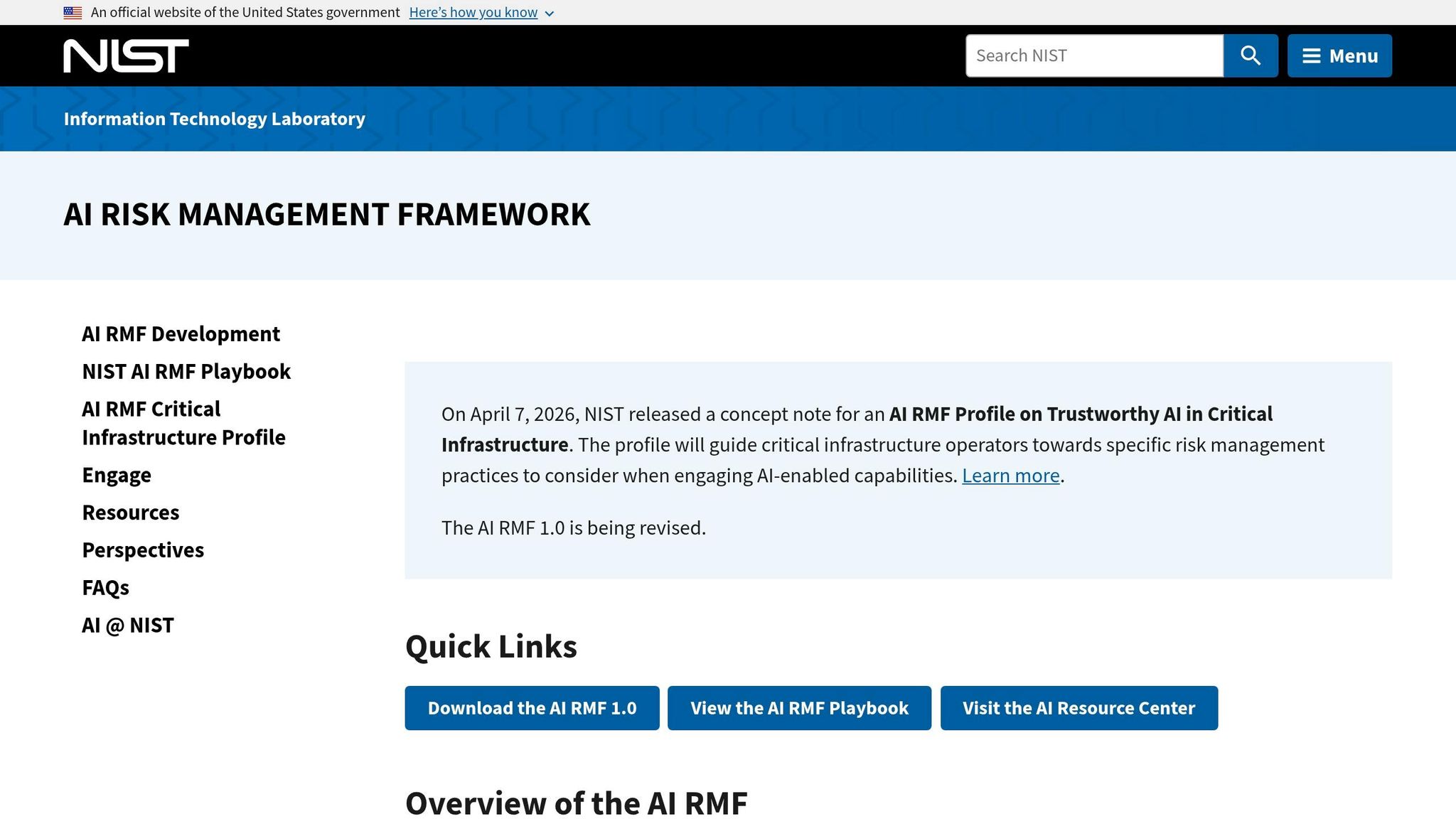
That kind of accountability belongs inside a formal AI governance framework, not scattered across team-by-team habits. Use the NIST AI Risk Management Framework to organize AI governance in a way that lines up with HIPAA risk analysis and risk management.
Here’s the basic flow:
- Govern sets policy and accountability.
- Map builds the AI inventory and data-flow map.
- Measure evaluates confidentiality, integrity, availability, and AI-specific risks.
- Manage drives monitoring, change control, and incident response.
Track BAA status and data-use terms for each AI system in the inventory.
Centralize AI Governance Tasks and Accountability
Once roles are clear, the next move is to centralize evidence, approvals, and oversight in one operating model. Uncontrolled AI adoption leads to shadow AI, unclear data flows, uneven access controls, and BAA gaps. Centralizing governance through a platform like Censinet RiskOps™ replaces that sprawl with a single operating model.
Censinet AI routes findings and tasks to the right owners, including vendor risk managers, clinical safety committees, and AI governance boards. A shared AI risk dashboard gives security, compliance, and executive teams one view of policy status, open risks, and remediation progress.
When governance is centralized, inventory, approvals, BAA tracking, and audit trails stay aligned across teams.
A Practical Plan for Prioritizing AI Investments

Healthcare AI Risk Management: 4-Phase Implementation Roadmap
Focus first on the workflow that removes the most manual work and clears the biggest backlog. In practice, that means starting where the queue is longest, not where the tech seems the most advanced.
Start With Use Cases That Cut Cycle Time and Backlog
Begin with vendor intake assessments. Move to continuous monitoring next. Put incident prioritization third, and save broader AI governance until those first workflows are steady.
This order matters. The same intake data can support reassessments and monitoring, so you’re not building each workflow from scratch. Then, once continuous monitoring is in place, AI can help rank events based on PHI impact and system criticality.
Check the Prerequisites Before Scaling
AI is only as good as the data under it. Before you expand any use case, make sure four things are in place:
- A current vendor and asset inventory pulled from existing records
- A clear PHI data map
- Named owners across security, compliance, privacy, and IT
- Validation checks that keep AI outputs accurate and limit automation bias
Lean teams don’t need to build all of this at once. It often makes more sense to do it in phases, starting with high-risk vendor categories and tier-1 systems, then piloting AI in one narrow use case.
Match Your Operating Model to Available Resources
Fit the operating model to the staff you have, not the staff you wish you had.
A platform-led model works well for teams with a dedicated security or compliance function. A hybrid model makes sense when risk priorities are clear but configuration bandwidth is tight. Censinet One™ can work for lean teams or critical access hospitals that need fast relief from backlog pressure, with room to shift toward more internal ownership as the program grows.
That sequencing helps teams avoid stretching too far, too soon. And when the base workflows are stable, stronger oversight becomes much easier.
Conclusion: Scale Risk Management Without Lowering the Bar
Healthcare security and compliance teams are being asked to handle more vendors, more rules, and more threats, often with the same headcount or less. AI can help make that possible, but only when teams use it in the right places first.
The fastest path is phased. Start by automating intake and assessments. Then build from there with continuous monitoring and centralized governance.
That kind of efficiency matters because the price of getting risk wrong keeps going up. Boards, regulators, and clinical leaders are more likely to support AI when it strengthens day-to-day risk work without weakening controls. Healthcare has held the No. 1 spot for the costliest data breaches since 2011, and the average U.S. incident reached $9.77 million in 2024.[3][4] Put plainly, lean teams can’t depend on manual processes alone to protect patient data and keep operations running.
That’s where a purpose-built platform can turn strategy into day-to-day work. Censinet RiskOps™ and Censinet AI™ are built for this setting. By automating evidence analysis and centralizing oversight, they help lean teams manage a larger vendor portfolio and keep risk assessments more current, while human reviewers stay in control of every high-stakes decision.
Doing more with less means putting AI where it helps most, backing it with governance, and extending team capacity.
FAQs
How do we start using AI without losing control?
Start with a human-in-the-loop approach. Let AI handle routine work like vendor risk assessments, evidence validation, and data aggregation, while people stay in charge of the decisions that matter most.
Keep that control in place with clear governance. That means having intake controls, risk tiering, review and approval workflows you can configure to fit your process, and continuous monitoring for model drift, vendor changes, and shifting compliance requirements.
Which healthcare risk workflow should we automate first?
Automate vendor risk assessments first - especially the workflow for sending security questionnaires, collecting and validating evidence such as SOC 2 reports and BAAs, and generating dynamic risk scores with audit trails.
This is a high-impact use case because manual TPRM work across large vendor portfolios can take weeks. With automation, teams can cut that down to hours while still keeping compliance and oversight in place.
What data do we need before scaling healthcare AI?
Before scaling healthcare AI, organizations need a documented inventory and a governance base to keep oversight in place. You need a clear record of which AI tools exist, what data they can access, who approved them, each tool’s intended use case, the data types involved, and who is using them.
Risk tiering helps teams spot high-impact tools early, especially ones tied to protected health information or clinical decisions. That makes it easier to focus deeper validation on the tools that need the most scrutiny before launch.
