
If your logs don’t show who, what, when, where, and result, they may fail when a PHI case starts.
I’d boil the article down to this: HIPAA logging is not just about turning logs on. It’s about making sure logs can support an investigation months or years later. That means complete event data, centralized storage, tamper checks, documented review, and retention that lines up with HIPAA’s 6-year record rule. In healthcare, taking the risk out of healthcare matters even more when the average breach takes 255 days to find and 103 more days to contain.
Here’s the short version:
- HIPAA requires both logging and log review under 45 C.F.R. § 164.312(b)
- Security records must be kept for at least 6 years under 45 C.F.R. § 164.316(b)(2)(i)
- Logs should show:
- who did it
- what they did
- which record or system they touched
- when it happened
- where the request came from
- whether it worked or failed
- Common weak points are:
- missing read/export/admin events
- short retention like 30 to 90 days
- logs that admins can change
- scattered systems with mismatched timestamps
- review that happens only after an incident
- The fix is to use:
- a shared audit schema across PHI systems
- centralized log collection
- encryption in transit and at rest
- write-once or immutable storage
- hashing or signatures for log integrity
- daily, weekly, and incident-based review
- low-PHI log design that uses IDs and metadata instead of clinical content
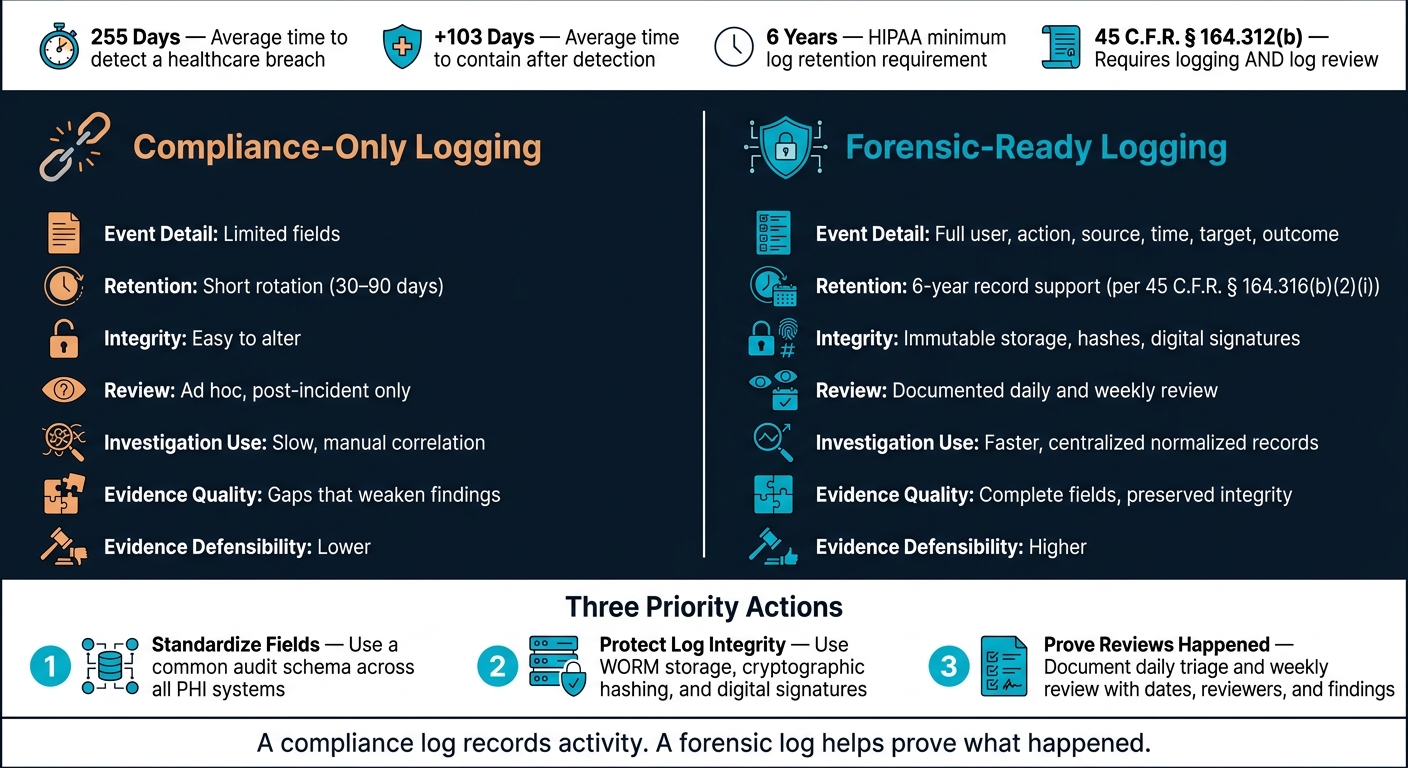
A simple way to think about it: a compliance log records activity; a forensic log helps prove what happened.
| Area | Weak logging | Forensic-ready logging |
|---|---|---|
| Event detail | Limited fields | Full user, action, source, time, target, outcome |
| Retention | Short rotation | 6-year record support |
| Integrity | Easy to alter | Immutable storage, hashes, signatures |
| Review | Ad hoc | Documented daily and weekly review |
| Investigation use | Hard to piece together | Easier to build and defend a timeline |
If I were setting priorities from this article, I’d start with three things: standardize fields, protect log integrity, and prove reviews happened. That’s what turns audit data into evidence. This process is a critical part of measuring what matters for cybersecurity in healthcare.
Compliance Logging vs. Forensic-Ready Logging: HIPAA Audit Log Standards
Understanding EMR Audits
sbb-itb-535baee
The Problem: Why Healthcare Audit Logs Often Fail Forensic Analysis
A lot of healthcare organizations think their logging is fine - until they have to rebuild a breach timeline under pressure.
That’s when the cracks show. During a forensic review, logging failures usually fall into three buckets: missing event detail, weak evidence protection, and fragmented review.
Incomplete Database Audit Trails Leave Gaps in Breach Timelines
Default database logs often track only successful logins. They may not record reads, writes, exports, or admin actions on tables that hold PHI. When those event fields are missing, investigators can’t prove what happened. They’re left piecing it together from hints.
This gets messier in mixed environments. EHR, EMR, lab, imaging, and billing systems often use different logging setups, complicating third-party vendor risk management. One system may record full event detail. Another may keep summary-only logs. A third may not log certain event types at all. That inconsistency creates blind spots, makes cross-system correlation shaky, and can push investigators to assume exposure was broader than what they can confirm.[3][5]
Weak Retention and Integrity Controls Undermine Evidence
Even complete logs don’t help much if they can be overwritten or changed.
Short retention is a common failure point. Many organizations keep logs for only 30 to 90 days, even though HIPAA’s documentation retention expectation is six years. If the logs aren’t there when an incident comes to light, investigators can’t build a reliable timeline or show the scope with confidence.
Integrity controls matter just as much. Logs stored without tamper-evident methods - such as WORM storage, cryptographic hashing, or digital signatures - can be challenged as unreliable evidence.[7][1][8] Broad administrator access to stored logs also creates chain-of-custody concerns.
Fragmented Systems and Ad Hoc Review Slow Investigations
The problem snowballs when the evidence is scattered.
In large health systems, PHI-related activity often spans on-premises EHR databases, data warehouses, identity and access management platforms, VPN and SSO services, cloud applications, endpoints, and network tools. Each system may store logs locally, use a different format, rely on different timestamp conventions, and record a different level of detail. So when an incident hits, investigators have to pull records by hand, normalize them, and line them up across systems. That slows down timeline building and makes the evidence harder to defend.
Ad hoc review makes things worse. Many organizations check audit logs only after something has already gone wrong. In many cases, there’s no written standard for what counts as suspicious PHI access or who owns each part of the review process.[4][6] When that happens, logging becomes a passive record instead of an active detection control.
The contrast shows up pretty clearly:
| Logging model | Investigation speed | Evidence quality | Retention approach | Evidence defensibility |
|---|---|---|---|---|
| Minimal compliance-only logging | Slow due to manual correlation and missing details | Limited, with gaps that weaken findings | Often short rotation or inconsistent retention | Lower, because evidence is harder to defend |
| Forensically prepared audit logging | Faster due to centralized, normalized records | Stronger, with complete fields and preserved integrity | Defined retention aligned to HIPAA documentation needs and investigation support | Higher, because evidence is more defensible |
HIPAA and NIST Requirements Applied to Forensic-Ready Logging
What HIPAA Audit Controls Require in Practice
45 C.F.R. § 164.312(b) requires mechanisms that record and review activity in systems that contain ePHI. NIST SP 800-66 ties this to NIST audit-and-accountability controls for event selection, record content, retention, integrity, timestamps, and review. On paper, that sounds clear enough. In practice, it only starts to matter when you turn those requirements into specific log fields and clear review rules.
That means policy can't stay vague. It should spell out which systems are in scope, which events must be logged, who owns log review, how often reviews happen, and when an issue must be escalated.
Scope should cover more than the main production database. It also includes:
- production databases
- replicas with live PHI
- reporting environments
- backup-access systems
- vendor-managed platforms with data access , which require rigorous third-party risk oversight
It also helps to keep a current inventory of each system's data class, owner, purpose, and logging status as part of your enterprise risk management strategy. That way, gaps don't stay buried in a spreadsheet somewhere. You can spot them fast.
Regulators have treated failure to review logs as a compliance gap. OCR has cited this exact issue in enforcement, including Memorial Healthcare System.[2] Put simply, logs that no one reviews - and can't prove they reviewed - do not satisfy the standard.
Minimum Audit Fields for Healthcare Database Forensics
At a minimum, each record should show who did what, when they did it, where it came from, and what happened next. NIST SP 800-53 AU-3 defines these core elements as event type, time, location, source, outcome, and the identity of the individuals or objects involved. In a healthcare database setting, that maps straight to a practical set of fields.
| Audit Category | Minimum Required Fields | Forensic Value |
|---|---|---|
| User Details | Unique User ID, Role or privilege level, Service Account ID | Establishes accountability; prevents shared-login ambiguity |
| Temporal Data | Timestamp with time zone, Session ID | Builds a reliable breach timeline across correlated systems |
| Access Events | Logon, Logoff, SELECT, INSERT, UPDATE, DELETE, Export | Identifies the nature and scope of interaction with ePHI |
| System Actions | Success/Failure Outcome, Privilege Escalation | Detects unauthorized elevation of rights or probing behavior |
| Origin & Target | Source system or origin, Client IP address, Application or API, Affected table or record, Database instance | Maps the actor's path and the specific data involved |
Getting the fields right is only half the job. Time accuracy matters just as much. If timestamps drift across systems, even a detailed log set can fall apart when you try to rebuild an incident timeline.
Log both successful and failed actions. Failed exports, for example, can point to credential misuse or probing before exfiltration. If you log only successful events, that part of the story disappears.
Use a common time source, and record the time zone in every log. That helps close the gaps that show up when logs come from different systems, different apps, or different teams. It also makes the timeline much easier to defend during an investigation.
The Solution: Build HIPAA-Compliant Logging That Supports Forensic Analysis
Standardize Log Content and Centralize Collection
Knowing what to log is only half the job. It also has to look the same across every system that touches PHI.
If an EHR login event, a database query, and a vendor access session all use different field names and formats, investigators lose time translating logs instead of studying them. That slows down breach response and makes it much harder to rebuild one clear timeline across systems.
Set a common audit schema for EHR databases, clinical apps, and identity, network, cloud, and vendor systems. At a minimum, every event should include:
- a unique user ID
- role
- event type
- UTC timestamp with time zone
- source IP or device
- affected resource or object reference
- success or failure status
Use structured JSON so logs can be parsed and matched up the same way every time. That consistency is what turns scattered records into one defensible timeline.
Centralized collection fixes another major problem: local logs can be deleted, overwritten, or missing by the time an investigation begins. Protect log transport and storage with integrated risk operations with encryption in transit and at rest, and apply least-privilege access to the log repository so only approved security and compliance staff can read or export audit data.
Protect Logs With Retention, Immutability, and Documented Review
Once logs are standardized, the next issue is simple: do they last long enough, and can you show they weren't changed?
HIPAA documentation retention under 45 C.F.R. § 164.316(b)(2)(i) sets a six-year minimum. A tiered storage setup works well here: hot for 90 days to 1 year, warm for 1 to 3 years, and archive through 6 years.[9][10][12][13][11]
Integrity controls are what make logs defensible when evidence is questioned. Immutable or write-once storage, cryptographic hashing, and digital signatures help show that records have not been altered since collection. Every configuration change should be logged too.
Review schedules matter just as much as storage. A practical setup combines daily triage, weekly trend review, and incident-driven deep analysis.
Daily triage should focus on high-risk alerts like:
- bulk PHI exports
- privilege changes
- failed login spikes
- exports from sensitive databases
Weekly review should look for access outside normal job duties. Each review should be documented with the date, reviewer, log sources checked, notable findings, follow-up actions, and escalation decisions.
Reduce PHI Exposure in Logs Without Losing Investigative Value
Forensic value goes up when logs record behavior instead of clinical detail.
Logs do not need clinical content to be useful in an investigation. Recording that a user accessed a chart, exported a file, or changed a medication order gives investigators what they need without storing diagnoses, lab results, or free-text notes. Use object IDs, account IDs, role assignments, timestamps, network origin, and action results instead of raw clinical data.
That keeps logs useful during an investigation without turning them into a privacy problem. If PHI must appear in logs for a specific security function, access to those records should be tightly restricted and kept only as long as needed.
The key difference is whether investigators can answer who accessed which record, from where, and with what outcome.
Managing Audit Logging Risk Across the Healthcare Environment
Audit logging falls apart when even one PHI system sits outside the program. In a healthcare setting, that goes far past the core EHR database. You also need to account for third-party platforms, cloud services, medical devices, and vendor integrations. If logs are missing in a vendor system, investigators may have no clear way to show who accessed PHI or whether data moved outside the environment. That’s where the risk shows up fast: controls break down when vendors, cloud services, or devices aren’t part of the logging effort.
Assess Audit Logging Gaps Across Vendors and Internal Databases and Applications That Store PHI
Forensic completeness comes down to one simple point: can each system help build an incident timeline? A timeline is only as good as the logs behind it. If an attacker starts with a compromised vendor account and then moves into an internal database, a gap in either place creates a blind spot. And once that happens, it gets much harder to show what PHI was accessed or whether data left the organization.
A practical review should check whether each system creates logs that record user identity, timestamp, action type, object accessed, source, and success or failure. It should also confirm that those logs can be exported in a format the incident response team can actually use. This applies across clinical applications, databases, EHR integrations, SaaS tools, cloud workloads, and connected medical devices. For medical devices, the best evidence often lives upstream in network or EHR logs. [17]
The review should also look at retention, integrity controls, and whether privileged actions are logged. That includes account provisioning, permission changes, and configuration updates, along with user access events. HHS 405(d) HICP guidance states that audit records must be "defined, documented, implemented, and reviewed under policy." [16][14][15] That standard applies to vendors just as much as it does to internal systems.
How Censinet Supports Healthcare Audit Logging Governance
Once teams find the gaps, they need a clear way to track fixes across both internal groups and outside vendors. Logging risk doesn’t sit with one department. It touches IT, security, compliance, privacy, legal, clinical leadership, and vendor management.
Censinet RiskOps™ gives healthcare organizations a structured way to assess logging-related risks across enterprise and third-party environments. As a governance layer, the platform helps teams map gaps, assign owners, track exceptions, and document remediation across vendors, cloud services, and internal systems that handle PHI. Its benchmarking and collaborative workflows help HDOs track gaps, assign remediation, and document follow-up.
Conclusion: Controls That Make Logs Defensible in a HIPAA Investigation
Taken together, these controls make audit logs defensible in a HIPAA investigation. If a log can’t be trusted, it won’t help much as evidence. For audit logs to hold up, they need complete fields, centralized collection, integrity protection, and documented review.
OCR and auditors want proof that logs were reviewed, retained, and tied to incident detection. That proof carries more weight than policy language on its own. Correlated logs, review records, and a clear breach timeline mean more than a policy document with no supporting data - and that same bar applies under the six-year HIPAA documentation window of §164.316(b)(2). [18][19][20][21][22]
Defensible logging is a program, not a one-off task. It needs consistent standards across every PHI system - internal databases, cloud services, SaaS tools, and third-party vendors. Even one logging gap can break the forensic record.
FAQs
What makes an audit log forensic-ready under HIPAA?
Under HIPAA, a forensic-ready audit log needs to be complete, tamper-proof, and verifiable.
That means the log should be stored immutably, protected with hashing or digital signatures, and tied to trusted NTP so timestamps stay precise, synced, and in UTC.
Each log entry should include:
- User ID
- Role
- Timestamp
- Source IP or device ID
- Action
- Resource accessed
- Outcome
HIPAA also requires logs to be kept for at least six years. Access should be controlled with RBAC, and teams should have documented review processes in place.
How long must HIPAA audit logs be retained?
Under HIPAA, audit logs must be kept for at least six years from the date they were created or from the date the related policy or procedure was last in effect, whichever is later.
That’s the federal baseline. Some state laws require you to keep records longer, so your retention schedule should match the rule that asks for the longer time period.
A tiered storage approach can help you keep logs for the long haul without driving up costs. In plain English: keep newer logs in faster, easier-to-access storage, and move older logs to lower-cost storage over time.
Which audit events are most often missing in PHI systems?
PHI system audit logs often leave out the details you need for forensic work.
The usual gaps are pretty basic, but they matter a lot:
- No clear way to tie an action to one specific person
- No record of the exact fields someone viewed or changed
- No tight link between the user, the record, and the exact time of the interaction
Another common problem: timestamps aren't standardized in UTC. And many systems log activity only at the endpoint level instead of tracking what happened at the resource level.
That means when something goes wrong, the audit trail can feel incomplete right when you need it most.
