
HITECH still shapes how I handle healthcare cyber risk today: if ePHI is exposed, I may need to notify patients, report the event to HHS, review vendor fault, and show proof that my security program was in place before the incident.
Here’s the short version:
- HITECH pushed healthcare into digital records and added more pressure to protect ePHI.
- Breach notification is a core duty. If unsecured PHI is exposed, notice rules can start fast, often within 60 days of discovery.
- Vendors are on the hook too. Business associates are not outside the rule set.
- Risk analysis sits at the center. I need to know where ePHI lives, what can hit it, and which gaps need fixing first.
- Proof matters. OCR can look for logs, policies, training records, vendor files, and incident records.
- Enforcement is active. Through late 2024, OCR had resolved 152 cases with about $144.9 million in settlements and penalties. In 2024 alone, OCR resolved 785 breach investigations.
A few numbers explain why this still matters:
- In 2024, HHS logged 663 breach notifications
- Those breaches affected about 242.9 million people
- In 2023, business associates made up 21% of breach reports but 49% of affected people
If I had to boil the article down to five steps, it would be this:
- Test breach response and notice workflows
- Apply HIPAA Security Rule safeguards across ePHI systems
- Run risk analyses on a set schedule
- Treat vendors as cyber risk, not just contract risk, by transforming third-party risk management
- Keep records that show security practices were in place
This article is, at its core, about one thing: HITECH turned healthcare cybersecurity into a legal, financial, and patient-care issue - not just an IT task.
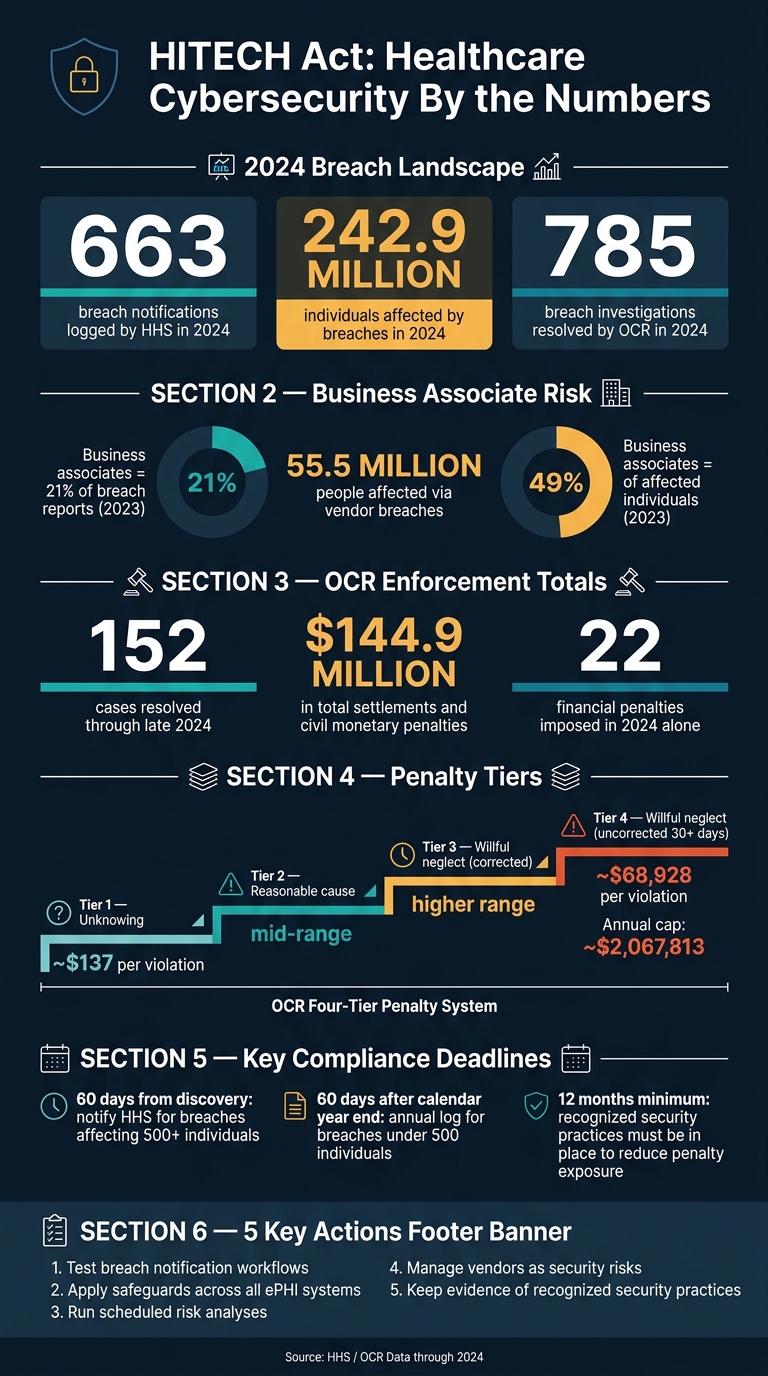
HITECH Act Enforcement & Breach Statistics: By the Numbers
Breach notification requirements for unsecured PHI
When unsecured PHI is accessed, used, or disclosed in a way that's not allowed, a security issue becomes a compliance issue. The hard part isn't just figuring out what happened. It's getting the facts down fast enough to meet federal deadlines.
In 2024, HHS logged 663 breach notifications affecting about 242.9 million individuals.[4][10] That tells you something right away: breach response isn't a once-in-a-blue-moon problem. It's a routine business problem, and often the first place where HITECH rules get tested in practice.
When an incident becomes a reportable breach
Any impermissible access, use, or disclosure of unsecured PHI should be treated as a reportable breach unless a documented risk assessment shows a low probability of compromise.[5] That review looks at four things: the PHI involved, who received it, whether it was actually viewed or acquired, and whether the risk was reduced after the fact.[5]
Encrypted ePHI is usually outside breach-notification scope if the key was not compromised.[1][11][12] There are also a few narrow exceptions. For example, unintentional access by an authorized workforce member acting in good faith does not count as a reportable breach, as long as the information is not misused further.[13]
Who must be notified and by when
The notice path depends on who needs to hear about the breach and how many people were affected.
| Audience | When Required | Key Threshold |
|---|---|---|
| Individuals | Any reportable breach affecting that person | All affected individuals, regardless of breach size |
| HHS | All reportable breaches | 500+ individuals: within 60 days of discovery; fewer than 500: annual log within 60 days after calendar year end |
| Media | Breaches affecting more than 500 residents of a single state or jurisdiction | >500 residents in one state/jurisdiction |
The 60-day clock starts at discovery. That means organizations can't sit around waiting for every detail to be nailed down. They have to move while the picture is still coming into focus.
How to build a breach response process
A repeatable breach response process makes it much easier to hit the 60-day deadline across IT, security, privacy, legal, and compliance teams. At a basic level, the workflow has four parts: prepare, detect, investigate, and notify.
Prepare with approved policies, role-based training, incident playbooks, and pre-vetted counsel and forensic firms.[5] Reporting channels should make it easy for staff to flag incidents fast, before small problems snowball.
Investigate by preserving logs and endpoint evidence while privacy teams identify the PHI elements involved and the affected population.[5][7] A standard risk assessment form should document the four OCR factors and show whether the event meets the definition of a reportable breach.
Notify with pre-approved templates that spell out the breach summary, the information involved, the response steps taken, and contact details.[1][6][8]
After each response, log root causes and assign remediation owners, then track those fixes through closure.[5][8] Feed what you learn back into the next risk analysis. Done well, a repeatable response process turns incident handling into something teams can measure and improve.
After notification, organizations must harden the safeguards that prevented the incident in the first place.
sbb-itb-535baee
Security Rule safeguards for covered entities and business associates
Once a breach is contained, HITECH compliance moves to the safeguards meant to stop the next one. HITECH also made business associates directly liable under the HIPAA Security Rule. The same digital risk that triggers breach notices also triggers safeguard duties.
Administrative, physical, and technical safeguards in practice
Each safeguard layer protects ePHI in its own way, and regulators want proof that the controls are both documented and in use.
Administrative safeguards are the starting point. An enterprise-wide risk analysis should map threats to controls, owners, and remediation timelines.[18][14] That also means keeping version-controlled policies, role-based training records, phishing simulation results, and documented disciplinary actions for violations. Auditors want to see leadership governing security in a hands-on way, not treating it like an informal handoff.
Physical safeguards cover facility access controls, visitor logs, workstation placement, screen-lock timeouts, and device inventories.[16][21] Every server, laptop, tablet, mobile device, and removable media item that touches ePHI should be tracked, with encryption status on file. If a device goes missing, the organization should be able to produce the inventory record, encryption status, and incident review without scrambling.
Technical safeguards include access control, audit controls, authentication, and transmission security.[19] In practice, that means role-based access control, MFA for remote and privileged access, and a timed joiner/mover/leaver process. Centralized logs for EHR and clinical systems should be reviewed for odd activity, like after-hours access or mass downloads, so there’s a clear audit trail when regulators come calling. ePHI in transit should be encrypted with TLS for portals and APIs, and VPN for remote access.
Why business associate oversight is a cybersecurity issue
The numbers tell the story. In 2023, business associates made up only 21% of breach reports but accounted for 49% of all affected individuals - more than 55.5 million people.[15] Vendors often hold huge volumes of PHI, so when their controls break down, the fallout can be far larger than many internal incidents.
High-risk partners include cloud-hosted EHRs, telehealth platforms, revenue-cycle vendors, medical device manufacturers with remote support access, and health information exchanges. Each one can become a way in. That’s why Business Associate Agreements (BAAs) need to do more than repeat HIPAA in broad terms. They should spell out permitted PHI uses, require Security Rule safeguards, set breach notification timeframes, and include rights to audit or request security evidence. On top of that, documented third-party vendor risk assessments, BAA records, and remediation tracking are the hard proof regulators and boards expect.[20][17]
Those controls must then be checked through risk analysis on a regular basis.
Risk analysis and controls that support HITECH compliance
Once safeguards are in place, risk analysis shows where a healthcare organization is still exposed.
Risk analysis sits at the center of HITECH compliance. It shows where ePHI lives, what could put it at risk, and what needs attention first. This isn't just paperwork for a file cabinet. It's how healthcare groups cut breach risk in digital care settings.[18][21]
Core controls that reduce HITECH-related cyber risk
A useful risk analysis starts with a full asset inventory. That means every EHR, imaging system, clinical application, cloud service, medical device, and backup repository that creates, receives, maintains, or transmits ePHI.[18][21] If that map is out of date, it's hard to know which exposures are most likely to lead to a breach.
From there, the focus moves to threats like ransomware, phishing, insider misuse, missing patches, and misconfigured cloud storage. The goal is simple: rank each risk by likelihood and impact so teams know where to act first.
Several controls tend to reduce HITECH risk most often:
| Control | What it protects against | HITECH relevance |
|---|---|---|
| Role-based access control + least privilege | Unauthorized PHI access | Access control standard (§ 164.312(a)(1)) |
| MFA on remote and privileged access | Credential theft | Access control, authentication |
| Encryption at rest and in transit | Breach impact reduction | Breach safe harbor for encrypted PHI |
| Vulnerability management and patching | Ransomware and known vulnerabilities | Risk management standard |
| Centralized logging and SIEM monitoring | Unauthorized access and data movement | Audit control standard (§ 164.312(b)) |
| Immutable backups with tested restores | Ransomware recovery | Contingency plan standard |
| Incident response plan with tabletop exercises | Breach response readiness | Breach notification readiness |
There's another piece people sometimes overlook: each control also produces proof. Patch records, access review logs, and test results can all serve as evidence during an OCR audit.
A direct map from requirement to control
One of the biggest sticking points is turning legal requirements into day-to-day security work. A simple requirement-to-control matrix helps both security teams and leadership see what's covered, what's only partly covered, and where gaps still exist.
| Regulatory requirement | Cybersecurity problem | Practical control |
|---|---|---|
| Risk analysis (§ 164.308(a)(1)) | Unknown ePHI locations and threats | Annual enterprise risk analysis with documented findings and risk ratings |
| Access control (§ 164.312(a)(1)) | Overprivileged accounts, shared credentials | RBAC, least-privilege reviews, MFA on remote and admin access |
| Audit controls (§ 164.312(b)) | No visibility into unauthorized access or data movement | Centralized SIEM with EHR and endpoint log correlation |
| Transmission security (§ 164.312(e)(1)) | PHI intercepted in transit | TLS for portals and APIs; VPN for remote access |
| Contingency plan (§ 164.308(a)(7)) | Inability to recover PHI after ransomware | Immutable backups with documented RTO/RPO and tested restores |
| Business associate management (§ 164.308(b)) | Vendor breaches exposing large PHI volumes | Standardized vendor risk assessments linked to remediation tracking |
Assigning an owner and a due date to each gap turns the matrix from a reporting document into a working remediation plan. When teams track closure over time, leadership gets a plain view of risk reduction, and that record also helps during OCR audits.[23][24]
Scaling assessments and vendor oversight across the healthcare ecosystem
Managing risk across dozens or even hundreds of vendors calls for risk-based tiering. In plain English, that means classifying vendors by PHI volume, sensitivity, and how deeply their systems connect into the organization. High-risk partners get deeper reviews. Lower-risk vendors get lighter checks.
At scale, the hard part usually isn't finding risk. It's triaging it the same way every time. Standardized questionnaires aligned to frameworks like HITRUST or NIST CSF help keep assessments consistent across the vendor population.
Vendor exposure matters because one failed control at a third party can become a reportable breach that affects a large number of patients.
Censinet RiskOps™ is built for healthcare delivery organizations that need to streamline third-party and enterprise risk assessments at scale. The platform centralizes risk analyses, vendor assessments, and remediation tracking in one system of record, so findings flow into a risk register with defined owners, timelines, and status tracking.[22] Censinet RiskOps™ centralizes enterprise and third-party risk assessments, remediation tracking, and benchmarking for healthcare organizations.
Those records also become part of the evidence OCR reviews when it evaluates compliance.
Enforcement, penalties, and how to stay ready
What enforcement means for healthcare leaders
Once controls and response processes are in place, enforcement is where the pressure shows up. It’s the point where regulators look past intent and ask a simple question: Was this program real? HITECH didn’t just increase fines. It made cybersecurity a leadership issue. OCR looks at whether leaders approved policies, completed risk analyses, and kept watch over vendors.
OCR uses a four-tier penalty system tied to culpability. Unknowing violations start at about $137 per violation, while willful neglect that goes uncorrected for more than 30 days starts at about $68,928 per violation, with annual caps of roughly $2,067,813 for identical violations.[31]
The money is only one part of the risk. Enforcement is active, and the numbers make that plain. Through late 2024, OCR had resolved 152 cases totaling about $144.9 million in settlements and civil monetary penalties.[32][33] In 2024 alone, OCR imposed 22 financial penalties and resolved 785 data breach investigations.[30][34] OCR can also require a Resolution Agreement with a Corrective Action Plan (CAP). That usually means a multi-year effort with leadership-approved policy updates, enterprise risk assessments, workforce training, and regular reporting back to OCR.[26][27][29]
Organizations that can show mature, continuous controls start these investigations from a better spot. Under Section 13412, OCR must consider whether recognized security practices, such as NIST CSF or 405(d), were in place continuously for at least 12 months before the incident.[25][21][28] That can lower penalty exposure and reduce the CAP burden.[2][35][36]
This is where documentation matters. A lot. Recognized security practices mean little if you can’t prove they were in place. That proof includes current risk analyses, access review logs, training records, vendor assessment reports, and incident response documentation, all approved by leadership. Censinet RiskOps™ centralizes risk analyses, vendor assessments, and remediation evidence across PHI systems and vendors.[26][27][28]
Conclusion: Key actions organizations should take now
Focus on five actions:
- Test breach notification workflows.
- Apply safeguards across all ePHI systems.
- Run scheduled risk analyses.
- Manage vendors as security risks.
- Keep evidence of recognized security practices.
FAQs
What counts as unsecured PHI under HITECH?
Under the HITECH Act, unsecured PHI means electronic protected health information that has not been made unreadable, unusable, or indecipherable to unauthorized individuals through encryption or other approved security measures.
If that data is exposed, it usually triggers a breach risk assessment and notice to affected individuals, HHS, and, in some cases, the media - unless it falls under the safe harbor for encryption.
How often should we run a HITECH risk analysis?
Treat HITECH risk analysis as an ongoing process, not a one-time task. Healthcare organizations should run an organization-wide security risk assessment at least once a year.
It also makes sense to do focused reassessments after major changes, like system upgrades, cloud migrations, new network-connected devices, new vendor integrations, or security incidents. Censinet RiskOps™ can help streamline assessments and support continuous monitoring.
What proof does OCR expect after a breach?
After a breach, OCR expects documented proof that your organization did its homework and had a serious security posture in place.
That usually means a written breach risk assessment that covers:
- the PHI involved
- who accessed it
- whether it was acquired
- the steps taken to reduce harm
OCR may also ask for records like:
- security risk analyses
- incident and breach logs
- HIPAA Security Rule policies and procedures
- signed BAAs
- workforce training and related compliance records
