
If you handle PHI, card data, or both, one control can often cover more than one framework. In the source article, overlap was 60% between SOC 2 and HIPAA and 76% between SOC 2 and PCI DSS. That means one access review, one encryption record, or one vendor check may support several audit needs at once.
Here’s the short version:
- I’d use shared controls to cut repeat work
- I would not treat SOC 2, HIPAA, and PCI DSS as the same
- I’d check three things first: scope, evidence, and vendor risk
- I’d expect the biggest time savings in:
- access control
- encryption
- logging
- incident response
- vendor reviews
The five tools covered are:
- Censinet RiskOps
- Drata
- Vanta
- Secureframe
- AuditBoard
What stood out to me is simple: the best tool depends on your environment. If you run mostly cloud apps, broad automation may be enough. If you deal with EHRs, medical devices, hybrid systems, and many vendors, you need stronger healthcare coverage.
Utilizing the SOC 2 Framework for HIPAA HITRUST Compliance
sbb-itb-535baee
Quick Comparison
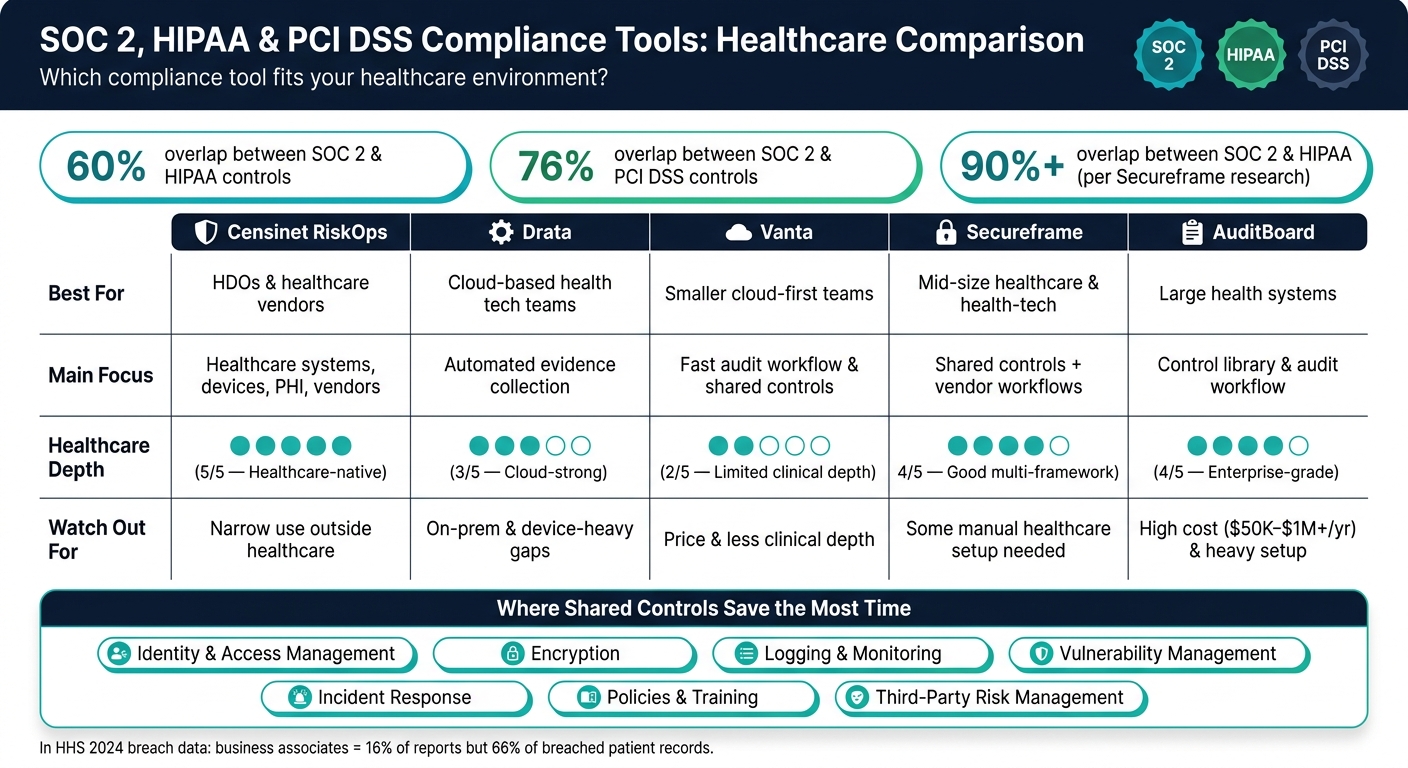
SOC 2 vs HIPAA vs PCI DSS: Compliance Tool Comparison for Healthcare
| Tool | Best for | Main focus | Watch out for |
|---|---|---|---|
| Censinet RiskOps | HDOs and healthcare vendors | Healthcare systems, devices, PHI, vendors | Narrow use outside healthcare |
| Drata | Cloud-based health tech teams | Automated evidence collection | Extra tracking may be needed for on-prem and device-heavy setups |
| Vanta | Smaller cloud-first teams | Fast audit workflow and shared controls | Price and less depth for clinical settings |
| Secureframe | Mid-size healthcare and health-tech teams | Shared controls plus vendor workflows | Some healthcare details still need manual setup |
| AuditBoard | Large health systems | Control library and audit workflow | High cost and heavier setup |
My main takeaway: mapping works best when the tool matches your actual risk footprint, not just your audit list. If your vendors touch a lot of PHI, which increases the economic impact of third-party risk, or your systems include clinical apps and device networks, that should shape your choice more than dashboard polish.
1. Censinet RiskOps
Censinet RiskOps™ is built for healthcare. That matters because its compliance mapping follows healthcare workflows instead of broad audit wording. When the control matrix lines up with how healthcare teams actually work, the overlap across frameworks becomes much easier to use.
Framework crosswalks
Censinet RiskOps puts SOC 2, HIPAA, and PCI DSS controls into one healthcare-focused matrix. So teams can map MFA, encryption, logging, and third-party oversight once, then reuse the same evidence across those frameworks.
Healthcare scope support
Censinet RiskOps maps controls to the way healthcare organizations run day to day, including clinical systems, connected devices, and vendors that handle PHI.
Evidence reuse
Tagged evidence can be reused across frameworks when the scope, owner, date, and validity match each requirement. For example, a remediation record or policy document linked to an encryption control can cover overlapping SOC 2, HIPAA, and PCI DSS requirements without being collected again.
Third-party risk linkage
In healthcare, a large share of compliance risk sits outside the organization - with business associates, device vendors, and third-party service providers that handle PHI or payment data. Censinet RiskOps connects vendor assessments and remediation status to related HIPAA and PCI DSS controls, so business-associate risk stays visible inside the control matrix instead of living in a separate silo.
Censinet RiskOps is SOC 2 Type 2 compliant, which supports confidence in its internal controls for security, availability, and confidentiality.[1]
That makes the control matrix a practical place to start when comparing how different tools manage shared controls.
2. Drata
Drata brings shared controls and evidence into one place across SOC 2, HIPAA, and PCI DSS. That matters for healthcare teams that are juggling more than one compliance program at the same time. Instead of tracking the same control in separate places, Drata uses a shared-control model for audit evidence and framework tracking.
Framework crosswalks
Drata maps controls across SOC 2, HIPAA, and PCI DSS in a single interface. It also shows the same control status anywhere those frameworks overlap. So if a control relates to PHI, teams can see how it lines up across all relevant requirements without maintaining separate trackers.
Healthcare scope support
Drata connects with AWS, Azure, GCP, Okta, Azure AD, and HR systems to pull access, configuration, and onboarding evidence for healthcare audits. Its HIPAA mappings support healthcare-focused SaaS companies and HDOs that need to show safeguards for PHI and often work under business associate agreements.[4]
That same integration layer cuts down on duplicate evidence collection across frameworks. In plain English: teams don't have to keep pulling the same proof again and again for each audit.
Evidence reuse
Drata lets teams tag evidence once and reuse it across overlapping requirements tied to PHI-related controls. If SOC 2, HIPAA, and PCI DSS are all in scope, that makes audit prep much easier to handle. Drata applies this same mapping approach to third-party risk signals too.
Third-party risk linkage
Its vendor-risk links help surface third-party gaps tied to shared controls. For healthcare teams working with vendors that handle PHI or payment data, this helps keep controls, evidence, and audit artifacts in order.[2][3][4]
3. Vanta
Vanta puts shared controls and evidence for SOC 2, HIPAA, and PCI DSS into one system. That matters for teams dealing with overlap across these frameworks. Instead of keeping audit files in separate tracks, you can map controls across standards and reuse evidence where it applies. The platform also supports HIPAA-compliant vendor risk management workflows across all three, so vendors, evidence, and audit tasks can live in the same place.
Its Marketplace pricing includes a TPRM option at $13,600/year for up to 50 vendors, with higher-tier packages going up to $23,000/year.[6] On G2, Vanta holds a 4.6/5.0 rating based on 2,705 reviews. Reviewers often point to ease of use, while smaller organizations often flag price as a sticking point.[5]
That leads to the next issue: how much control reuse can the tool handle once evidence, vendors, and audit work start overlapping?
4. Secureframe
Secureframe tackles this with a shared control layer that maps one control across SOC 2, HIPAA, and PCI DSS.[14][15] Its research found more than 90% overlap between SOC 2 and HIPAA controls, and that organizations already compliant with HIPAA are 80%+ compliant with SOC 2.[18]
Framework crosswalks
The Frameworks view shows that overlap at the requirement level.[17] In plain terms, one test - like multi-factor authentication on production systems - can connect to SOC 2 logical access criteria, HIPAA technical safeguards, and PCI DSS authentication requirements at the same time.[8][14]
Once evidence is uploaded and the test passes, that status updates across every mapped framework automatically.[8] If one framework needs different proof than another, teams can add framework-specific custom tests without disrupting the shared control model.[8][13]
Healthcare scope support
Secureframe directly supports healthcare organizations, including health plans, providers, and other healthcare organizations.[14][7] The platform automates evidence collection and task management for repeat HIPAA work such as risk assessments, training, and policy reviews.[7][9][12]
Its HIPAA guidance also spells out the evidence auditors expect for each test.[13] That matters because teams often know what they need to do, but not always what they need to show.
Evidence reuse
The same shared view applies to evidence reuse. Evidence gathered through hundreds of integrations goes into a centralized data room, and when one test maps to more than one framework, that evidence carries over automatically.[15][16][8]
Teams can also export framework-specific evidence packages from the same repository.[16] So instead of rebuilding the same audit trail again and again, they can pull from one place.
Third-party risk linkage
That model also extends to vendor risk. Secureframe's vendor risk management features let healthcare organizations keep one vendor inventory, run standardized risk assessments, attach compliance documents like SOC 2 reports, and keep findings linked to HIPAA and PCI DSS controls.[10][11]
This makes third-party access to ePHI or cardholder data easier to map to the right requirements.[10][14][15]
5. AuditBoard
AuditBoard uses a control-first approach for multi-framework compliance. For healthcare teams, that means you can build one master control catalog and map each control to SOC 2, HIPAA, and PCI DSS requirements in the same platform.[19][24][27]
Here’s the practical upside: one access control process can do a lot of work at once. A single process for role-based access, unique IDs, and periodic access reviews can map to SOC 2 logical access criteria, HIPAA administrative safeguards for workforce access management, and PCI DSS user identification and authentication requirements.[19][26][27]
That cuts down on duplicate interviews and messy spreadsheet cross-checking. It also makes cross-framework impact easier to spot when a control changes.[20][26][27]
Framework crosswalks
AuditBoard’s framework mapping shows where one control covers more than one requirement and where a requirement still doesn’t have a mapped control.[19][26][27]
Healthcare scope support
Healthcare organizations can scope key systems like EHRs, clinical apps, patient payment portals, and device networks as controlled assets, then link them straight to controls and framework requirements.[20][27][29]
This asset-centered view helps teams check that SOC 2, HIPAA, and PCI DSS scopes match the places where PHI and cardholder data actually live. That can cut scope gaps before they turn into audit problems.[20][27][29]
Evidence reuse
Access review reports, configuration exports, audit logs, and policy documents can be tagged with metadata like system name, date range, control ID, and data type. From there, teams can link that evidence to SOC 2, HIPAA, and PCI DSS requirements in one step.[19][20][26][29]
Recurring tasks also remind owners to refresh and resubmit evidence before each audit period.[20][29]
Third-party risk linkage
AuditBoard’s TPRM module lets healthcare organizations tier vendors by criticality, run structured assessments, and map findings straight to compliance requirements.[21][22][23][25][28]
For example, a vendor handling PHI - like an EHR hosting provider or telehealth platform - can be assessed, and gaps such as weak encryption or missing logging can map to HIPAA and PCI DSS requirements in the centralized control matrix.[23][25][28]
That control-first setup makes it easier to see where shared controls cut the most duplicated work.
Where Shared Controls Create the Most Efficiency
Across the tools above, the biggest time savings usually come from the same set of shared controls. The highest-yield areas are identity and access management, encryption, logging and monitoring, vulnerability management, incident response, policies and training, and third-party risk management. You can see the pattern most clearly in identity, encryption, and vendor oversight.
Identity and access management is a good example. A single access policy that enforces unique user IDs, role-based access, least privilege, and periodic access reviews across clinical systems, patient portals, and billing platforms can map to SOC 2 CC6.1–CC6.3, HIPAA §164.312(a)(2) access control, and PCI DSS Requirements 7–8 at the same time. That means one policy, plus one set of evidence, can support all three frameworks.
Encryption follows the same logic. If the scope and settings line up, encryption controls can share one evidence package across SOC 2, HIPAA, and PCI DSS.
Third-party risk management is another area with a lot of payoff. All three frameworks require vendor oversight, but they talk about it in different ways. HIPAA focuses on business associate agreements and PHI protection. PCI DSS focuses on service provider compliance in the cardholder data environment. SOC 2 looks at vendor risk assessment criteria. Even with those differences, one vendor assessment program can satisfy all three at once. Censinet RiskOps™ centralizes vendor assessments across PHI, clinical applications, medical devices, and supply chains, then maps each vendor to the right requirements.
The table below shows how each shared control area lines up across the three frameworks:
| Control Area | SOC 2 | HIPAA | PCI DSS |
|---|---|---|---|
| Identity & Access Management | CC6.1–CC6.3 | §164.312(a)(2) Access control | Req. 7–8 |
| Encryption | Confidentiality criteria | §164.312(e) Transmission security | Req. 3–4 |
| Logging & Monitoring | CC7.x | §164.312(b) Audit controls | Req. 10 |
| Vulnerability Management | CC7.x / risk management criteria | §164.308(a)(1) Security management process | Req. 11 |
| Incident Response | Incident response criteria | §164.308(a)(6) | Req. 12.10 |
| Policies & Training | Policy and awareness criteria | §164.308(a)(5) Workforce training | Req. 12.6 |
| Third-Party Risk Management | Vendor management / risk assessment criteria | §164.308(b) Business associates | Req. 12.8 |
What makes crosswalks pay off in practice is the workflow. That’s where the difference between manual work and tool-assisted mapping starts to show.
| Dimension | Manual Mapping | Tool-Assisted Mapping |
|---|---|---|
| Mapping and audit preparation | Weeks of spreadsheet work; days assembling binders | Prebuilt libraries reduce mapping time; exportable evidence packages generated on demand |
| Evidence collection and status visibility | Email chains, shared drives, inconsistent naming; status lives in documents or inboxes | Structured repositories with integrations and metadata tagging; dashboards show live control status and remediation progress |
| Error/omission risk | High - manual cross-referencing misses gaps | Lower - platforms enforce required fields and flag uncovered requirements |
| Third-party oversight | Fragmented spreadsheets per vendor | Centralized assessments mapped to multiple frameworks simultaneously |
These gains come with tradeoffs, which the next section breaks down.
Pros and Cons
These tools split apart most clearly in three areas: healthcare scope, how much evidence you can reuse, and how deep they go on third-party risk. The core tradeoff is pretty simple: healthcare depth vs. implementation speed.
Censinet RiskOps™ is the best fit for healthcare-native compliance mapping across PHI, clinical applications, medical devices, supply chains, and third-party risk.
Drata works best for cloud-based teams that want strong automation and continuous evidence collection across SOC 2, HIPAA, and PCI DSS. If you have on-prem EHRs, medical devices, or hybrid environments, you'll likely need separate asset and risk inventories.
Secureframe is a good match for healthcare and health-tech teams that want multi-framework coverage with lighter setup. That said, healthcare-specific details may still need manual tailoring.
AuditBoard fits large enterprises that need a flexible control library and already have the GRC bench to run it well. Its control library gives you room to shape things your way, but healthcare crosswalks usually demand deep internal GRC skill.
The table below puts those tradeoffs into one snapshot.
| Product | Strengths | Limitations | Best Fit |
|---|---|---|---|
| Censinet RiskOps™ | Healthcare-native scoping for PHI, clinical applications, medical devices, and supply chains; third-party and enterprise risk assessments; AI-assisted assessments | Built only for healthcare, so it has limited use outside that space | Healthcare delivery organizations (HDOs) and healthcare vendors |
| Drata | Strong SOC 2 automation; continuous evidence collection; 4.7/5 G2 rating [32][30] | Horizontal scoping; on-prem EHRs, medical devices, and hybrid environments may need separate asset and risk inventories | Growth-stage digital health and healthcare-adjacent SaaS companies |
| Vanta | Automated compliance workflows; fast SOC 2 and HIPAA readiness; 4.6/5 G2 rating [30] | Horizontal scoping; limited depth for complex clinical environments | Cloud-based health-tech teams needing faster compliance progress |
| Secureframe | Multi-framework support; clear healthcare focus; vendor risk management; 4.7/5 G2 rating [30] | Medical devices and on-prem clinical systems may still need separate asset and risk tools | Healthcare vendors and mid-size health-tech companies |
| AuditBoard | Enterprise-grade control library; flexible multi-framework configuration; strong audit workflows | High cost ($50,000–$1,000,000+/yr) [31]; healthcare crosswalks require deep internal GRC expertise | Large U.S. health systems with mature compliance and audit teams |
Conclusion
Tool choice comes down to scope. If your cloud setup is fairly simple, broad automation can do the job. But in healthcare, things get messier fast. Once shared controls have to work across PHI, vendors, and multiple systems, the gap shows up in plain sight.
In HHS's 2024 breach dataset, business associates submitted only 16% of incident reports but accounted for 66% of breached patient records.[33] That mismatch is exactly where generic compliance tools can fall short. It's also where healthcare-native risk operations carry more weight.
For HDOs and vendors managing large amounts of PHI, clinical apps, medical devices, and third-party risk, Censinet RiskOps™ links compliance mapping with healthcare risk in one system of record.
A good starting point is simple:
- Your PHI footprint
- Your vendor count and how critical those vendors are
- Your current audit obligations
Organizations with a smaller number of PHI systems and fewer third-party dependencies can often get solid value from broader compliance automation. But if you're dealing with multiple EHR instances, a dense vendor ecosystem, or a fleet of medical devices tied into the network, you usually need deeper healthcare-specific risk support. Otherwise, blind spots can sit quietly behind a polished compliance dashboard.
Track a few numbers at 6, 12, and 18 months: audit prep time, unassessed vendor count, and PHI incident frequency. The right tool cuts duplicate work without stripping away the healthcare context that matters most.
FAQs
How do I know which systems are in scope?
Start by finding every asset, system, and data flow that stores, receives, maintains, or transmits ePHI. Bring in IT, facilities, legal, and admin teams early so you can spot less obvious systems, side tools, and third parties with access to PHI.
Censinet RiskOps™ can help by keeping a single, authoritative inventory of data flows and vendors. That makes it easier to set scope with less guesswork and avoid gathering the same evidence again across multiple compliance frameworks.
What evidence can be reused across SOC 2, HIPAA, and PCI DSS?
Organizations can reuse evidence by mapping shared controls across frameworks. In plain English, that means looking for the same guardrails showing up in more than one place, like access management, encryption, audit logging, and incident response.
Because many frameworks ask for similar safeguards, one artifact can often cover multiple requirements.
For example, MFA logs can support both SOC 2 security criteria and HIPAA technical safeguards. A unified control matrix, paired with centralized documentation, helps teams cut down on duplicate evidence collection, keep the audit trail consistent, and stay ready for audits without scrambling at the last minute.
When do I need healthcare-specific compliance tooling?
You need healthcare-specific compliance tooling when your organization works with PHI and has to manage multiple standards like HIPAA, SOC 2, and NIST CSF. At that point, spreadsheets usually start to crack. They take too much manual effort, they’re easy to mess up, and they become hard to manage fast - especially if you have a large vendor network or a stack of clinical apps.
Platforms like Censinet RiskOps™ can take a lot of that load off your team. They automate evidence collection, make control mapping easier across frameworks, and help support continuous, audit-ready compliance while also addressing risks that are specific to healthcare.
