
If you build or buy connected medical software, IEC 62304 can help you turn cybersecurity into part of the software lifecycle instead of a last-minute patch job.
I’d sum the article up like this: IEC 62304 gives me a way to place security work inside planning, requirements, design, testing, release, and maintenance. When I pair it with ISO 14971, IEC 81001-5-1, UL 2900-2-1, and FDA cybersecurity expectations, I get a clear path for threat modeling, SBOM control, security testing, patch handling, and audit records.
Here’s the short version:
- Plan security early in the Software Development Plan, with named owners, tools, and security outputs
- Write security into the SRS for access control, confidentiality, availability, and patch support
- Design clear trust boundaries between network-facing and safety-related functions
- Track third-party software with an SBOM in SPDX or CycloneDX and watch for CVEs
- Test abuse cases, not just normal use, with SAST, SCA, fuzzing, DAST, and pen testing
- Use maintenance and problem resolution for CVE review, patching, disclosure, and retesting
- Keep records linked so each threat, control, requirement, and test result can be traced
- Support FDA and hospital reviews with security architecture, SBOMs, test records, and response plans
A few facts stand out. The article ties IEC 62304 to FDA Section 524B documentation needs, calls out monthly SOUP reviews, and says teams should patch critical issues within days, not weeks. It also points to machine-readable SBOMs and measurable outputs like % of security requirements traced to passing tests and time from disclosure to patch availability.
The core idea is simple: IEC 62304 is not a cybersecurity standard by itself, but it gives me the lifecycle structure to run cybersecurity work in a way I can document, test, and maintain.
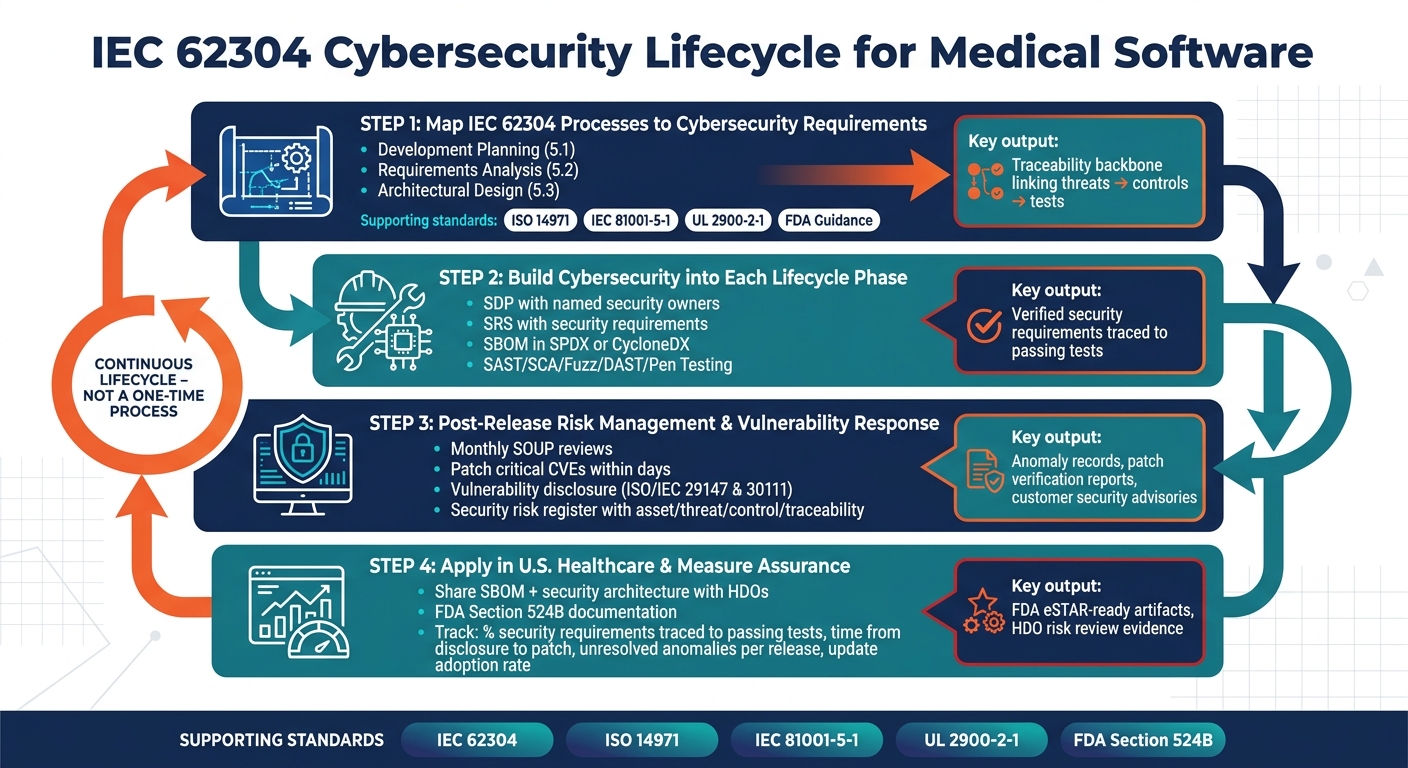
IEC 62304 Cybersecurity Lifecycle: 4-Step Framework for Medical Software
Ensuring Cyber Security Using IEC 62304 SDLC for Medical Software
sbb-itb-535baee
Step 1: Map IEC 62304 Processes to Cybersecurity Requirements
IEC 62304 already gives you the software lifecycle structure. The job here is to plug cybersecurity into that structure in the right places.
Start with 5.1 Development Planning, 5.2 Requirements Analysis, and 5.3 Architectural Design. Those three are the hardest to bolt on later, and they produce some of the strongest security evidence. If planning misses security roles, if requirements skip security needs, or if the architecture ignores trust boundaries, fixing it downstream gets messy fast.
IEC 62304 covers planning, requirements, architecture, verification, maintenance, configuration management, and problem resolution. Each of those process areas can carry cybersecurity controls.
One point trips teams up: IEC 62304 class changes how much you document, not whether you need security analysis. A Class A device with strong connectivity and PHI handling may still require Enhanced documentation because of cybersecurity risk [2][4].
IEC 62304 controls that strengthen security
Traceability is the backbone. Security requirements that come out of threat modeling should connect all the way through design, implementation, and test results. If you can't trace a security requirement from its source to proof that it was tested, the security case starts to fall apart.
Traceability isn't the only piece doing heavy lifting.
- Configuration management should control the SBOM. Track exact dependency versions in the SBOM so new CVEs can be monitored [5].
- Problem resolution should give you a structured way to take in vulnerability reports and run a vulnerability disclosure process.
- Maintenance should support vulnerability monitoring and patch deployment.
How IEC 62304 aligns with ISO 14971, IEC 81001-5-1, UL 2900-2-1, and FDA expectations
Think of IEC 62304 as the lifecycle backbone. ISO 14971, IEC 81001-5-1, UL 2900-2-1, and FDA guidance layer security criteria and evidence onto that backbone.
IEC 81001-5-1 was intentionally structured to follow the IEC 62304 clause architecture, which makes it feel less like a second framework and more like a direct extension of the one teams already use [1][3].
UL 2900-2-1 adds testable criteria for network-connectable products. In practice, teams often lean on it for cybersecurity testing evidence during verification [6].
ISO 14971 ties in through risk management. Security vulnerabilities have to be handled as possible causes of hazardous situations, which means failure mode analysis for SOUP and third-party items matters here [5][6].
During requirements analysis, define the security requirements that matter most:
- authenticity
- authorization
- availability
- confidentiality
- patchability
Those objectives should shape the software requirements specification and keep the security story traceable across the lifecycle.
Used together, these standards split the work cleanly: IEC 62304 provides the process, while the others define the security outcomes and evidence expected along the way. The table below shows how each lifecycle step maps to security evidence.
| IEC 62304 Process Area | Cybersecurity Activity | Related Standard / Guidance |
|---|---|---|
| 5.1 Development Planning | Define security roles, tools, and verification plans | IEC 81001-5-1; FDA cybersecurity management plan |
| 5.2 Requirements Analysis | Use threat modeling and define authenticity, authorization, availability, confidentiality, and patchability | IEC 81001-5-1; FDA security objectives |
| 5.3 Architectural Design | Identify security boundaries, data flows, and SOUP/SBOM | IEC 81001-5-1 |
| 5.5–5.7 Verification | Fuzzing, penetration testing, vulnerability scanning | UL 2900-2-1; IEC 81001-5-1 |
| Maintenance | Vulnerability monitoring, patch management | FDA post-market guidance; IEC 81001-5-1 |
| Configuration Management | SBOM maintenance, secure update mechanisms | FDA SBOM requirements; IEC 81001-5-1 |
| Problem Resolution | Vulnerability triage, vulnerability disclosure | FDA post-market guidance; ISO 14971 |
Early mapping makes FDA cybersecurity documentation much easier to manage.
Step 2: Build Cybersecurity into Each IEC 62304 Lifecycle Phase
Once you've mapped the standard to your cybersecurity needs, the next move is simple: build those controls into each IEC 62304 phase. Security shouldn't sit off to the side as its own workstream. It needs to live inside IEC 62304 from the start.
Planning and requirements: define security roles, controls, and traceability
Your Software Development Plan (SDP) should name specific security owners, not just a department or team. For example, assign a Vulnerability Response Owner and a deputy in your QMS. That way, if a post-market security signal shows up, accountability is clear.
The SDP should also spell out:
- Which security tools will be used
- When threat modeling takes place
- Which security deliverables each phase must produce
During requirements analysis, security belongs right next to functional requirements in the Software Requirements Specification (SRS). It should NOT live in a separate document. A good way to do this is to use the IEC 81001-5-1 security objectives as your SRS checklist.
Then make the links explicit. Each security requirement should trace back to:
- A threat
- A control
- A verification result
That traceability matters later, especially when teams need to show how a security need moved from idea to test evidence.
Architecture and implementation: isolate critical functions and manage third-party software
At the architecture stage, the main job is setting clear security boundaries. Separate safety-critical functions from network-facing components, and apply least privilege across software, users, and interfaces.
During implementation, third-party code needs close attention. Every library you bring in inherits the system's risk profile unless you can show architectural segregation. In plain English: if that component has a problem, it may become your problem too.
Keep your SBOM in a machine-readable format such as SPDX or CycloneDX, and connect it to automated CVE monitoring so affected components are flagged quickly [7]. Static analysis (SAST) should run as part of the build process, not as a one-time checkpoint. That helps teams catch insecure patterns before they pile up.
Verification and validation: test security requirements and abuse cases
Design controls don't mean much unless testing proves they work.
IEC 62304 verification artifacts - such as test protocols, results, and the traceability matrix - should include security testing directly. They shouldn't just point to security as some outside activity.
Abuse cases matter just as much as functional test cases. For every threat in your STRIDE model, there should be a test that shows the device responds the right way. That includes moving to a safe state when compromise is detected. For penetration testing, be clear in the records that the testers were independent of the development team.
Use the test type that fits the lifecycle phase.
| Testing Type | IEC 62304 Phase | Purpose |
|---|---|---|
| SAST / Code Review | Unit Verification (5.5) | Identify coding flaws and insecure patterns in source code. |
| SCA (Composition Analysis) | Unit Verification (5.5) | Identify known vulnerabilities in third-party/open-source libraries. |
| Fuzz Testing | Integration Testing (5.6) | Evaluate robustness of protocols against malformed or unexpected data. |
| DAST | System Testing (5.7) | Probe running interfaces for exploitable vulnerabilities. |
| Penetration Testing | System Testing (5.7) | Simulate real-world attack scenarios against the complete system. |
Keep all of this traceable. Your traceability matrix should link each security requirement to its source threat, the risk control it supports, and the test result that closes the loop.
Step 3: Use IEC 62304 for Post-Release Risk Management and Vulnerability Response
After release, IEC 62304 doesn't let cybersecurity go quiet. It stays active through maintenance, configuration management, and problem resolution. The goal here is simple: turn those controls into a working post-market response process.
Tie security risk analysis to lifecycle records
Your security risk register should stay inside the IEC 62304 record set. For each entry to be useful, it needs four fields: asset, threat, control, and traceability links back to the requirements, design elements, and test records that handle it.
When a new CVE shows up or a field report comes in, that register helps you see what changed right away. You can tell which control is affected, which test needs to be run again, and which risk file entry needs an update. Connect the risk register to SBOM changes, field reports, and retest triggers so the record matches the device's current state.
Use that record set to decide what needs triage, what needs a patch, and what needs retesting.
| Lifecycle Event | IEC 62304 Process | Required Action | Evidence Produced |
|---|---|---|---|
| New CVE Disclosed | Clause 8.1.2 (SOUP Monitoring) | Impact analysis on SBOM components | Anomaly Evaluation Record |
| Security Bug Reported | Clause 9 (Vulnerability Triage) | Root cause analysis and risk assessment | Problem Report / Risk File Update |
| Patch Developed | Clause 6 (Maintenance) | Regression testing of safety/security functions | Verification Test Report |
| Version Update | Clause 8 (Configuration Mgmt) | Update version history and deployed asset list | Updated Configuration List / SBOM |
| Vulnerability Disclosure | Clause 5.1.16 (Communication Plan) | Notify HDOs of risks and fixes | Customer Security Advisory |
Control versions, patches, and vulnerability handling
Use Clause 8 to identify affected versions fast. Tie the SBOM to version-controlled build records so you can isolate affected libraries without digging through guesswork.
Pin exact version numbers in your build configuration. Never use "latest." Review SOUP components monthly, and patch critical vulnerabilities within days. Once a patch is ready, validate it against both safety and security functions before deployment. Also make sure the update mechanism includes rollback capability. For external reports, line up your intake and response process with ISO/IEC 29147 and ISO/IEC 30111.
Name the post-market vulnerability owner in the QMS so HDO risk reviews have one clear contact. That person should also provide the evidence HDOs need for risk reviews and audit trails.
Step 4: Apply IEC 62304 in U.S. Healthcare Settings and Measure Assurance
Connect lifecycle evidence to HDO risk reviews and RiskOps workflows
In U.S. healthcare settings, IEC 62304 artifacts help HDOs review medical device security risks and handle post-market due diligence. Once a product is released, those same lifecycle records often become the proof HDOs use during risk review and procurement.
When a manufacturer shares an SBOM, security architecture views, and a Cybersecurity Management Plan, the HDO risk team has something concrete to review. SBOMs show components, connectivity, and contacts for vulnerability response. That helps answer the questions that matter most:
- Which third-party components are on the device?
- How does it connect to our network?
- Who do we call when a vulnerability is disclosed?
Findings from those documents should feed back into development. If an HDO review spots a gap in network segmentation or an undocumented interface, that finding should trigger requirement updates, design changes, and new test cases. This loop works best when both the vendor and the HDO clearly own vulnerability review and remediation.
Platforms like Censinet RiskOps™ help HDOs bring this work into one place. Instead of juggling vendor questionnaires and device risk files across separate spreadsheets, risk teams can run third-party and enterprise assessments together, compare risk across devices and vendors, and manage remediation with clear accountability. Route findings to named owners for human review before remediation. Then feed that evidence straight into the metrics below.
Track metrics and build evidence for audits and submissions
A solid IEC 62304 process by itself isn't enough. You also need to show an FDA reviewer or an HDO procurement team that the process works, with metrics tracked across the lifecycle.
Track a small set of measures that show the process works in day-to-day use: the percentage of security requirements traced to passing tests, the time from vulnerability disclosure to verified patch availability, the number of unresolved software anomalies per release, and update adoption rates across deployed versions. FDA cybersecurity submissions require multiple linked artifacts and testing records, so aligned IEC 62304 outputs help cut rework.
| HDO/FDA Expectation | IEC 62304 Work Product | Related Standard | Sample Metrics / Artifacts |
|---|---|---|---|
| Vulnerability Management | Software Bill of Materials (SBOM) | Section 524B | Machine-readable inventory (SPDX/CycloneDX); vulnerability triage records |
| System Architecture | Security Architecture Views | IEC 81001-5-1 | Data flow diagrams; interface security controls; Global System View |
| Supply Chain Security | SOUP Inventory & SBOM | Section 524B | % of third-party components with known vulnerabilities; SBOM completeness |
| Verification | Software Testing Documentation | IEC 62304 | % of security requirements traced to passed tests; fuzz/pen-test results |
| Incident Response | Cybersecurity Management Plan | - | Coordinated Vulnerability Disclosure procedures; customer communication records |
Build your Software Requirements Specification and risk templates to meet both IEC 62304 and FDA eSTAR needs from day one. Retroactive documentation costs more and tends to create mistakes. Keep your threat model and anomaly list as living documents so you're ready for HDO review and FDA submission at any time, not just at the end [4].
Conclusion: Apply IEC 62304 as a Practical Framework for Cybersecurity
Security needs to show up in planning, design, testing, and maintenance - not get bolted on at the end. IEC 62304 gives you a clear lifecycle for that work, with built-in checkpoints to define security requirements, shape the architecture around known threats, run security testing, and keep controls in place after release.
When you use it alongside ISO 14971, IEC 81001-5-1, and FDA guidance, IEC 62304 becomes a full security workflow. Each one adds security requirements, but none of them replaces IEC 62304.
PHI protection fits into that same lifecycle. Requirements such as encryption, access controls, and secure authentication should be part of the Software Requirements Specification from day one. Then those controls need to be checked through DAST and penetration testing before release [4].
In day-to-day work, that means keeping the threat model, SBOM, and issue log up to date across the full lifecycle - not scrambling to pull them together at the end. That habit ties cybersecurity, risk management, and post-market evidence into one program that supports safe, reliable medical software.
FAQs
Is IEC 62304 enough for cybersecurity?
No. IEC 62304 gives you a solid framework for medical device software lifecycle processes, including risk management, software safety, and configuration control. But it is not a dedicated cybersecurity standard.
It can help support cybersecurity work, but it doesn't fully address areas like threat detection, continuous monitoring, or incident response. In practice, it should sit within a broader cybersecurity strategy.
How does IEC 62304 support FDA cybersecurity documentation?
IEC 62304 can help with FDA cybersecurity documentation because it gives manufacturers a clear way to show how cybersecurity controls are handled across the software lifecycle.
In plain English, it helps you document things like:
- security requirements
- testing activities
- risk management work
That can make FDA review smoother and show that your software process lines up with current cybersecurity expectations.
What security evidence should teams maintain under IEC 62304?
Teams need to keep documented evidence of cybersecurity requirements, testing-based verification, risk analysis, vulnerability management, and traceability of security controls across the full software lifecycle.
That record should show what the team planned, what they tested, what they found, and how they addressed it. In plain terms, you need a paper trail that connects security goals to the controls put in place and the checks used to confirm they work.
This also includes testing such as SAST, DAST, and penetration testing.
