
Third-party failures can hurt patients in two main ways: device malfunction and care delays. If outside software, firmware, cloud tools, or vendor platforms fail, you can end up with missed alarms, blocked therapy, canceled procedures, and manual workarounds that increase error risk.
Here’s the short version:
- FDA treats third-party risk as a device safety issue, not just an IT issue.
- Manufacturers must track software components with SBOMs and watch them after release.
- Hospitals face both direct and indirect harm from these failures.
- Research and incident data show clear patient impact, including delayed tests, longer stays, and higher mortality during ransomware events.
- The highest-risk cases involve life-support devices, remote monitoring, imaging, and vendor-connected systems.
- The main ways to cut risk are simple: know what you have, link devices to SBOM data, segment high-risk systems, test downtime plans, and set clear response roles.
A few numbers make the point fast:
- 661 device vulnerabilities were found in one 2023 study, with more than half rated high or critical.
- In one 2026 review of FDA safety notices, 94% of reported device cyber flaws were high risk.
- A Ponemon–Censinet survey found 22% of healthcare groups reported increased mortality after ransomware.
- A University of Minnesota study found in-hospital mortality went up 33% during ransomware incidents.
- A 2025 JAMA study found 239 of 1,098 outages - or 21.8% - directly affected patient-facing care.
If you lead security, IT, biomed, compliance, or clinical teams, the takeaway is simple: third-party dependency risk belongs in patient safety planning. It needs the same attention as any other failure that can stop treatment, delay diagnosis, or block clinician response.
This article explains where that risk shows up, how it turns into harm, and what you can do to lower exposure.
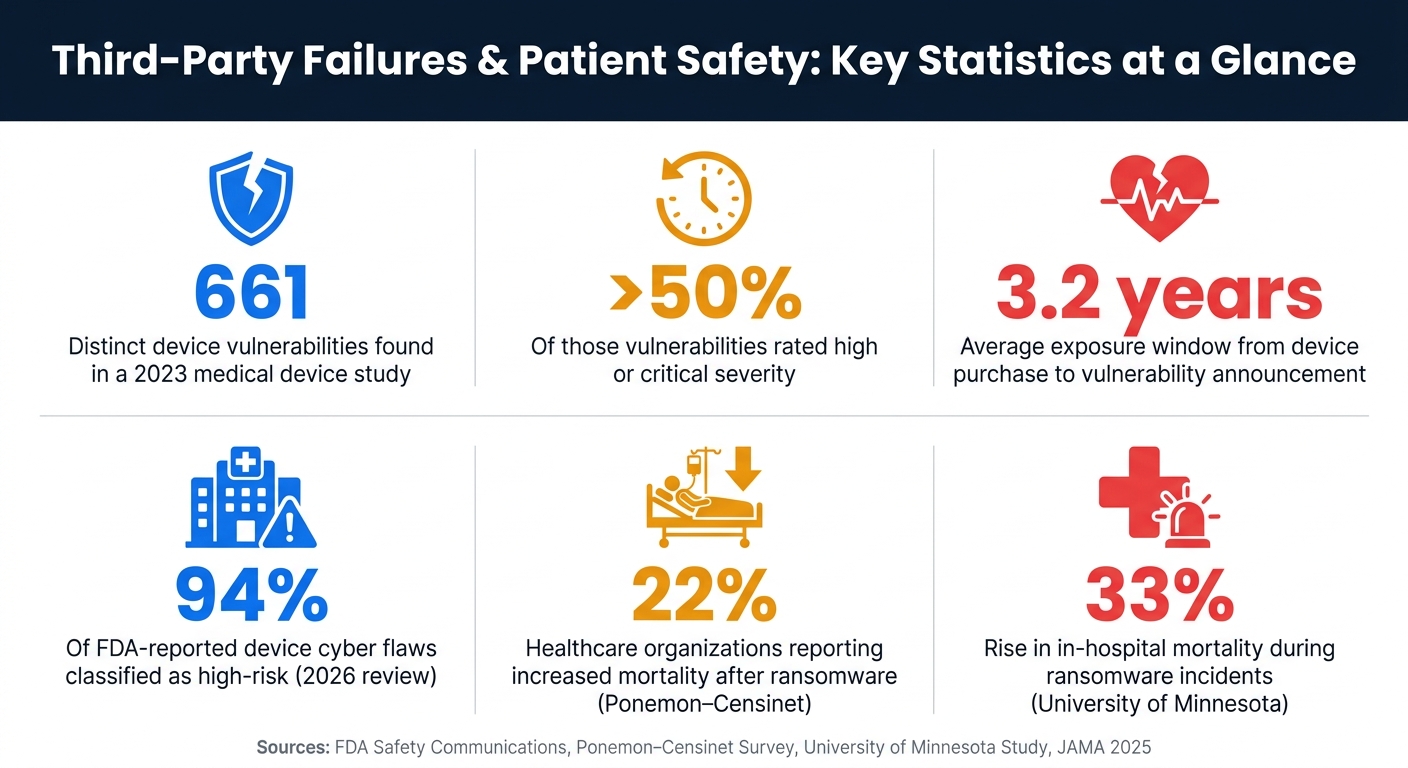
Third-Party Failures & Patient Safety: Key Statistics at a Glance
#407: Cybersecurity in MedTech: FDA Compliance, Patient Safety & the Hidden Risks You’re Missing
sbb-itb-535baee
Regulatory Expectations for Third-Party Components in Medical Devices
Under Section 524B of the FD&C Act, cybersecurity is part of device safety and effectiveness. If a manufacturer can't provide reasonable assurance of cybersecurity, the device can be deemed adulterated, which means it is noncompliant under the FD&C Act.[4][13][15]
FDA Requirements for SBOMs, Threat Modeling, and Secure Design
For any medical device covered by Section 524B, manufacturers must include an SBOM in premarket submissions. That SBOM needs to cover all software components, versions, and dependencies.[1][8][7] FDA expects machine-readable formats like SPDX or CycloneDX.[8][11] If the required cybersecurity material is missing, FDA may refuse to accept the submission.[15][16]
That matters for a simple reason: if a manufacturer doesn't have a complete inventory, it can't quickly tell which devices are exposed when a flaw shows up in a component.
The SBOM is only one piece of the picture. Manufacturers also need to submit threat models that map attack surfaces, trust boundaries, and supply-chain dependencies. That includes flaws tied to third-party libraries, operating systems, communication stacks, cloud services, and update tools.[12][6][7] FDA also expects secure-by-design controls to be built into the device life cycle, including signed firmware, authenticated updates, access controls, encryption, and logging.[2][1][5]
That inventory then serves as the starting point for monitoring, patching, and recall response.
Postmarket Monitoring and Remediation Duties
Clearance is not the finish line. FDA's postmarket cybersecurity guidance says manufacturers must monitor third-party components for new vulnerabilities throughout the device life cycle.[5][14] When FDA identifies a vulnerability such as Log4j, manufacturers are expected to assess the clinical impact, define a fix, and notify healthcare organizations when safety or availability may be affected.[18][5][14]
Updates and patches for third-party components also need to be verified before deployment, so they don't introduce new hazards.[14] On top of that, manufacturers are expected to maintain coordinated vulnerability disclosure processes. In plain terms, there needs to be a way for weaknesses to be reported and addressed before someone exploits them in a clinical setting.[5]
Why Third-Party Cyber Risk Is a Patient Safety Issue
FDA is direct on this point: cyber incidents can disable devices and hospital networks, which can delay diagnosis, stop monitoring, and interrupt therapy.[9][5] And when flaws in third-party operating systems, communication stacks, or remote access tools are exploited, the effect doesn't stay in the server room. It can turn into a ventilator that can't be managed, an imaging system that won't respond, or an alarm that goes silent.
A 2023 study found 661 distinct vulnerabilities across medical devices purchased by national health services. More than half were rated critical or high severity, and the average exposure window was 3.2 years from purchase to vulnerability announcement, even if you assume patching happens right away.[17]
That's why FDA tells manufacturers to assess cyber vulnerabilities using the same lens used for other safety risks: look at the severity of potential patient harm if the vulnerability were exploited, not only the technical severity score.[10] For healthcare delivery organizations, that changes who owns the issue. Third-party component risk belongs in clinical risk committees and patient safety programs, not just on IT dashboards. This shift is critical given the economic impact of third-party risk on healthcare delivery.
The next section shows how these duties play out in device failures and patient harm.
What Research and Incident Data Show About Patient Safety Impact
FDA requirements line up with what hospitals and device makers have seen in practice: third-party failures can harm patients at two levels. They can hit the device itself, and they can disrupt the systems clinicians rely on to deliver care.
The examples below show both.
Direct Device Risks From Embedded Third-Party Software and Firmware
When weak third-party code sits inside a medical device, the damage can be immediate. And in some cases, the stakes are obvious.
In a 2026 analysis of 18 FDA cybersecurity safety communications, 94% of reported vulnerabilities were classified as high-risk, with consequences ranging from unauthorized remote access to device malfunction and data exposure.[1]
Two well-known cases make the pattern easy to see.
In July 2019, FDA warned about URGENT/11 - 11 vulnerabilities in IPnet, a third-party TCP/IP stack embedded in real-time operating systems used across infusion pumps, imaging systems, and other connected devices. The vulnerabilities allowed remote attackers to control affected devices or trigger denial of service, which could interrupt life-sustaining therapy.[21]
Ripple20 showed much the same issue at a lower software layer. A TCP/IP library from Treck, Inc. had been embedded in millions of devices, including infusion pumps and patient monitors. That opened the door to remote code execution that could change device settings or silence critical patient alarms.
More recently, a 2025 FDA safety communication flagged Contec and Epsimed patient monitors for containing a software backdoor that exfiltrated patient data when the device connected to the internet.[20][22] In each case, the root problem came from third-party code embedded in the device stack. This highlights the urgent need for hospitals to effectively manage third-party risk across their entire digital ecosystem.
Indirect Patient Harm Through Care Delivery Disruption
Third-party risk doesn't stop at firmware. Vendor outages, cloud failures, and hospital infrastructure breakdowns can disrupt care across an entire system. A patient may never touch the weak component directly and still feel the impact.
A Ponemon–Censinet survey found that 22% of healthcare organizations reported increased mortality after ransomware, 64% reported delays in tests and procedures, and 59% reported longer stays. A University of Minnesota analysis found that in-hospital mortality rose 33% during ransomware incidents.[23][25]
The ripple effects can spread beyond the hospital that was hit. A cohort study of a month-long ransomware attack on one health system found that nearby, unaffected emergency departments still saw increased patient volume, more EMS arrivals, longer wait times, and higher county-wide ambulance diversion rates.[24][26]
And this isn't only about headline cyberattacks. A 2025 JAMA analysis of 1,098 service outages in a large health system found that 239 (21.8%) were patient-facing, with direct safety impact. Those outages often blocked provider access to medication lists, lab results, and clinical decision support.[19]
These are patient safety events, plain and simple. Delayed diagnostics, canceled procedures, and manual workarounds that increase documentation error risk all carry clinical consequences, even when no single device fails on its own.
How Failure Type Changes Patient Harm
The table below shows how different failure types lead to different patient outcomes and recovery burdens.
| Failure Type | Affected Systems | Patient Safety Consequence | Recovery Challenge |
|---|---|---|---|
| Embedded software defect | Infusion pumps, ventilators | Therapy interruption; incorrect dosing; device becoming inoperable | Requires physical access or manual firmware flashing |
| Vulnerable operating system | Imaging (MRI/CT), diagnostic workstations | Loss of diagnostic visibility; delayed triage; data corruption | Patching legacy systems without breaking FDA validation |
| Cloud or update service outage | Remote monitoring, AI-assisted diagnostics | Failure to alert clinicians to critical events; loss of AI-assisted triage | Dependent on third-party vendor uptime; no local workaround |
| Supply chain compromise | Device firmware, fleet management tools | Unauthorized device control; mass disabling of device fleets | Identifying clean vs. compromised versions across inventory |
| Vendor network access issue | Telemetry systems, EHR integrations | Workflow breakdown; manual charting errors; delayed lab results | Re-establishing secure access and verifying data integrity |
Failure type shapes both the clinical impact and the recovery burden. That link matters, because the technical path to fixing an embedded defect looks very different from the path to restoring a down vendor platform.
How Third-Party Failures Become Clinical Risk
The table above shows the outcomes. This section explains how those failures make their way to the bedside.
Technical Pathways: From Vulnerable Component to Unsafe Condition
Third-party failures turn unsafe when they disrupt core device functions. Software libraries, operating systems, update mechanisms, remote-access tools, and vendor integrations can crash devices, block patches, or corrupt data flow. Many embedded components are software of unknown provenance (SOUP), which makes them harder to track, patch, and replace. That also makes them harder to secure before they affect patient care.
In plain terms, one weak component can take away accurate readings, therapy delivery, or data transmission. And once that happens, a clinical safety control can disappear with it.
Clinical Pathways: From Outage or Malfunction to Patient Impact
A technical failure matters because it removes a clinical function staff rely on. If a device alarm stops firing, that may look like a data transmission issue on paper. In the ICU, it means a nurse may not know a patient is getting worse.
You can see this chain clearly in major hospital outages. The 2017 WannaCry attack is a well-known case: 47 NHS organizations were infected, 1,220 diagnostic devices were affected, and care was disrupted through canceled procedures, delayed appointments, and ambulance diversions.[28][29][30][31][32][33][34][35] The root cause was unpatched Windows systems.
Risk goes up when three things come together:
- The device is tied to high-stakes care
- The device depends on outside systems or vendors
- Recovery takes a long time
A failure in an administrative workstation is disruptive. The same failure in a ventilator, infusion pump, or telemetry system is a clinical emergency. Some devices can stop functioning in practice even when the hardware still powers on. If they rely on cloud authentication, vendor-managed updates, or remote support, the third-party layer can fail first and leave the device stranded.
And the longer staff have to work in manual mode, the more room there is for missed alerts, documentation errors, and delayed intervention.
The Joint Commission urges hospitals to plan for critical technology outages lasting four weeks or longer, including biomedical devices, cloud platforms, and vendor access tools.[27] That is why inventory, segmentation, and recovery planning need to account for prolonged device downtime.
How HDOs and Vendors Can Reduce Third-Party Risk
Core Controls: Inventory, SBOM Visibility, Segmentation, and Response Planning
Third-party failures don't stay in the IT department. In healthcare, they move through clear clinical pathways and can end up affecting patient care. That's why risk reduction has to start with visibility and containment.
First, build a centralized inventory of all networked devices, clinical applications, and third-party services. That inventory should track the owner, version, connectivity, and support status for each asset.[36][39] Without that starting point, teams can't tell which systems are exposed when a new vulnerability shows up.
That inventory also needs to connect to current, machine-readable SBOMs. When teams have that link in place, they can match vulnerable components to affected devices much faster.[3][1] HDOs should ask for SBOMs during procurement and keep them in a searchable repository tied to the device inventory. It's also smart to track end-of-support dates for embedded components with automated alerts, so teams can review clinical impact before a component slips into unsupported status.
Network design matters too. Life-critical devices should be separated from general IT systems, and vendor remote access should be tightly limited.[36][37]
Downtime plans need to be tested with clinical staff using actual workflows, not just tabletop theory. That includes manual workarounds.[38] And when a third-party issue hits, response decisions can't happen in a silo. Security, clinical engineering, IT, compliance, and clinical leadership all need clear roles so the response reflects patient impact, not only technical severity.[36][13]
| Control Area | What Good Looks Like |
|---|---|
| Inventory | Devices, versions, vendors, support status, and connectivity tracked centrally |
| SBOM | Machine-readable SBOMs searchable by component and version |
| Segmentation | Life-critical devices isolated; vendor access monitored and restricted |
| Downtime planning | Manual workflows tested with clinical staff |
| Cross-functional governance | Defined roles across security, biomed, IT, compliance, and clinical leadership |
The catch? These controls get hard to manage by hand when you're dealing with large device fleets and broad vendor networks.
Managing Third-Party Risk with Censinet
Censinet RiskOps™ is built for this exact healthcare challenge. The platform helps HDOs handle third-party risk assessments, track device inventories, and coordinate remediation.
Censinet AI™ speeds up the assessment process by helping vendors complete security questionnaires in seconds. It can also summarize evidence and documentation automatically and flag downstream dependency risks. Just as important, it routes findings to the right decision-makers while keeping human oversight in place for safety-critical decisions.
Conclusion: Key Findings for Patient Safety and Resilience
Third-party component failures are a material patient safety issue, not just a background IT problem. The evidence points to two main paths to harm: direct device malfunction when embedded software or firmware fails, and broader care disruption when vendor systems, cloud platforms, or remote-access tools go down. Accurate inventories, SBOM-linked vulnerability tracking, segmented clinical networks, tested downtime procedures, and cross-functional governance all help reduce the odds that a third-party dependency turns into a clinical emergency.
FAQs
Which medical devices face the highest third-party risk?
Devices with the highest third-party risk are the ones that can directly reach patient data or handle safety-critical tasks. That includes devices that depend on cloud platforms, Bluetooth modules, or AI algorithms.
Why does that matter? Because those parts can affect clinical outcomes and the integrity of the whole system. For that reason, they need the strictest oversight. Manufacturers and healthcare organizations put the most attention on components that touch PHI or support core clinical workflows.
How can hospitals connect SBOM data to patient safety planning?
Hospitals can tie SBOM data directly to patient safety planning when they treat it as part of day-to-day risk work, not just paperwork that sits in a file.
During procurement, teams should ask for machine-readable SBOMs in SPDX or CycloneDX formats. That makes it easier to spot vulnerable components and software that’s getting close to end of support before it turns into a care risk.
From there, hospitals can compare SBOM data against the CISA Known Exploited Vulnerabilities catalog and weigh the clinical impact. That helps teams decide what to patch first and where they may need compensating controls, such as network segmentation, when an immediate fix isn’t possible.
Censinet RiskOps™ can help bring SBOM data into one place so teams can use it during risk assessments and incident response.
What should teams do first during a third-party outage?
First, put continuity of care front and center by turning on pre-set downtime plans for critical workflows. Start with the high-risk processes flagged in your business impact analysis, such as medication administration, patient identification, and critical diagnostics.
Make containment decisions with clinical input. During an incident, disconnecting systems can create bigger patient safety risks than the outage itself. Bring in clinical leaders right away.
