
GDPR can apply to a U.S. healthcare provider even with no office in Europe. If I offer care to people in the EU, track their behavior there, run research with EU participants, or let vendors handle EU patient data, I may fall under GDPR.
Here’s the short version:
- GDPR scope is broader than many U.S. teams expect. It can reach telehealth, patient portals, wellness apps, clinical research, cloud EHRs, and remote monitoring tied to people in the EU.
- HIPAA does not equal GDPR compliance. GDPR uses a broader view of personal data, gives patients more rights, and sets stricter rules for legal basis, notices, transfers, and breach response.
- Health data gets extra protection. Under GDPR, health data is a special category. That can include diagnoses, notes, lab results, device data, recordings, IP addresses tied to a patient, and portal activity.
-
Every data use needs two things documented. I need:
- one Article 6 lawful basis, and
- one Article 9 condition for health data.
- The main rules affect daily work. Teams need to limit what they collect, keep records accurate, set retention schedules, control access, encrypt data, log activity, review vendors, and document decisions.
- Patient rights need a working process, not just a policy. GDPR rights include access, correction, deletion in some cases, restriction, portability, and objection. Most requests must be handled within 1 month.
- High-risk uses may need a DPIA before launch. This often applies to AI tools, large analytics projects, and remote monitoring programs.
- Breach timing is tight. If EU personal data is involved and risk is present, notice to the supervisory authority may be due within 72 hours of awareness.
A simple way to think about it: if I touch EU patient data, I need to know what data I have, why I use it, where it goes, who can access it, how long I keep it, and how I respond when a patient or regulator asks questions.
That’s the core of this article.
The Core GDPR Principles and What They Mean in Daily Healthcare Operations
GDPR Article 5's seven principles show up in day-to-day healthcare work, from intake and EHR charting to billing and vendor oversight. The big shift is simple: these rules have to shape how work gets done, not just sit in a policy binder.
Lawfulness, Fairness, Transparency, and Purpose Limitation
When your organization processes data that falls under GDPR, you need a clear, documented reason for each use. Lawfulness means naming a valid legal basis for every processing activity instead of assuming HIPAA compliance covers it. Fairness means patients shouldn't be caught off guard or put at a disadvantage by how their data is used. Transparency means telling people what you're doing in plain English. Privacy notices should be easy to read, consistent, and tied to the exact reason the data is being used.
Purpose limitation is where many healthcare groups trip up. Data collected at patient registration can't just be reused for analytics or research without a new lawful basis and an updated patient notice. One practical way to handle this is with a data purpose register: a documented list of each processing activity, its stated purpose, and its legal basis. If someone wants to use existing patient data in a new way, that request should go through a formal review before anything goes live.
After the purpose is set, the next step is straightforward: collect only what you need, and keep it only for as long as you must.
Data Minimization, Accuracy, and Storage Limitation
Data minimization means asking for only the data you actually need. For patient registration, that means intake forms should include fields with a clear clinical or operational reason. For remote monitoring, it means setting devices to collect only the metrics tied to a patient's condition, such as heart rate, blood pressure, or blood glucose, instead of turning on broad geolocation or always-on audio by default.
Accuracy takes coordination across systems. A master patient index, with the EHR as the main source and connected systems syncing from it, helps cut down on duplicate records, mismatched remote monitoring devices, and stale contact details that lead to misdirected messages. Staff should confirm patient identity at key points using at least two identifiers and fix any mismatch right away.
Storage limitation can clash with U.S. medical-record retention rules. Federal and state laws often require records to be kept for 6–10 years or longer, while GDPR says data should not be kept longer than needed. The practical answer is a documented retention schedule by data type, tied to legal retention rules, with automated deletion or archiving where possible.
Of course, retention limits don't mean much if the data isn't protected while it still sits in active systems.
Integrity, Confidentiality, and Accountability
Integrity and confidentiality call for technical controls that hold up in daily use. That includes role-based access control (RBAC) mapped to clinical and operational roles, encryption for data in transit and at rest, pseudonymization where it fits, and audit logging that records who accessed what, when, and what changed. Those audit logs shouldn't just exist for show. They should be reviewed on a regular basis for odd activity, especially in high-risk systems like EHRs and PACS.
Accountability ties the whole set of principles together, and it depends on proof, not good intentions. Regulators will want to see things like:
- Access control matrices
- Training records
- DPIAs for high-risk processing activities
- Vendor risk assessments
- Documented remediation plans
Vendor risk management matters a lot here. Cloud EHR providers, telehealth platforms, and remote monitoring vendors all process patient data on your behalf, and their security posture becomes part of your compliance exposure. Censinet RiskOps™ can support third-party risk assessments and ongoing benchmarking across vendors, devices, and clinical applications.
These principles only work when each processing activity has a lawful basis and, for health data, a valid Article 9 condition.
sbb-itb-535baee
Lawful Basis for Processing and Special Rules for Health Data
GDPR vs HIPAA: Key Differences for U.S. Healthcare Providers
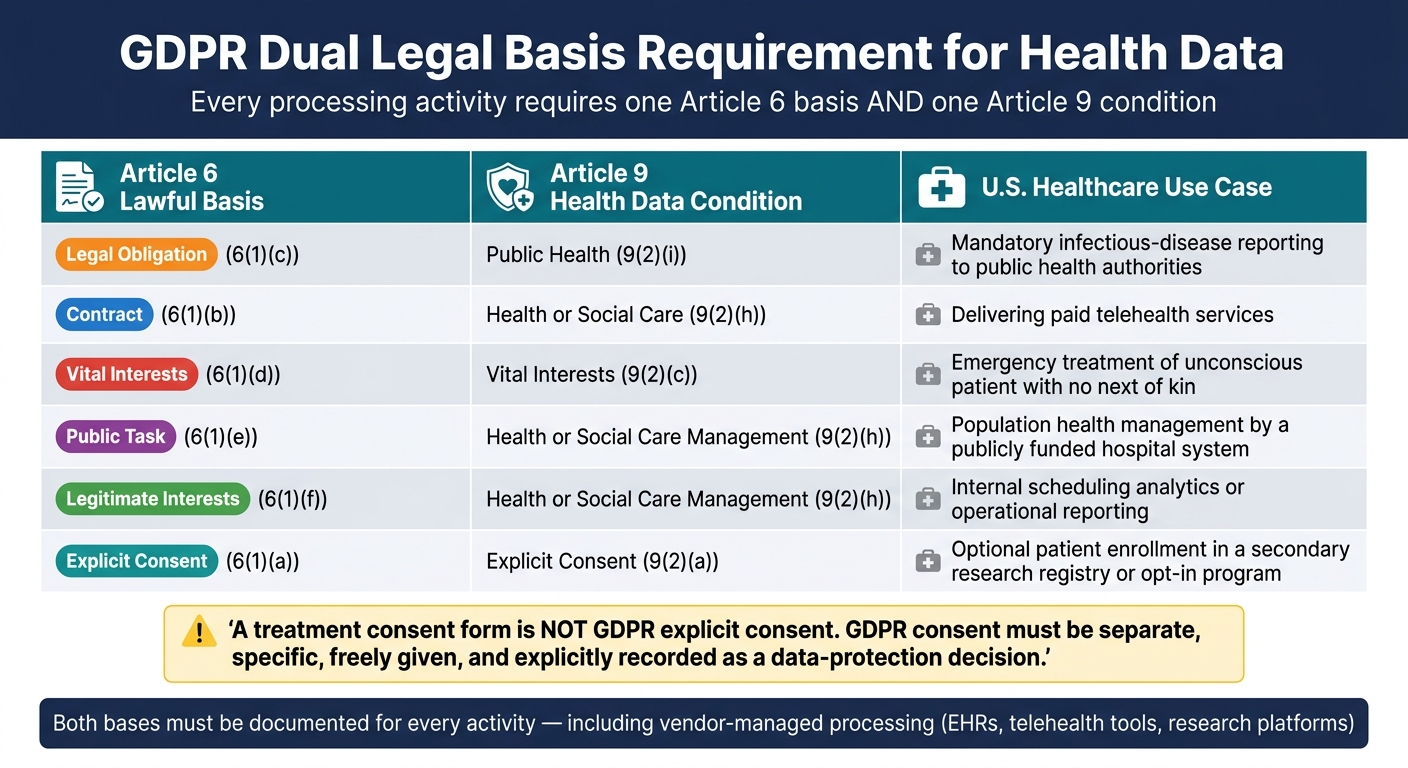
Those principles boil down to one clear rule: every workflow needs a lawful basis and a matching health-data condition. For each use of patient data, you need to document one Article 6 basis and one Article 9 condition. Both have to be identified and recorded for every processing activity.[6][4][8]
Choosing an Article 6 Lawful Basis
Pick the basis that fits what’s actually happening in the workflow.
Legal obligation applies when processing is required by law. A common example is mandatory reporting to public health authorities.
Contract works when processing is needed to provide a service the patient asked for, such as a paid telehealth visit.
Vital interests is narrow. It’s meant for life-or-death situations, like treating an unconscious patient in the ER.
Public task shows up more often in publicly funded health settings, where processing supports an official public-health role.
Legitimate interests can apply to internal uses like scheduling analytics, but there’s a catch: the organization must complete and document a balancing test showing its interests do not outweigh patient rights.
Use consent only for optional processing, such as research or opt-in programs, where saying no does not affect care.[9][10][11][13][1][14]
Meeting an Article 9 Condition for Health Data
In U.S. healthcare, the main Article 9 conditions are:
- Article 9(2)(h): Preventive or occupational medicine, diagnosis, treatment, or health/social care management. This is the main condition for day-to-day clinical care.
- Article 9(2)(i): Public-health purposes, including serious cross-border threats.
- Article 9(2)(j): Scientific, historical, or statistical research, with safeguards such as pseudonymization and data minimization.
- Explicit consent (9(2)(a)): Available when the data subject gives specific, documented consent to health data processing.
A treatment consent form is not GDPR explicit consent. Under GDPR, consent must be separate, informed, specific, freely given, and explicitly recorded as a data-protection decision.[8][2][12]
Use the table below to match common healthcare workflows to the right legal grounds.
| Article 6 Basis | Article 9 Condition | U.S. Healthcare Use Case |
|---|---|---|
| Legal obligation (6(1)(c)) | Public health (9(2)(i)) | Mandatory infectious-disease reporting to public health authorities |
| Contract (6(1)(b)) | Health or social care (9(2)(h)) | Delivering paid telehealth services |
| Vital interests (6(1)(d)) | Vital interests (9(2)(c)) | Emergency treatment of an unconscious patient with no next of kin available |
| Public task (6(1)(e)) | Health or social care management (9(2)(h)) | Population health management by a publicly funded hospital system |
| Legitimate interests (6(1)(f)) | Health or social care management (9(2)(h)) | Internal scheduling analytics or operational reporting |
| Explicit consent (6(1)(a)) | Explicit consent (9(2)(a)) | Optional patient enrollment in a secondary research registry or opt-in program |
This pairing has to be documented for every activity, including vendor-managed processing. The same rule applies to vendor-hosted EHRs, telehealth tools, and research platforms.[6][7][3]
Once the legal basis is in place, the next step is honoring patient rights and documenting the workflow.
Patient Rights, Privacy Notices, and Documented Governance
Once you have a lawful basis, the work doesn’t stop there. You also have to honor patient rights. Under GDPR, that means more than handing over a notice. You need a process to receive requests, act on them, and record what happened.
Handling Data Subject Rights in Clinical and Administrative Workflows
Under GDPR, patients have six rights that affect both clinical and administrative workflows: access, rectification, erasure, restriction of processing, data portability, and objection.[5][3]
Access lets patients get a copy of their data and details about how it is used.[16][5][3] Rectification means inaccurate data must be corrected, although clinical judgment entries are usually annotated rather than removed so the medical record stays intact.[5] Erasure is often limited in healthcare when data must be kept by law or is needed for care, public health, or research. If you deny an erasure request, you need to record the legal basis for that decision.[15][17][5]
Restriction allows a patient to pause processing while a dispute is sorted out, and your systems need to enforce that in practice, not just on paper.[15][16] Portability applies only when processing is based on consent or contract, done by automated means, and limited to data the patient provided.[26][29] Objection often comes up with secondary uses like research or analytics, where the objection must be weighed against public health, scientific, or legal grounds.[5][3][21]
In day-to-day work, privacy, HIM, IT, legal, and clinical teams should use a set request workflow. That should start with identity verification through patient portal credentials, a checked photo ID, or multi-factor authentication for remote requests.[15][16][5][3][30][31]
Timing matters. You must respond within one month, with a possible two-month extension for more involved requests. But if extra time is needed, the patient must be told within the first month.[26][28][29][31] Each request should be logged along with the decision, any exception used, and the action taken. If a request is refused or only partly granted, explain the reason in plain language and tell the patient they can file a complaint with a supervisory authority.
Writing Clear Privacy Notices and Maintaining Records of Processing
A GDPR privacy notice needs to be written in plain language. It should include the categories of data collected, the purposes of processing, the lawful bases under Article 6 and Article 9, recipients, retention periods, safeguards for international transfers, patient rights, and contact details for the privacy office or DPO.[5][3][9]
Layered notices work best across patient touchpoints. Provide the notice at the time of collection under Article 13, or within one month if the data came from another source under Article 14.[25] That notice also helps patients use their rights because it tells them where to go and what the process looks like.
Records of Processing Activities (RoPA) sit at the center of accountability.[27][29] Each record should describe the processing activity, the systems and vendors involved, the data categories, recipients, retention schedule, and security measures.[5][3] Data maps show how patient data moves across EHRs, billing systems, labs, cloud services, and connected devices.[20][22] Decision logs record why a lawful basis was chosen, why an erasure request was denied, or what a DPIA found.[18][20][22][23]
DPIAs, Vendor Oversight, and Governance Across the Data Ecosystem
A Data Protection Impact Assessment (DPIA) is required before processing that is likely to create a high risk to individuals.[18][20][22][23][24] In healthcare, that can include AI-driven clinical decision support, remote monitoring, and large-scale analytics.[20][22][23]
The DPIA needs to be done before processing begins. It should define scope, data flows, recipients, retention, and security measures. It should also assess necessity and proportionality, identify risks like discrimination, clinical harm, or loss of confidentiality, and record controls such as pseudonymization, access controls, and human oversight of automated decisions.[18][22][23][24] For U.S. providers, tying DPIAs to existing clinical risk assessments and technology review boards can make privacy governance fit into processes teams already know.[18][19][22]
Vendor oversight also plays a big part here. EHR providers, cloud hosts, telehealth platforms, and connected medical devices all shape how rights requests are handled, what notices need to say, and which DPIAs are needed.[20][9][22] Under GDPR, you still remain responsible for making sure each vendor gives sufficient guarantees and uses proper measures.[18][20][22][23]
Censinet RiskOps™ helps healthcare organizations streamline third-party risk management, keep vendor inventories current, track data processing agreements and breach notification obligations, and document findings and fixes. That governance record supports the security controls and breach response steps covered next.
Security Controls, Breach Response, and a U.S. Implementation Roadmap
Security Safeguards That Support GDPR Compliance
The governance work above has to turn into day-to-day controls for each EU data flow. Put simply, records on paper aren't enough. Those records need to show up in how systems are set up, how staff work, and how access is handled. GDPR Article 32 calls for risk-based technical and organizational controls, so each control choice should be documented and easy to defend[40][41].
On the technical side, that starts with encrypting data in transit with TLS 1.2+ and at rest with AES-256 across EHRs, databases, backups, and endpoints. It also means using role-based access control (RBAC) so billing staff can see only the demographic fields needed for claims, while clinicians can view only records for patients under their care. Add multi-factor authentication, least-privilege provisioning, and quarterly access reviews, and you're far less likely to leave broad access sitting around longer than it should[41][42][43].
Audit logging matters too. Logs should record who accessed EU patient data, what they did, and when they did it. Those logs also need active monitoring for warning signs, such as large exports[41][42][44]. In research, analytics, and test environments, use pseudonymization. Keep re-identification keys separate and tightly restricted. And keep a live inventory of the systems and devices that touch EU data. If you don't know where the data goes, it's hard to protect it.
Training needs to do more than check the annual HIPAA box. Staff should understand GDPR basics, data subject rights, special issues tied to EU patients, and the safe handling of health data. Testing should be part of the routine as well. Regular penetration testing at least once a year and twice-yearly security reviews help confirm that controls are working and help teams fix weak spots. Test results and remediation steps should be documented, and remediation should be tracked through closure[32][42][44].
Breach Notification Timelines and Incident Coordination
Security controls cut risk, but incident response often decides whether a bad day turns into a reportable breach. When an incident happens, first determine whether EU personal data are involved. If they are, GDPR requires notice to the relevant supervisory authority without undue delay and, where feasible, no later than 72 hours after becoming aware of a personal data breach if it is likely to pose a risk to individuals' rights and freedoms[33][38][39]. If the risk is high, affected individuals must also be notified without undue delay.
Run GDPR and HIPAA breach clocks in parallel and document the decision tree[34].
GDPR severity analysis depends on the facts of the case. The type and volume of data, the sensitivity of the information, whether the data were actually accessed or exfiltrated, and the mitigation already in place all affect the notice decision[35][36][37]. Writing down that analysis - and the reason behind it - is just as important as sending the notice. It helps show that the team made a careful call instead of guessing under pressure.
It also helps to prepare patient communication templates ahead of time. Have versions ready for both GDPR and HIPAA situations so time isn't lost drafting language during an active incident. In a breach, every hour counts.
A Practical Roadmap for U.S. Healthcare Organizations
GDPR alignment is not a one-and-done task. A phased approach makes the work easier to handle and helps teams avoid getting in the way of clinical operations.
| Phase | Focus | Key Actions |
|---|---|---|
| 1. Scope & Map | Identify where GDPR applies | Audit data flows; inventory systems, vendors, and devices that touch EU personal data |
| 2. Align & Document | Establish lawful bases and governance | Confirm Article 6 and Article 9 bases; update RoPA; revise privacy notices |
| 3. Embed & Protect | Put rights and controls into daily practice | Operationalize rights workflows, core controls, and DPIAs |
| 4. Test & Improve | Validate and refine | Run breach tabletop exercises; conduct penetration tests; review vendor assessments; track remediation |
Vendor oversight cuts across every phase. Censinet RiskOps™ can support third-party risk assessments, benchmarking, and collaborative risk management.
FAQs
Does GDPR apply if my practice is only based in the U.S.?
Yes. GDPR can apply if your practice handles the personal data of EU residents, even when your organization operates only in the U.S.
A U.S.-based healthcare provider may need to follow GDPR if it treats EU patients, runs international research, or otherwise processes the personal data of people who live in the EU. If your data moves across borders, you may need to deal with both GDPR and HIPAA at the same time.
What is the difference between HIPAA compliance and GDPR compliance?
HIPAA and GDPR differ in both scope and purpose.
HIPAA is a U.S. law centered on protecting PHI in healthcare. GDPR is an EU law that covers the personal data of EU residents, even when that data is processed outside the EU.
The biggest gaps show up in a few areas: consent rules, breach notice deadlines, penalty caps, and who has to follow each law.
Under GDPR, organizations generally face tighter consent rules and must report certain data breaches within 72 hours. Under HIPAA, covered entities can have up to 60 days to report a breach, depending on the case.
The penalty structure is also very different. GDPR can impose fines of up to €20 million or 4% of global revenue, while HIPAA penalties can reach $1.5 million annually.
Just as important, the two laws apply to different groups. HIPAA applies to specific healthcare-related entities and their business associates. GDPR applies more broadly to organizations that handle the personal data of people in the EU, even if the organization itself is based elsewhere.
When does a healthcare provider need a DPIA under GDPR?
Under GDPR Article 35, a healthcare provider must carry out a Data Protection Impact Assessment (DPIA) when processing is likely to pose a high risk to people’s rights and freedoms.
That usually applies to:
- Large-scale processing of sensitive health data
- Systematic patient monitoring
- New tools like AI diagnostics or some telemedicine solutions
- Any processing that could have a major effect on patient privacy
The DPIA should also be updated when the processing changes, the risks shift, or the technology used changes.
