
A vulnerability assessment tells me what is wrong. Risk management tells me what to do about it. That is the whole point.
In U.S. hospitals, that gap matters. More than 50% of connected medical devices have at least one known critical flaw, and 23% have at least one CISA-known exploited vulnerability. But a high CVSS score alone does not tell me whether to patch now, isolate the device, watch it more closely, replace it, or accept the risk for a set period.
If I had to boil the article down, it comes to this:
- Vulnerability assessment = a technical check for weaknesses
- Risk management = a decision process that weighs patient care, device use, downtime, controls, and compliance
- Assessment is point-in-time
- Risk management runs across the device life
- IT, biomed, clinical, compliance, and supply chain all need to be involved
- A patch is not always the first or safest move
You can think of it this way: a scanner may flag an infusion pump, monitor, or imaging system for a flaw, but the hospital still has to decide how much that flaw matters in practice. A device on a locked-down VLAN with tight access rules may not rank the same way as a life-support device with the same CVE and no fallback option.
The short answer: assessment finds the issue; risk management sets the response.
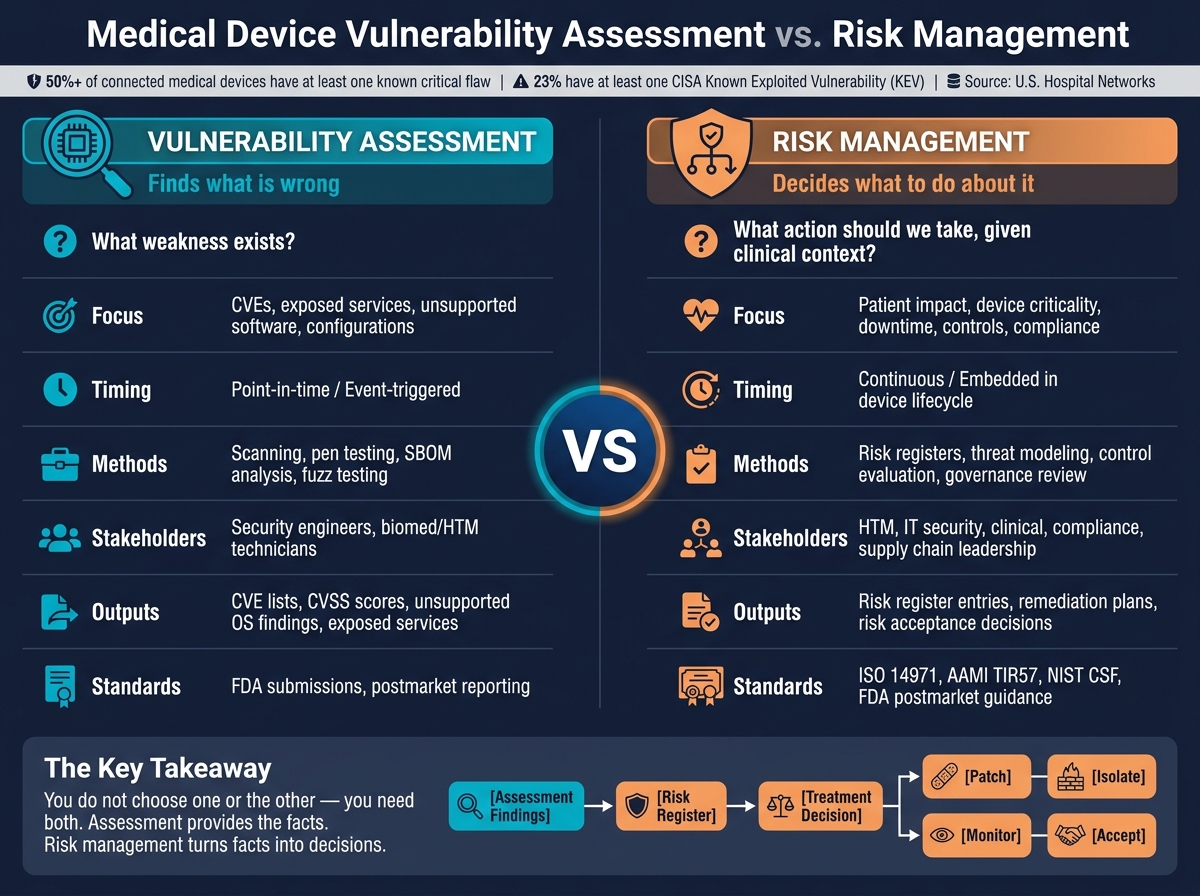
Medical Device Vulnerability Assessment vs. Risk Management: Key Differences
Series 5: Best Practices for Medical Device Vulnerability Management
sbb-itb-535baee
Quick Comparison
| Aspect | Vulnerability Assessment | Risk Management |
|---|---|---|
| Main question | What weakness exists? | What action should I take? |
| Focus | CVEs, exposed services, unsupported software, configs | Patient impact, device criticality, downtime, controls, compliance |
| Timing | Point-in-time | Through the full device life |
| Main output | Findings, severity scores, device lists | Risk ranking, action plans, acceptance, replacement or mitigation decisions |
| Main users | Security and biomed teams | IT, biomed, clinical, compliance, leadership, supply chain |
So if you are trying to choose between these two ideas, the answer is simple: you do not pick one or the other. You need both. The assessment gives the facts. Risk management turns those facts into decisions.
What a Medical Device Vulnerability Assessment Does
A medical device vulnerability assessment is a tactical cybersecurity review of one device or a whole device fleet. Its job is to find and document technical weaknesses and show how severe they are. What it doesn't do is make enterprise risk calls. That technical starting point comes from a solid device inventory, SBOMs, CVE data, manufacturer advisories, FDA communications, and network context.[5][10]
The quality of the assessment depends on how complete that inventory and context are, not just what a scan turns up. In practice, exposure often depends just as much on how a device is connected as on the software running on it.[1]
Common Assessment Activities and Triggers
Most assessments include a handful of core activities: asset discovery, configuration review, vulnerability correlation, validation, and severity scoring.[5][10]
- Asset discovery finds all connected devices, including shadow assets.
- Configuration review checks password policies, encryption, logging, and remote access controls.
- Vulnerability correlation matches SBOM components and OS versions against CVE databases and known-exploited vulnerability lists.
- Validation may test exploitability in controlled environments.
- Severity scoring uses methods such as CVSS v3 to rate each finding by technical severity and exploitability so teams can sort response work.[5][6][8][10]
These assessments are often triggered by newly disclosed CVEs, FDA safety or cybersecurity communications, manufacturer security advisories, new device purchases, internal audits tied to Joint Commission readiness or HIPAA Security Rule compliance, or network changes like redesigns, EHR migrations, or new remote access tools.[7][10][11][12] One example is the FDA's October 2019 URGENT/11 safety communication, which addressed vulnerabilities affecting certain medical devices and hospital networks and pushed manufacturers to identify affected devices and build mitigation plans.[11]
What a Vulnerability Assessment Produces
When done well, an assessment gives teams outputs they can act on: an affected-device list, a vulnerability catalog, severity ratings, and remediation options such as patching, configuration changes, service disabling, segmentation, or other compensating controls. It also creates evidence - scanner reports, configuration exports, and test logs - that helps with audit trails and coordination between IT security and clinical engineering.[5][6][10]
Those findings then feed into clinical, operational, and governance risk decisions. A CVSS score tells you technical severity; it does not tell you patient harm, workflow disruption, or compliance exposure. Risk management uses the assessment results to decide what to patch, isolate, monitor, replace, or accept.[10][9]
What Medical Device Risk Management Covers
Medical device risk management is a continuous program that identifies, evaluates, treats, and monitors risk from procurement through retirement.[13][15][16][18][19][20]
Put simply, it takes the findings from an assessment and asks the next set of questions: How critical is this device? What happens to patient care if it goes down? What safeguards already exist? Those answers matter because a technical issue on paper doesn't always match the risk inside a hospital.
That broader view helps teams set priority, assign ownership, and decide timing. The move from finding flaws to choosing action is the heart of risk management.
Risk Management Standards and Governance in the U.S.
Several frameworks shape how U.S. healthcare organizations build their risk management programs.
ISO 14971:2019 lays out a structured process for medical device risk management: identify hazards, estimate and evaluate risk, put controls in place, and monitor how well those controls work across the device lifecycle.[22][26]
AAMI TIR57 builds on that base for cybersecurity. It helps manufacturers and HDOs identify assets, threats, and vulnerabilities, choose security controls, and monitor results over time.[17][19][20]
For postmarket work, AAMI TIR97 covers postmarket monitoring and disclosure, and it ties security into safety processes.[21][24][25] The FDA recognizes both TIR57 and TIR97 as consensus standards.[23]
On the day-to-day side, the NIST Cybersecurity Framework (CSF) gives HDOs a practical model:
- Identify
- Protect
- Detect
- Respond
- Recover
That structure helps map device risk to enterprise security controls, monitoring programs, and incident response plans.[4]
Governance usually sits with a multidisciplinary committee made up of HTM/biomed, IT security, clinical leadership, compliance, and supply chain. This group works from the same risk record to rank actions, review high-risk devices, approve remediation plans, and decide whether a device should stay in service, be restricted, or be retired.[13][15][16][4][18][19][20] In other words, these roles turn technical findings into formal decisions.
Risk Treatment Decisions Beyond Technical Severity
Organizations weigh device criticality - whether a device is life-support, diagnostic, or administrative - alongside downtime tolerance, meaning how long the device can be offline before care is affected.[13][14][15][16][4][19][20]
A ventilator and a low-acuity device may share the same vulnerability. Still, the response timeline can be very different because the clinical stakes are not the same.
Compensating controls also change the picture. A vulnerable device on a dedicated VLAN, with limited user access and active monitoring, may carry less actual risk than its raw CVSS score would suggest.[13][15][16][17][4][19][20]
Because of that, treatment decisions - patching, segmentation, added monitoring, or device retirement - are based on the full context, not technical severity alone.[13][14][15][16][17][4][19][20] During periods of high demand, teams may delay remediation until a safer maintenance window and document any temporary controls in the meantime.[13][14][15][16][4][19][20]
Regulatory exposure matters too. A moderate-severity finding that could trigger a HIPAA breach or an FDA reportable incident often jumps up the priority list, even if its CVSS score looks less urgent.[13][14][15][16][17][4][19][20] That difference leads directly into the side-by-side comparison in the next section.
Medical Device Vulnerability Assessments vs. Risk Management
A vulnerability assessment finds weaknesses. Risk management decides what to do about them, and when.
Key Differences in Scope, Timing, and Outputs
Vulnerability assessments are point-in-time. Teams usually run them during procurement, after software changes, or as part of scheduled testing. Risk management works differently. It stays active across the full device lifecycle and gets updated as new vulnerabilities, advisories, and threat intelligence come in.[2][3][27]
The scope is different too. A vulnerability assessment looks at device-level technical issues like CVEs, unsupported operating systems, exposed services, and CVSS scores. Risk management takes those findings and puts them in context. That means looking at clinical impact, operational limits, and governance decisions.[2][28][31][32]
| Aspect | Vulnerability Assessment | Risk Management |
|---|---|---|
| Scope | Device-level technical issues such as CVEs, unsupported operating systems, exposed services, and CVSS scores | Assets, threats, impacts, controls, and governance across clinical and operational needs |
| Timing | Point-in-time; event-triggered | Continuous; embedded in the device lifecycle |
| Primary question | What is weak? | What should we do now, given clinical and business context? |
| Typical methods | Scanning, penetration testing, SBOM analysis, fuzz testing | Risk registers, threat modeling, control evaluation, governance review |
| Stakeholders | Security engineers, biomed/HTM technicians | Multidisciplinary group: HTM, IT security, clinical, compliance, supply chain |
| Outputs | CVE lists, CVSS scores, unsupported OS findings, exposed services | Risk register entries, remediation plans, risk acceptance decisions, documentation |
| Decision context | Evidence for FDA submissions and postmarket reporting | Alignment with FDA postmarket guidance, ISO 14971, AAMI TIR57, and NIST SP 800-30[2][17][31][32] |
A high CVSS score by itself does not set the response order. 23% of medical devices on hospital networks had at least one CISA-tracked Known Exploited Vulnerability (KEV).[29] But that still doesn't answer the hard part: which one gets patched first? The answer depends on clinical criticality and compensating controls. That's a risk management call, not something the assessment decides.
How the Two Functions Work Together in Practice
Once a weakness is found, the next step is simple to say and harder to do: patch it, mitigate it, accept it, or replace it. Assessment findings feed into risk decisions. Teams log them in the risk register, then review likelihood, harm, and criticality before choosing a treatment path.[2][28][30][31]
That handoff shows up clearly in FDA guidance. The FDA's postmarket guidance frames the issue as deciding whether patient-harm risk from a vulnerability is controlled or uncontrolled, using matrices that combine exploitability with severity of harm.[2][28] In plain English, a technical finding doesn't become action until it's checked against clinical and safety impact.
Here’s how common assessment outputs usually connect to risk management actions:
| Assessment Output | Risk Management Action |
|---|---|
| CVE with high CVSS score on a critical device | Immediate escalation; segmentation or patching within a defined maintenance window |
| Unsupported operating system | Replacement planning; interim compensating controls (VLAN isolation, access restrictions) |
| Exposed remote access service | Network segmentation; access control review; monitoring enhancement |
| End-of-support software component (from SBOM) | Lifecycle tracking; vendor engagement; formal risk acceptance if replacement is delayed |
| Weak or default authentication | Credential hardening; access policy update; monitoring for anomalous login activity |
| Known exploited vulnerability (CISA KEV) | Prioritized remediation; regulatory documentation |
Building an Integrated Medical Device Security Program
Practical Steps for HDOs and Vendor Collaboration
The link between assessment and risk management is a shared way of working. It starts with a complete, continuously updated device inventory. Each record should include device type, OS and firmware, patch level, connectivity, clinical use, and ePHI status.[35] If that inventory is missing pieces, assessments miss devices, and risk decisions happen without the full picture.
Next comes clinical criticality. Tag each device as life-support, diagnostic, or ancillary. That tag helps teams turn severity into priority. A critical flaw on an ICU ventilator does not call for the same response as that same flaw on an administrative kiosk, even when the CVSS score is identical.[33][34]
It also helps to standardize how teams handle manufacturer documents. MDS2 responses, SBOMs, vulnerability disclosures, and patch notices should all follow the same intake path so the right reviewer sees each item and the same risk workflow gets used every time.
Teams need a system of record, too. That system keeps inputs, reviews, and follow-up actions in sync. Tools like Censinet RiskOps™ can centralize device and vendor risk data, route findings, and track remediation ownership while still keeping human approval in the process.
Conclusion: Assess Vulnerabilities, Manage Risk Continuously
Vulnerability assessments find weaknesses. Risk management turns those findings into patient safety, operational, and compliance decisions. That link is what turns device findings into disciplined action.
FAQs
When should a hospital patch a vulnerable device?
Hospitals should patch vulnerable devices as soon as possible. The best way to set priorities is simple: look at how likely a flaw is to be exploited and how much harm it could cause to patient safety or clinical operations.
Sometimes patching has to wait. A vendor may need to approve the update first, or the device may be in use for patient care and can't be taken offline right away. In those cases, organizations should set SLAs based on vulnerability severity and asset criticality. For critical systems, a common window is 24 to 72 hours.
If an immediate patch isn't possible, teams should put compensating controls in place until they can apply the permanent fix.
Who should be involved in medical device risk decisions?
Medical device risk decisions need a multidisciplinary team. One person alone usually can't judge the full effect on patient safety, clinical workflows, and device performance.
That team should include people from cybersecurity, privacy, device engineering, clinical operations, IT interoperability, and quality assurance. Why? Because a vulnerability on paper can look very different in an actual care setting.
A cross-functional group can assess issues where the device is used, see how they affect care delivery, and weigh them against clinical outcomes and patient safety priorities.
How often should medical device risk be reassessed?
Medical device risk needs to be reassessed continuously across the full device lifecycle. It’s not a one-and-done task.
Review risk any time there’s a major change. That includes software updates, shifts in the threat landscape, or changes to the clinical setting or day-to-day workflows.
For routine monitoring, quarterly or biannual scans are a good baseline. High-risk devices may need monthly assessments. And if a new vulnerability appears or a vendor releases a critical update, that should trigger an immediate review.
