
No, wired medical devices are not automatically safer than wireless ones. Wireless devices face RF threats like eavesdropping, spoofing, replay, and jamming. Wired devices avoid RF risk, but they still face LAN attacks, open ports, weak passwords, malware through USB, and hands-on tampering.
Here’s the short version:
- Wireless risk centers on over-the-air access, interference, and remote control attempts
- Wired risk centers on internal network access, exposed services, and physical ports
- Both can put patient safety, PHI, uptime, and device integrity at risk
- Both still need encryption, device identity checks, segmentation, logging, patching, and vendor follow-through
- For hospitals, this is not just an IT choice. It is a device risk decision tied to care delivery and compliance
A few numbers show why this matters:
- Claroty found 89% of healthcare organizations had medical systems with public exploit exposure and poor connection security
- In one radiology study, 83% of devices had at least one high-risk flaw, and 44% had at least one critical flaw
- In that same study, 84% of devices with USB ports had insecure port access
If I boil the article down to one point, it’s this: pick the connection type based on the device’s risk profile, not old assumptions. Wireless is not “bad,” and wired is not “safe.” What matters most is how the device is built, connected, monitored, and maintained.
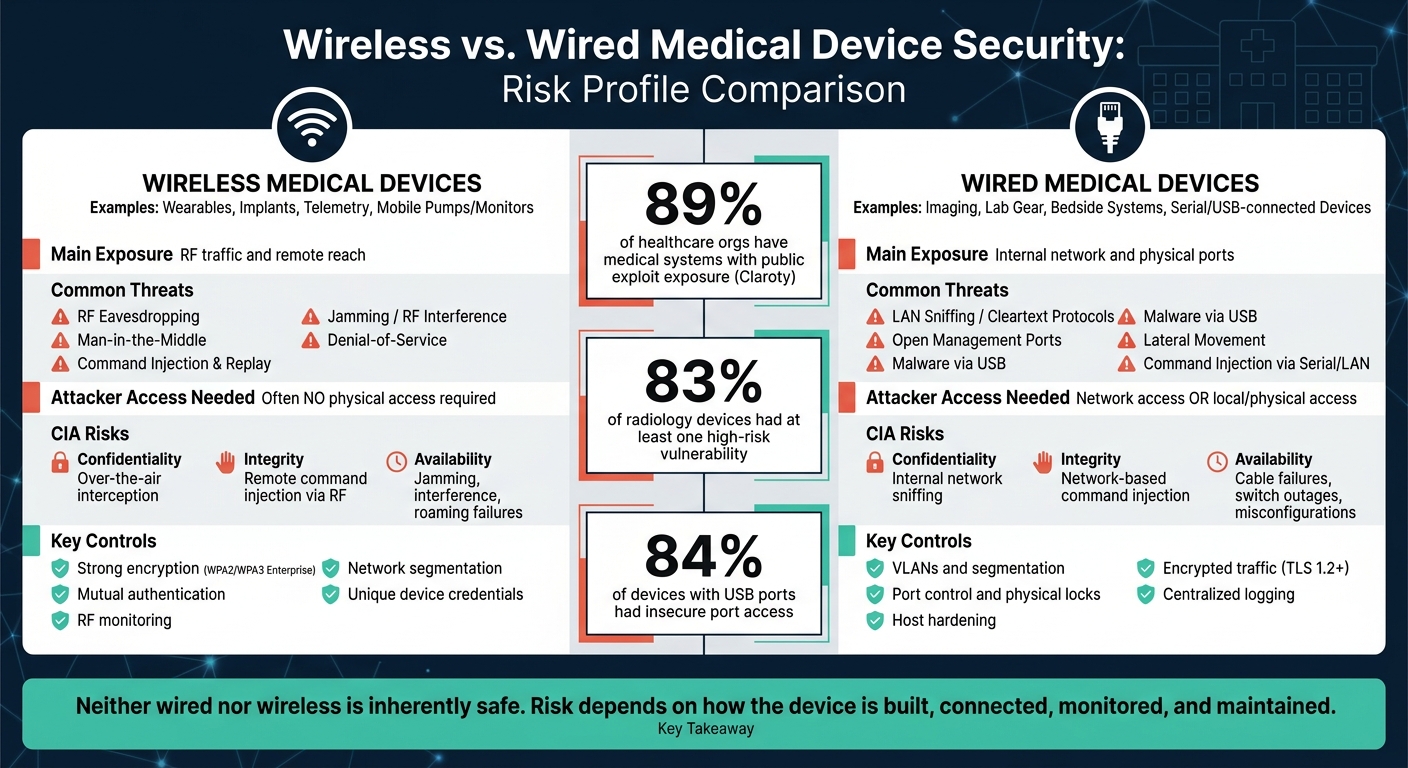
Wireless vs. Wired Medical Device Security: Risk Profile Comparison
Webinar: Cybersecurity for Bluetooth Low Energy (BLE) Medical Devices | Orthogonal
sbb-itb-535baee
Quick Comparison
| Criteria | Wireless Medical Devices | Wired Medical Devices |
|---|---|---|
| Main exposure | RF traffic and remote reach | Internal network and physical ports |
| Common threats | Eavesdropping, spoofing, replay, jamming, DoS | Sniffing on LAN, open management ports, malware via USB, lateral movement |
| Access needed by attacker | Often no hands-on access | Often network access or local access |
| Confidentiality risk | Over-the-air interception | Cleartext traffic on hospital network |
| Integrity risk | Remote command injection | Command injection through LAN, serial, or attached systems |
| Availability risk | RF interference, jamming, roaming issues | Cable faults, switch outages, bad network changes |
| Main controls | Strong encryption, mutual auth, RF monitoring, segmentation | Segmentation, port control, host hardening, encrypted traffic, logging |
| Common device examples | Wearables, implants, telemetry, mobile pumps/monitors | Imaging, lab gear, bedside systems, Ethernet/serial/USB-connected devices |
If you manage medical devices, the practical takeaway is simple: review wireless and wired systems together, map each device to its care role, and apply controls based on actual exposure.
Wireless medical device security: attack surface and clinical benefits
Wireless medical devices can be attacked without physical access. That’s the big shift. Radio traffic can be intercepted, spoofed, or jammed from outside the device enclosure - and in some cases from outside the room or even the building.[1][5][12]
Core wireless threats: interception, command injection, and jamming
The wireless attack surface is bigger than just the radio link. It also includes the device itself, the access point, the controller, and the keys and credentials used to connect everything. If encryption is weak or missing, or if systems rely on shared credentials or default passwords, a wireless device can become a remote entry point.
Here’s how the main wireless threats line up with the security properties they hit hardest:
| Threat | Primary Impact | Common Mitigations |
|---|---|---|
| RF eavesdropping | Confidentiality | Strong encryption, WPA2/WPA3 Enterprise |
| Man-in-the-middle | Integrity | Mutual authentication |
| Command injection and replay | Integrity | Signed messages, replay protection, secure boot, firmware validation |
| Jamming / RF interference | Availability | Spectrum monitoring, resilient alarm pathways |
| Unauthenticated services | Confidentiality, Integrity | Unique device credentials, network segmentation |
| Denial-of-service | Availability | Intrusion detection, segmentation |
This isn’t just a theory. Research by Halperin et al. showed that attackers could eavesdrop on pacemaker and ICD traffic and replay messages to disable therapy.[4] Older insulin pumps offered another stark example: weak encryption and weak authentication made it possible to capture traffic and alter delivery commands.[4][7][9]
Implantable, ingestible, and mobile devices: long-term risk factors
Implantable and ingestible devices are among the hardest systems to secure. Battery, compute, and memory limits restrict what controls can run on the device. On top of that, these products often stay in use for a long time, which makes patching and key rotation much harder than it is on equipment that can be swapped out more easily.
That’s why postmarket monitoring and coordinated disclosure matter so much here. In some implantable systems, researchers showed attacks from tens to hundreds of meters away by intercepting communications between an implant and its programmer when signals lacked strong encryption and authentication.[1][8]
Mobile bedside devices - like monitors and infusion pumps - bring a different set of problems. Pairing issues can create gaps. Shared wireless infrastructure can spread risk across many devices. And in dense hospital settings, interference can hurt both security and reliability at the same time.
These devices may remain in service for years or even decades, which increases the importance of postmarket monitoring and coordinated vulnerability disclosure.[10][11] Proof-of-concept attacks shown at Black Hat demonstrated that malware could be injected into pacemaker systems and insulin delivery could be halted remotely.[6][9][13]
Where wireless delivers clinical value despite the risk
Wireless still has a clear clinical upside. It can improve care when mobility, remote communication, or easier deployment matters. The better approach is simple: use wireless where it helps care, then lock it down with mutual authentication, strong encryption, segmentation, RF monitoring, and vendor accountability.
Wired systems reduce RF exposure, but they come with their own network and physical-layer risks.
Wired medical device security: narrower exposure, but not low risk
Wired devices cut down exposure because an attacker usually needs network access or hands-on access to the device. That makes the attack surface smaller. It does not make the device safe.
Wired channels and their security characteristics
The three wired connections you’ll see most often in hospital medical devices are Ethernet, serial interfaces (RS-232/RS-485), and USB ports. These links remove radio-specific threats like interception and jamming. But each one brings its own problems.
Ethernet-connected devices live inside the hospital IP network. So their security depends a lot on how that network is built and maintained. Serial connections often rely on older protocols with no built-in encryption or authentication. If someone gets access to the port, or to the PC connected to it, they may be able to inject commands or alter data. USB ports create a simple malware path: one infected drive used for log exports or updates can drop malware onto embedded devices that often have limited defenses.
That risk gets worse when the device is connected to a shared hospital network.
Persistent vulnerabilities in wired hospital networks
The bigger issue is often the network around the device. Many hospitals still use flat networks or networks with weak segmentation. When that happens, malware that lands on one endpoint can move sideways into imaging systems, analyzers, and infusion pumps.[2][15]
A study of networked medical equipment in a radiology department found that, out of 144 items scanned, 119 (83%) had at least one high-risk vulnerability, and 64 (44%) had at least one critical vulnerability. Most devices transmitted data without encryption, which meant traffic could be captured on the hospital network.[14] The same study also found that USB ports were not secure on 49 of 58 (84%) devices that had them. That’s a plain example of how physical port exposure adds risk.[14]
Another weak spot shows up again and again: embedded web servers and open management ports.[12][14] Many devices expose HTTP interfaces, Telnet, or SSH, sometimes with default or hard-coded credentials. Industry data shows that 21% of connected medical devices still use default or weak credentials. And that problem affects wired and wireless devices alike.[15] Once an attacker gets onto the internal network, they can scan for open ports, identify device types, and try logins without ever going near a wireless signal.
Here’s how the main wired channels line up with their usual weak points and the controls that target them most directly:
| Wired Channel | Typical Vulnerabilities | Key Security Controls |
|---|---|---|
| Ethernet (infusion pumps, monitors) | Cleartext protocols, lateral movement, open management ports | Dedicated VLANs, ACLs, internal firewalls, monitoring |
| Ethernet (PACS/imaging systems) | Unencrypted DICOM, default credentials, outdated OS/firmware | Imaging-specific VLANs, HTTPS enforcement, regular patching |
| Serial (legacy monitors, lab analyzers) | No authentication, no encryption, command injection via attached PC | Physical port locks, hardened host PCs, managed serial concentrators |
| USB (data export, software updates) | Infected media, unauthorized PHI copying, rogue peripherals | Device control, approved-media-only policies, port locks |
That distinction becomes clearer when wired and wireless systems are compared across confidentiality, integrity, and availability.
Wireless vs. wired systems: side-by-side risk assessment
Confidentiality, integrity, and availability compared
For HDOs, the key question isn't which link is "safer." It's which risk profile matches the device's clinical role.
Wireless can expand attack distance and RF exposure. Wired systems move more of that risk to internal network access and physical ports. Same goal, different weak spots.
| Security Dimension | Wireless Devices | Wired Devices |
|---|---|---|
| Confidentiality | Over-the-air interception risk; requires strong encryption and mutual authentication | Internal network sniffing risk; requires encryption even on LAN |
| Integrity | Remote command injection via RF; requires cryptographic authentication | Network-based command injection; requires segmentation and access control |
| Availability | Vulnerable to RF jamming, interference, and roaming failures | Vulnerable to cable failures, switch outages, and network misconfigurations |
Those gaps matter because they change both outage response and forensic work.
Operational impact, incident response, and FDA expectations

Wireless outages often show up as lost telemetry or devices falling back to local modes. Wired outages usually come from cable problems, switch failures, or integration issues, and they can hit many devices at the same time.
Incident response changes with the connection type too. Wireless cases call for RF-specific tools and records, such as:
- wireless IDS logs
- access point records
- spectrum analysis
The search area can also spread past clinical rooms into hallways, waiting rooms, and even building exteriors. Wired cases lean more on switch logs, NetFlow data, firewall records, and SIEM correlation. In both setups, strong logging, centralized monitoring, and clear playbooks are a must.
This split also affects what manufacturers need to show during review. FDA expectations stay the same at a high level, but the proof is different. Wireless devices need to deal with RF interception, jamming, and authentication. Wired devices need to deal with LAN exposure, exposed services, and segmentation.
In day-to-day terms, wireless risk tends to sit in RF exposure and remote attacks. Wired risk tends to sit in LAN access, exposed services, and physical port abuse.
Risk reduction and governance for mixed medical device environments
Security controls that apply across both connectivity models
Once the attack paths are clear, HDOs need one security model across both connectivity types. Whether a device connects through Ethernet or Wi‑Fi, the core controls stay the same: encryption, mutual authentication, segmentation, least privilege, secure updates, and continuous monitoring.
That means using TLS 1.2 or higher for data in transit, mutual certificate-based authentication, and VLANs mapped to clinical function and risk. A ventilator, for example, should connect only to its clinical system and an approved remote service endpoint. In plain terms, segmentation should follow clinical function and risk, not department lines.
Physical safeguards matter just as much. Locked network closets, port security on switches, and careful access point placement help cut the chance of unauthorized connections on both wired and wireless networks. A 2025 FDA safety communication about the Automated Impella Controller cited residual medical device security risks from network and physical access[17]. That’s a useful reminder: wired devices are not protected from physical-layer threats just because they use a cable.
How enterprise risk management supports device security at scale
That control set works only if teams can track it, verify it, and keep it current across the whole environment. Managing security across thousands of devices and dozens of vendors is hard. Without a clear system, things slip through the cracks.
HDOs should keep an asset inventory that records device type, manufacturer, model, firmware version, connectivity type, clinical location, and patch status. That inventory should feed threat modeling, vulnerability tracking, and procurement reviews, so security requirements are applied the same way before a device ever reaches the floor.
Claroty's analysis of more than 2.25 million IoMT devices and 647,000+ OT devices across 351 organizations found that 89% of healthcare organizations have medical systems vulnerable to publicly available exploits[3][16]. That number makes the case on its own: a current, accurate inventory is the starting point for any serious risk reduction effort.
Censinet RiskOps™ supports standardized third-party and enterprise risk assessments for medical devices, clinical applications, and supply chains, helping teams track vendor commitments, security requirements, and remediation in one place.
Conclusion: base connectivity decisions on risk profile, not assumptions
The better choice is not wireless or wired by itself. It’s the connectivity model that fits the device’s risk profile.
Treating wired as safe and wireless as risky is too simplistic. What drives risk is network architecture, update discipline, access control, and governance maturity. Both connectivity models need documented risk assessments, compensating controls when technical limits exist, and repeat reviews as vulnerabilities, vendor support, and regulatory expectations change. Without that work, connectivity decisions turn into assumptions - and assumptions put patients at risk.
FAQs
How do hospitals choose between wired and wireless devices?
Hospitals make these choices by weighing clinical workflow, security needs, budget, and the work it takes to deploy the system. They look at device types, communication protocols, and vendor risk. Many also use Censinet RiskOps™ to help with risk assessments and to track medical device security.
Wired connections give hospitals stable, direct links. That’s why they’re often the top pick in high-acuity areas, where uptime matters and there’s little room for disruption. Wireless systems, on the other hand, give staff more mobility. But that added flexibility comes with tighter security needs, including WPA3-Enterprise, VLAN segmentation, and continuous monitoring.
Which medical devices are better suited for wireless use?
Wireless works best for connectable medical devices that can support current security controls over Wi-Fi, Bluetooth/BLE, or cellular in a reliable way.
That includes devices used in clinical or home settings, such as networked hospital/IVD systems, home-use devices, and cloud-connected products. The key is that they can handle strong encryption and authentication, secure firmware updates, and clear access controls.
What controls matter most for both wired and wireless systems?
For both wired and wireless medical devices, the top priorities are tight access control, network integrity, and continuous visibility.
That means putting a few core safeguards in place and making sure they work together. Key measures include:
- Network segmentation
- Zero Trust restrictions
- Multi-factor authentication
- Encryption for data at rest and in transit
- Centralized inventories with a Software Bill of Materials
- Real-time monitoring with automated threat detection
Censinet RiskOps™ can help streamline risk assessments and security efforts.
