
Healthcare supply chain risk is a patient care issue, not just an IT issue. In 2024, 663 large healthcare breaches affected about 242.9 million people, and third parties played a major role in that exposure.
If I had to boil this article down to the main point, it would be this: NIST CSF 2.0 gives healthcare teams a clear way to handle vendor, device, software, and cloud risk from intake through offboarding. The article shows how to use GV.SC and NIST SP 800-161 Rev. 1 to set roles, tier suppliers, tighten contracts, review vendors before purchase, track risk over time, plan for incidents, and remove access when a supplier exits.
Here’s the short version:
- Start with governance. Write down your C-SCRM approach, assign owners, and tie supplier risk to enterprise risk reporting.
- Tier suppliers by impact. Look at patient care, PHI access, network connectivity, and service dependence.
- Put security terms in contracts. Include breach notice timeframes, audit rights, subcontractor rules, and data handling terms.
- Review vendors before and after onboarding. Use evidence like SOC 2 reports, MDS2 forms, SBOMs, and pen test summaries.
- Plan for incidents and supplier exit. Include vendors in response drills, track patch and end-of-support dates, and remove access at contract end.
- Use metrics to track progress. Examples include 100% of critical suppliers tiered, annual reviews for high-risk vendors, and contract clause coverage.
A few facts stand out: over 76% of medical devices have supply chain vulnerabilities, and business associates were tied to 212 major breaches affecting 131 million people. That is why supplier risk needs the same attention as internal security.
This article is best read as a simple roadmap: govern, tier, assess, monitor, coordinate, and offboard. If you run healthcare security, procurement, privacy, legal, or clinical engineering, these are the core steps the piece wants you to put into daily work.
Using the NIST Supply Chain Risk Management Standard to Measure TPRM Success | KPIs & KRIs
sbb-itb-535baee
NIST CSF 2.0 and C-SCRM Basics for Healthcare
NIST CSF 2.0 groups cybersecurity outcomes into six functions: Govern (GV), Identify (ID), Protect (PR), Detect (DE), Respond (RS), and Recover (RC).[2][4] For healthcare leaders, the job is to turn those outcomes into day-to-day actions like supplier inventory, contract language, and incident coordination. In a hospital or health system, all six matter for supply chain security.
Put simply, these functions show up in healthcare as vendor inventory, contract controls, supplier monitoring, incident coordination, and service restoration.
| CSF 2.0 Function | Healthcare Supply Chain Application |
|---|---|
| Govern | Set C-SCRM strategy, assign roles, define supplier expectations |
| Identify | Map vendors, devices, and software tied to clinical operations or PHI |
| Protect | Apply contractual controls, access requirements, and secure configurations |
| Detect | Monitor supplier adherence, threat signals, and vendor incident reports |
| Respond | Coordinate with vendors during breaches, outages, or device vulnerabilities |
| Recover | Restore clinical services and validate supplier controls post-incident |
These functions move from theory to practice through GV.SC governance requirements.
Cybersecurity supply chain risk management (C-SCRM) is NIST's systematic, lifecycle-based approach to managing cybersecurity exposure across ICT and OT products, services, and suppliers from design and acquisition through deployment, operations, maintenance, and disposal.[3][11] In healthcare, that reaches far beyond a simple vendor list. It includes EHR providers, cloud services, telehealth platforms, medical device manufacturers, pharmaceutical logistics vendors, managed service providers, and the identity, network, and hosting services behind them.
How NIST SP 800-161 Rev. 1 supports CSF outcomes
If CSF 2.0 lays out what organizations need to achieve, NIST SP 800-161 Rev. 1 gets into how to do it. It is the main implementation guide for C-SCRM and helps healthcare organizations set supplier requirements, conduct risk assessments, validate controls, and monitor supply chain risk.[1][3][5]
In plain terms, it turns CSF goals into work teams can act on: supplier requirements, risk reviews, control checks, and continuous monitoring. That matters because supply chain risk does not begin and end with procurement. It runs through the full lifecycle.
U.S. healthcare guidance that shapes supply chain security decisions
Three U.S. guidance areas shape how healthcare organizations use these NIST frameworks in practice.
HIPAA's Security Rule requires covered entities and business associates to use a risk management process that identifies risks to electronic protected health information (ePHI), reduces those risks, and documents decisions and activities.
HHS OCR reinforced this in its January 2026 cybersecurity newsletter, which recommends using medical device labeling and manufacturer-provided security information to help maintain device security across the lifecycle.[9]
FDA's medical device cybersecurity guidance adds another layer. FDA issued its final guidance on June 27, 2025, "Cybersecurity in Medical Devices: Quality System Considerations and Content of Premarket Submissions," which applies to devices that contain software, firmware, or programmable logic.[6][7][8] The guidance calls for a plan to monitor, identify, and address postmarket vulnerabilities, maintain secure development processes, and provide a software bill of materials (SBOM).[10]
Together, these requirements shape the GV.SC practices that follow.
Applying NIST CSF GV.SC to Healthcare Supply Chain Security
GV.SC is CSF 2.0's supply chain governance category, not a procurement-only task. In healthcare, that means a lot more than signing vendor paperwork. It applies to EHRs, clinical SaaS, connected devices, imaging, revenue cycle vendors, MSPs, and the subcontractors behind them. The subcategories below turn GV.SC into concrete steps for strategy, supplier intake, monitoring, incident response, and exit.
GV.SC-01 through GV.SC-05: strategy, roles, integration, supplier criticality, and contract requirements
The first five GV.SC subcategories set the base for the program.
GV.SC-01 calls for a formal, written C-SCRM strategy. This aligns with recent health sector supply chain guidance designed to help organizations implement these programs. That strategy should spell out which supplier types are in scope, what data and systems they touch, which business services they support, the organization's risk tolerance, and where issues get escalated. Without that, teams tend to react case by case, and that usually gets messy fast.
GV.SC-02 is about accountability. In healthcare, ownership rarely sits with one team. Security, procurement, legal, compliance, clinical engineering, privacy, and operations all have a part to play, and each group needs clear duties and escalation paths. That matters because a third-party problem doesn't stay neatly inside IT. It can disrupt care delivery, delay cash flow, and block access.
GV.SC-03 pushes supplier risk into enterprise risk management, or ERM, and board-level reporting. Put simply, supplier risk should be tracked next to other business risks, not buried in a security queue that few people outside IT ever see.
GV.SC-04 focuses on prioritization. HDOs should tier suppliers based on the business service they support, the sensitivity of the data they can access, how connected they are to the network, and the operational hit the organization would take if they fail or get compromised. A cloud-based EHR component provider, imaging system vendor, or connected medical device vendor with remote support access will usually rank much higher than a low-touch office services vendor.
GV.SC-05 turns that tiering into contract terms. This is where contract language, BAAs, and vendor addenda do the heavy lifting. They should define security requirements, breach-notification timelines, audit rights, subcontractor flow-downs, and data-handling rules. If those items are missing, the organization may have little leverage when something goes wrong.
GV.SC-06 through GV.SC-10: due diligence, monitoring, incident coordination, oversight, and supplier exit
GV.SC-06 deals with pre-contract due diligence, while GV.SC-07 covers what happens after onboarding. For a clinical SaaS vendor, due diligence often means reviewing SOC 2 reports and documentation, security questionnaires, and penetration test summaries. For a connected medical device vendor, it means looking at patch support timelines, remote access controls, and MDS2 forms. The point is simple: validate risk instead of just collecting paperwork.
GV.SC-07 covers continuous monitoring after onboarding. That includes periodic reassessments, remediation tracking, and external posture checks tied to supplier criticality. If a high-impact vendor was reviewed once and then ignored for years, that is a weak spot waiting to be exposed.
GV.SC-08 says suppliers, especially those hosting clinical applications or managing remote access, need to be part of incident response and recovery planning before an incident happens. Tabletop exercises with high-impact vendors can help surface gaps in escalation timing and dependency recovery. It's much better to find those problems in a drill than in the middle of a live outage.
GV.SC-09 covers lifecycle oversight, including patch cadence and end-of-support tracking. This matters a lot in healthcare, where a product may stay in use long after the first security review.
GV.SC-10 handles offboarding. That includes access revocation, credential removal, data return or secure destruction, and integration shutdown. Many supply chain incidents get worse for one simple reason: old vendor access is still active after the contract has ended.
Table: GV.SC subcategories mapped to healthcare supplier types and controls
Use the table below to connect each subcategory to supplier type, control, and red flag.
| GV.SC Subcategory | Healthcare Supplier Types | Example Control Activities | Risk Indicators |
|---|---|---|---|
| GV.SC-01 (Strategy) | All third parties | Written C-SCRM policy, risk appetite, program charter | No formal supplier-risk program exists |
| GV.SC-02 (Roles) | Procurement, legal, clinical engineering, IT, operations | Defined RACI, escalation paths, cross-functional ownership | Unclear accountability for vendor risk |
| GV.SC-03 (Integration) | Enterprise risk, security, compliance | Supplier risk in ERM register and board reporting | Vendor risk tracked only within IT |
| GV.SC-04 (Criticality) | EHR, imaging, device, billing, cloud vendors | Tiering by patient-safety impact, PHI exposure, network access | High-impact vendors treated as low-risk |
| GV.SC-05 (Contracts) | BAAs, MSAs, SLAs, vendor addenda | Security clauses, breach notification SLAs, audit rights, subcontractor terms | Security obligations absent from contracts |
| GV.SC-06 (Due Diligence) | New vendors, renewals, device manufacturers | SOC 2 review, MDS2 review, questionnaire, pen test summary | Onboarding based on questionnaire alone |
| GV.SC-07 (Monitoring) | Managed service providers, SaaS, device vendors | Periodic reassessment, remediation tracking, posture monitoring | No reassessment after initial onboarding |
| GV.SC-08 (Incident Coordination) | Cloud hosts, clinical app vendors, device vendors | Joint response roles, downtime plans, tabletop exercises | Vendor excluded from IR and BCP planning |
| GV.SC-09 (Oversight) | Product and service lifecycle vendors | Patch/version monitoring, end-of-support tracking | Security reviewed only at purchase |
| GV.SC-10 (Supplier Exit) | Terminated vendors, retired apps and devices | Access revocation, data return or destruction, integration shutdown | Old vendor access remains active post-contract |
How to Build a NIST-Aligned C-SCRM Program in Healthcare
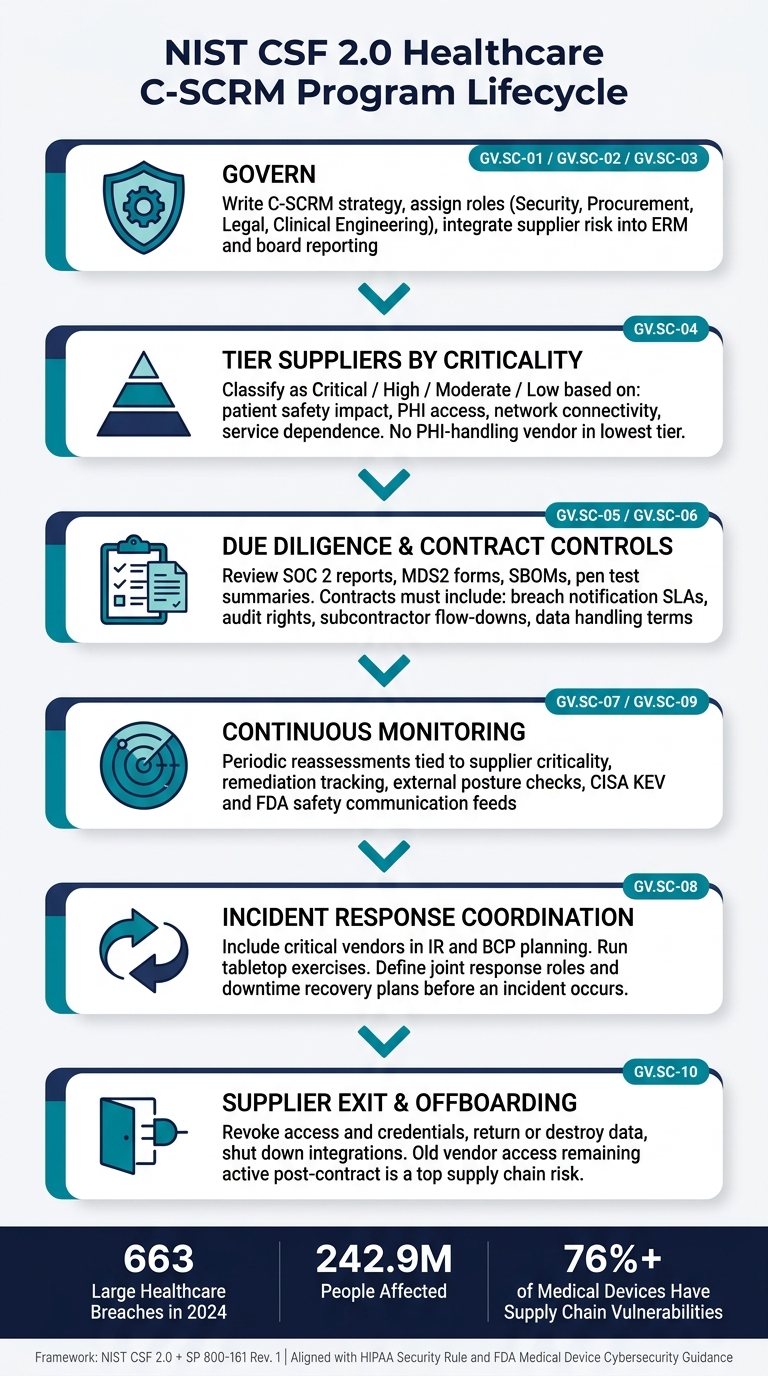
NIST CSF 2.0 Healthcare Supply Chain Risk Management Lifecycle
Once GV.SC is set, the job shifts from policy to execution. You need to turn it into supplier scope, risk tiers, and control baselines. In practice, a healthcare C-SCRM program usually follows a clear sequence: build the supplier inventory, set requirements, tier risk, and close the gaps.
That order matters. In healthcare, a supplier issue isn't just an IT problem. It can disrupt patient care, expose PHI, or slow down recovery when systems go down.
Scope, supplier tiering, and control requirements
Start with scope. Pinpoint the business processes, clinical services, and technology systems that would create patient safety, PHI, operational continuity, or regulatory risk if they were disrupted or compromised. Put the most attention on suppliers tied to EHRs, imaging, revenue cycle, pharmacy, connected medical devices, cloud-hosted clinical applications, and managed IT services.
From there, tier suppliers based on a few plain questions:
- How critical is the supplier to the business?
- Could a failure affect patient safety?
- Does the supplier handle PHI?
- How much connectivity does the supplier have?
- How dependent is the organization on that service?
Use Critical, High, Moderate, and Low as the shared language across procurement and security. That keeps decisions easier to explain and easier to enforce. One hard rule stands out: no PHI-handling vendor should sit in the lowest tier.
Critical suppliers should meet baseline controls for MFA, encryption, patch SLAs, logging, incident notification, backup and recovery, subcontractor oversight, and secure configuration. Those expectations also need to show up in the contract. If the language just says "industry standard," you're left with almost no leverage when something breaks.
Supplier tiers also can't stay frozen. Re-tier vendors whenever service delivery, access, hosting, or subcontractors change.
Those tiers drive both the depth of the controls and the maturity level expected from the program.
Using CSF tiers to measure supply chain security maturity
The NIST CSF 2.0 implementation tiers - Partial, Risk-Informed, Repeatable, and Adaptive - give healthcare leaders a way to judge how mature their C-SCRM program is. They are not a compliance checklist; they are a maturity lens.
At Tier 1, Partial, supplier risk management is ad hoc and reactive. At Tier 2, Risk-Informed, policies exist, but teams apply them unevenly. At Tier 3, Repeatable, governance is documented, assessments follow a defined process, and findings tie back to named remediation owners. At Tier 4, Adaptive, continuous monitoring and steady improvement help the program respond to supplier changes and new threats.
Table: NIST CSF tier characteristics for healthcare supply chain programs
| CSF Tier | Governance | Vendor Assessment Rigor | Monitoring Practices | Likely Risk Exposure |
|---|---|---|---|---|
| Tier 1 – Partial | Ad hoc supplier risk decisions | Assessments are reactive or absent | No structured monitoring; issues surface after incidents | High; critical suppliers may be unknown or unreviewed |
| Tier 2 – Risk-Informed | Basic policy and awareness exist, but application is inconsistent | Assessments occur, but coverage and depth vary | Periodic reviews; trigger-based reassessment is limited or inconsistent | Moderate-high; critical suppliers may still have gaps in coverage |
| Tier 3 – Repeatable | Documented program with defined roles and ERM integration | Structured, tiered assessments with evidence requirements and remediation tracking | Regular reassessments tied to supplier criticality; trigger-based reviews in place | Moderate; most critical suppliers are covered with measurable controls |
| Tier 4 – Adaptive | C-SCRM is embedded in procurement and ERM; the program is continuously updated | Continuous risk review | Continuous monitoring and rapid response | Low; the program adapts to supplier changes proactively |
Gap analysis is where the picture gets clear. Compare current controls against target controls, then define the target profile in terms you can actually measure. For example:
- 100% of critical suppliers are tiered
- All high-risk vendors are reviewed annually
- All critical supplier contracts include minimum cyber clauses
Then score each gap by risk severity, clinical or operational impact, and implementation effort. Group the work into near-term, mid-term, and long-term phases so teams know what has to happen now versus later.
Useful progress metrics include inventory coverage, annual review coverage for critical suppliers, contract clause coverage, average remediation time for high-risk findings, and supplier participation in incident exercises.
Ownership usually cuts across security, procurement, legal, compliance, privacy, clinical operations, and clinical engineering. That cross-functional piece is easy to overlook, but it's where many programs either move or stall. Quarterly or semiannual executive reviews help keep the roadmap tied to business risk.
That output then sets the control and metric needs the tooling section has to support.
Tools to Put NIST Supply Chain Security into Practice in Healthcare
Once supplier tiers and control gaps are clear, the next step is turning that plan into day-to-day work. That’s where tooling comes in. Gap analysis only helps if teams can act on it. Spreadsheets and email fall apart fast when you’re dealing with vendors, devices, and clinical systems at scale. A healthcare C-SCRM platform gives teams a repeatable way to assess, track, and follow through.
Use the same supplier tiers from the prior section to decide which vendors should enter the platform first.
What healthcare C-SCRM tools should be able to do
The tool should support the full GV.SC lifecycle: intake, monitoring, incident response, oversight, and exit.
A healthcare C-SCRM tool needs to do more than gather questionnaires. It should support standardized assessments aligned to NIST CSF, HICP, HIPAA, and HHS 405(d), with evidence collection built in. In practice, that means collecting SOC 2 Type II reports, BAAs, penetration test summaries, SBOMs, MDS2 forms, vulnerability reports, and incident history. It should also keep a central inventory and risk profile for suppliers, devices, and clinical applications, tied to business and clinical impact.
After onboarding, the tool should support continuous monitoring through integrations with threat intelligence, vulnerability feeds, CISA Known Exploited Vulnerabilities, and FDA safety communications. That way, a supplier’s risk profile reflects current conditions, not just what was true during intake.
These capabilities put GV.SC-06 through GV.SC-10 into daily use.
Data collection is only part of the job. Collaboration matters too. HDOs and vendors should be able to work in a shared workspace where vendors answer questionnaires, reviewers comment on specific findings, and remediation owners track progress against agreed timelines. Governance workflows should enforce approval steps for high-risk vendor onboarding, escalation paths for overdue critical findings, and audit-ready logs for OCR investigations or FDA postmarket reviews. Executive dashboards should surface top high-risk vendors, unresolved critical findings by age, PHI exposure across third parties, and mean time to remediate.
How Censinet RiskOps supports NIST-aligned supply chain risk management
Those requirements map directly to a healthcare-specific workflow in Censinet RiskOps™.
Censinet RiskOps™ applies these healthcare-specific requirements in one workflow. Its assessment templates and risk categories reflect PHI, clinical workflows, EHRs, imaging systems, medical devices, and outsourced IT services. Organizations can run automated NIST CSF 2.0 enterprise assessments across all six functions, including Govern, while also using the HPH CPG dashboard to map NIST CSF 1.1 and HICP assessments to the HHS Healthcare and Public Health Sector Cybersecurity Performance Goals. That mix helps teams standardize assessment work and improve reporting for internal and external stakeholders.
Censinet AI™ speeds up the assessment cycle by pre-filling questionnaire responses with Censinet Connect™ Copilot based on previously validated vendor data, extracting key risks from long-form evidence such as SOC 2 reports and security policies, and routing findings to the right team - clinical engineering, IT security, privacy, or procurement - based on asset type and data sensitivity. The automation is built for a human-reviewed workflow, so designated owners still review and approve decisions while the platform provides recommendations, triage, and documentation. Cybersecurity benchmarking helps organizations compare vendor security posture and NIST CSF maturity across healthcare peers to prioritize investments and track progress.
That leads to faster reviews, cleaner remediation tracking, and more consistent reporting.
Table: Censinet capabilities mapped to NIST CSF and SP 800-161 practices
| NIST CSF / SP 800-161 Practice Area | Censinet Capability | What It Does in Practice |
|---|---|---|
| GV.SC-01/02: Strategy & roles | RiskOps dashboards | Tracks program maturity, resource allocation, and risk ownership across the organization |
| GV.SC-06: Due diligence | Automated assessments + evidence collection | Standardizes vendor questionnaires, captures BAAs, SOC 2 reports, MDS2 forms, SBOMs, and supplier risk scores |
| GV.SC-07: Ongoing monitoring | Continuous monitoring feeds | Pulls CISA KEV, FDA safety communications, and threat intelligence to keep vendor risk current |
| GV.SC-08: Incident coordination | Workflow automation + response/recovery testing | Routes incident findings to designated owners and tracks remediation against defined timelines |
| GV.SC-09: Supplier oversight | Audit-ready reporting | Produces traceable records of assessments, risk decisions, and contractual compliance for OCR or FDA reviews |
| SP 800-161: Information sharing and analysis | Censinet AI™ evidence summarization | Extracts key controls and exceptions from long-form documents and generates summaries for CISOs and clinical leaders |
| NIST CSF Tiers: Maturity modeling | Benchmarking study | Compares organizational NIST CSF coverage against healthcare industry peers to identify gaps and justify investments |
Conclusion: A NIST Roadmap for Healthcare Supply Chain Resilience
In 2024, business associates were involved in 212 major breaches affecting 131 million people - about 75% of all major health breach victims.[12] That scale shows why the NIST stack matters.
NIST CSF 2.0 gives healthcare teams a governance model for handling this risk. GV.SC puts that model into day-to-day work: tiering suppliers by criticality, putting security terms into contracts, running due diligence before onboarding, monitoring vendors over time, and planning for vendor exit. SP 800-161 Rev. 1 then carries those CSF outcomes into practice across the supplier lifecycle, from acquisition planning through offboarding.
To put that model to work, healthcare teams need tooling built for the job. Censinet RiskOps™ makes NIST-aligned assessments, monitoring, and reporting repeatable, so security, procurement, compliance, and clinical teams can work from the same risk picture.
The aim is simple: safer care delivery, stronger vendor accountability, and faster, risk-informed decisions before supplier issues reach patients.
FAQs
How do we decide which suppliers are critical?
Identify critical suppliers by looking at how each vendor affects clinical operations and patient safety.
Start by building a vendor catalog and mapping each one to core assets such as EHRs, medical devices, and clinical applications. Then rank vendors based on factors like:
- Access to PHI
- Impact on revenue
- Importance to day-to-day care delivery
A tiered structure works well here. Higher-risk vendors get stricter oversight, while lower-risk vendors can follow a lighter review path.
What evidence should we collect before onboarding a vendor?
Before you onboard a vendor, gather the same set of documents each time to check its security posture and its alignment with NIST standards.
That usually includes:
- Completed security questionnaires
- Third-party certifications and audit reports, such as SOC 2 and ISO
- SBOM, security policies, and incident response plans
- Penetration test results, MDS2 forms, and liability or contract documents
Don't rely on self-attestations alone. Back up vendor claims with objective documentation.
How often should healthcare organizations reassess vendor risk?
Healthcare organizations should look past once-a-year reviews and use continuous monitoring to keep an eye on vendor security posture in real time.
How often a vendor gets reassessed should match its risk tier:
- High-risk vendors: every year
- Moderate-risk vendors: every 18 to 24 months
- Low-risk vendors: every 2 to 3 years or when the contract comes up for renewal
It also makes sense to reassess after major events, like breaches, ownership changes, or changes in scope. Censinet RiskOps helps with this through automated, risk-based scheduling and real-time updates.
