
NIST Framework and HIPAA: Aligning for Healthcare Compliance
Post Summary
HIPAA and NIST CSF serve complementary but non-overlapping compliance functions. HIPAA is legally mandatory — violations carry penalties from $100 to $50,000 per violation with annual caps of $1.5 million, and non-compliance is a prohibited act. However, HIPAA's Security Rule is technology-neutral, specifying what organizations must protect through administrative, physical, and technical safeguards without prescribing how to implement those protections technically. NIST CSF fills this implementation gap with its five core functions — Identify, Protect, Detect, Respond, and Recover — providing detailed technical guidance for each safeguard category. The relationship is captured succinctly: organizations need HIPAA to remain legal and NIST to remain operational. Healthcare's 42.5% share of all reported data breaches demonstrates that meeting HIPAA's minimum requirements alone leaves organizations exposed to modern threats.
Identify corresponds to HIPAA's requirement for regular risk assessments — mapping assets, understanding vulnerabilities, and documenting where ePHI resides. Protect corresponds to HIPAA's administrative, physical, and technical safeguards — access controls, encryption, and workforce training ensuring only authorized individuals access PHI. Detect corresponds to HIPAA's audit control requirements — continuous monitoring and audit mechanisms catching unauthorized access attempts quickly. Respond corresponds to HIPAA's incident response procedures — security incident response plans that minimize damage during breaches. Recover corresponds to HIPAA's contingency planning requirements — backup, disaster recovery, and contingency plan testing restoring services after incidents. The OCR crosswalk specifically maps NIST's detection processes (DE.DP) to HIPAA's mandate to appoint a security officer, and NIST's response planning (RS.RP) to HIPAA's security incident handling requirements.
The OCR crosswalk tool was developed by the Office for Civil Rights, NIST, and the Office of the National Coordinator for Health IT to map HIPAA Security Rule requirements to NIST CSF controls. It provides a control-by-control mapping that makes it easier for healthcare organizations to identify gaps in their security programs by showing which NIST controls satisfy which HIPAA requirements. Using the crosswalk, organizations already compliant with HIPAA can identify NIST controls they have not yet implemented, and organizations already using NIST CSF can identify HIPAA-specific requirements their NIST program satisfies. OCR describes the crosswalk as providing a roadmap for covered entities and business associates to understand overlap between NIST CSF, the HIPAA Security Rule, and other security frameworks — with specific gap identification enabling targeted action to strengthen compliance and security simultaneously.
HIPAA is legally enforceable with defined penalties; NIST CSF is voluntary with no direct legal consequences. HIPAA applies specifically to covered entities and business associates handling ePHI; NIST CSF is a general-purpose framework applicable across industries and organization types. HIPAA sets mandatory minimum safeguard requirements that all covered entities must meet regardless of size; NIST CSF provides adaptable guidance that organizations scale to their complexity and resources. HIPAA's technology-neutral language avoids specifying how safeguards must be implemented, giving organizations flexibility; NIST CSF provides specific technical implementation guidance that HIPAA's flexibility does not prescribe. HIPAA focuses narrowly on ePHI protection; NIST CSF addresses the full organizational cybersecurity posture including assets that do not contain ePHI but whose compromise could enable ePHI access. Together: HIPAA defines the legal floor; NIST CSF defines the operational best practice ceiling.
Organizations implementing the NIST Cybersecurity Framework have reduced cyber insurance premiums by up to 66% — a direct financial return on compliance investment that compounds annually. With average healthcare breach costs of $9.77 million and over 20 days of operational downtime, the cost avoidance from breach prevention substantially exceeds both framework implementation costs and premium reductions. Beyond direct financial outcomes, NIST-HIPAA alignment builds patient trust and organizational reputation — outcomes with long-term revenue implications that breach events erode. The OCR crosswalk enables security investments to satisfy both HIPAA compliance requirements and NIST cybersecurity best practices simultaneously, eliminating the duplication cost of maintaining parallel compliance and security programs that address identical underlying risks.
Censinet RiskOps™ streamlines risk assessments aligned with both HIPAA requirements and NIST CSF functions, supporting healthcare organizations in achieving HIPAA compliance while improving their overall cybersecurity posture. The platform simplifies evidence collection and compliance management for OCR audits by documenting how controls are applied across policies, procedures, and risk assessments in a format auditors can readily evaluate. For organizations managing vendor risk across both NIST and HIPAA frameworks, automated vendor assessments verify that third-party relationships satisfy both frameworks' requirements. The platform's alignment with NIST CSF and HIPAA enables organizations to move from basic compliance to comprehensive risk management — addressing the security gaps that standard HIPAA audits identify as HIPAA-compliant but NIST analysis identifies as cybersecurity-deficient.
Healthcare organizations face increasing threats to patient data security, with over 40% of reported data breaches occurring in this sector over three years. Combining the NIST Cybersecurity Framework with HIPAA's Security Rule offers a structured way to protect sensitive electronic protected health information (ePHI) while meeting legal requirements.
Here’s what you need to know:
Aligning these frameworks strengthens security, reduces risks, and helps avoid penalties. Start by using the OCR crosswalk to map safeguards and appoint a security officer to oversee compliance. This approach not only keeps you compliant but also better protects patient data.
1. NIST Cybersecurity Framework
Core Functions and Safeguards
The NIST Cybersecurity Framework breaks down security into five core functions, offering healthcare organizations a clear path to protect electronic protected health information (ePHI). Here's how it works:
This structured framework helps organizations align their cybersecurity efforts with compliance goals through crosswalk mapping.
Alignment and Crosswalk Mapping
To bridge the gap between HIPAA requirements and NIST controls, the Office for Civil Rights (OCR), NIST, and the Office of the National Coordinator for Health IT created a crosswalk tool. This tool maps HIPAA Security Rule requirements to NIST CSF controls, making it easier for healthcare providers to spot vulnerabilities in their security programs.
While using the NIST CSF is not mandatory for HIPAA compliance, it offers detailed technical guidance that HIPAA's broader, technology-neutral regulations lack. In essence, it provides a "how-to" for implementing specific security measures.
Benefits for Healthcare Compliance
By following the NIST framework, healthcare organizations can strengthen both their compliance efforts and their overall security strategies. The framework's systematic approach ensures that entities address all key areas, from risk analysis to disaster recovery, while remaining adaptable to different organizational sizes and complexities.
Using the OCR crosswalk, organizations can identify specific weaknesses in their current practices. This is critical, considering that 42.5% of all reported data breaches in a recent three-year period occurred within the healthcare sector [2]. Adopting NIST's five core functions not only helps meet HIPAA's administrative, physical, and technical safeguard requirements but also builds a stronger defense against emerging threats.
Additionally, tools like Censinet RiskOps™ can simplify this process by streamlining risk assessments and enhancing collaborative risk management. These platforms support healthcare organizations in achieving HIPAA compliance while improving their overall security posture.
sbb-itb-535baee
Road to HIPAA Compliance: Using the NIST Cybersecurity Framework to Protecting PHI
2. HIPAA Security Rule
The HIPAA Security Rule builds on the structured NIST Cybersecurity Framework by setting mandatory safeguards specifically designed for healthcare organizations.
Core Functions and Safeguards
Under the HIPAA Security Rule, covered entities must protect electronic protected health information (ePHI) using three types of safeguards:
The rule's flexibility allows organizations to tailor these measures based on their size and specific risks.
Alignment and Crosswalk Mapping
To simplify compliance, the crosswalk tool maps HIPAA requirements to NIST controls. This tool helps organizations already using one framework identify gaps in the other. For instance, NIST's detection processes (DE.DP) align with HIPAA's mandate to appoint a security officer, while its response planning (RS.RP) corresponds to HIPAA's requirements for handling security incidents.
"The crosswalk provides a helpful roadmap for HIPAA covered entities and their business associates to understand the overlap between the NIST Cybersecurity Framework, the HIPAA Security Rule, and other security frameworks that can help entities safeguard health data." - U.S. Department of Health and Human Services
This alignment not only helps meet legal obligations but also simplifies and strengthens cybersecurity efforts.
Benefits for Healthcare Compliance
Integrating HIPAA standards with NIST controls offers clear advantages. Organizations can systematically pinpoint security gaps and take targeted actions to better protect ePHI. This is critical, considering that 91% of healthcare organizations reported data breaches between 2014 and 2016 [1].
The financial risks are steep, with penalties ranging from $100 to $50,000 per violation and annual caps of $1.5 million. Beyond avoiding fines, aligning these frameworks enhances patient trust and boosts an organization's reputation.
"Taking specific action to address these gaps can bolster compliance with the Security Rule and improve an entity's ability to secure ePHI from a broad range of threats." - Office for Civil Rights (OCR)
Healthcare providers should prioritize appointing a dedicated security officer, routinely auditing monitoring systems, and testing detection and recovery processes. Leveraging tools like the OCR crosswalk ensures that security investments meet both regulatory and cybersecurity needs.
Platforms like Censinet RiskOps™ (https://censinet.com) can further simplify compliance by streamlining risk assessments and aligning with both HIPAA and NIST requirements.
Pros and Cons
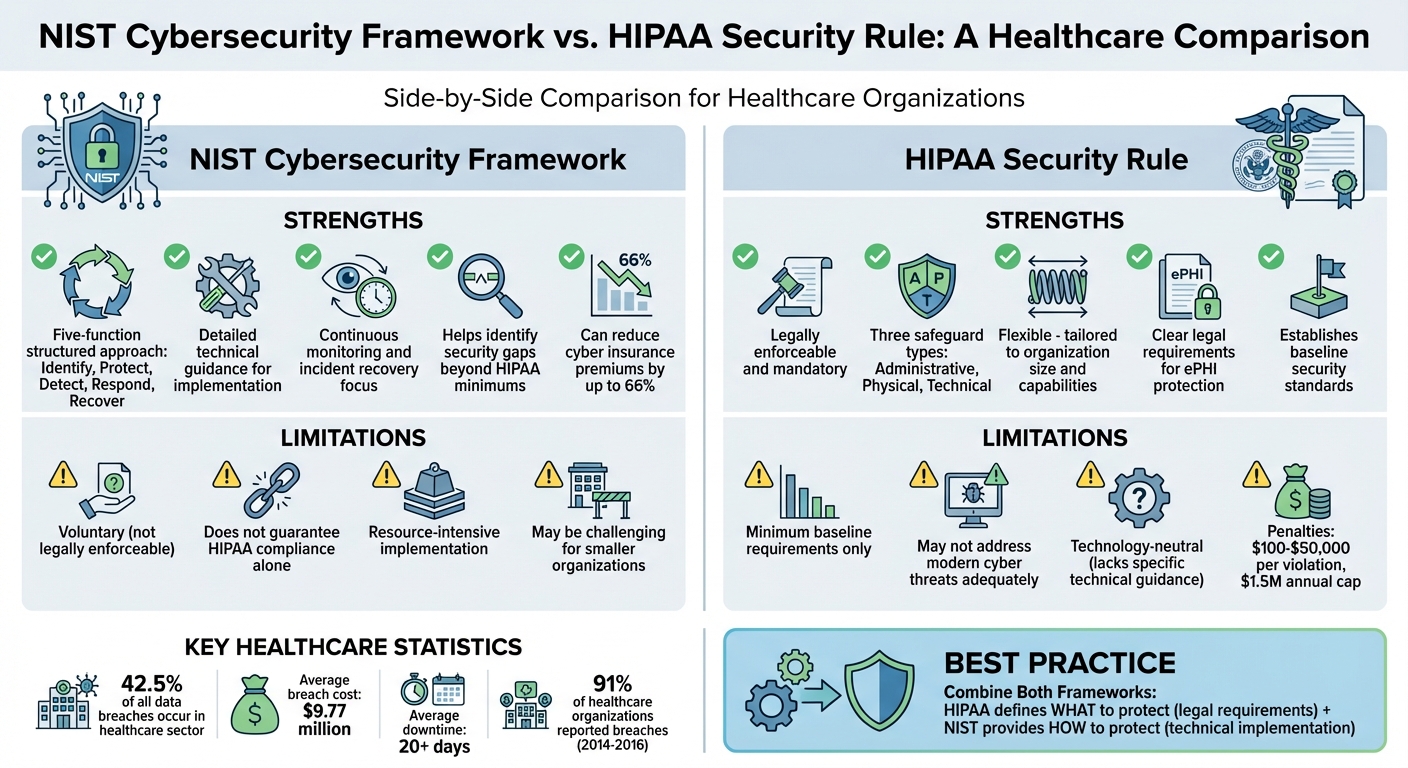
NIST Framework vs HIPAA Security Rule Comparison for Healthcare Compliance
When you look at healthcare cybersecurity through the lens of established frameworks, it's clear there are both strengths and limitations to consider.
The NIST Cybersecurity Framework stands out for its structured, five-function approach: Identify, Protect, Detect, Respond, and Recover. It provides detailed guidance for continuous monitoring and incident recovery, making it easier for organizations to spot security gaps and vendor risks that HIPAA's minimum requirements might miss. However, there's a catch - NIST is voluntary. It doesn't carry legal weight, meaning compliance with NIST alone won't guarantee you're meeting HIPAA standards. Plus, implementing NIST's full set of controls can demand significant resources, which might be a challenge for smaller organizations.
On the other hand, the HIPAA Security Rule is legally enforceable, with strict requirements designed to protect electronic protected health information (ePHI). Its mandatory nature means that non-compliance can lead to hefty fines - ranging from $100 to $50,000 per violation, with annual caps reaching $1.5 million. The flexibility within the rule allows organizations to tailor safeguards to their size and capabilities, but it’s still a baseline standard. And in a world where healthcare accounted for 42.5% of all reported data breaches over a recent three-year period [2], sticking to just the minimum requirements may leave organizations exposed to modern cyber threats.
"By aligning NIST CSF with HIPAA's Security Rule, you can strengthen your data security and protect PHI beyond HIPAA's minimum requirements." - RSI Security
The best strategy? Combine both frameworks. HIPAA spells out the legal "what" you need to do, while NIST offers the technical "how" to do it. Mapping HIPAA compliance to NIST's functions can help uncover vulnerabilities and ensure patient data is better protected.
Conclusion
Healthcare organizations face a critical choice: stick to the basics of compliance or adopt a stronger cybersecurity approach that safeguards both operations and patient care. Aligning the NIST Cybersecurity Framework with HIPAA requirements offers a way to achieve both. With the average data breach costing $9.77 million and causing over 20 days of downtime [4], the risks are too big to ignore.
A good starting point is to use the OCR crosswalk tool to map HIPAA safeguards to NIST's core functions. This process strengthens compliance while addressing real-world risks. It also helps identify vulnerabilities that standard HIPAA audits might miss. Appointing a dedicated security officer to oversee this alignment can push your organization toward a more proactive approach to risk management.
"You need HIPAA to remain legal. You need NIST to remain operational." - CompassMSP
Enhance your readiness by conducting regular tabletop exercises with IT, legal, and clinical teams. Strengthen your defenses with measures like multi-factor authentication, continuous monitoring, and recovery plans designed to keep patient care uninterrupted during cyber incidents.
The advantages go beyond compliance. Organizations using the NIST Cybersecurity Framework have seen cyber insurance premiums drop by as much as 66% [4]. While HIPAA outlines what needs protection, NIST provides the "how" for effective safeguarding.
For those looking to simplify this integration, tools like Censinet RiskOps™ offer a practical solution. Platforms like these help healthcare organizations move past basic compliance and embrace a comprehensive risk management strategy that aligns HIPAA with NIST.
FAQs
What’s the quickest way to map HIPAA Security Rule safeguards to NIST CSF?
The quickest way to align the HIPAA Security Rule safeguards with the NIST Cybersecurity Framework is by using a crosswalk tool. These tools offer a detailed, control-by-control mapping along with clear explanations. Trusted sources, like the Department of Health and Human Services (HHS), provide such resources to make the process easier. This approach helps healthcare organizations simplify compliance and better align their efforts with both frameworks.
How can I show that NIST-based controls support HIPAA compliance during an OCR audit?
To meet HIPAA Security Rule requirements, leverage official crosswalk documents that map NIST Cybersecurity Framework (CSF) controls to these standards. These crosswalks provide a structured way to ensure your organization's cybersecurity measures align with regulatory expectations.
Document how these controls are applied within your organization. This includes detailing your policies, procedures, and risk assessments. Each of these elements plays a critical role in demonstrating compliance and maintaining a robust security posture.
It's equally important to perform regular evaluations of your controls. This ensures they remain effective and adapt to evolving threats or regulatory updates. Keeping your documentation up to date will also help during audits or reviews.
To simplify this process, tools like Censinet RiskOps™ can be invaluable. They streamline evidence collection and compliance management, making it easier to demonstrate alignment with both NIST and HIPAA requirements - particularly during an OCR audit.
What should a HIPAA security officer prioritize first when aligning NIST and HIPAA?
To kick off, a HIPAA security officer needs to perform a thorough risk assessment. This process helps uncover weaknesses and gaps in the organization's cybersecurity framework. By addressing risks tied to patient data, PHI (Protected Health Information), and other sensitive areas, this step ensures the program aligns with both NIST standards and HIPAA requirements. It also sets the stage for building a strong compliance strategy.
Related Blog Posts
- “Risk Management Under HIPAA: Why Framework Alignment Beats Compliance Alone”
- NIST CSF and HIPAA: Crosswalk Explained
- Healthcare’s Risk Paradox: Organizations Pass HIPAA Audits but Fail on Cyber Readiness Benchmarks
- NIST Cybersecurity Framework for Healthcare: Overview
{"@context":"https://schema.org","@type":"FAQPage","mainEntity":[{"@type":"Question","name":"What’s the quickest way to map HIPAA Security Rule safeguards to NIST CSF?","acceptedAnswer":{"@type":"Answer","text":"<p>The quickest way to align the HIPAA Security Rule safeguards with the NIST Cybersecurity Framework is by using a <strong>crosswalk tool</strong>. These tools offer a detailed, control-by-control mapping along with clear explanations. Trusted sources, like the Department of Health and Human Services (HHS), provide such resources to make the process easier. This approach helps healthcare organizations simplify compliance and better align their efforts with both frameworks.</p>"}},{"@type":"Question","name":"How can I show that NIST-based controls support HIPAA compliance during an OCR audit?","acceptedAnswer":{"@type":"Answer","text":"<p>To meet HIPAA Security Rule requirements, leverage official crosswalk documents that map NIST Cybersecurity Framework (CSF) controls to these standards. These crosswalks provide a structured way to ensure your organization's cybersecurity measures align with regulatory expectations.</p> <p>Document how these controls are applied within your organization. This includes detailing your <strong>policies</strong>, <strong>procedures</strong>, and <strong>risk assessments</strong>. Each of these elements plays a critical role in demonstrating compliance and maintaining a robust security posture.</p> <p>It's equally important to perform regular evaluations of your controls. This ensures they remain effective and adapt to evolving threats or regulatory updates. Keeping your documentation up to date will also help during audits or reviews.</p> <p>To simplify this process, tools like <em>Censinet RiskOps™</em> can be invaluable. They streamline evidence collection and compliance management, making it easier to demonstrate alignment with both NIST and HIPAA requirements - particularly during an OCR audit.</p>"}},{"@type":"Question","name":"What should a HIPAA security officer prioritize first when aligning NIST and HIPAA?","acceptedAnswer":{"@type":"Answer","text":"<p>To kick off, a <strong>HIPAA security officer</strong> needs to perform a thorough <strong>risk assessment</strong>. This process helps uncover weaknesses and gaps in the organization's cybersecurity framework. By addressing risks tied to patient data, PHI (Protected Health Information), and other sensitive areas, this step ensures the program aligns with both <strong>NIST</strong> standards and <strong>HIPAA</strong> requirements. It also sets the stage for building a strong compliance strategy.</p>"}}]}
Key Points:
Why does healthcare account for 42.5% of all reported data breaches and what structural vulnerabilities make the sector a persistent target?
- PHI value exceeding credit card data creating persistent attacker incentive — Healthcare data's black market value — medical records fetching prices that far exceed stolen credit card data — creates a persistent financial incentive for healthcare-targeted attacks that general enterprise cybersecurity threats do not face at the same intensity. Attackers invest more sophisticated resources targeting healthcare specifically because the financial return from successful breaches is proportionally higher.
- 91% of healthcare organizations reporting breaches between 2014 and 2016 establishing systemic vulnerability — The near-universal breach rate among healthcare organizations from 2014 to 2016 reflects not individual security failures but systemic security infrastructure gaps across the sector — a technology estate that prioritized clinical function over cybersecurity, legacy systems without security update capability, and distributed device environments that general enterprise security frameworks were not designed to protect.
- $9.77 million average breach cost with 20-plus days downtime establishing the operational stakes — The combination of financial cost and operational disruption in the average healthcare breach — $9.77 million and over 20 days of downtime — reflects that healthcare breaches are not merely data protection failures. They are operational events that disrupt patient care delivery, trigger regulatory investigations, generate notification obligations, and create reputational consequences that compound the direct financial impact.
- HIPAA minimum requirements leaving security gaps that NIST analysis reveals — Healthcare organizations that pass HIPAA audits and receive no findings are frequently found to have significant cybersecurity deficiencies when evaluated against NIST CSF standards. HIPAA's minimum requirements establish a legal compliance floor that prevents the most egregious data protection failures; they do not establish a security posture adequate to defend against the sophisticated threats that account for healthcare's disproportionate share of reported breaches.
- Legacy systems and clinical device diversity creating security complexity — Healthcare IT environments combine modern cloud-hosted EHR systems with decades-old clinical devices, networked medical equipment with embedded systems, and patient-facing portals with back-office administrative infrastructure — all within regulatory frameworks that restrict the security modifications organizations can make to clinical devices without triggering re-certification. This environment complexity creates security gaps that HIPAA's administrative, physical, and technical safeguard categories describe without prescribing technical solutions for.
- 42.5% sector share establishing healthcare as the highest-value attack target — Healthcare's 42.5% share of all reported data breaches in a recent three-year period — despite representing a fraction of the total economy — establishes that threat actors have specifically identified healthcare as offering superior breach value relative to attack cost. This concentration of breach activity in one sector reflects deliberate attacker resource allocation, not random vulnerability distribution — requiring deliberate, sector-specific defense strategies beyond general enterprise security frameworks.
How do HIPAA's administrative, physical, and technical safeguards map to NIST CSF's five core functions?
- Administrative safeguards spanning Identify, Protect, and Detect functions — HIPAA's administrative safeguards — appointing a security officer, conducting risk analyses, implementing workforce training, and establishing access management procedures — correspond to NIST's Identify function for risk assessment activities, Protect function for workforce training and access management, and Detect function for the monitoring and audit program oversight that the security officer manages. Administrative safeguards are not a single NIST function; they span the operational governance that multiple NIST functions require.
- Physical safeguards corresponding primarily to NIST Protect function controls — HIPAA's physical safeguards — facility access controls, workstation security, and device and media controls — correspond primarily to NIST's Protect function, which covers the technical and physical safeguards that limit unauthorized access. Physical safeguards implementation details — badge access systems, security camera coverage, workstation screen positioning — represent the specific how-to guidance that NIST provides and HIPAA's technology-neutral language does not prescribe.
- Technical safeguards spanning Protect, Detect, and Respond functions — HIPAA's technical safeguards — access controls, audit controls, integrity verification, and transmission security — span NIST's Protect function for access control and encryption implementation, Detect function for audit logging and monitoring, and Respond function for the automated and manual response capabilities that detect and contain security events. Technical safeguards are the most directly mapped to NIST controls because both frameworks address the same technical security mechanisms.
- Contingency planning directly corresponding to NIST Recover function — HIPAA's contingency plan requirements — data backup, disaster recovery, emergency mode operation, testing, and revision procedures — correspond directly to NIST's Recover function, which addresses the restoration of capabilities and services impaired during cybersecurity events. The specificity of HIPAA's contingency plan sub-requirements provides a direct implementation guide for what NIST's Recover function requires healthcare organizations to demonstrate.
- NIST Detect and Respond functions exceeding HIPAA's incident response requirements — NIST's Detect and Respond functions provide more detailed technical guidance for continuous monitoring infrastructure, anomaly detection, incident classification, and response coordination than HIPAA's incident response procedures require. Organizations implementing NIST's full Detect and Respond controls satisfy HIPAA's incident response requirements while building security capabilities — real-time monitoring, behavioral analytics, automated containment — that HIPAA does not mandate but that modern threat detection requires.
- NIST Identify function extending HIPAA risk analysis beyond ePHI scope — HIPAA's risk analysis focuses on risks to ePHI confidentiality, integrity, and availability. NIST's Identify function extends asset and risk identification to the full organizational technology environment — including systems that do not contain ePHI but whose compromise could enable ePHI access, create operational disruption, or introduce supply chain vulnerabilities. Organizations using NIST's Identify function to scope their risk analysis satisfy HIPAA's risk analysis requirement while identifying broader organizational security risks that HIPAA-only analysis would miss.
How does the OCR crosswalk tool work in practice and what does it enable healthcare organizations to discover?
- OCR, NIST, and ONC collaborative development establishing authoritative alignment — The OCR crosswalk was developed collaboratively by the Office for Civil Rights, NIST, and the Office of the National Coordinator for Health IT — the three federal entities responsible for HIPAA enforcement, cybersecurity framework development, and health IT standards. This collaborative development establishes the crosswalk's authority as the definitive mapping between the two frameworks rather than a third-party interpretation that regulators might challenge.
- Control-by-control mapping enabling gap identification within existing compliance programs — The crosswalk's control-by-control format enables organizations to examine their current HIPAA compliance program control by control and identify the corresponding NIST controls that are either already implemented, partially implemented, or absent. This gap identification is the crosswalk's primary operational value — organizations learn not that they need NIST broadly, but specifically which NIST controls their current program lacks.
- HIPAA-compliant organizations discovering NIST gaps through crosswalk analysis — Organizations that have achieved HIPAA compliance through administrative, physical, and technical safeguard implementation frequently discover through crosswalk analysis that specific NIST controls — particularly in the Detect function's continuous monitoring requirements and the Respond function's incident response automation — are absent from their HIPAA compliance program because HIPAA does not require them. This gap discovery reveals the security exposure that HIPAA compliance leaves unclosed.
- NIST-implementing organizations discovering HIPAA specificity through crosswalk analysis — Organizations that have implemented NIST CSF for general cybersecurity purposes frequently discover through crosswalk analysis that HIPAA-specific requirements — the security officer appointment mandate, ePHI-specific risk analysis documentation, BAA obligations for business associates, and HITECH breach notification procedures — are not covered by NIST's general-purpose controls and require specific HIPAA compliance implementation.
- Demonstrating NIST-based controls support HIPAA compliance during OCR audits — OCR audits evaluate whether organizations can demonstrate that their security controls satisfy HIPAA's administrative, physical, and technical safeguard requirements. The crosswalk provides the formal mapping that enables organizations to show OCR auditors how specific NIST controls they have implemented satisfy corresponding HIPAA requirements — reducing the audit burden of explaining the compliance relationship between the two frameworks on an ad hoc basis.
- Security officer prioritization: risk assessment as the first NIST-HIPAA alignment action — A HIPAA security officer beginning the NIST-HIPAA alignment process should start with a comprehensive risk assessment — the activity that both HIPAA's administrative safeguards and NIST's Identify function require as their foundation. This shared starting point means that a well-executed risk assessment simultaneously satisfies HIPAA's first administrative safeguard requirement and NIST's first core function, creating compliance value for both frameworks from a single activity.
What are the practical implementation steps for aligning NIST CSF with HIPAA and what activities deliver the most compliance value?
- OCR crosswalk gap analysis as the first implementation action — Using the OCR crosswalk to map current HIPAA safeguard implementation against the corresponding NIST controls identifies the specific gaps where security investment would simultaneously improve compliance posture and operational security. This analysis produces a prioritized remediation roadmap that avoids the inefficiency of implementing NIST controls comprehensively without regard for which controls address the highest-priority HIPAA gaps.
- Dedicated security officer appointment as the governance prerequisite — Appointing a dedicated security officer responsible for NIST-HIPAA alignment oversight provides the centralized accountability that both frameworks' implementation requires. HIPAA explicitly requires a designated security officer; NIST's governance category requires organizational accountability for cybersecurity risk management decisions. A single dedicated function satisfies both requirements and ensures that NIST-HIPAA alignment is managed as a continuous operational discipline rather than a periodic compliance project.
- Tabletop exercises testing Respond and Recover function readiness — Regular tabletop exercises with IT, legal, and clinical teams test whether NIST's Respond and Recover functions operate as designed when activated under incident conditions. HIPAA's contingency plan testing requirements mandate that organizations verify their disaster recovery and emergency mode operation procedures — tabletop exercises satisfy this HIPAA requirement while building the cross-functional incident response capability that NIST's Respond function requires.
- Multi-factor authentication as the highest-value single control investment — MFA implementation satisfies NIST's Protect function access control requirements, aligns with HIPAA's technical safeguard access control specifications, and has been documented as one of the single most effective controls for preventing the credential-based attacks that account for a significant proportion of healthcare breach events. MFA represents the clearest example of a single control investment that delivers simultaneous HIPAA compliance and NIST security posture improvement.
- Continuous monitoring infrastructure enabling NIST Detect function compliance — Implementing continuous monitoring infrastructure — SIEM systems, behavior analytics, real-time alerting — enables organizations to satisfy NIST's Detect function requirements while building the monitoring capability that HIPAA's audit control technical safeguard requires for ePHI access. Many healthcare organizations satisfy HIPAA's audit control requirement through log collection without implementing the active analysis that NIST's Detect function requires, leaving a gap that continuous monitoring infrastructure closes.
- Recovery plan testing confirming actual rather than theoretical capability — Healthcare organizations must test their recovery plans to confirm that data can actually be restored within the RPO and RTO that clinical operations require — not merely that recovery procedures are documented. NIST's Recover function and HIPAA's contingency plan testing requirement both mandate this verification. Organizations discovering during actual incident recovery that their recovery plans do not function as documented face both the operational disruption of extended downtime and the compliance exposure of untested contingency procedures.
What financial and operational benefits do healthcare organizations achieve through NIST-HIPAA alignment beyond regulatory compliance?
- 66% cyber insurance premium reduction for NIST-implementing organizations — The documented 66% cyber insurance premium reduction for organizations implementing NIST CSF represents a direct annual financial return on framework alignment investment. For a mid-sized healthcare organization paying $500,000 annually in cyber insurance, a 66% reduction represents $330,000 in annual savings — potentially exceeding the annual cost of maintaining the NIST-aligned security program generating the premium benefit.
- $9.77 million average breach cost avoidance justifying framework investment — NIST-HIPAA alignment investment that reduces breach probability converts average breach cost avoidance into a quantifiable ROI calculation. An organization investing $200,000 annually in NIST-aligned security controls that reduces breach probability by 10% generates expected annual breach cost avoidance of $977,000 — nearly five times the control investment — in addition to the insurance premium savings and compliance penalty avoidance the same controls produce.
- 20-plus days operational downtime avoidance protecting clinical revenue — Healthcare organizations experiencing the average 20-plus days of operational downtime during a breach lose not only the direct revenue from disrupted clinical operations but the patient relationship damage from service unavailability during care-sensitive periods. NIST's Respond and Recover functions specifically address the incident containment and service restoration capabilities that determine how quickly organizations return to operational status following security events.
- Patient trust and organizational reputation as long-term revenue drivers — Patient trust in healthcare data security has become a competitive differentiator as patients gain awareness of healthcare data breach frequency and severity. Organizations demonstrating proactive security posture through NIST framework adoption communicate a security commitment that exceeds legal minimums — a reputational asset that influences patient choice in competitive healthcare markets and that breach events erode in ways that are difficult to quantify but easy to observe in patient retention data.
- Security investment efficiency through crosswalk-guided dual-framework satisfaction — Organizations using the OCR crosswalk to guide security investment allocate resources to controls that satisfy both HIPAA compliance requirements and NIST cybersecurity best practices simultaneously — eliminating the duplication cost of parallel compliance and security programs that address the same underlying risks through separate control implementations. This efficiency is the primary operational benefit of aligned framework management versus sequential compliance approaches.
- HIPAA compliance posture improvement through NIST gap identification — Organizations whose HIPAA compliance programs satisfy audit requirements but miss security gaps that NIST analysis surfaces have the compliance record of technically compliant organizations and the breach risk of non-compliant ones. NIST-HIPAA alignment converts this hidden exposure into identified, manageable risk — enabling organizations to address security gaps before incidents occur rather than discovering them through breach events that trigger both operational disruption and compliance investigation.
How does Censinet RiskOps™ support the practical implementation of NIST-HIPAA alignment for healthcare organizations?
- Streamlined risk assessments satisfying both NIST Identify function and HIPAA administrative safeguard requirements — Censinet RiskOps™ streamlines risk assessments aligned with HIPAA requirements and NIST CSF functions simultaneously — enabling organizations to conduct a single comprehensive risk assessment that satisfies HIPAA's administrative safeguard risk analysis requirement while building the asset inventory and threat assessment that NIST's Identify function requires. This dual satisfaction from a single assessment activity eliminates the redundant effort of conducting separate HIPAA and NIST risk assessments.
- Evidence collection and compliance documentation for OCR audit demonstration — Demonstrating during OCR audits that NIST-based controls satisfy HIPAA requirements requires organized documentation of how specific controls are implemented across policies, procedures, and risk assessments. Censinet RiskOps™ supports this documentation in a format that auditors can readily evaluate — providing the evidence organization that ad hoc documentation processes cannot sustain under audit time pressure.
- Vendor risk assessments verifying third-party NIST and HIPAA compliance simultaneously — Healthcare organizations' business associates must satisfy HIPAA's technical safeguard requirements; many also need to satisfy NIST controls relevant to the systems they manage on the organization's behalf. Censinet RiskOps™ automated vendor assessments verify that third-party relationships satisfy both frameworks' requirements — identifying vendor compliance gaps that affect both HIPAA BAA compliance and the organization's overall NIST-aligned security posture.
- Moving beyond compliance to comprehensive risk management — Organizations using Censinet RiskOps™ move from basic HIPAA compliance — satisfying minimum regulatory requirements — to the comprehensive risk management posture that NIST-HIPAA alignment represents. This transition addresses the security gaps that standard HIPAA audits identify as compliant but that NIST analysis identifies as cybersecurity-deficient — the gaps that account for healthcare's disproportionate share of data breaches despite widespread formal HIPAA compliance.
- Collaborative risk management across IT, compliance, and clinical teams — NIST-HIPAA alignment requires coordinated action across IT security implementing NIST technical controls, compliance teams maintaining HIPAA documentation, and clinical teams managing ePHI access workflows. Censinet RiskOps™ provides the collaborative risk management infrastructure that aligns these teams around shared NIST-HIPAA compliance objectives rather than allowing parallel compliance and security programs to diverge.
- Cybersecurity benchmarking enabling relative posture assessment — Internal NIST-HIPAA alignment assessment reveals whether organizational controls satisfy both frameworks' requirements; it cannot reveal whether that satisfaction represents strong, average, or inadequate performance relative to peer healthcare organizations. Censinet RiskOps™ benchmarking against the Censinet Risk Network provides the comparative context that supports evidence-based investment decisions for security improvement and enables organizations to demonstrate to regulators and leadership that their posture reflects healthcare industry standards.
