
A single access-control gap can expose millions of records. In 2024, HHS OCR reported 663 PHI breaches affecting 242,908,056 people, and the Change Healthcare attack hit about 190–192 million.
If I had to sum up the article in plain English, it’s this: healthcare access can’t rely on passwords and static roles alone. I need identity checks plus policy-based access rules that look at who the user is, why they want access, what device they’re using, where they are, whether they’re tied to the patient, and if consent allows it.
Here’s the core idea:
- Authentication proves the user’s identity
- Authorization decides what they can open
- ABAC uses live attributes like role, care-team status, purpose of use, device, location, and risk signals
- HIPAA ties this to minimum necessary access, audit logs, and emergency access rules
- NIST gives the identity and access framework behind these controls
- SMART on FHIR, XACML, and XSPA help apply these rules across EHRs, APIs, and outside partners
- Break-glass access should be short, logged, justified, and watched
- Sensitive records like behavioral health and 42 CFR Part 2 data need tighter policy checks
- CP-ABE, anonymous credentials, and zero-knowledge proofs can limit what data a user sees or reveals
- Governance matters just as much as policy design: stale attributes, weak vendor sync, and poor consent handling can break the whole model
I’d frame the article around one simple point: good access control in healthcare depends on context. A doctor logging in is not enough. The system should also ask: Are they on the care team? Is the request for treatment? Is consent in place? Is the device approved? Is this an emergency?
That’s how I move from broad access to least-privilege access, tighter PHI protection, and cleaner audit trails. This approach is essential for measuring what matters for cybersecurity in healthcare and ensuring long-term resilience.
What is Attribute Based Access Control (ABAC)?
sbb-itb-535baee
U.S. Regulatory and Standards Requirements
ABAC isn't just a security model in healthcare. It's one of the main ways organizations meet access-control rules without exposing more PHI than a person needs to see.
HIPAA Security Rule and Minimum Necessary Access
In healthcare, ABAC matters because compliance and least-privilege access need to work side by side. The HIPAA Security Rule's technical safeguards under 45 CFR 164.312 line up closely with ABAC: access control, audit controls, integrity, person/entity authentication, and transmission security.[14][16][18][17]
The access control standard is the clearest match. It requires technical policies and procedures that let only approved people or software programs get access, and it specifically includes unique user IDs, emergency access procedures, automatic logoff, and encryption/decryption as implementation specifications.[14][16][18][17] ABAC helps turn those requirements into policy rules that can be enforced the same way across systems and checked later through logs and audits. Put simply, the regulation sets the boundaries, and ABAC helps enforce them.
The HIPAA minimum necessary principle also fits ABAC almost perfectly. A policy can look at attributes like a user's job function, patient assignment, encounter status, data sensitivity, location, time, treatment relationship, and purpose of use to share only the data needed for the task at hand.[1][2][3] That sounds simple on paper, but this is where the rubber meets the road. In day-to-day use, minimum necessary becomes a policy design problem, a data-segmentation problem, and an audit-review problem all at once.
Break-glass access is another key case. HIPAA explicitly requires documented emergency access procedures.[18][19][20] With ABAC, attributes like emergency status, emergency role, or critical-care context can trigger short-term elevated access. That access should come with guardrails: require a reason, log the event, alert security or compliance, and then revoke access automatically when the emergency window closes.
NIST Guidance for Digital Identity and Access Control
NIST SP 800-63-4 is the current federal baseline for digital identity guidance.[21][23][26][27] It defines three assurance levels - IAL, AAL, and FAL - that ABAC policies can use as trust inputs.[22][23][24][25] That's a big deal because ABAC is only as good as the identity data behind it. If the identity proofing or authentication signal is weak, the policy decision can be weak too. SP 800-63-4 sets that trust baseline.
It also expands guidance around fraud detection, deepfake resistance, passkeys, and wallet-based identity signals that can feed access decisions.[22][24][25] In other words, modern identity signals don't just help someone log in. They can shape whether access should be allowed in the first place.
NIST SP 800-162 lays out the formal ABAC framework. It explains how subject, object, action, and environment attributes combine to produce fine-grained access decisions.[28][29][30] In healthcare terms, that can mean using attributes like clinician location, device trust level, patient relationship, and encounter context —factors critical for managing medical device cyber risk— when a system decides whether to allow access.
Healthcare Policy Standards: XACML, XSPA, and FHIR-Linked Identity Flows
XACML gives organizations a structured policy language for fine-grained authorization across multiple systems. Its standard architecture uses a Policy Enforcement Point (PEP) to intercept a request, a Policy Decision Point (PDP) to evaluate it, and a Policy Information Point (PIP) to supply attributes like user role, patient relationship, location, and device trust.[7][8][9] That setup makes it much easier to apply the same policy logic across healthcare systems instead of rebuilding access rules over and over.
The XSPA (Cross-Enterprise Security and Privacy Authorization) profile builds on XACML so those decisions can work across organizations. It standardizes a shared vocabulary of attributes, including subject ID, provider ID, role, resource ID, purpose of use, confidentiality code, allowed organizations, and consent directives.[7][8][9] That shared language matters. If one system labels a request as treatment, payment, or operations, the other system needs to read it the same way. Otherwise, access decisions can drift fast.
SMART on FHIR brings attribute-based authorization into modern API workflows. It uses OAuth 2.0 scopes and identity claims to limit access to FHIR resources. The difference between user/ and patient/ scopes, along with launch context claims like patient=123, is a direct example of context-aware, patient-specific access at the API layer.[10][11][12][13]
Implementations such as Oracle Cerner and AWS HealthLake show this pattern in practice. Access can be limited to specific patient compartments, scopes can be tied to user type, and fhirUser identity claims can be used as attributes in policy decisions.[11][12][13] SMART on FHIR doesn't replace policy governance, but it gives healthcare apps and APIs a practical way to carry identity and authorization data with enough context to support patient-specific decisions.
How Attribute-Based Authentication Works in Healthcare Systems
Once the rules are set, the next job is making them work inside live clinical systems.
Core Architecture: Policies, Attributes, and Decision Points
With policy rules in place, healthcare systems enforce them through XACML-style decision points. The PEP intercepts the request, the PDP applies policy, the PIP supplies the PDP with attributes from trusted sources, the PAP stores policies, and logs keep the decision for audit.[5][6][33][34]
That engine is only as good as the data it relies on. If attributes moving across systems can't be trusted, access decisions can fall apart. That's why teams need an attribute dictionary that lists each attribute, where it comes from, and how often it should be refreshed. Stale attributes can cause real trouble. A role that wasn't updated after a staff transfer, for example, can weaken ABAC decisions.[5][6][3][48]
Break-glass access handles emergencies by allowing temporary elevation when normal permissions aren't enough. But it can't be a free pass. It should require explicit justification, strong authentication, short session duration, and full logging.[31][32][6][3][33]
Federated Identity and Context-Aware Access Across EHRs, APIs, and Vendors
Clinicians don't stay in one system. They move across EHRs, FHIR APIs, and vendor tools, so federated identity has to carry verified attributes across those environments without weakening control.[36][37][38]
SAML is still common for enterprise single sign-on in legacy and web-based clinical systems. OpenID Connect (OIDC), used with OAuth 2.0, is often the better fit for modern apps and APIs because it works well with JSON-based claims.[36][38][39]
Here's what that looks like in practice: a clinician signs in once through the organization's identity provider, and the token then carries verified claims like role, department, or patient assignment into downstream systems. A vendor support engineer, by contrast, might get a narrow, time-limited token that allows access only to one clinical application during a set troubleshooting window.[37][38]
SMART on FHIR uses this same pattern directly with FHIR resources. A launch context parameter such as launch/patient can limit an app's access to one patient in scope. In plain terms, that's an attribute-based control at the API layer. Access depends on who the user is, what they're allowed to do, and which patient or encounter is in play.[37][39][40][41][42]
After identity moves across systems, the policy layer can use live context to adjust access.
Risk-Aware Access Decisions for Sensitive PHI and Clinical Workflows
Device trust, time, and location add another layer to the same policy engine. A physician opening a standard patient chart from a hospital-managed device during a scheduled shift is a lower-risk request. That same physician asking for data from an unmanaged personal device at 2:00 a.m. from an unusual location is a different story. In that case, the policy engine can require stronger authentication, limit the data returned, or block access altogether.[43][44][46]
Some data needs tighter control from the start. Behavioral health records and data protected under 42 CFR Part 2 call for narrower role requirements, documented treatment-relationship checks, and detailed audit logging.[43][45][47][48]
Emergency department workflows sit in a controlled exception path tied to patient safety and minimum necessary access. When a clinician needs records beyond normal authorization, break-glass access requires explicit justification, enforces strong authentication, limits session duration, and triggers automated alerting. That way, emergency care can move forward without turning exceptions into blind spots. Every use stays visible, logged, and open to review.[31][6][35]
Privacy-Preserving Techniques for Patient Data Protection
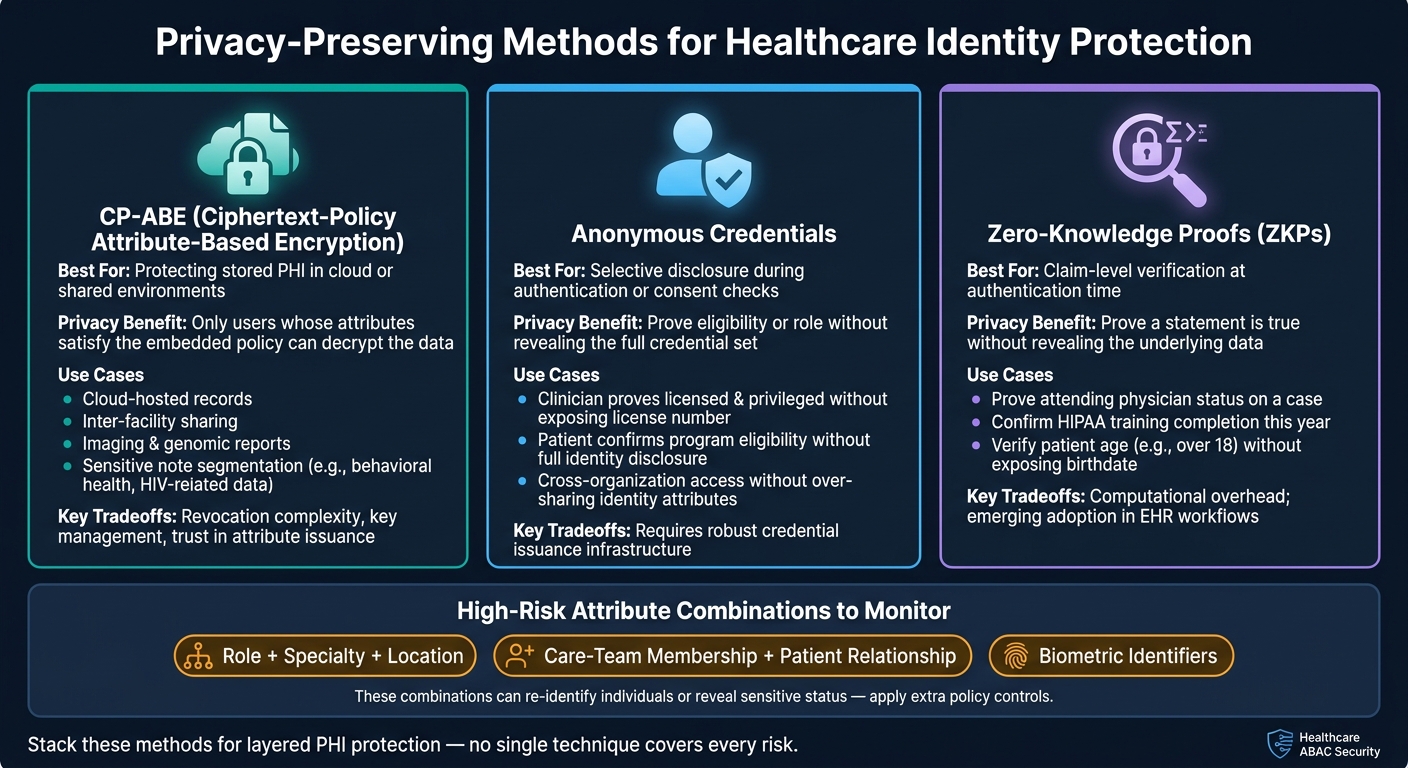
Privacy-Preserving Methods for Healthcare Identity: CP-ABE vs Anonymous Credentials vs Zero-Knowledge Proofs
Access control answers one question: who gets in. Privacy-preserving methods answer another: how much they get to see. That difference matters. Even when policy-based access is in place, an authorized user may still learn more than they need. These methods cut that down.
Attribute-Based Encryption for Fine-Grained PHI Access Control
Ciphertext-Policy Attribute-Based Encryption (CP-ABE) places the access policy inside the ciphertext itself. Only users whose verified attributes match that policy can decrypt the data.[49][50][54]
Here’s what that looks like in practice. An oncology note can be encrypted so that only a board-certified oncologist on the active treatment team at the affiliated hospital can read it. Everyone else sees ciphertext and nothing more.[49][50][53]
That makes CP-ABE a strong fit for data that travels beyond one hospital’s direct control, including:
- cloud-hosted records
- inter-facility sharing
- imaging sharing
- genomic reports
- sensitive note segmentation[61][62][63]
Some CP-ABE designs go even further and protect single items inside one record, such as a lab result or diagnosis, each with its own policy.[61] That kind of fine control helps with segmented access for behavioral health or HIV-related data.
There’s a tradeoff, of course. CP-ABE brings three main operating burdens: revocation, key management, and trust in attribute issuance. So it works best when paired with strong attribute issuance, revocation, audit logging, and key rotation.[51][52][64]
Encryption protects stored PHI. Identity proofing deals with what users must reveal to get access.
Anonymous Credentials and Zero-Knowledge Proofs for Selective Disclosure
Not every access request needs a full identity dump. Anonymous credentials let a clinician prove they are a licensed physician and privileged at this facility without disclosing a license number, home institution, or unrelated personal details.[56][57] A patient can do something similar by confirming eligibility for a care program without handing over a complete identity profile.
Zero-knowledge proofs (ZKPs) push that idea further. They let one party prove a statement is true - such as being an attending physician on the case, having completed HIPAA training this year, or being a patient over 18 - without exposing the data behind that claim.[57][59][60]
In healthcare, ZKPs can fit into EHR access workflows so providers prove they hold the required attributes without exposing what those attributes actually are.[55]
The payoff is selective disclosure at authentication time. Instead of sending over a full set of credentials and letting the receiving system sort through them, the user proves only what the request calls for. No more, no less.
Comparing Privacy-Preserving Methods for Healthcare Identity
These methods don’t do the same job, which is why many healthcare teams stack them together.[55][56][58]
| Method | Best For | Privacy Benefit |
|---|---|---|
| CP-ABE | Protecting stored PHI in cloud or shared environments | Only users whose attributes satisfy the policy can decrypt the data |
| Anonymous Credentials | Selective disclosure during authentication or consent checks | Prove eligibility or role without revealing the full credential set |
| Zero-Knowledge Proofs | Claim-level verification | Prove a statement is true without revealing the underlying data |
| Revocable CP-ABE | Environments that need ciphertext-level protection plus revocation | Maintains fine-grained control while supporting user/key revocation |
Some attribute combinations also need extra care because they can re-identify people or reveal sensitive status. High-risk examples include:
- role + specialty + location
- care-team membership + patient relationship
- biometric identifiers
The next hurdle is governance. Policy updates, consent, and audit trails decide whether these controls hold up in production.
Governance, Risk Management, and Conclusion
Once you've limited access and cut down disclosure, the risks that stick around are usually more mundane - but no less serious. Policies drift. Attributes go stale. Vendors become weak links.
Policy Lifecycle, Consent Management, and Audit Readiness
Attribute-based policies need clear governance. That means a named owner, version control, an approval workflow, and a set review schedule. When staff change roles or leave, attributes should update right away so stale role data is revoked fast and improper PHI access gets blocked.[66][67]
Consent and purpose of use should sit inside the policy engine itself. In plain terms, they need to be policy inputs checked at decision time. Treatment, research, and payment do not follow the same rules, especially when you're dealing with sensitive data classes like behavioral health or substance use disorder records.[68][15] That shifts governance into the authorization process instead of leaving it as a separate compliance exercise.
Audit readiness comes down to logging the full decision path:
- subject
- resource
- key attributes
- policy version
- outcome
- timestamp
- break-glass reason
Those logs should be tamper-evident, kept according to regulatory requirements, and tied back to EHR access records and SIEM alerts.[4][74]
Access drift usually happens when teams work in silos. Cross-functional groups - security, compliance, identity, clinical, and application teams - help stop that. A phased rollout works best: start with a pilot, compare expected and actual decisions, tune the policies, and then expand.[66][72][73]
Third-Party Risk and Continuous Oversight in Healthcare
This governance issue doesn't stop at internal systems. It extends to third-party services and connected devices too. If their data is stale or can't be trusted, authorization breaks down.
Third-party-related breaches climbed from 74 in 2018 to 254 in 2023, and more than 80% of stolen PHI records came from vendors, software services, business associates, and other nonhospital entities.[69][70]
Vendor reviews should look at PHI protection, authentication and logging standards, patching practices, attribute synchronization reliability, subcontractor exposure, and incident notification commitments. If a vendor can't keep role attributes in sync - or drags its feet on breach notification - it can weaken access control decisions across the whole environment.
Censinet RiskOps™ supports third-party and enterprise risk assessments, cybersecurity benchmarking, and collaborative risk management for PHI, clinical applications, medical devices, and supply-chain exposure. For organizations with a large vendor ecosystem feeding into attribute-based decisions, that kind of structured oversight is an operational requirement.
Key Takeaways for Healthcare Leaders
Attribute-based authentication is a core control for protecting ePHI. But it only lowers risk when identity assurance and governance stay current.[65][66]
The main issue isn't whether ABAC works in theory. It's whether the organization can keep its attributes, policies, and vendor data trustworthy over time. Zero Trust programs that combine ABAC with continuous verification and least privilege have shown an 87% reduction in mean time to detect incidents - from 173 hours to 22 hours - and a 94% reduction in unauthorized access attempts reaching sensitive systems.[71]
When attributes are accurate, consent is enforced, decisions are auditable, and vendor oversight is strict, the architecture becomes a working risk program.
FAQs
How is ABAC different from RBAC in healthcare?
In healthcare, RBAC gives access based on steady job roles, like radiologist or billing staff. That setup fits well with HIPAA’s minimum necessary standard when day-to-day duties stay mostly the same.
ABAC works in a more context-based way. It looks at attributes like time, location, device posture, and the patient relationship or current assignment. That lets teams apply tighter, more dynamic access control as clinical conditions shift.
What attributes should healthcare systems check first?
Healthcare systems should start with attributes tied to location - for example, ICU vs. outpatient clinic - along with employment type (staff vs. contractor) and shift status (on-duty vs. off-duty).
They should also give close attention to the user’s relationship to the patient, such as whether they’re an assigned provider, and to the risk level of the action they’re trying to perform.
How should break-glass access be controlled?
Break-glass access should be a tightly controlled exception, not an easy shortcut people lean on when things get messy. Each event needs explicit justification, immutable logging, and real-time alerts sent to compliance teams.
These temporary elevated permissions should remain separate from normal access rules. Teams should still require strong authentication, such as multi-factor authentication, and they should test these procedures on a regular basis during disaster recovery or business continuity drills.
