
Healthcare cyber risk is no longer a one-company problem. When one shared vendor fails, hospitals, payers, labs, and public health groups can all feel it at once.
I’d sum up the article like this: SMART by Design gives the health sector a way to see shared dependencies, score sector-level risk, set ownership, and plan for downtime before one outage spreads. That matters because 58% of the 77.3 million people affected by healthcare breaches in 2023 were hit through a business associate, and that figure was 287% higher than in 2022.
If I were boiling it down for a reader in a hurry, here’s the core idea:
- Map which vendors, platforms, and subcontractors support care and business functions
- Measure risk with common criteria like PHI use, EHR links, concentration risk, AI use, and recovery effort
- Mitigate with BAAs, control baselines, downtime plans, and joint drills
- Govern through board reporting, escalation rules, and AI review groups
- Use intelligence from peer data and shared sector signals to keep priorities current
The article’s main point is simple: vendor risk is now sector risk. So instead of checking vendors one by one, health leaders need a system that shows single points of failure, fourth-party exposure, and clinical downtime risk in one view.
It also draws a clear line between older vendor review and SMART by Design:
| Area | Older vendor review | SMART by Design |
|---|---|---|
| Focus | One vendor at a time | Shared health sector risk |
| Dependency view | Direct vendors | Vendors plus subcontractors |
| Main concern | Security posture | Clinical continuity and spread risk |
| Response model | After the issue starts | Before and during multi-org disruption |
| Recovery view | Data recovery targets | Multi-week downtime for care delivery |
I see the article as a push for a different mindset: don’t ask only whether a vendor is secure; ask what breaks across the sector if that vendor goes down. From there, the piece ties that idea to day-to-day steps such as vendor tiering, BAA rules, MFA, segmentation, backups, downtime drills, and AI oversight.
That’s the lens for the rest of the article.
Nexus Podcast: Healthcare Cybersecurity & Third-Party Risk with Greg Garcia on the SMART Toolkit
sbb-itb-535baee
The SMART by Design framework: 5 components leaders can put into practice
SMART by Design takes sector interdependence and turns it into something teams can use day to day. It gives CISOs, CIOs, compliance leaders, and AI leaders a shared way to handle risk that moves across organizational boundaries. The framework is built around five parts: Map, Measure, Mitigate, Governance, and Intelligence.
The idea is simple: start by showing where risk builds up and how it can spread. From there, each part can slot into risk and governance workflows many organizations already use.
Map dependencies across providers, payers, vendors, and public health
Mapping starts with a plain but often overlooked step: identify the vendors, platforms, and services your organization depends on, then trace the vendors those vendors depend on. That also means pulling in unseen fourth-party subcontractors.
Good mapping covers core functions like pharmacy, diagnostic radiology, EHR connectivity, cloud hosting, and pharmaceutical distribution. For each node, leaders need direct answers to a few questions:
- How many other organizations depend on the same vendor or platform?
- What happens to clinical or administrative continuity if that service goes offline?
Those answers show where concentration risk sits and where single points of failure exist. In other words, they show the spots where one disruption can ripple across the sector.
Measure systemic impact using common risk criteria
Once dependencies are mapped, the next step is to score them the same way across the board so teams know what to fix first. A risk scoring model can assess vendors and platforms across several dimensions:
| Risk Factor | Why It Matters |
|---|---|
| PHI Interaction | Increases regulatory and patient privacy exposure |
| EHR Connectivity | Direct link to clinical workflows and patient safety |
| Concentration Exposure | Defines how far the disruption can spread if the vendor fails |
| AI Capabilities | Introduces new governance and oversight requirements |
| Recovery Complexity | Determines how long sector-wide disruption could last |
Using both qualitative and quantitative scoring across these factors helps teams compare risk in a consistent way, even when they are looking at very different vendor types and organizational settings.
Mitigate risk through governance, controls, and coordinated resilience
After risk is measured, leaders need clear ownership and response plans that work across organizations, not just inside one enterprise. SMART by Design addresses this through governance, controls, and resilience.
On the governance side, Business Associate Agreements (BAAs) should be updated to include specific cybersecurity and cyber insurance requirements tied to each vendor's risk level. [1] On the controls side, teams should set minimum baselines for critical vendors and services. On the resilience side, hospitals need continuity plans built for extended service loss, not only fast recovery.
That means business continuity plans and downtime procedures should be built into incident command and emergency preparedness functions instead of being handled as separate IT tasks. [1]
After mitigation, governance and intelligence keep the framework up to date. Governance brings systemic risk into board-level reporting and AI oversight committees. Intelligence keeps priorities current by using shared risk data and peer benchmarks.
How the framework applies to real healthcare risk scenarios
The framework starts to matter when leaders use it during incidents that can ripple across providers, payers, vendors, and public health. The key question is simple: do those five parts help teams move faster once risk becomes an operations problem?
Supply chain compromise in a shared clinical or business application
When a shared vendor gets hit, every organization tied to that platform can be exposed at the same time. SMART by Design deals with this by pushing teams to map more than direct vendors. It also asks them to track the subcontractors those vendors depend on.
That matters because fourth-party dependencies often hide the biggest exposure. Once that map is in place, leaders can spot which critical functions are at risk - claims, pharmacy, lab, radiology, and blood services - and move on containment in the right order.
The same concentration risk can also fuel ransomware spread through shared services.
Ransomware spread through shared vendors and network dependencies
Shared identity providers, remote support tools, and clearinghouses can create concentration risk for ransomware. If a threat actor breaks into one of these shared vendors, they may be able to reach many connected healthcare organizations at once. SMART by Design helps teams spot those single points of failure before an incident starts.
When spread does happen, recovery often comes down to coordination. Teams need response expectations set in advance, not in the middle of the mess. Use BAAs to lock in response duties, and run joint downtime drills with shared vendors.
The same system-wide logic carries over when shared technology turns into an AI workflow risk.
Unsafe AI deployment in clinical, operational, or administrative workflows
AI risk is as much a governance and integration issue as it is a model-risk issue. SMART by Design handles this through critical function mapping, which ties AI tools to care delivery functions like radiology and pharmacy so teams can find single points of failure. Network intelligence can also flag hidden AI functions inside vendor updates before those updates hit production.
That leads straight to common risk criteria, governance controls, and reporting.
Implementation blueprint: assessments, controls, metrics, and reporting
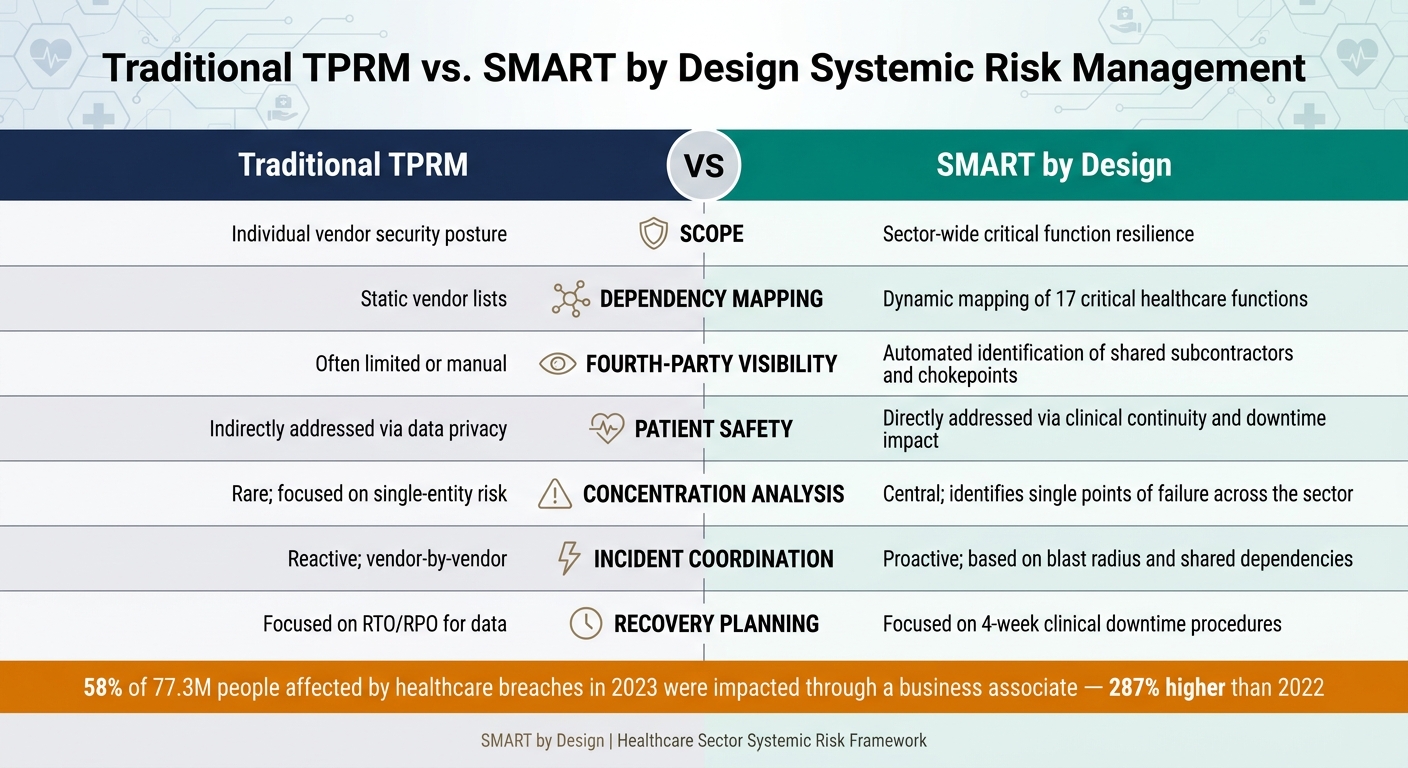
Traditional TPRM vs. SMART by Design: Healthcare Systemic Risk Management
Risk assessment criteria and governance controls to set up first
These scenarios bring the focus down to the day-to-day operating layer. Leaders need shared criteria, clear controls, and reporting they can use before mitigation grows across the organization. That means setting vendor tiers, onboarding evidence, and escalation authority early. Assessments should also trace subcontractors so teams can spot fourth-party risk and concentration points [1].
Start with criticality tiers. Give each vendor and internal system a tier based on the healthcare functions it supports. A Tier 1 vendor that supports several functions at the same time should get the closest review. Then set escalation thresholds for cases where a vendor issue could affect more than one organization and call for a coordinated response.
Build governance controls around three anchors:
- Reporting that shows concentration risk, fourth-party exposure, and shared dependencies
- Vendor onboarding requirements that include specific cybersecurity and cyber insurance requirements in BAAs, scaled to the risk tier [1]
- Downtime activation rules that spell out when to activate downtime procedures and who has the authority to make that call
Sector-wide mitigation strategies that improve resilience and compliance
Once risk is mapped and scored, the next move is to harden the shared services most likely to break first. The controls below support resilience and line up with HIPAA and the NIST CSF.
Start with full asset visibility. Pair that with MFA and privileged access controls across shared services.
Network segmentation helps contain the blast radius if a shared vendor is compromised. Immutable backups and documented downtime procedures shape how fast clinical operations can recover.
Patch and vulnerability management should run all the time, not on a set periodic cycle. Shared vendors should also be part of regular downtime drills and cyberattack exercises so teams can test incident command and emergency preparedness [1].
Comparison table: third-party risk management vs. SMART by Design systemic risk management
Use this table to compare vendor-by-vendor review with systemic risk management.
| Dimension | Traditional TPRM | SMART by Design Systemic Risk Management |
|---|---|---|
| Scope | Individual vendor security posture | Sector-wide critical function resilience |
| Dependency mapping | Static vendor lists | Dynamic mapping of 17 critical healthcare functions [1] |
| Fourth-party visibility | Often limited or manual | Automated identification of shared subcontractors and chokepoints [1] |
| Patient safety | Indirectly addressed via data privacy | Directly addressed via clinical continuity and downtime impact |
| Concentration analysis | Rare; focused on single-entity risk | Central; identifies single points of failure across the sector |
| Incident coordination | Reactive; vendor-by-vendor | Proactive; based on blast radius and shared dependencies [1] |
| Recovery planning | Focused on RTO/RPO for data | Focused on 4-week clinical downtime procedures [1] |
Using Censinet to support SMART by Design at scale
How Censinet RiskOps, Connect, and One support shared risk workflows
To put SMART into practice across a large health system, leaders need shared workflows that tie together assessment, evidence, and remediation. Censinet RiskOps™ automates the HSCC SMART workflow by mapping vendor products to critical healthcare functions and showing chokepoints and single points of failure in visual workflows.
Censinet also assigns each product an inherent risk score based on 11 defined healthcare risk factors, including PHI interaction and EHR connectivity. That score uses network intelligence from 200+ healthcare organizations and 55,000+ vendors, which helps teams prioritize reviews even when their own internal data is incomplete.
Censinet Connect™ and Censinet One™ build on that base by supporting standardized assessments and letting teams reuse evidence across assessments. That cuts duplicate work for both providers and vendor partners.
That same setup also helps teams review AI-related risk faster without giving up oversight.
How Censinet AI and Censinet AITM help teams move faster while keeping oversight
When vendor risk goes up, time matters. Censinet AITM speeds up the assessment process by automatically summarizing vendor evidence, capturing integration details, and surfacing fourth-party exposure that manual reviews often miss.
AI risk can ripple across many organizations at the same time. That’s why speed alone isn’t enough. Censinet AI keeps people involved at key points in evidence validation, policy drafting, and mitigation decisions. Risk teams set the rules, and the platform routes findings to the right reviewers, including the AI governance committee, before final approval.
A centralized AI risk dashboard brings policies, risks, and tasks into one place. That gives leadership a clear view of what’s happening so they can make informed decisions.
Conclusion: Make systemic risk visible and manageable across the health sector
The point isn’t software by itself. It’s about turning shared dependency risk into coordinated action.
Whether the threat comes from a third-party hub or an AI oversight gap, the response depends on shared governance, clear escalation paths, and sector-wide risk visibility. That’s what SMART by Design, backed by the right operational infrastructure, makes possible.
The payoff is simple: faster visibility, clearer ownership, and better sector-wide resilience before the next disruption spreads.
FAQs
How is SMART by Design different from traditional vendor risk management?
SMART by Design shifts the focus away from one-off vendor questionnaires and toward system-wide operational resilience.
Most vendor risk programs look at security one vendor or one product at a time. That can help, but it often misses the bigger picture: how those vendors connect to patient care and where they create shared single points of failure.
SMART by Design takes a dependency-based approach instead. It maps third-party tools to 17 critical health delivery functions. That makes it easier to spot system-level risks, such as concentration clusters and chokepoints, and then rank mitigation work based on clinical impact rather than vendor compliance alone.
What should we map first in a systemic risk review?
Start by mapping your critical clinical and business services, not your vendor list.
Look first at the functions that would disrupt patient care or cash flow within 72 hours. That usually includes things like claims processing, EHR access, pharmacy transactions, diagnostic imaging, and scheduling.
Then work backward. Identify the vendors, platforms, subcontractors, and shared infrastructure behind each of those services.
That shift matters. If you begin with a long vendor spreadsheet, it's easy to miss what actually keeps the organization running. But when you start with the services that patients and staff depend on, the weak spots come into focus much faster.
How can healthcare teams prepare for a shared vendor outage?
Healthcare teams should take a system-wide approach that protects both business and clinical continuity. Start by mapping core functions, like claims, pharmacy, and imaging, to the vendors, subcontractors, and shared infrastructure behind them. Then sort those dependencies by how much they could affect patient safety and day-to-day operations.
For mission-critical systems, build continuity plans and test them on a regular basis. Bring vendors into tabletop exercises so everyone knows their role before something goes wrong. It also helps to set clear expectations for incident support and notification, with timelines that aren't vague or open-ended.
Just as important, define the exact points that trigger a move to an alternate vendor or a shift to manual processes. That way, teams aren't stuck debating next steps in the middle of an outage.
