
Your hospital can keep its own network locked down and still lose access to supplies, support, and ordering if a vendor goes down. That’s the main takeaway here.
I’d sum it up like this:
- A March 2026 attack on Stryker wiped data on 200,000+ devices
- The hit disrupted manufacturing, orders, and shipping
- Hospitals were affected even though their own systems were not directly breached
- Iran-linked groups may use wipers, not ransomware, which means data may be destroyed instead of held for payment
- The weak spots are often vendor admin access, MDM/RMM tools, cloud consoles, support portals, and fourth parties
- The best response starts before an incident: map vendors, limit access, set backup suppliers, and define downtime steps
Put simply: a vendor outage can become a patient care problem fast. If I were reading this for action, I’d focus on three things right away: which suppliers touch patient care, which of them can reach my systems, and how I would keep orders moving for up to 30 days if one went dark.
This article explains what the Stryker event showed, what warning signs to watch for, what to ask suppliers during an incident, and how to cut supply-chain disruption before it hits care.
Stryker Cyberattack Disrupts Surgeries And Medical Supply Chains Across US | WION Podcast
sbb-itb-535baee
How Iran-Linked Attacks Reach Your Environment Through the Supply Chain
Your organization doesn’t have to be the main target to take a hard hit. What matters is how a vendor breach turns into your outage. The weak spot is often the access those vendors already hold inside your environment.
High-Risk Access Paths: Vendors, Software, and Remote Support Channels
Vendors don’t just ship products and walk away. In many cases, they keep privileged access for management, updates, support, and admin work.
That’s what made the Stryker attack so dangerous. Handala used Stryker’s Microsoft environment and MDM platform, specifically Microsoft Intune, to carry out a mass device wipe.[1][2][6] When a centralized management tool falls into the wrong hands, it can be used against many systems at once.
The same problem exists across other vendor-managed channels, including:
- RMM consoles
- Cloud admin panels
- Support portals
- ERP systems
If one of those vendor accounts gets taken over, their breach can become your downtime.
Fourth-Party Risk and Downstream Operational Dependencies
The exposure doesn’t end with your direct vendors. It keeps going.
When Stryker’s internal order processing and shipping systems went down, the disruption spread through global logistics providers and third-party distribution centers that many hospitals may never deal with directly.[1][3][4][5] One supplier outage can move through logistics, distribution, and fulfillment long before it shows up at a hospital loading dock.
A 2024 third-party breach analysis found that breaches caused by 81 vendors affected 251 downstream companies in 2023, with healthcare accounting for roughly 33–38.7% of victim organizations.[8][9] For healthcare teams, that means one of the biggest risks may sit outside the contract you signed.
Operational Disruption Versus Direct Clinical Compromise
This is a key distinction, and it often gets blurred after an incident.
In the Stryker case, investigators found no evidence of malicious activity directed toward customer or partner systems. No hospital networks were directly breached.[4][7] Even so, the damage was real. Order processing stopped for about three weeks, manufacturing halted across 79 countries, and around 56,000 employees were left idle.[1][2][3][5] That led to surgical equipment shortages and postponed procedures across U.S. hospitals.
So yes, clinical systems can remain online while the supply chain around them breaks down. Procurement can stop. Shipping can stop. Maintenance can stop. And when that happens, care feels the impact anyway.
What to Watch and What to Validate Across Third Parties
Once you know where vendor access comes in, the next step is simple: figure out when that access has gone bad.
If vendor access is the entry point, these are the signs that access may be under abuse.
Threat Indicators That Require Immediate Escalation
Treat these as signs of a destructive incident.
Watch for privileged account anomalies. If a third-party account is suddenly given global admin rights, logs in from unexpected regions, or starts showing a spike in failed sign-in attempts against service accounts tied to EHR systems, imaging platforms, or connected medical devices, that needs immediate review.
Abuse of endpoint-management tools is another top-priority signal. If RMM tools or MDM platforms are used without notice to push scripts, turn off security agents, or run commands across large groups of endpoints - especially outside approved maintenance windows - escalate right away. CISA, FBI, and NSA advisories have repeatedly documented this tactic in destructive Iran-linked campaigns.[10][11][14]
Political threat messaging is another sign to watch. When politically charged content tied to geopolitical grievances shows up on vendor portals or support consoles, it usually points to destructive intent rather than extortion.[15][16][17] If several hospitals using the same vendor go down at the same time, treat that as a supply-chain escalation trigger.
Use these signals to decide which third-party controls need to be checked first.
Third-Party Controls to Verify Before an Incident Occurs
Start with a vendor inventory. Map each vendor to the systems, workflows, and data it touches: EHR, PACS, lab interfaces, OR scheduling, and facilities management. Then assign criticality tiers such as patient-care critical, regulatory and financial, and ancillary. That way, your team knows which vendors need the fastest response.
Map subcontractors and fourth parties. Require vendors to disclose key subcontractors, such as cloud providers, MSPs, and device service partners. Also confirm that BAAs extend to subcontractors that handle PHI.
On the technical side, confirm that vendor remote access ends in segmented network zones with tight limits on lateral movement. Check that RMM and MDM tools require MFA, log all admin actions, and limit bulk script execution to approved, documented workflows. Least-privilege and just-in-time access should be standard, not optional. Require SOC 2 Type II, ISO 27001, or HITRUST evidence that covers remote access and privileged access.
Finally, verify business continuity, breach notification, and recovery terms in every contract for a critical vendor. Require 24-hour incident notice, named IOCs, affected systems, remediation steps, and documented RTOs and RPOs for patient-care-critical services.[12][13]
Comparison Table: Vendor Compromise Signals Versus Enterprise Impact Signals
Use the table below to separate signs of vendor compromise from the business impact they can create.
| Risk Signal | What It Looks Like | Internal Owner | Immediate Action |
|---|---|---|---|
| Privileged account anomaly | Third-party admin account elevated unexpectedly; logins from atypical regions | Security Operations (SOC) | Restrict vendor access; initiate vendor contact; increase segment monitoring |
| MDM/RMM abuse | Unscheduled scripts pushed outside maintenance windows | SOC / IT Operations | Block execution; audit affected endpoints; suspend vendor remote session |
| Sudden token or access changes | API keys reissued or permissions expanded without change-management documentation | Identity & Access Management | Revoke new tokens; require vendor explanation; review audit logs |
| Unexplained cloud admin actions | New IAM roles or cross-account trusts created in vendor-managed cloud tenant | Cloud Security / SOC | Disable new roles; preserve logs; engage vendor security team |
| Political threat messaging | Political threat content on vendor portals or support consoles | Third-Party Risk / Legal | Treat as destructive incident; escalate to leadership; assess PHI exposure |
| Coordinated multi-site downtime | Multiple facilities using the same vendor report simultaneous outages | Clinical Operations / SOC | Activate business continuity plan; identify manual fallbacks; notify compliance |
Use these signals and controls to shape the incident-response questions that follow.
Questions to Ask Suppliers and Steps to Reduce Disruption
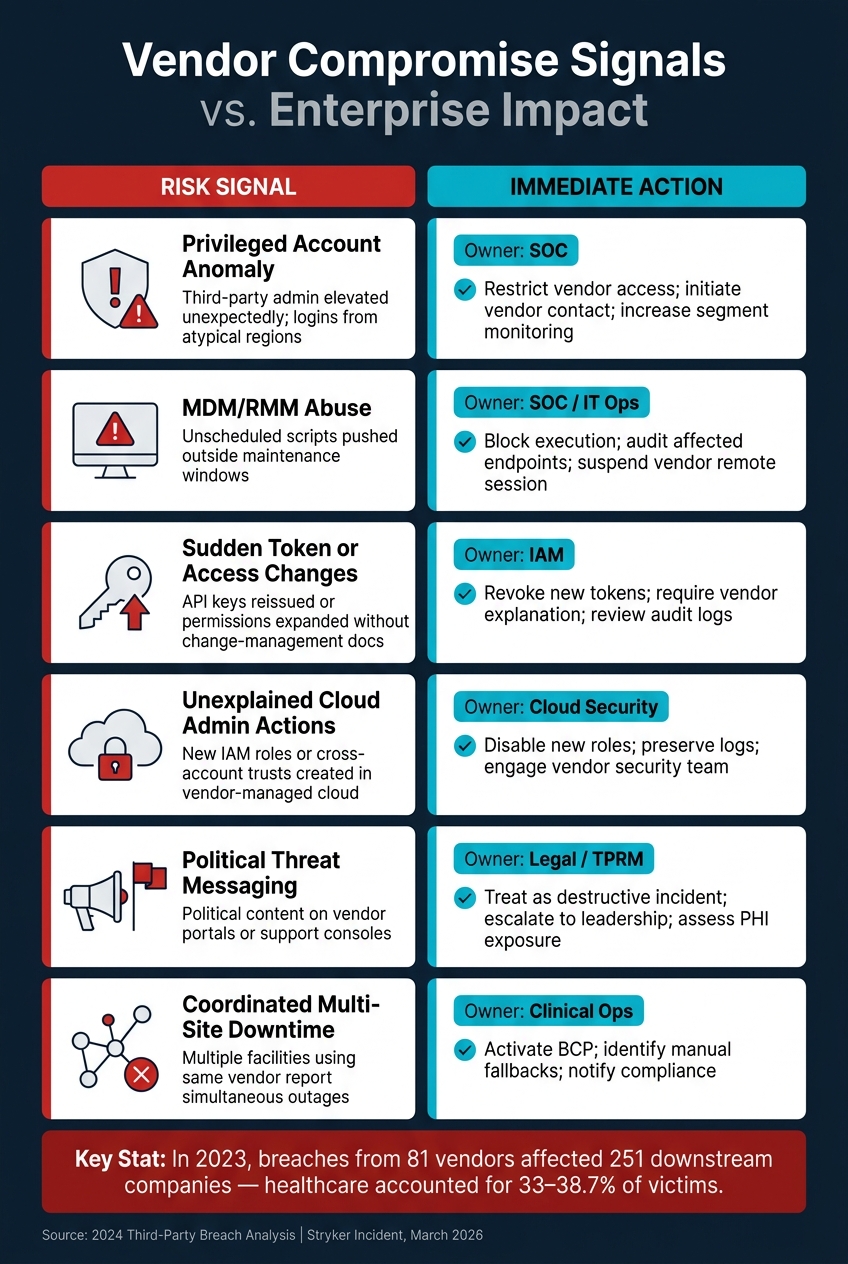
Vendor Compromise Signals vs. Enterprise Impact: Healthcare Supply Chain Cyber Risks
Once your monitoring flags a signal from the comparison table above, you need two things right away: the right questions for the supplier and a clear internal action plan. The same kind of vendor access tied to the Stryker outage can also shape how you respond.
Incident-Response Questions to Ask Affected Suppliers
Ask whether SSO, MFA, or privileged access systems were compromised, disabled, or bypassed, and whether any accounts used to administer your systems were involved. Use the signals above to tell the difference between a vendor outage and an active compromise.
Ask whether EDR/RMM tools, device management consoles, VPN gateways, or maintenance portals that connect to your environment are degraded, offline, or acting suspiciously.
Ask whether any API keys, OAuth tokens, or service accounts tied to your environment were accessed or rotated, and which systems or interfaces are affected.
Ask which business processes are disrupted, such as ordering, logistics, cloud hosting, device monitoring, or claims processing. Also ask whether the supplier has seen unusual remote sessions, unexpected file transfers, or abnormal configuration changes in customer or partner environments.
Request a clear incident timeline, including the date and time of initial compromise, detection, and containment, along with any IOCs the supplier has observed and the likely entry point.[19][18]
If backups are involved, ask when last known-good backups were taken, whether they are isolated from production, and whether integrity checks show they are intact. Ask for the estimated time to restore critical operations and any interim workaround, such as manual ordering, alternate portals, or temporary data feeds.
Confirm whether any potential PHI exposure could trigger a HIPAA breach assessment or related notification duties.[19]
Once the supplier confirms scope, move right into continuity actions.
Mitigation Steps for Healthcare Delivery Organizations
Have pre-approved secondary suppliers documented before an incident, not in the middle of one. For high-criticality items like specific implants, emergency medications, and surgical reagents, know exactly how to reroute orders through phone, fax, secure email, or a secondary portal if the main digital system goes down. That way, OR schedules, implants, medications, and lab supplies keep moving.
Manual downtime workflows need to live in downtime playbooks now. AHA and Health-ISAC guidance says continuity plans should support the loss of critical third-party services for up to 4 weeks, or about 30 days, without major care degradation.[20][21][23]
Inside your organization, escalation should be coordinated across procurement, cybersecurity, legal, compliance, and clinical operations. Define ahead of time which indicators trigger business continuity activation, when clinical leadership must be brought in, and who owns the call to suspend vendor access or shift to manual processes. Document every supplier communication during the incident. Indiana's statewide healthcare vendor guidance recommends logging every vendor communication to support later regulatory and legal review.[22]
When those decisions are set ahead of time, care is far more likely to keep moving during a vendor outage.
How to Reduce Third-Party Disruption Faster
The priority is an updated supplier dependency map, a fast way to collect incident details, and a cross-functional trigger for switching suppliers or moving to manual workflows.
Conclusion: Supplier Disruption Is a Patient Safety and Compliance Risk
The Stryker incident showed something many health systems learn the hard way: a vendor outage can delay care even when bedside devices are still working. The devices may be fine, but if the supplier behind them goes down, care can still slow or stop. In plain terms, a supply chain failure became a clinical failure.
Recent healthcare data shows that supply chain cyberattacks often disrupt care, not just back-office work.[25] The impact may start on the admin side, but the effect lands on patients.
Iran-linked attacks often use legitimate admin tools as weapons, which means trusted vendor access can become the path to destructive action. If that kind of activity hits a supplier upstream from your organization, the damage can move through software integrations, logistics partners, and remote support channels before anyone has a clear picture of what's happening.
That’s why the controls in the previous section matter before an outage starts. The lesson isn’t complicated: prepare before a supplier goes dark. Resilience comes from validated controls, continuity plans, and supplier escalation paths that are already in place.
Supplier disruption should be treated as a patient safety and compliance risk, not just an IT problem. It belongs in enterprise risk management, tied to patient-safety metrics, and shared across procurement, cybersecurity, legal, and clinical operations.[24][26]
FAQs
How can a vendor cyberattack disrupt patient care if our network is secure?
Even if your internal network is locked down, patient care can still take a hit. Why? Because day-to-day clinical work depends on outside systems you don’t control - like electronic health records, billing platforms, medical device management systems, and logistics partners.
If one of those vendors gets compromised, the damage can spread to your facility fast. Connected devices may stop working. Staff can get locked out of key applications. Teams may have to switch to manual workarounds just to keep things moving.
And that’s where the pressure shows up in care delivery. Surgery can be delayed. Diagnostics can slow down. Medication management can get harder at the worst possible moment. In a hospital setting, even a short disruption can put patient safety at risk.
What should we verify first with critical suppliers after an attack?
First, line up your incident response process with the supplier’s so both sides can trigger contingency plans fast and keep critical clinical workflows running.
Then review their incident response policies, security controls, breach notification procedures, and backup and recovery steps. Make sure your manual fallback procedures are written down and practiced, not just sitting in a binder somewhere.
It also helps to check machine identities, including cryptographic keys and digital certificates. On top of that, confirm device management platforms are locked down with multifactor authentication and least-privilege access.
How long should we be ready to operate without a key vendor?
Plan for systems to be offline for weeks or even months. At the bare minimum, put a 72-hour continuity plan in place so clinical and operational workflows can keep moving during the first phase of an outage.
That matters because supply chain disruptions don’t always stop at one vendor. They can spread into cloud services and third-party networks, which means outside support may not be there when you need it. In plain terms: your team should be ready to operate for an extended stretch without outside infrastructure.
