
If a vendor handles PHI, your HIPAA risk doesn’t stop at the contract. In healthcare, breaches tied to business associates often hit more people than breaches at covered entities, and 44% of healthcare and pharma groups said a third party caused a data breach in the past 12 months.
If I had to boil this down to one point, it’s this: HIPAA-ready vendor risk work needs layers. A BAA sets the legal floor. Risk reviews test controls. Monitoring spots changes between reviews. Frameworks keep reviews consistent. Platforms help teams keep all of that in one place.
Here’s the short version of what matters most:
- Contracts alone are not enough.
- Vendor reviews need evidence, not just yes/no answers.
- High-risk vendors need closer checks than low-risk vendors.
- Breach reporting terms should be tight, often within 24–72 hours of discovery.
- HIPAA’s outside limit for breach notice is 60 days, so delay at the vendor level creates trouble fast.
- Subcontractors matter too, because risk runs through the full vendor chain.
How to Comply with Third-Party Risk Management Requirements in HIPAA
Quick Comparison
| Strategy | What it does best | Main gap |
|---|---|---|
| Contractual and governance-based | Sets duties through BAAs, policies, and review steps | Signed terms do not show that controls work |
| Risk assessments and periodic reviews | Checks PHI handling, safeguards, and incident process with evidence | Reviews are snapshots in time |
| Continuous monitoring and incident coordination | Spots changes and incident signals between review cycles | Needs staff, tools, and tight follow-up |
| Framework-driven programs | Maps vendor reviews to NIST, HITRUST, and HIPAA control sets | Can take more setup and training |
| Technology-enabled platforms | Centralizes intake, evidence, scoring, remediation, and incident tracking | Tools still need human review and ownership |
So if you’re looking at third-party risk for HIPAA, I’d keep the model simple: start with inventory and BAAs, add evidence-based reviews, then add monitoring and a platform as vendor count and PHI exposure grow.
1. Contractual and Governance-Based TPRM
Contractual and governance-based TPRM relies on BAAs, addenda, and oversight workflows - vendor risk committees, tiered policies, and procurement controls - to turn HIPAA duties into enforceable vendor requirements. Put simply, this is the legal and admin starting point for HIPAA-aligned vendor oversight.
HIPAA Rule Coverage
HHS treats BAAs as the tool for getting satisfactory assurances that business associates will protect PHI.
Each HIPAA rule ties back to a contract term and a check step:
- Privacy Rule: BAA clauses for permitted uses and disclosures, plus downstream BAA terms for subcontractors
- Security Rule: Required safeguard terms tied to 45 CFR § 164.308, checked through independent assurance evidence
- Breach Notification: Contract-based incident reporting deadlines and periodic incident response plan testing
Vendor Assurance Depth
A BAA creates a legal duty. It does not prove that a vendor's controls work.
That distinction matters. A vendor can sign a BAA and still fall short in practice. To close that gap, organizations should ask for independent assurance evidence such as SOC 2 Type II, HITRUST, or penetration test summaries. Vendors with direct PHI access also need closer review than a basic questionnaire can provide.
Breach Response Readiness
Contracts start the clock. HIPAA allows up to 60 days for breach notification, but many healthcare organizations now require vendors to report within a 24–72 hour reporting window after discovery.
One contract detail matters a lot here: BAAs should define "discovery" as the point when the vendor becomes aware of an incident - not when its investigation is finished. If that language is missing, a vendor may delay notice while it investigates. That can leave the covered entity scrambling to meet its own deadlines.
Operational Scalability
Standard BAA templates and risk-based vendor tiering help this model work across a large vendor base. Grouping vendors into High, Medium, or Low risk tiers - based on PHI volume, data sensitivity, and service criticality - lets teams spend more time on the vendors that matter most and use lighter review for lower-risk providers.
The weak spot is enforcement. Without automated tracking, it gets messy fast to manage hundreds of BAA renewal dates, subcontractor disclosures, and review cycles. Teams that depend on spreadsheets and email threads often end up with expired BAAs and overdue vendor reviews sitting in the background until an incident brings the problem into plain view.
Once contracts set the rules, the next job is checking whether those controls still work day to day. That gap between legal commitment and proof in practice is where the next TPRM model starts.
2. Risk Assessments and Periodic Reviews
Contracts set the rules. Risk assessments check whether those BAA duties hold up in day-to-day work.
This approach turns HIPAA requirements into repeatable vendor reviews that look at PHI flows, safeguards, incident response, and contract controls. From there, the next step is simple: check whether those controls still work between review cycles.
HIPAA Rule Coverage
A solid assessment maps vendor controls to the HIPAA Privacy, Security, and Breach Notification Rules.
Privacy Rule coverage looks at minimum necessary use, access limits, training, and PHI handling rules. Security Rule coverage reviews administrative, physical, and technical safeguards, including encryption, MFA, logging, integrity controls, and contingency planning. Breach Notification Rule coverage checks whether the vendor can carry out a documented four-factor breach risk assessment.
Periodic reviews then confirm that those controls still work and reflect changes such as:
- data flows
- PHI use
- new services
- system changes
- security incidents
- regulatory updates
Vendor Assurance Depth
Questionnaires are a starting point, not proof.
Stronger assessments ask for evidence, such as SOC 2 Type II reports, HITRUST certifications, ISO/IEC 27001 audits, and recent penetration test results, scoped to PHI systems. Reviewing sample policies for access control, incident response, and data retention also gives teams a clearer view than self-attestation alone.
Business associates have their own duty to perform a HIPAA security risk analysis. That duty is separate from the covered entity's assessment, even when both sides coordinate the work.
Breach Response Readiness
HIPAA's four-factor breach risk assessment is specific and documented. It is not a generic incident review.
Teams should review:
- the nature and extent of the PHI
- who received it
- whether it was actually acquired or viewed
- the effect of mitigation
If a vendor can't show this during an assessment, that's not a small paperwork miss. It's a gap that can turn into a breach notification problem fast.
Operational Scalability
Use the same vendor tiers to set review frequency. Review high-risk vendors every year. Review lower-risk vendors every two or three years.
Industry data shows why this matters: 44% of healthcare and pharmaceutical organizations reported a data breach caused by a third party in the prior 12 months.[3] The space between reviews is often where problems grow, which is why continuous monitoring matters.
3. Continuous Monitoring and Incident Coordination
Continuous monitoring fills the gap that periodic reviews leave behind. A yearly or quarterly check can tell you where a vendor stood at one moment. Continuous monitoring shows what’s happening now.
HIPAA Rule Coverage
For the Security Rule, monitoring should focus on the systems that touch ePHI. That includes configurations, vulnerabilities, access controls, patching, and encryption.
For the Privacy Rule, the focus shifts to data flows and integrations. You’re watching for PHI use that goes beyond the BAA or the minimum-necessary standard.
For the Breach Notification Rule, monitoring should flag odd activity, signs of exfiltration, and outages that may trigger a breach review.
Vendor Assurance Depth
Questionnaires and certifications show a point-in-time view. Continuous monitoring shows current conditions.
A strong program brings together several signals:
- Attack-surface scanning
- Exposed-port checks
- TLS checks
- Reviews of access logs
- Reviews of incident logs
- Reviews of major vendor changes, such as mergers or new sub-processors
When these signals feed into vendor profiles, risk scores can update automatically when something changes instead of sitting still until the next scheduled review. That matters because vendor risk doesn’t wait for the calendar.
Breach Response Readiness
When monitoring reveals active risk, response has to move just as fast. BAAs should require vendor notice within 24–72 hours of discovering any security incident that may involve PHI. That gives the covered entity time to begin its breach-risk assessment and stay on track for the 60-day deadline.
Pre-agreed incident playbooks spell out roles, data sharing, and escalation paths. Annual tabletop exercises then test those plans under pressure, when decisions have to happen fast and there’s little room for confusion.
Operational Scalability
Monitoring intensity should match vendor criticality. Not every vendor needs the same level of scrutiny, and that’s the whole point.
- Tier 1 vendors - cloud EHRs, imaging archives, and telehealth platforms handling large PHI volumes - should get monthly checks and quarterly deep dives.
- Tier 2 vendors should get quarterly checks.
- Tier 3 vendors can be reviewed semiannually or annually.[4]
This setup keeps the closest watch on vendors with the highest HIPAA exposure, while lower-risk relationships don’t soak up time and staff hours that are better spent elsewhere.
Censinet RiskOps™ can centralize vendor risk data, automate alerts, and route reassessment tasks when monitoring signals change.
sbb-itb-535baee
4. Framework-Driven TPRM
Continuous monitoring shows what's happening right now. Framework-driven TPRM sets the baseline for what should be in place. Instead of relying on ad hoc checklists, it uses repeatable standards so every vendor is reviewed the same way. That's what makes it the link between point-in-time reviews and day-to-day execution.
In healthcare, teams often use NIST CSF, NIST SP 800-53, HITRUST CSF, and HICP. NIST SP 800-66r2 and the HHS-NIST crosswalk also help map HIPAA Security Rule requirements into vendor review templates.[5][6]
HIPAA Rule Coverage
A framework-driven program ties vendor controls straight to HIPAA's three core rules.
For the Security Rule, NIST SP 800-66r2 turns safeguards like access control, audit controls, authentication, encryption, and transmission security into specific requirements that can be tested. Each vendor control can be tagged to a HIPAA citation, so gaps are visible instead of guessed at.
For the Privacy Rule, framework controls around data classification, least-privilege access, and data flow documentation help confirm that vendors use PHI only within the scope of the BAA. For the Breach Notification Rule, framework-based incident response planning supports detection, investigation, escalation, and notification workflows.
NIST CSF 2.0 added a dedicated Govern function that places third-party risk in the core model.[7] That drives home a simple point: vendor oversight sits with governance. It isn't a one-time due diligence task.
Vendor Assurance Depth
Framework assessments ask vendors to show proof. That includes encryption standards, key management, and audit artifacts tied to named control requirements. HITRUST CSF scores control implementation and residual risk at a granular level, which helps covered entities judge whether a vendor's environment meets set thresholds for PHI protection.
That means teams can work from mapped controls, scored evidence, and consistent thresholds instead of just checking a box.
Breach Response Readiness
Framework-driven TPRM requires vendors to prove they can respond to a breach, not just say they'll report one. Assessments mapped to Detect, Respond, and Recover - and to NIST SP 800-53's IR control family - check for documented response plans, defined escalation paths, detection tooling, and forensic capabilities.
A BAA can require notice within HIPAA's breach-notification timeline. A framework assessment checks whether the vendor has actually tested its incident response process and can meet that timeline under real conditions.
Operational Scalability
Standard control sets make large vendor programs easier to manage. Use one baseline, then change the depth based on risk tier. If a vendor already has a HITRUST certification or a SOC 2 Type II report, that can often stand in for a full custom questionnaire, which cuts redundant work across the vendor portfolio.
These same standard controls are also easier to run at scale when software turns them into repeatable workflows. Technology-enabled platforms put these frameworks into practice by collecting evidence, scoring gaps, and routing follow-up tasks.
5. Technology-Enabled TPRM Platforms
These platforms put the control framework into day-to-day use. Instead of managing third-party risk across scattered spreadsheets, email threads, and folders, a dedicated platform brings TPRM into one place. It turns mapped controls into repeatable workflows across the full vendor lifecycle: intake, assessment, evidence review, remediation, and reporting. The result is a single system of record.
HIPAA Rule Coverage
A well-set-up platform builds HIPAA requirements right into the workflow and scores vendor controls automatically. That helps keep each assessment tied to the same control set every time, which matters when different teams review different vendors.
For the Security Rule, the platform maps vendor controls to Administrative, Physical, and Technical safeguards and scores each area. For the Privacy Rule, it standardizes questions about PHI use, access, and vendor policies. For the Breach Notification Rule, it tracks contract-based notification deadlines and records incident details in a structured format so covered entities can meet reporting duties on time. The platform should also track BAAs and subcontractor duties.
Censinet RiskOps™ is built for healthcare, mapping vendor assessments directly to HIPAA requirements while also supporting NIST CSF and HITRUST.
Vendor Assurance Depth
A strong platform connects every vendor response to uploaded evidence. In plain terms, vendors should provide proof, not just check a box and move on. That can include policies, audit reports, screenshots, configuration records, or test results.
Platforms can also pull in outside risk data, such as:
- Security ratings
- Known vulnerabilities
- Breach history
That extra layer helps teams compare what a vendor says against what outside sources show.
Questionnaires can also shift based on vendor type. An EHR add-on, a telehealth app, and a connected medical device do not create the same PHI risk, so they should not get the same questions. Platforms can adjust depth and focus to match that reality.
They also support shared remediation workflows, so healthcare organizations and vendors can agree on corrective actions, due dates, and compensating controls when gaps show up. That changes the reviewer’s job. Instead of spending most of the time chasing responses, teams can focus on judging gaps, applying the same scoring logic, and reusing evidence across the vendor portfolio.
Breach Response Readiness
When monitoring detects risk, the platform should route the response automatically. Each vendor profile should store contacts, escalation paths, notification deadlines, and incident records. It should also support tabletop exercises for high-risk vendors.
If a vendor reports an incident, the workflow should guide the covered entity through the key steps:
- Triage
- PHI impact assessment
- Evidence gathering
- Legal review
- Documentation of whether notification is required
The platform should also record the date the breach was discovered, the date the vendor notified the covered entity, details about the compromised PHI, and the risk assessment output.
Censinet RiskOps™ is designed around healthcare workflows, which makes it easier to align vendor incident procedures with HIPAA's notification timelines and documentation requirements.
Operational Scalability
Centralized workflows handle intake, scoring, routing, and renewals without constant manual coordination. Role-based access lets each stakeholder work from the same system of record, which cuts confusion and keeps activity tied to one source.
In healthcare-focused platforms like Censinet RiskOps™, vendors can keep a shared library of completed responses and evidence that multiple health systems can reference. That cuts repeat assessments and reduces vendor fatigue across the portfolio. Teams can scale oversight without matching headcount growth one for one, and metrics such as assessments per FTE and time to decision make that easy to track. That is the core advantage this model brings over manual TPRM.
Side-by-Side Analysis by Compliance Outcome
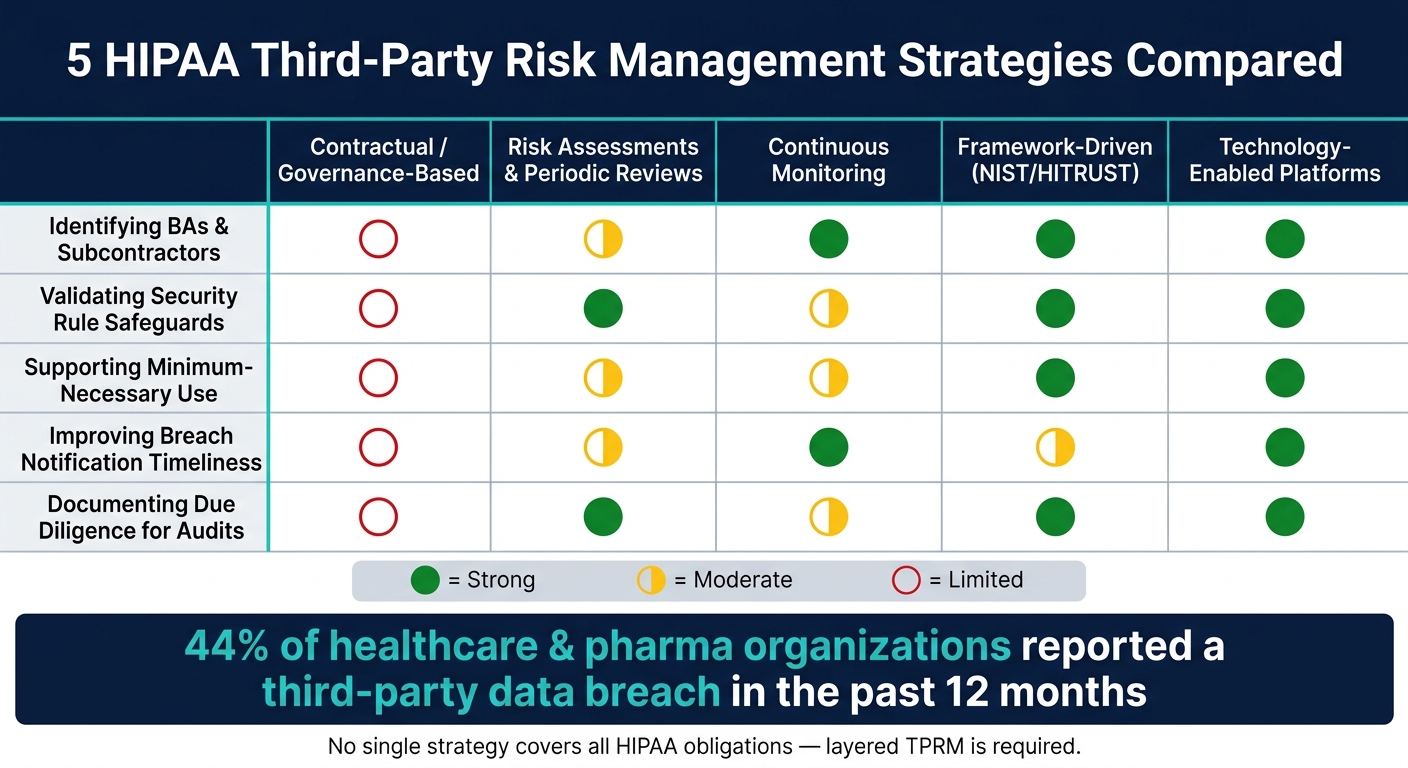
5 HIPAA Third-Party Risk Management Strategies Compared
After looking at the five models above, the next step is simple: see how they stack up against the same compliance outcomes.
Each TPRM approach supports HIPAA in a different way. A signed BAA covers the legal floor, but OCR also expects documented risk analysis, risk management, and ongoing oversight.[2]
Two outcomes separate these models the fastest:
- finding every BA and subcontractor that handles PHI
- meeting breach-notification deadlines
The table below shows how the five strategies compare across five compliance outcomes.
| Compliance Outcome | Contractual / Governance-Based | Risk Assessments & Periodic Reviews | Continuous Monitoring | Framework-Driven (NIST/HITRUST) | Technology-Enabled (Censinet RiskOps™) |
|---|---|---|---|---|---|
| Identifying BAs and subcontractors | Limited - relies on self-reporting; misses shadow IT and informal data sharing | Moderate - scoping questionnaires map PHI data flows | Strong - asset discovery and vendor inventory dashboards maintain a current list of all third parties interacting with PHI | Strong - formal vendor classification criteria and data mapping required | Strong - automated intake, classification logic, and dynamic business associate catalog |
| Validating Security Rule safeguards | Limited - attestation only; no independent verification | Strong - evidence-based review (SOC 2, HITRUST reports, pen test summaries, access control matrices) | Moderate - ongoing visibility into posture changes between formal assessments | Strong - controls mapped to HIPAA Security Rule, NIST, and HITRUST; scored against industry norms | Strong - healthcare-specific questionnaires, automated scoring, benchmarking, and evidence storage |
| Supporting minimum-necessary use | Limited - generic BAA clauses; difficult to enforce operationally | Moderate - reviews data elements accessed and challenges overbroad access | Moderate - detects scope creep via access log and configuration change reviews | Strong - minimum necessary embedded in design reviews, change management, and privacy risk analysis | Strong - standardized data-use classification, permitted-use tracking, and auditable change history |
| Improving breach notification timeliness | Limited - depends on vendor's unverified internal detection and reporting | Moderate - establishes baseline expectations and verified contacts; response still ad hoc | Strong - near-real-time alerts, incident playbooks, and structured communication channels reduce detection-to-notification lag | Moderate - framework mandates documented incident response plans but does not drive real-time coordination | Strong - centralized incident records, collaborative workflows, and automated deadline tracking |
| Documenting due diligence for audits / OCR review | Limited - BAA copies and policy manuals; lacks proof of operational oversight | Strong - structured risk analysis, control evidence, and documented risk decisions | Moderate - ongoing audit trail but may lack the structured framework mapping OCR looks for | Strong - risk registers, control mappings, and framework-mapped artifacts provide traceability | Strong - time-stamped assessment artifacts, remediation plans, and communication histories in one system |
These tradeoffs lead straight into the pros and cons below.
Pros and Cons
Each strategy has its own strengths and weak spots. If you look at them through the lens of HIPAA compliance results, the tradeoffs are easier to spot. The right mix comes down to your organization’s size, how many vendors you manage, and how much PHI is in play. That’s why a side-by-side view helps.
The table below compares pros, cons, cost, and best fit.
| Strategy | Key Pros | Key Cons | Cost Profile | Best Fit |
|---|---|---|---|---|
| Contractual / Governance-Based | Clear responsibilities; enforceable remediation; fast to deploy | Depends on legal language, not technical verification; paper compliance risk; can become static | Low direct cost; higher legal and negotiation time | Small to mid-size organizations |
| Risk Assessments & Periodic Reviews | Evidence-based and gap-focused | Labor-intensive; point-in-time snapshots; smaller vendors may struggle to complete detailed assessments | Medium; mix of FTE time and consulting spend | Mid-size to large organizations |
| Continuous Monitoring & Incident Coordination | Near-real-time visibility and faster response | Alert fatigue risk; requires integrations and skilled staff; may miss contextual vendor environment data | High ongoing operational cost | Large organizations with mature security operations |
| Framework-Driven (NIST / HITRUST) | Standardized, benchmarkable, audit-ready | Complex to implement; high upfront training and mapping costs; can feel like overhead for smaller organizations | High upfront; lower marginal cost per vendor over time | Mid-size to large organizations |
| Technology-Enabled (Censinet RiskOps™) | Automates assessments, centralizes evidence, and improves audit readiness for healthcare PHI workflows | Platform licensing and integration effort; requires vendor onboarding; risk of overreliance on automated scoring without human review | Medium-high upfront; lower per-assessment cost at scale | Mid-size to large organizations; highest value with large vendor ecosystems |
The biggest day-to-day gap is this: legal coverage is not the same as operational proof. A BAA can spell out obligations, but it does not replace a current, documented risk analysis or remove liability after a breach.[9][8][1]
That’s where many teams get tripped up. On paper, things can look buttoned up. In practice, if you can’t show current evidence, tracked reviews, and clear follow-through, the file won’t tell the full story.
Platforms tend to work best when they sit on top of clear governance and named vendor owners. The tool can speed up the work, but people still need to own decisions, follow-ups, and risk calls.
Conclusion
The five models point to a simple idea: HIPAA-ready TPRM needs layers, not just one control. No single move checks the whole HIPAA box on its own. The right setup depends on how many vendors you manage, how much PHI they touch, and how mature your program is.
For small clinics and single-site practices, the starting point is pretty clear: build a complete vendor inventory, lock in solid BAAs, and use a standard risk questionnaire for any vendor that handles PHI. Regional health systems can go a step further with formal risk tiering, scheduled reviews, and a known framework like NIST CSF. Large integrated delivery networks (IDNs), academic medical centers, and payers with thousands of vendor relationships need that full stack, plus continuous monitoring and a tech platform that can keep up with the workload. In plain terms, smaller teams can begin with contracts and reviews. Larger teams need monitoring and platform support. As vendor volume and PHI exposure go up, that base needs to get stronger too.
There’s also an important distinction here: legal coverage is not the same as operational proof. A contract sets the floor. But assessments, monitoring, frameworks, and platforms are what help an organization stay compliant in day-to-day practice. If you lean on just one layer - especially contracts alone - you leave gaps that a signed BAA or a once-a-year review simply can’t close.[10]
Censinet RiskOps™ supports this layered approach by bringing third-party and enterprise risk assessments, benchmarking, and collaboration into one place across PHI, clinical applications, medical devices, and supply chains. The idea is simple: make each layer connect to the next, from intake through incident response.
The goal is to match the right layers to your risk profile: governance sets direction, assessments find gaps, monitoring spots change, frameworks bring consistency to reviews, and technology keeps the program workable as it grows.
FAQs
How do we decide which vendors are high-risk?
Use a tiered approach based on what could hurt patient safety, expose data, or disrupt day-to-day operations.
Start with a full third-party inventory. Then rank each vendor based on factors like:
- access to PHI
- criticality of services
- cybersecurity posture
- operational importance
From there, place vendors into tiers such as critical, high, moderate, and low. That makes it easier to decide which vendors need deeper reviews and which ones need closer, more frequent monitoring.
What evidence should we request from business associates?
Request a signed Business Associate Agreement (BAA), along with records that show the associate’s HIPAA security risk assessment and the main safeguards in place.
Ask for:
- Security policies, training records, and breach response procedures
- Documentation for encryption, patch management, disaster recovery, and firewalls
- SOC 2 Type II reports, HITRUST certifications, penetration test summaries, and access logs or audit trails
When should we move from spreadsheets to a TPRM platform?
Move from spreadsheets to a dedicated TPRM platform like Censinet RiskOps once your vendor portfolio gets too large for manual work to handle well.
That switch usually makes sense when spreadsheets start slowing the team down, adding to assessment fatigue, or causing assessment delays as regulatory demands grow and your vendor network gets bigger. A centralized platform can support continuous monitoring and automation at scale for HIPAA compliance.
