
Risk-based compliance means this: spend more time on the software functions that can harm patients, expose ePHI, or stop care, and spend less time on low-risk changes. That is the core idea. It matters because one review cited in the article found patient harm in 52% of studies on health IT issues, and another study showed EHRs still missed about one-third of harmful drug interactions and errors.
If I had to sum up the whole article in a few points, I’d say:
- Not every feature needs the same level of validation
- One risk register should pull in FDA, HIPAA, ISO 14971, IEC 62304, NIST, and GAMP 5
- Risk should be scored across three areas: patient safety, security, and continuity of care
- High-risk functions need deeper testing, traceability, and tighter release control
- Validation does not end at go-live; changes, patches, incidents, and vulnerabilities must feed back into the risk file
- Clear ownership matters across engineering, security, quality, privacy, clinical safety, and leadership
Here’s the plain-English version:
- If software can affect dosing, orders, results, alarms, or clinical decisions, it needs more proof before release.
- If software handles ePHI, teams need documented HIPAA risk analysis and security controls.
- If downtime can disrupt care, teams should score that risk in both care impact and cost, such as less than $50,000 up to more than $1,000,000.
- If a change touches a validated function, data flow, or security control, it should go through impact review and targeted retesting.
A short way to think about it: score the risk, map the controls, test to the level of harm, and keep the validated state in place after release.
This article walks through how I’d connect the rules, score risk, tie that score to design and testing, and keep the records ready for review.
Automate Your Medical Device Risk Management With Formwork, An eQMS (ISO 14971 Compliance)
sbb-itb-535baee
Regulatory foundations for risk-based compliance in the U.S.
No single framework covers clinical software risk. The safer move is to use FDA guidance, IEC 62304, ISO 14971, HIPAA, NIST, and GAMP 5 together as one control model. That helps you avoid gaps and cuts down on duplicate work.
But here’s the key point: these frameworks only start to matter when they feed into one documented risk assessment. If each one lives in its own silo, teams end up doing extra work and still miss things.
FDA, IEC 62304, ISO 14971, HIPAA, NIST, and GAMP 5 explained
FDA's Computer Software Assurance (CSA) guidance applies to software that supports quality systems, such as QMS, eDHR, and CAPA tools. It shifts assurance work toward risk and keeps evidence focused on intended performance. For device software, and for software used to design, develop, or manufacture medical devices, GPSV remains the baseline for validation for intended use.
IEC 62304 lays out the medical device software lifecycle. Its safety classification system - Class A, B, or C - sets how much testing, documentation, and verification a software module needs. In plain English, higher-risk clinical functions need more proof than non-clinical utilities.
ISO 14971 is the core standard for medical device risk management. Teams use it to identify hazards, estimate the probability and severity of harm, put controls in place, and decide whether residual risk is acceptable. IEC/TR 80002-1 adds guidance for applying ISO 14971 to medical device software in the context of IEC 62304.
HIPAA's Security Rule requires a formal risk analysis of ePHI confidentiality, integrity, and availability under 45 CFR 164.308(a)(1)(ii)(A). NIST SP 800-66 Rev. 2 turns those requirements into implementation guidance, and NIST SP 800-30 Rev. 1 gives teams a structure for risk assessments.
GAMP 5 is industry guidance for validating GxP computerized systems. It scales lifecycle effort based on GxP impact, complexity, novelty, and process criticality. Its Category 4 configured systems and Category 5 custom software can help justify how deep validation needs to go.
How each framework maps to software risk decisions
Use each framework for a specific input, then bring everything into one risk register. Together, they map to the three risk lenses that matter most: patient safety, security, and operational continuity.
| Framework | Primary Focus | Risk Concept | Required Evidence | Typical Use in Clinical Software |
|---|---|---|---|---|
| FDA GPSV | Fitness for intended use | Intended use and impact | Validation rationale, test results, fitness evidence | Device software; software used to design, develop, or manufacture devices |
| FDA CSA | Software supporting quality systems | Risk to patient safety, product quality, and data integrity | Risk-based rationale, testing summary, record of conclusion | QMS, eDHR, CAPA, inspection, and release systems |
| IEC 62304 | Medical device software lifecycle | Safety classification (A, B, C) | Lifecycle plans, verification records, problem resolution logs | SaMD, SiMD, embedded clinical device software |
| ISO 14971 | Medical device risk management | Hazard identification, risk estimation, residual risk | Risk management file, hazard analysis, residual risk evaluation | Safety-related software requirements and design controls |
| HIPAA Security Rule | ePHI protection | Confidentiality, integrity, and availability of ePHI | Risk analysis, safeguard documentation, implementation evidence | EHR-connected clinical apps, portals, PHI workflows |
| NIST SP 800-30 / 800-66 | Risk assessment and HIPAA implementation | Threat- and vulnerability-based risk assessment | Assessment results, control mapping, remediation plan | Security risk method and HIPAA implementation support |
| GAMP 5 | GxP computerized system validation | GxP impact, complexity, novelty, and process criticality | Intended use, risk assessment, traceability, verification evidence | Regulated clinical and quality systems; supporting computerized systems |
A single risk register works best when each item is tagged by source - clinical safety, cybersecurity, privacy, or GxP quality - and linked to the right controls. ISO 14971 hazards and HIPAA/NIST threats can feed into IEC 62304 requirements and test cases, while FDA CSA and GAMP 5 help decide how much assurance evidence is needed.
That setup cuts duplicate work and closes gaps. From there, those inputs drive scope, scoring, and control depth in the next step. Next, turn these frameworks into a practical risk assessment for your software.
A practical risk assessment method for clinical software
Once you’ve set the scope, the next step is to turn it into a risk assessment people can actually use. This approach works for in-house apps, vendor-hosted systems, HL7/FHIR interfaces, and connected devices. The starting point is simple: map what the software touches, who depends on it, and where the data moves.
Define scope, assets, workflows, and data exposure
Begin with a system context diagram that shows every upstream and downstream connection: EHRs, PACS, LIS, revenue cycle platforms, external registries, and any networked medical devices. For each component, document the deployment model (cloud or on-premises), data stores, authentication dependencies, and external integrations.
Next, build an asset register that shows what each system does in clinical use. Rank assets by clinical criticality and patient-safety impact. This tiering makes it clear where compliance work should go first. Assign each asset a tier:
- Tier 1: Direct patient safety impact
- Tier 2: Indirect impact through workflows
- Tier 3: No patient impact, but high regulatory or financial exposure
Tier 1 systems should go first. The same goes for any asset that handles large amounts of ePHI, especially in high-acuity settings like oncology or emergency departments. Map ePHI flows in plain terms: what data categories are involved, how many records move through the system each day, whether data leaves the organization, and whether it feeds automated clinical decisions.
It also helps to validate workflows with clinicians. That’s often where teams find workarounds, shadow processes, and undocumented integrations that never made it into the original diagrams.
Once scope and exposure are clear, you can score the failure modes that matter most.
Score risk by patient safety, security, and operational impact
With scope in place, identify hazards, threats, vulnerabilities, and failure modes across safety, security, privacy, and operations.
For patient safety, use a combined hazard analysis and threat modeling workshop with clinical, security, and engineering stakeholders in the same room. Walk through each workflow step and look for patient harm, data exposure, and care disruption. Then document each failure mode, its cause, and its effect. Examples include "lab results not delivered to EHR", "alarm not triggered", or "chemotherapy dose calculation returns incorrect value."
For operational and financial impact, tie downtime and incident cost to realistic U.S. dollar ranges:
| Impact Level | Financial Range |
|---|---|
| Level 1 | < $50,000 |
| Level 2 | $50,000–$250,000 |
| Level 3 | $250,000–$1,000,000 |
| Level 4 | > $1,000,000 |
This cost view helps separate moderate issues from events that could lead to major clinical or financial loss.
The score should then drive treatment, evidence depth, and approval level. A common setup is to rate likelihood and impact on a documented 1–5 scale and multiply them into a risk score. From there, map score ranges to treatment rules. For example, scores of 15–25 may be treated as High and should be mitigated or accepted by the CIO and Chief Medical Officer within 30 days. Write down the threshold so the method can be audited later.
That impact view makes it easier to pick the right scoring model.
Choose a risk scoring model and document the rationale
Pick the scoring model that fits the system’s risk profile, the team’s validation maturity, and how the results will be used.
| Scoring Model | How It Works | Strengths | Limitations | Best Fit in Clinical Environments |
|---|---|---|---|---|
| Qualitative (High/Medium/Low) | Descriptive categories based on team judgment | Fast, intuitive, and easy for non-technical stakeholders to review | Subjective; harder to compare consistently across projects | Initial triage of large vendor portfolios or low-complexity administrative tools |
| Numeric (1–5 or 1–10) | Defined scales for likelihood and impact; combined into a risk score | Better granularity; supports dashboards and trend tracking | Requires calibration and governance to avoid misuse | Ongoing risk registers, secure SDLC gating decisions, and security vulnerability prioritization |
| Risk Priority Number (RPN) | Severity × Occurrence × Detection; scores typically range from 1–1,000 | Adds detectability as a third dimension and aligns well with FMEA | More complex; requires training and well-calibrated scales | Medication management, ICU monitoring, and medical device integrations |
Many organizations treat RPN scores above 100 as high risk and below 50 as low risk, with the middle range as Medium [1][2][3][4][5][6]. Many organizations also use RPN for safety-critical systems and numeric or qualitative scoring for lower-acuity administrative software.
Document the method in a controlled standard: scale values, formulas, thresholds, and the link to risk appetite. If the team makes an exception, capture that deviation in version control. Censinet RiskOps™ can standardize these models across standard questionnaires, workflows, and reassessments.
That score should now drive requirements, controls, and test depth.
Embedding risk-based compliance into the secure SDLC and operations
Risk-Based Compliance Framework: Testing & Documentation by Risk Level
Once risk scores are in place, the next step is simple in theory and harder in practice: turn those scores into day-to-day engineering decisions. That means using the risk register to shape requirements, testing, and release approval. Compliance can't sit at the end of the line like a final box to check. It needs to influence how software is built, changed, and supported every day.
Translate risk into requirements, design controls, and test depth
Each high-risk finding should lead to specific controls. If the risk is unauthorized ePHI access, that should push teams toward RBAC, MFA for privileged users, session timeouts, and least privilege. If the risk is MAR tampering, the answer should include tamper-evident audit logs, immutable storage, and anomaly detection. The point is to tie every control back to something concrete: patient safety, security, or operational continuity.
A risk-to-requirement matrix helps keep that link clear. It connects each risk to its controls, tests, and release evidence. In plain English, it gives teams one place to show why a control exists, how it was tested, and what proof supports release. That same artifact also supports regulatory review and validation documentation across the lifecycle.
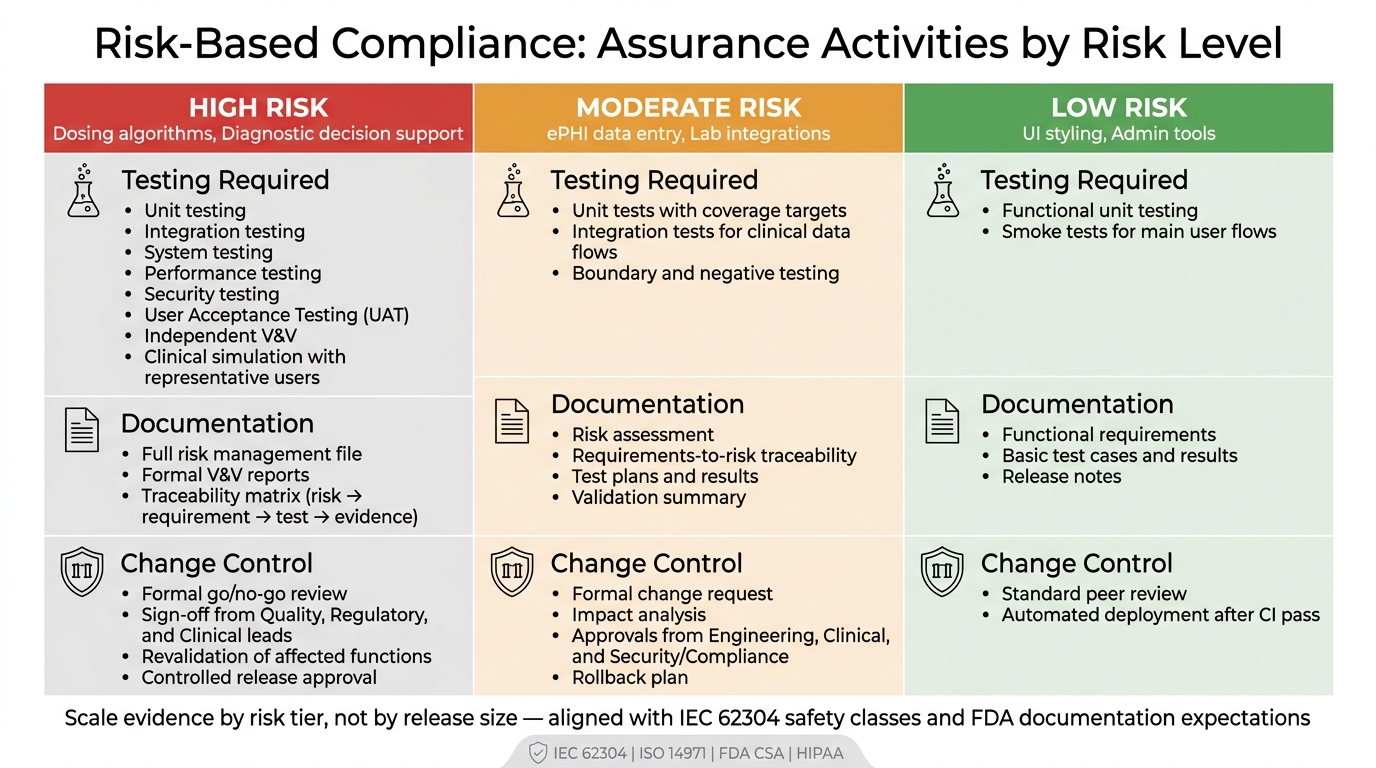
Test depth should match the risk. High-risk workflows like medication ordering need broad coverage: unit, integration, system, performance, security, UAT, and clinical simulation testing. Lower-risk functions, such as non-patient-facing dashboards, can rely on exploratory testing and targeted regression testing, as long as the risk analysis explains why that level is enough.
The same principle applies during design. High-risk modules that handle ePHI or clinical logic should go through component-level threat modeling. Lower-risk modules can use a high-level system threat model reviewed once a year. That keeps the process proportionate without skipping it.
Those links shouldn't stop at design or QA. They need to carry through to release criteria and post-release monitoring too.
Preserve the validated state after release
Validation doesn't stop when code reaches production. Release is not the finish line. Any change to code, configuration, infrastructure, integrations, or intended use can affect a previously validated state. Because of that, every such change needs a documented impact analysis before it goes live.
A useful filter is this: does the change affect a validated function, a critical data flow, or a security control? If the answer is yes, teams need targeted regression testing and documentation updates before deployment. And if a patch can touch a life-critical workflow, it should be validated before release. No shortcuts.
Configuration management matters just as much. The validated state includes more than application code. It also covers OS versions, database schema, third-party libraries, and integration endpoints. Automated tools that flag drift from approved baselines can catch problems before they hit production. Maintaining a Software Bill of Materials (SBOM) gives teams immediate visibility into which components are exposed when a new vulnerability is disclosed, which makes targeted risk reassessment much faster.
Production issues should also feed the system, not sit in a ticket queue and fade away. If an incident exposes a control gap that wasn't in the original hazard analysis, that gap needs a corrective and preventive action (CAPA) record and an update to the risk documentation. After release, incident reviews and vulnerability findings should feed back into the risk register. Teams should reassess at least once a year and after major changes to confirm that residual risk still remains acceptable.
Scale assurance activities based on risk category
Testing, documentation, and change control should scale by risk tier. Put differently, scale evidence by risk tier, not by release size. A small change in a high-risk module can need far more scrutiny than a large cosmetic change in a low-risk one.
The table below is the direct operational output of the risk scores established earlier. It shows how assurance activities should differ by risk level, aligned with IEC 62304 safety classes and FDA's basic vs. enhanced documentation expectations:
| Risk Level | Required Testing | Documentation Expectations | Change Control Rigor |
|---|---|---|---|
| Low (e.g., UI styling, admin tools) | Functional unit testing; smoke tests for main user flows | Functional requirements, basic test cases and results, release notes | Standard peer review; automated deployment after CI pass |
| Moderate (e.g., ePHI data entry, lab integrations) | Unit tests with coverage targets; integration tests for clinical data flows; boundary and negative testing | Risk assessment, requirements-to-risk traceability, test plans and results, validation summary | Formal change request; impact analysis; approvals from engineering, clinical, and security/compliance stakeholders; rollback plan |
| High (e.g., dosing algorithms, diagnostic decision support) | Full unit, integration, system, performance, security, and user acceptance testing; independent V&V; clinical simulation with representative users | Full risk management file, formal verification and validation reports, traceability matrix from risk to requirement to test to evidence | Formal go/no-go review with Quality, Regulatory, and Clinical leads; revalidation of affected functions; controlled release approval |
High-risk changes need a formal go/no-go meeting before release, with sign-off from Quality, Regulatory, and Clinical leads. Low-risk releases can move through normal engineering approval and automated deployment pipelines. The key is to write these thresholds into SOPs and release gates so teams aren't guessing when the pressure is on.
Governance, documentation, automation, and conclusion
Roles, risk records, and audit-ready evidence
Risk-based compliance doesn't run on autopilot. It needs clear owners, clear decision rights, and records that stand up to scrutiny. That's how the risk tiers above turn into repeatable review and approval decisions.
Engineering owns implementation evidence. Security owns threat and vulnerability management. Quality/Regulatory owns the risk file and traceability. Clinical Safety reviews patient harm. Privacy/Compliance oversees HIPAA obligations. Executive Leadership sets risk appetite and accepts residual risk. Some risk management plans also name a Risk Management Authority with the power to block a release if overall residual risk is unacceptable.[7] From there, the job is to turn controls into clear ownership, records, and review cycles.
Auditors expect traceability in both directions - from hazard to control to requirement to design to test. Core artifacts include the hazard log, traceability matrix, V&V records, residual-risk acceptance records, and change and incident records.
A cross-functional risk committee can handle residual-risk exceptions and vendor waivers. When that happens, document the rationale, conditions, and review date.
Once ownership is clear, automation helps keep assessments current and cuts down on spreadsheet drift.
Using Censinet to streamline healthcare risk operations
Spreadsheet-based risk workflows in healthcare often lead to version control problems, uneven questionnaires, siloed work, and evidence buried in email threads.[8] The result? A risk register that can fall behind what's actually happening.
Censinet RiskOps™ is built for healthcare organizations managing risks across clinical applications, medical devices, PHI, and third-party supply chains. It puts risk assessments in one place, tracks corrective action plans, and supports cybersecurity benchmarking across healthcare delivery organizations and their vendors. In plain terms, it acts as the operating layer that keeps the risk register, evidence, and remediation tracking current at scale.
| Dimension | Spreadsheet-Based Workflow | Censinet RiskOps™ Platform |
|---|---|---|
| Assessment Speed | Weeks or months of back-and-forth emails | Days or hours via automated workflows |
| Consistency | Varies by assessor experience | Standardized scoring models and peer benchmarking |
| Auditability | Fragmented files and version control issues | Centralized, time-stamped audit trail of all decisions |
| Remediation Tracking | Manual follow-ups; often dropped after initial review | Automated alerts and real-time tracking of open items |
With governance and automation in place, the risk model becomes something a team can keep up with instead of something they chase.
Conclusion: Build compliance around real risk, not uniform effort
Risk-based compliance works when effort matches actual risk, not release size or fear. The point isn't cleaner paperwork. It's safer care delivery, stronger operational resilience, and compliance outcomes that can be defended in front of regulators, clinical leadership, and patients alike.
FAQs
How do we start a risk register?
Start by building an inventory of clinical assets and workflows that handle ePHI or touch patient safety. From there, set the scope and identify threats and weaknesses with a structured risk analysis.
For each risk, record:
- the asset
- the threat
- likelihood
- impact
- current safeguards
- residual risk
- owner
- remediation deadline
- status
Then rank risks based on clinical criticality and exploitability. Use the register to track fixes and support compliance.
Which software changes need revalidation?
Any change that affects ePHI handling needs a documented risk review. That covers updates to access controls, encryption, multi-factor authentication, system integrations, mobile features, and infrastructure.
You also need to revalidate after major application updates, security patches, cloud migrations, major workflow changes, security incidents, or when you add network-connected devices.
Who should approve high-risk releases?
High-risk releases should move forward only after explicit approval from formal leadership through a documented go/no-go security gate.
The designated Security Official should oversee the risk management plan and authorize the final decision. That includes formally accepting any unresolved high-risk findings before release.
