
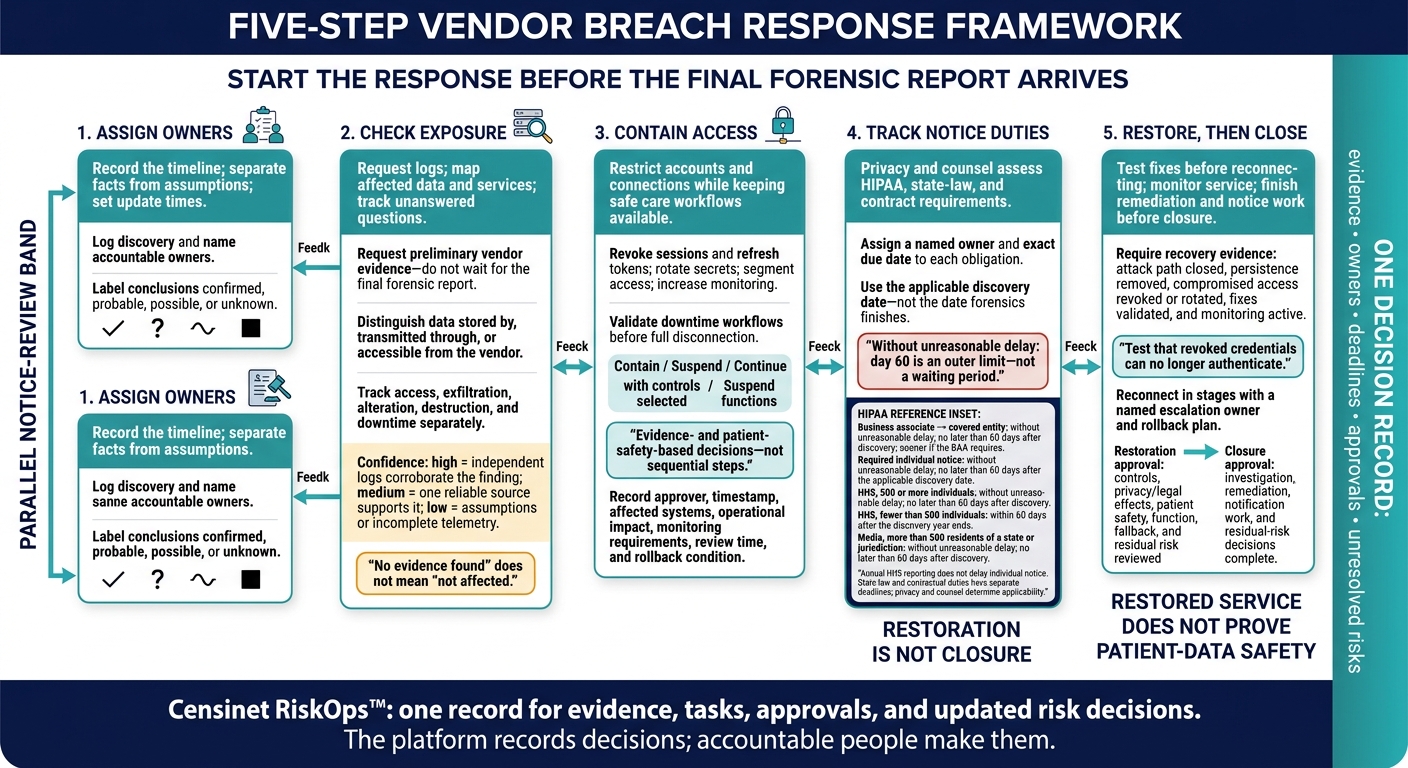
When a vendor is breached, I start the response before the final forensic report arrives. I log discovery, limit affected access without putting patients at risk, and start reviewing PHI exposure and notice duties. HIPAA’s 60-day limit for certain notices is an outer limit - not permission to wait.
My response follows vendor breach response best practices across five steps:
- Assign owners: Record the timeline, separate facts from assumptions, and set update times.
- Check exposure: Request logs, map affected data and services, and track unanswered questions.
- Contain access: Restrict accounts and connections while keeping safe care workflows available.
- Track notice duties: Have privacy and counsel assess HIPAA, state-law, and contract requirements, with a named owner and due date for each.
- Restore, then close: Test fixes before reconnecting, monitor service, and finish remediation and notice work before closure.
Restored service does not prove patient data is safe. I keep supporting records, approvals, and remaining risks in Censinet RiskOps™ so <u>each decision has an owner and a documented basis</u>.
Vendor Breach Response: Five Steps to Safe Closure
The Boardroom Meltdown: The Cost of a Vendor Breach
sbb-itb-535baee
Assess Exposure and Limit Vendor Access
Once you’ve classified the event, move from suspicion to evidence.
Request Incident Evidence from the Vendor
Security checks the facts; vendor risk tracks evidence requests and follow-up. Ask for a written preliminary incident package - don’t wait for the vendor’s final forensic report. Require:
- Timeline and scope: Timestamps, with time zones, for initial access - or compromise, if confirmed - discovery, containment, eradication, and recovery. Include affected products, environments, systems, data stores, interfaces, regions, and subcontractors, along with draft customer communications, proposed notice language, law-enforcement restrictions, and reporting limitations.
- Accounts and data: Affected identities and access paths, including user, service, admin, API, VPN, and subcontractor access. Identify potentially affected PHI, credentials, payment data, employee data, and service data. Provide estimated counts of affected patients, members, employees, and records.
- Evidence and corrective actions: Authentication, database-query, cloud-audit, and file-access logs; endpoint telemetry; network-flow data; indicators of compromise; threat-intelligence and forensic findings; root cause; containment actions; remediation steps; and a validation plan. Include retention gaps and what the vendor cannot yet determine.
Track the owner, vendor contact, request date, due date, response, evidence received, confidence, open questions, and next follow-up. Label every conclusion confirmed, probable, possible, or unknown. When evidence is missing, record the interim assumption and escalation date. An unsupported assurance does not close the request.
Use the vendor packet to check what was exposed and which services still need restrictions.
Confirm Affected Data and Services
Privacy, security, identity, infrastructure, and service owners should reconcile vendor findings with internal records. Before narrowing access, map downstream clinical and billing dependencies, including EHR, laboratory, pharmacy, imaging, scheduling, claims, and subcontractors.
Compare contracts, data-flow maps, inventories, and patient and transaction histories against identity, VPN, API, cloud, application, firewall, proxy, endpoint, and network logs. Separate data stored by, transmitted through, or accessible from the vendor. Track access, exfiltration, alteration, destruction, and downtime separately.
Use this exposure matrix to replace scope estimates with validated counts as evidence arrives.
Data type Affected system or integration Population Status Evidence source Confidence Owner PHI Vendor-hosted care-management database or clinical interface Unique patients and records Confirmed access; exfiltration unknown Vendor database logs; internal API logs; patient-record histories High for access; medium for exfiltration Privacy and application owner Credentials Vendor API integration Accounts and connected systems Compromised Identity-provider and API-gateway logs High IAM owner Payment information Billing interface Accounts and transactions No evidence of access; review incomplete Vendor statement; incomplete query logs Low Revenue-cycle security owner Service data Scheduling integration Clinics, workflows, and transactions Integrity and availability impact possible Queue errors; application monitoring Medium Clinical operations owner
Alongside each entry, record the investigation window, last-known-good date, last-known-compromised date, affected data owner, required containment action, and next evidence request.
Apply confidence ratings consistently: high when independent logs corroborate the finding, medium when one reliable source supports it, and low when it rests on assumptions or incomplete telemetry.
“No evidence found” does not mean “not affected.”
Use the exposure map to decide whether access stays limited or is fully suspended.
Contain Access While Protecting Patient Care
Identity and infrastructure teams should restrict implicated accounts, revoke sessions and refresh tokens, rotate secrets, segment access, and increase monitoring. Preserve logs and forensic evidence unless doing so would delay urgent isolation.
Validate downtime workflows before full disconnection. Narrow access while preserving urgent clinical workflows: containment must limit damage without causing avoidable care disruption.
| Decision | Compromise evidence | Clinical criticality | Workaround | Patient-safety impact | Required approval |
|---|---|---|---|---|---|
| Contain | Suspicious activity or exposed credentials, but no confirmed lateral movement | Moderate or high | Partial manual process or segmented operation available | Low if access is narrowed and monitored | Security incident lead, system owner, and clinical operations |
| Suspend | Confirmed compromise, active attacker access, malware, or unexplained data changes | Low or moderate, or safe downtime process exists | Tested downtime workflow available | Acceptable and time-bounded | Incident commander, clinical executive, privacy/legal as applicable |
| Continue with controls | No compromise evidence in the organization’s environment and vendor containment supported by evidence | Critical | No safe alternative or interruption would threaten care | High if service stops | Incident commander, clinical executive, CISO, and service owner |
| Suspend selected functions | Administrative or transfer functions implicated, but the core clinical function can operate safely | High | Core service remains available through segmentation or manual steps | Lower than full shutdown | Security, service owner, and clinical continuity lead |
For every action, record the approver, timestamp, affected systems, expected operational impact, monitoring requirements, review time, and rollback condition. Reassess when new evidence arrives, the vendor changes its assessment, or clinical conditions change. Feed the containment record into breach-notification review and restoration planning.
Determine Notification and Reporting Duties
Once exposure and containment are documented, turn those facts into legal and contractual notice deadlines. The designated privacy officer and counsel make notice and reporting decisions. Security provides technical findings, while vendor risk management enforces contract duties.
Base each obligation on the logged discovery date, affected information, applicable law, and contract - not a blanket 60-day countdown. Use the exposure map and case record to identify which notice duties begin now.
Assess HIPAA Breach and Contract Requirements
Determine whether the vendor acted as a business associate and whether unsecured PHI was involved. Check whether encryption or destruction met applicable requirements, including whether encryption keys were compromised.
Document any applicable HIPAA exception. For example, an inadvertent disclosure between authorized persons may qualify if the information was not further used or disclosed impermissibly. A limited data set is not itself an exception.
If no exception applies, treat the event as a breach unless a documented risk assessment shows a low probability that PHI was compromised. Assess all four required factors - the vendor’s conclusion alone does not decide the outcome:
- Nature and extent of PHI: Identifiers and the risk of re-identification.
- Unauthorized recipient: Who received or used the PHI.
- Actual exposure: Whether PHI was acquired or viewed.
- Mitigation: How much mitigation reduced the risk.[1][2][9]
Review the BAA and related agreements for deadlines, updates, cooperation, audit rights, notice support, and cost allocation. Counsel should separately assess state laws, insurance conditions, payment-card obligations, and other applicable reporting rules. A contractual reporting deadline does not replace a legal notification deadline.[7][8][13]
Assign Notice Owners and Track Deadlines
Counsel should establish the controlling discovery date for each duty: when the entity knew or should have known of the breach, not when forensics finished. Use the vendor and covered-entity discovery dates already logged to set each notice clock. Assign one accountable owner to each tracker entry and calculate exact due dates.[9]
Track obligations separately. One deadline does not control the others. When HIPAA requires notice without unreasonable delay, day 60 is an outer limit - not a waiting period.
| Trigger or obligation | Decision-maker / accountable owner | Deadline | Evidence required | Recipient | Status |
|---|---|---|---|---|---|
| Business associate discovers a breach | Privacy officer and vendor-risk lead | Without unreasonable delay; by day 60 at the latest after discovery, and sooner if the BAA requires.[8][13] | Vendor notice, discovery timeline, BAA | Covered entity | Open / received / overdue |
| HIPAA individual notice required | Privacy officer, with counsel approval | Without unreasonable delay; by day 60 at the latest after the applicable discovery date.[1][10] | Breach assessment, affected-person list, approved notice | Affected individuals | Pending / approved / sent |
| Breach affects 500 or more individuals | Privacy officer, with counsel review | Without unreasonable delay; by day 60 after discovery.[8] | Validated count, incident facts, submission receipt | HHS Secretary | Pending / filed |
| Breach affects fewer than 500 individuals | Privacy officer | Within 60 days after the discovery year ends.[8][9] | Breach log, count, incident record | HHS Secretary | Logged / filed |
| Breach affects more than 500 residents of a state or jurisdiction | Communications lead, with privacy and counsel approval | Without unreasonable delay; by day 60 after discovery.[1][12] | Resident counts, approved release, delivery record | Prominent media serving the affected state or jurisdiction | Pending / sent |
| State, insurance, payment-card, or other duty triggered | Counsel assigns the accountable filing owner | Applicable legal or contractual deadline | Obligation analysis, required filing, receipt | State regulator, insurer, card brand, or other required recipient | Open / due / filed |
Annual HHS reporting does not delay individual notice.[1][8][9] Counsel should approve notice content covering what happened, the information involved, protective steps, response actions, and contact details.
Review any legally permitted delay and retain documentation of its authority, scope, and duration. An unfinished vendor investigation alone does not justify a delay. Preserve approvals, count revisions, reasons for any delay or non-notification, and delivery receipts. If the vendor sends notices or files reports, verify completion - the covered entity retains accountability.[1][8][11]
Restore Services and Confirm Fixes
Use the exposure map, containment record, and notice decisions to control each restoration step. Restoration is not closure. The recovery record must show whether the service can safely reconnect. Build on the incident record created during containment and notification review. Closure requires completed investigation, remediation, notification work, and residual-risk decisions. Keep restoration and closure approvals separate.
Require Evidence Before Restoring Access
Require a written recovery package that confirms the attack path, root cause, revoked access, removed persistence, remediation, validation results, and active monitoring. It must document:
- How the attack path was closed and persistence removed.
- Revocation or rotation of compromised accounts, API keys, tokens, certificates, and sessions.
- Vulnerability fixes or approved compensating controls.
- Clean-backup validation, malware and integrity scans, and active monitoring.
Test that revoked credentials can no longer authenticate. A rotation record alone is not enough. Preserve evidence, record remaining unknowns, and wait until review is complete before rebuilding.
Pause restoration until all required evidence and approvals are complete. Security approves controls; privacy/legal reviews privacy and legal effects; clinical operations checks patient safety; the service owner verifies function; business continuity approves fallback; and the risk owner accepts remaining risk.
Reconnect in stages. Start with narrowly scoped access, then expand only after interface and workflow checks. Set a risk-based monitoring period, name an escalation owner, and write a rollback plan. Suspend access if indicators of compromise return, logs disappear, activity occurs without permission, or care workflows become unsafe.
Track Remediation and Incident Closure
Once reconnection begins, use the tracker to verify fixes, residual risk, and readiness for closure. Check that fixes address both technical exposure and the effect on care.
Maintain the tracker below with named owners and exact dates. Verify fixes through testing, access reviews, configuration checks, or audit evidence - not vendor assurances alone. Reassess vendor and fourth-party exposure, PHI risk, service impact, and patient safety.
Reconcile notice delivery and patient inquiries, complete an after-action review, and update contracts and continuity plans where needed. Document whether the relationship continues, continues under conditions, is suspended, or ends. Preserve records under retention rules and legal holds. Every open item needs an owner and a review date.
| Finding | Business impact | Corrective action | Owner | Due date | Completion evidence | Residual risk | Approval status |
|---|---|---|---|---|---|---|---|
| Compromised vendor access | Access to PHI or systems without permission | Revoke exposed credentials and sessions; test denied access | Vendor identity lead; internal security reviewer | Before reconnection | Revocation logs, access review, negative-test results | Document any unresolved access gap. | Security sign-off required |
| Restoration integrity not verified | Unsafe or unreliable clinical service | Validate clean restoration, interfaces, and downtime workflow | Vendor recovery lead; clinical service owner | Before affected service resumes | Integrity checks, restoration results, signed workflow test | Document temporary controls. | Security and clinical sign-off required |
| Fourth-party scope unresolved | Unknown downstream exposure | Complete downstream investigation and update risk assessment | Vendor-risk lead; vendor investigation owner | Exact investigation deadline | Scope findings and updated assessment | Document unresolved downstream exposure and the review date. | Privacy/legal and risk-owner decision required |
Tie every remediation decision to the same case record.
Keep the Decision Record in Censinet RiskOps™
Use Censinet RiskOps™ as the single record for evidence, tasks, approvals, and updated risk decisions, keeping them in one decision history. Link PHI findings, affected services, monitoring results, fourth-party risks, and contract actions. Give each task an owner, deadline, evidence attachment, and escalation path.
Keep notification decisions, access authorization, clinical restoration, and residual-risk acceptance with accountable people. The platform records those decisions; accountable people make them.
Conclusion: Require Evidence Before Each Decision
Require evidence at every step before closing the case. Confirm that the incident is verified, exposure is scoped, access is contained, notice duties are documented, and restoration is approved. Verify remediation and follow-up before closure.
If the vendor cannot establish whether PHI was accessed or exfiltrated, document the uncertainty and escalate it to privacy counsel. Treat it as unresolved until privacy counsel completes the HIPAA breach assessment and documents a low probability of compromise.[6]
Restored service does not prove patient-data safety. Require each owner to document approval evidence, unresolved questions, and triggers for reopening the case in one decision record. Keep every final decision and its supporting evidence in Censinet RiskOps™.
FAQs
What if our vendor won’t share breach evidence?
Start with your Business Associate Agreement (BAA). Use it to enforce the vendor’s forensic cooperation and incident reporting obligations [1][2]. Escalate the issue through your designated vendor liaison, following established communication protocols [3][4].
If the vendor still won’t comply, document every information request and risk assessment decision to show due diligence to the Office for Civil Rights [1][5]. You may also need to exercise your right to suspend access to protect your environment [2][5].
How do we handle changing patient counts after notification?
If the number of affected patients changes after your initial notification, update your regulatory filings to maintain HIPAA compliance. Reporting requirements depend on how many individuals are affected. Document any changes accurately and notify the Department of Health and Human Services (HHS) promptly through its Office for Civil Rights (OCR) portal.
Keep a detailed log of who you notified, when you notified them, and what information you shared. This record supports audits and post-incident reviews.
When should we end a breached vendor relationship?
End the relationship only after vendor access is contained and stabilized without compromising patient care. First, obtain the evidence needed for the HIPAA risk assessment and timely notifications and reporting, including compliance with the 60-day outer limit.
To contain access, revoke credentials and tokens and shut off exposed integrations. Before restoring or continuing services, confirm that vulnerabilities are patched and the vendor’s environment is secured. Document the remediation work and all decisions. [1][2][3]
