
If a resilience team pushes back, I would not treat it as a people problem. I would treat it as a fit problem. In healthcare, teams judge platforms by one test: does this make incident response, vendor risk management work, compliance proof, and clinical downtime handling easier - or harder?
Here’s the short version:
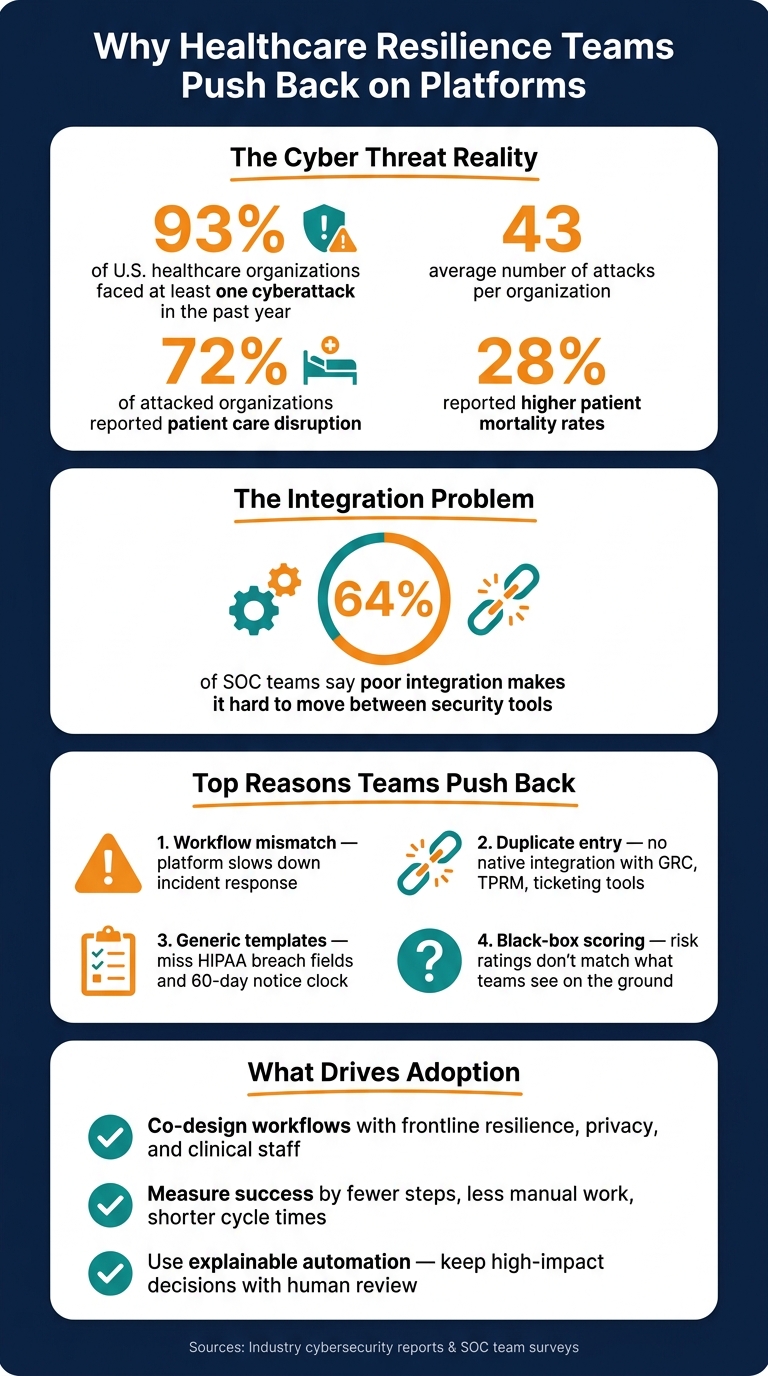
- Pushback usually means workflow mismatch, not dislike of change.
- Poor integration leads to duplicate entry, stale records, and side spreadsheets.
- Generic templates miss healthcare needs like HIPAA breach details, PHI review, and the 60-day notice clock.
- Black-box scoring loses trust fast when risk ratings do not match what teams see.
- Rollouts work better when frontline staff help shape workflows before go-live.
- Success should be measured by less manual work, fewer handoffs, and shorter cycle times. For example, Emory Healthcare streamlined their TPRM program to achieve these efficiencies.
A few numbers make the issue plain:
- 93% of U.S. healthcare groups faced at least one cyberattack in the past year.
- They saw an average of 43 attacks per organization.
- 72% of those hit by common attack types reported patient care disruption.
- 28% reported higher patient mortality rates.
- 64% of SOC teams say poor integration makes it hard to move between tools.
So if you want platform adoption, I would start with the work itself:
- map current incident, vendor, and downtime workflows
- test platform fit with live-use scenarios
- check system-to-system data sync, not just API claims
- keep automation for routing and evidence collection
- keep high-impact decisions with human review
- track results like fewer emails, fewer spreadsheets, and shorter assessment time
Bottom line: adoption goes up when the platform removes friction from daily healthcare risk work. If it adds steps, teams will work around it.
Healthcare Cybersecurity & Platform Adoption: Key Stats
Why Healthcare Resilience Teams Push Back on Platforms
In the real world, pushback tends to start when a platform gets in the way of the work resilience teams need to do most.
Workflow Disruption During Incident Response and Risk Operations
The first signs usually appear during live incident response. Governance-heavy platforms are built for audit trails, and that sounds fine on paper. But during an active ransomware incident, it can turn into a major problem.
If analysts need to isolate affected systems and alert clinical leadership right away, the last thing they need is a system that forces them to pick required incident categories and move through required approvals before any action is logged. That kind of setup can lead to slower containment, delayed notifications, and stalled escalations.
Clinical continuity work can fall apart for the same reason. A team dealing with a medication administration system outage needs to speak directly and fast with nursing leadership and pharmacy. They do not have time to sit in task queues built for normal review cycles. When response chains get too tangled, detection slows down, action gets delayed, and no one is fully sure who owns the next decision.
Even when a team can live with the workflow, weak integration creates another problem: extra manual work.
Duplicate Entry, Weak Integration, and Added Administrative Burden
When a resilience platform does not connect natively with the GRC, TPRM, asset management, vulnerability, and ticketing tools a team already uses, analysts end up doing the glue work themselves. They have to re-enter vendor profiles, security questionnaire results, remediation updates, and incident details across multiple systems.
That drains time from actual risk management and creates inconsistencies. If a remediation task is closed in ServiceNow but still appears open in the resilience platform, the team cannot trust the risk view without checking the source systems by hand. That is not a small annoyance. It changes how people use the platform day to day.
In fact, 64% of SOC teams report struggling to pivot between security tools due to poor integration.[1] In healthcare settings, where vendor relationships, PHI data flows, and clinical system dependencies are tightly regulated, that friction costs even more. What happens next is pretty predictable: teams fall back to parallel spreadsheets, platform data goes stale, and the analysts you most need start tuning the system out.
For healthcare teams, this burden is even harder to accept when the platform still cannot produce audit-ready evidence.
Poor Fit for Compliance Requirements and Low Trust in Scoring or AI
Healthcare vendor breach response assessments need structured fields for PHI type, affected population, minimum necessary analysis, and the 60-day notification timeline. Generic incident templates usually capture summaries, not the specific regulatory evidence auditors and regulators expect. So compliance teams end up piecing together audit packages by hand from multiple systems, which adds work and increases the odds that something gets missed.
Trust also drops fast when scoring does not make sense. If a platform marks a vendor as high risk during triage or incident prioritization but does not show which inputs drove that score, teams start to ignore it. The same thing happens when an incident gets labeled low risk even though there is clear PHI exposure.
At that point, the platform stops being a decision tool and starts feeling like background noise. Without explainable models and clear scoring logic that reflects healthcare-specific risk drivers, such as patient safety impact and clinical workflow continuity, automated prioritization often clashes with what seasoned teams already know. That is why adoption often comes down to a simple test: does the platform explain its outputs, and does it fit healthcare-specific work?
sbb-itb-535baee
How to Tell Whether a Platform Actually Supports Resilience Operations
Once you've mapped the weak spots, put the platform under pressure. Check how it handles the day-to-day work behind healthcare resilience: incident response, clinical continuity, and third-party risk.
Check Fit with Incident Response, Clinical Continuity, and Third-Party Risk Workflows
Start with your current workflow. Write down who logs incidents, who assigns tasks, how escalations move, and where clinical teams step in. Then check whether the platform can mirror those flows without adding extra steps.
A platform built for healthcare resilience should support task ownership, escalation paths, communication logs, and recovery tracking without making analysts squeeze their process into a strange new setup. For third-party risk, it needs to do more than score questionnaires. It should support the full vendor lifecycle - onboarding, monitoring, reassessment, and exceptions - with vendor tiering based on EHR access, medical device dependencies, and PHI exposure. If it can't support that full lifecycle, teams will stop using it, leading to a negative economic impact on the organization.
A simple test helps here: can a frontline user finish a common task faster, with fewer handoffs, than before? If the workflow still feels awkward, adoption will suffer.
Verify Integration Depth and Single-Source-of-Truth Value
An API by itself doesn't prove much. What matters is whether the platform syncs assessments, evidence, assets, and risk data without manual rekeying or reconciliation.[5][6][7]
A real single source of truth gives the team one place to see what's open, who owns it, and the current vendor status. If analysts still have to pull out spreadsheets to reconcile records, then the platform has just added one more system to manage. Integration should cut handoffs, not pile on new ones.
Require Explainable Automation, Analyst Review, and Realistic Staffing Demands
If a platform marks a vendor as high risk or pushes an incident down the queue but can't show what drove that result, experienced teams won't trust it. Ask for scoring that clearly shows which inputs produced the output.[2][3][4]
Leaders also need to be clear about who will maintain workflows, update scoring rules, and tune the system over time. If that work lands on already stretched analysts, then automation hasn't removed effort - it has just moved it around. Use automation for repetitive work like data entry, status updates, and evidence collection, while leaving judgment calls with analysts.
The test is pretty simple: if the platform doesn't make the most important workflows easier, it isn't improving resilience. A solid evaluation should show less friction than the current process, not just a nicer-looking interface sitting on top of the same disconnected work.
What Improves Buy-In and Measurable Adoption
A platform can pass workflow and integration checks and still flop at rollout. Why? Because deployment often ignores how resilience teams work when the pressure is on. The same things that block adoption in the first place - extra steps, duplicate entry, weak integration, and low trust - need to be removed during deployment too.
What happens in the first few weeks matters a lot. What gets set up, who joins the rollout, and how success is tracked will decide whether the platform becomes part of daily work or just another system people work around.
Co-Design Workflows with Resilience, Privacy, Compliance, and Clinical Stakeholders
Start with current work, not policy. Map how teams handle incident response, vendor onboarding, evidence storage, and clinical dependencies. Then bring in the people who live those workflows every day: resilience, cybersecurity, privacy, compliance, third-party risk, and a clinical or operations leader.
Each group affects a different part of the process. Leave one out, and the gap usually shows up later as friction, delays, or a workaround nobody planned for.
Before go-live, test the setup with tabletop exercises and dry runs built around ransomware or vendor outage scenarios. That’s where weak spots show themselves fast. If analysts are fumbling through task routing or can’t pull a contact list during a simulated breach, that’s not a training problem. It’s a setup problem, and it needs to be fixed before anyone calls the platform ready.
Once the workflow is mapped, the next check is simple: does the rollout remove steps and manual work?
Tie Deployment to Fewer Steps, Less Manual Work, and Clear Outcome Metrics
Buy-in tends to follow visible work removal. Before deployment, set a baseline. Count how many emails, spreadsheets, and tools go into a standard vendor risk assessment or incident documentation cycle. Then set concrete targets, like cutting manual data entry by 30% and reducing the number of tools used in a vendor assessment.[10][11]
That kind of before-and-after view matters. Teams don’t buy into a platform because someone says it will help. They buy in when they can see that it cuts busywork.
The best success metrics tie back to the work frontline staff care about most, such as:
- shorter assessment cycle times
- fewer duplicate questionnaires sent to the same vendors
- faster closure of remediation findings
- clearer visibility into which critical vendors still have unresolved issues
Metrics linked to regulatory work matter too. Faster documentation of incidents that meet HIPAA breach thresholds can ease compliance pressure on already stretched teams.[8][9]
If the platform still needs manual oversight for every routine task, adoption usually slows down.
Use Human-Guided Automation to Support Decisions Without Replacing Oversight
Automation gets buy-in when it cuts burden without taking judgment away from clinical and risk teams. It should handle routing, reminders, and evidence collection. Analysts should still review and approve any high-impact risk decision.
That visibility matters. If a vendor is flagged or an incident is deprioritized, analysts need to see what drove that result. Otherwise, trust drops fast.
A cross-functional governance group should own the rules behind automation and review them on a set schedule. That group should include resilience, privacy, compliance, and clinical stakeholders. Their job is to review things like:
- which data sources feed risk scores
- what triggers an escalation
- when thresholds should change
When rule ownership is visible and reviews happen on schedule, trust in the platform grows.[12][13][14]
Conclusion: Adoption Improves When Platforms Fit Real Healthcare Resilience Work
Pushback from resilience teams usually points to a workflow mismatch, not a dislike of change. The problem is fit. If a platform slows resilience work down, teams will push back no matter how polished the pitch sounds.
Healthcare teams already juggle incident response, clinical continuity, vendor oversight, HIPAA-compliant privacy, and documentation under nonstop pressure. In that kind of setting, one test matters most: does the platform cut friction, or does it add more of it?
The right question isn't whether a platform looks better on a dashboard. It's much simpler: does it make daily resilience work faster, clearer, and less manual? If the answer is no, adoption will stall, even if the business case looks strong on paper.
Adoption grows when deployment follows how teams already work, brings in the right stakeholders from the start, and leads to results people can measure - fewer steps, less manual work, and clearer outcomes.
The strongest adoption model is the one that lines up with those workflow demands directly.
How Censinet Supports Adoption
Censinet RiskOps™ is built for healthcare risk and resilience workflows. That matters because adoption often breaks down in the space between a generic platform and the day-to-day work tied to clinical operations and vendor risk. Its value comes from cutting manual work and giving teams better visibility across third-party risk and incident response.
Tower Health cut vendor assessment time from 5–6 weeks to less than 1 week, moved 3 staff members to higher-value work, and saw a 3x increase in assessment productivity.[15] Baptist Health moved away from what their team described as
"spreadsheet chaos"
to a standards-based, automated approach aligned to recognized frameworks.[16]
Those results didn't come from a platform that simply offered more reporting. They came from one that removed friction from work teams were already doing every day.
Censinet AI supports human-guided automation, so analysts stay in control while the system handles routing, reminders, and evidence collection. That kind of explainable automation helps teams trust the process and use the platform day after day.
FAQs
How can we spot platform fit issues early?
Start with a close audit of your current GRC setup, policies, and workflows. Trace how data moves across departments so you can spot bottlenecks and silos before they turn into bigger problems.
Before a full rollout, run a pilot or parallel test alongside your current processes. This gives you a chance to validate outputs, confirm that tracked risks are covered, and make sure the platform fits your clinical and administrative workflows without causing disruption.
What integrations matter most for healthcare resilience teams?
The most important integrations tie risk management directly to the clinical setting, including EHRs, medical devices, admin systems, and current vendor networks.
These connections help teams bring risk data into one place, track third-party access, watch how vendor incidents affect patient care, and build risk assessment into core GRC, IT, and procurement workflows.
How should we measure adoption after rollout?
Measure adoption by looking at two things over the first 6 to 12 months: day-to-day team output and whether people actually trust the system.
A good rollout should lead to shorter assessment cycles and broader vendor coverage without adding staff. You should also see fewer unmanaged high-risk vendors, along with steady progress on remediation and compliance work. On the operations side, watch incident response times, policy exceptions, and the mix of standard changes versus emergency changes.
Trust matters just as much. If AI alerts throw off too many false positives, teams will stop paying attention fast. The platform should keep noise low enough that people rely on it during normal work, not just when leadership is watching.
It also helps to gather frontline feedback. That’s often where you find out if the platform is part of daily work or if people are sidestepping it.
