
General AI security is not enough for hospitals. If AI can shape diagnosis, touch PHI, or sit inside a medical device, health systems need controls built for patient safety, HIPAA, FDA rules, and third-party AI risk.
Here’s the short version:
- AI use is already common in hospitals. By 2024, about 80% of U.S. hospitals used AI somewhere, and 31.5% of nonfederal hospitals were already using generative AI.
- Project Glasswing looks at technical AI risk. That covers things like model attacks and weak APIs.
- But hospitals face extra risk that broad AI security work does not fully address:
- bad triage or diagnosis output that affects care
- PHI leakage through prompts, logs, or vendor tools
- hidden AI inside devices and third-party platforms
- Shadow AI is part of the problem. About 40% of hospitals are estimated to have it.
- The fix is not just cyber control. I’d tie AI review to clinical impact, PHI use, and device status, then test, monitor, and review each tool based on that risk.
If I were leading this work, I’d keep the focus on three questions:
- Can this AI affect patient care?
- Can it expose PHI?
- Is it inside a regulated device or vendor product?
That simple frame gets closer to what hospitals need than a model-security-only approach.
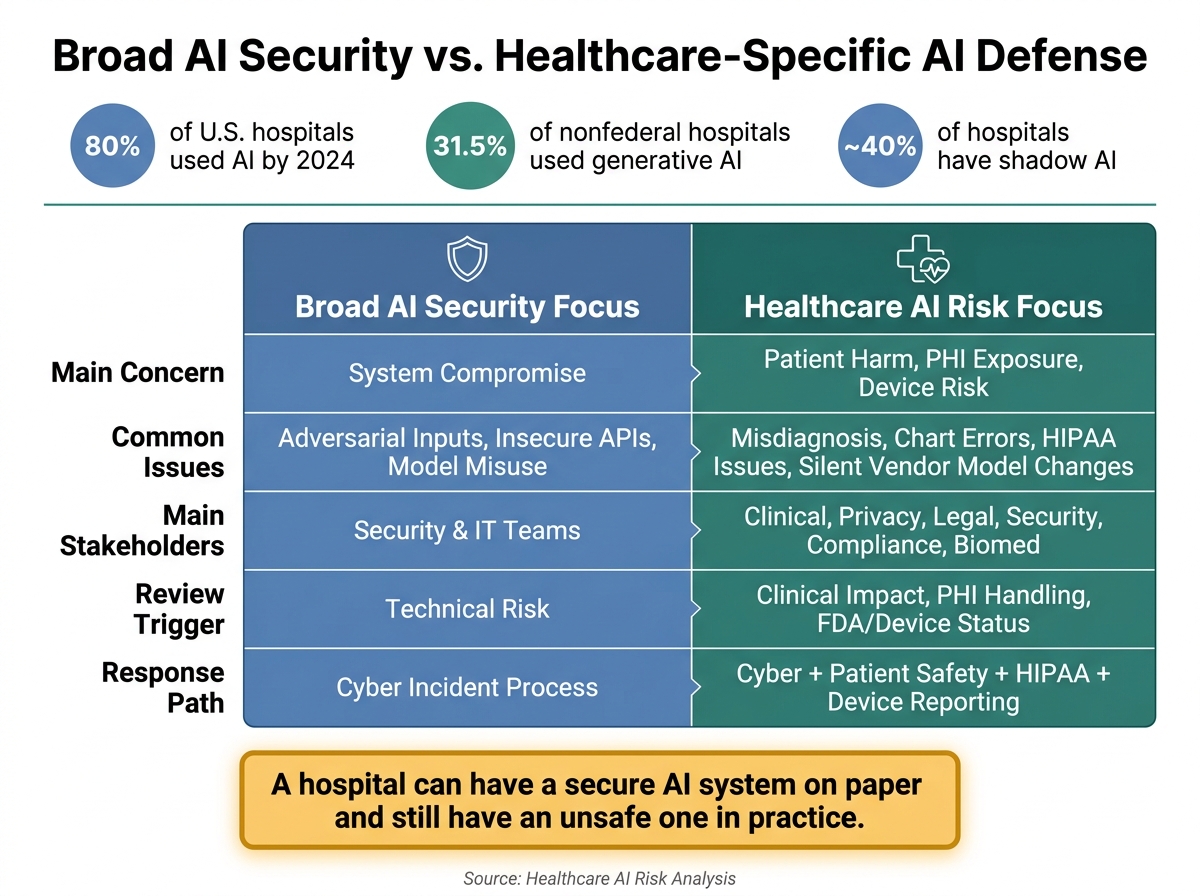
Broad AI Security vs. Healthcare-Specific AI Defense: Key Differences
AI Cybersecurity Risks and Compliance for Healthcare Organizations
sbb-itb-535baee
Quick comparison
| Area | Broad AI security focus | Healthcare AI risk focus |
|---|---|---|
| Main concern | System compromise | Patient harm, PHI exposure, device risk |
| Common issues | Adversarial inputs, insecure APIs, model misuse | Misdiagnosis, chart errors, HIPAA issues, silent vendor model changes |
| Main stakeholders | Security and IT teams | Clinical, privacy, legal, security, compliance, biomed |
| Review trigger | Technical risk | Clinical impact, PHI handling, FDA/device status |
| Response path | Cyber incident process | Cyber + patient safety + HIPAA + device reporting |
So the case is simple: a hospital can have a secure AI system on paper and still have an unsafe one in practice. That is the gap this article addresses.
The Gaps Broad AI Security Initiatives Leave in Healthcare
Broad AI security efforts can lock down systems and still miss what matters most in healthcare: patient care, PHI, and connected devices. In this setting, the main risks aren't just hacked apps or exposed servers. They're missed treatment, leaked patient data, and AI built into tools that touch care every day.
Those weak spots tend to show up in three areas: clinical workflow, PHI handling, and connected devices.
Clinical Workflow Risk: How AI Can Affect Care Without Breaking Software
When AI sits inside clinical decision support, it doesn't need to fail at the software level to cause harm. It shapes what clinicians see first, what looks urgent, and what gets acted on.
A sepsis tool or triage model can rank patients the wrong way and slow treatment, even if no one touched the code.
Under pressure, clinicians may lean on AI output even when it clashes with their own judgment. That risk gets sharper with LLM tools, which can produce advice that sounds sure of itself and still be wrong. If that output makes its way into the chart, it can steer care in the wrong direction later on, without anyone tagging it as a security issue.
There's another problem here too: scope drift. A model that was checked for one patient population can end up used on another, even when no one patched it, blocked it, or changed the system at all.
The same blind spot shows up when clinicians use generative AI with patient records.
PHI Exposure Risk: Prompt Leakage and Unsafe Generative AI Use
Generative AI moved into clinical documentation fast. In many cases, the guardrails didn't move with it.
A clinician or coder can paste patient data into an AI tool, and suddenly PHI has left the covered environment. At that point, the hospital may not have clear terms for retention, model training, or downstream use. If a tool takes in PHI, the hospital needs contract terms and HIPAA controls in place, including a valid BAA where required.
But exposure isn't the only issue. There's also a data integrity problem.
If generative AI writes into the chart, made-up diagnoses can spread from one place to the next. What starts as a bad output can flow into billing, quality reporting, and decision support. That's a nasty chain reaction, because one error doesn't stay put.
The risk grows again when AI is baked into devices and vendor platforms.
Device and Vendor Risk: How Connected AI Systems Expand the Attack Surface
AI inside CT systems, bedside monitors, remote patient monitoring platforms, and revenue cycle tools creates direct risk for care delivery. And many of these systems arrive with AI features that were never put through formal risk review.
Hospitals often can't confirm how embedded models were trained, checked, or updated. If an imaging AI's sensitivity or specificity shifts after a silent update, the clinical team may not know. The biomedical engineering team may be left out too.
That's where general AI security programs miss the mark. They tend to focus on cloud and app environments. Healthcare has a different problem: a networked device can be patched and still be unsafe in practice if its AI behavior isn't governed.
In other words, a "secure" system on paper can still create risk at the bedside.
That is why healthcare AI defense has to cover both software behavior and care delivery.
Healthcare AI Threat Scenarios Leaders Should Evaluate
Those gaps point to three threat scenarios leaders need to pressure-test: clinical AI, documentation AI, and vendor AI.
Clinical Decision Support, Diagnostics, and Imaging Manipulation
Clinical AI can fail fast when inputs are tampered with, training data is poisoned, or the model starts to drift. And the drop-off can be brutal. In breast cancer deep learning systems, adversarial attacks cut recognition accuracy from 98.90% to 10.99%. [11] That’s not a small miss. That’s a collapse.
Data poisoning is just as troubling. Attackers may need only 100–500 poisoned samples to compromise healthcare AI systems, with attack success rates of 60% or more. [2][3][4] So no, a large dataset by itself doesn’t make a model safe.
Then there’s drift. A model may look fine at the top-line level and still fail for certain patient groups. That creates a direct patient safety issue and opens the door to health equity problems too. Before any clinical decision support or imaging AI goes live in a care setting, the bare minimum is local validation on your institution’s own data, broken out by subpopulation. [6][8][15]
The same issue doesn’t stop at diagnosis. It shows up again when generative AI starts writing in the chart.
Documentation, Coding, and Revenue Cycle AI Misuse
AI scribing brings a documentation integrity problem that’s easy to miss at first glance. Generative AI can produce notes that sound right, read smoothly, and still include details that were never discussed. [7] That’s where things get messy.
Once those notes move into billing workflows, the risk shifts from bad documentation to payment and legal exposure. Systematic upcoding can trigger audits from Recovery Audit Contractors, Medicare Administrative Contractors, or commercial payers. In more serious cases, it can lead to False Claims Act liability. Undercoding creates its own set of problems.
Prior authorization and utilization management AI add another pressure point. Staff can start to lean too hard on denial recommendations simply because the system sounds sure of itself. That kind of automation bias can shape access to medically necessary care in ways people may not catch right away. [10][12][13][14]
The risk climbs again when AI enters through outside products and embedded tools.
Third-Party and Supply Chain AI Transparency Gaps
Vendor products like EHR modules, imaging platforms, revenue cycle management suites, and payer tools may come loaded with AI features that were never clearly disclosed and never formally reviewed. That blind spot matters.
A phishing-led compromise of Xsolis, an AI-powered utilization management vendor, exposed the protected health information of 1,396,519 individuals across seven hospital systems. The exposed data included Social Security numbers, insurance information, and treatment details. [16]
Most vendor reviews still focus on the usual checklist:
- access controls
- encryption
- incident response
Those checks matter, but they often skip the AI layer entirely. Organizations can close this gap by using automated security questionnaires to pressure-test vendor AI claims. Teams may never ask which models are embedded, where the training data came from, or how model updates are pushed into production. Contracts can make the problem worse by pushing liability back to providers and describing AI outputs as informational only. [5][9][15]
If AI-specific questions aren’t built into vendor review, an organization can approve a vendor that clears baseline cybersecurity checks while still bringing in opaque AI behavior that touches patient care and PHI.
Use these scenarios to set control criteria, governance checks, and vendor review questions.
A Practical Framework for Healthcare-Specific AI Defense
A useful starting point is the NIST AI Risk Management Framework (AI RMF 1.0). It gives healthcare groups four functions: Govern, Map, Measure, and Manage.[25][26][1] In plain English, that means setting risk limits, listing AI use cases, checking them for safety and misuse, and then putting guardrails in place.
In healthcare, those four functions should tie back to the three risks that matter most here: clinical misclassification, PHI leakage, and opaque vendor AI. Start by sorting each AI use case into three tiers: clinical impact, PHI exposure, and device status.
Apply NIST AI RMF to Tier Risk by Clinical Impact, PHI, and Device Status
Govern is where boards, clinical leaders, and risk owners decide what level of danger the organization will accept around patient safety, care quality, and regulatory exposure. If an AI tool can shape a diagnosis or treatment decision - like CDSS or imaging triage - it should not move forward without clinical governance approval.[24][26][27]
Map means writing down every AI use case and tagging it with healthcare-specific details. That includes whether PHI is used during training, inference, or both; which PHI types are involved; whether the tool is FDA-regulated Software as a Medical Device (SaMD); how much human review exists; and whether a third-party vendor runs any part of it. Behavioral health and substance use disorder data should be marked as highly sensitive.
Measure is where the rubber meets the road. High-impact AI needs safety and performance checks on patient groups that match the population it will touch. It also needs bias testing across age, race, sex, and comorbidity groups, plus red-team testing for unsafe outputs. Medium-impact AI should focus more on workflow reliability, documentation mistakes, and PHI leakage risk. Lower-impact automation still needs protection, but the focus shifts toward data handling and process control.
Manage turns those findings into day-to-day controls. High-impact systems need mandatory human-in-the-loop review. PHI should stay segregated in training environments. AI tied to connected devices needs tighter monitoring. And incident playbooks should line up with patient safety reporting, HIPAA breach notification, and FDA post-market surveillance rules - not just a standard cyber response plan.[25][26][1]
General AI security helps protect models. Healthcare-specific AI defense is about protecting patients, PHI, workflows, and regulated devices.
Once you’ve tiered risk, you can set clear rules for review, monitoring, and escalation.
Build AI Governance Controls Around Real Clinical Workflows
Start with an AI inventory that includes every AI-enabled tool, whether it was built inside the organization or bought from a vendor. Each record should list the clinical use case, department, PHI categories handled, device status, risk tier, known failure modes, and named owners across clinical, IT, security, and compliance. This is how organizations stop AI from slipping into care delivery through side doors, including shadow AI use and workflow drift.
An AI intake process should sit inside existing IT change management or digital health steering workflows. That way, teams review new tools before deployment instead of scrambling after the fact. Requestors should document intended use, affected workflows, patient populations, PHI use, and human oversight needs, along with an initial risk self-assessment based on NIST AI RMF criteria. A cross-functional AI governance committee - with leaders from clinical, security, privacy, legal, and operations - can then review medium- and high-risk use cases and set the minimum bar for validation and monitoring.[28][29][30][32][33]
For clinical AI, shadow-mode deployment is one of the smartest checks you can use. It lets teams compare AI output against clinician decisions before the tool starts shaping live care. Monitoring plans should then track signals tied to the actual workflow, such as adverse events linked to AI recommendations, odd billing patterns in revenue cycle tools, and PHI misdirection in generative documentation tools. AI incident response playbooks also need to plug into existing patient safety and cyber processes, with clear triggers, containment steps, HIPAA breach review, and root-cause analysis that looks at both technical issues and workflow breakdowns.[4][31][34][35]
Clinicians and staff also need basic clarity. They should be able to tell when a tool is AI-enabled, find plain-language documentation on its intended use and limits, and know exactly how to escalate concerns through the EHR or service desk.
Set Evaluation Criteria for Vendors and Internal AI Deployments
Whether the tool comes from an internal team or an outside vendor, the core review questions stay the same. The risk tier should decide which disclosures are mandatory. That matters because these checks are aimed at the exact failure points already discussed: prompt leakage, imaging manipulation, revenue cycle misuse, and black-box vendor models.
| Evaluation Criteria | What to Require |
|---|---|
| Data lineage | Origin of training and tuning datasets, time periods covered, preprocessing steps, and any external data sources such as social determinants data |
| PHI handling | Which PHI categories are processed in training and inference, whether PHI is stored in logs or used to improve models, and what controls govern access and environment segregation |
| De-identification and re-identification risk | Methods used, whether they rely on expert determination or safe harbor under HIPAA, how linkage attacks are mitigated, and whether de-identification is applied consistently across training, validation, and support workflows |
| Validation across patient groups | Evidence of performance across age bands, sex, race and ethnicity, comorbidity profiles, and care settings such as inpatient vs. outpatient |
| Known failure modes | Rare diseases, unusual imaging artifacts, incomplete records, device-specific imaging differences, and documentation practice variability |
Clinician-facing explainability should also be required. At a minimum, that means showing key drivers, uncertainty, and relevant regions of interest. If a clinician is expected to trust a tool, they need more than a score on a screen.
For high-impact tools like CDSS and imaging AI, adversarial testing should be part of the review. That means trying to break the model on purpose: odd symptom combinations, manipulated imaging inputs, and prompts meant to trigger PHI leakage. Update controls matter too. Vendors and internal teams should provide documented release notes, impact assessments, staged rollouts, versioning, rollback capability, and plain criteria for when revalidation is required. And if a tool may count as a medical device, vendors should provide FDA alignment documentation, including classification analysis and any submissions or clearances where they apply.[17][18][19][20][23]
Any AI platform that processes, stores, or transmits PHI - even for a moment through an API - needs a signed Business Associate Agreement (BAA) before any data exchange starts.[21][22] That includes documentation copilots, imaging platforms, revenue cycle tools, and any vendor that touches patient data during inference. Put that requirement inside third-party risk review before the first connection goes live.
Those controls work best when they live inside third-party risk management and routine governance.
Moving from AI Defense Policy to Repeatable Practice
Once risk is tiered and controls are set, the hard part begins: execution. Policies don't protect patients. Workflows do. The sticking point for many health systems isn't writing an AI governance policy. It's running that policy across procurement, security review, clinical oversight, and day-to-day monitoring. That's why AI risk management has to move beyond policy and into procurement and monitoring.
Extend Third-Party Risk Management to Cover AI-Specific Controls
A one-time vendor review doesn't work for AI. Models drift. Updates can shift behavior after the review is done. In the HSCC's 2026 Third-Party AI Risk and Supply Chain Transparency Guide, the organization warns:
"Traditional vendor risk practices fail to address AI systems that learn, drift and rely on opaque supply chains."
The guide calls for a seven-phase lifecycle, continuous visibility, and revalidation after major changes. [36]
In plain terms, this means vendor contracts and BAAs need AI-specific clauses. Those terms should cover data ownership, training limits, performance obligations, and end-of-life terms that protect continuity of care and require secure data destruction. This is where policy turns into enforcement, especially for the PHI exposure and third-party vendor security risks already discussed. Set these terms before any PHI is shared.
And those requirements can't live in scattered documents or email threads. They need a system that follows them across assessments, workflows, and updates.
Use Censinet to Manage Healthcare AI Risk at Scale
Spreadsheets won't hold up at scale. Censinet RiskOps™ brings healthcare AI risk management into one platform across third-party assessments, enterprise governance, PHI exposure review, medical device risk, and supply chain oversight. That matters in healthcare, where clinical workflows, PHI, and connected devices are all tied together.
Censinet AI™ summarizes vendor evidence, logs integration and fourth-party risk details, and generates risk reports. Human-guided automation keeps people in the loop while letting teams set the rules. Findings go to the right stakeholders, including AI governance committee members, and a real-time dashboard shows policies, risks, and open tasks.
That's how AI defense policy becomes day-to-day practice.
FAQs
How should hospitals classify AI risk?
Hospitals need to look past standard software reviews. A lifecycle-based approach works better, especially when patient safety and data security are on the line.
Start with a full AI inventory. For each tool, document:
- the clinical and business owners
- the data inputs it uses
- the integration points across the EHR, PACS, and other clinical systems
That gives teams a clear view of what’s in use, who owns it, and where it touches care and data.
Next, sort use cases into risk tiers. The main factors are their effect on patient outcomes, their role in clinical decision-making, and their exposure to PHI. Some tools may seem harmless at first glance, but if they influence diagnosis, treatment, or data access, the stakes climb fast.
High-risk systems need a deeper review. That means checking provenance, tracing data lineage, and testing safety controls with more care. And this can’t be a one-time exercise. These systems need steady oversight across their lifecycle, with governance shaped by the NIST AI Risk Management Framework.
When does AI use require a BAA?
Under HIPAA, any AI system, vendor, or third party that receives, processes, or otherwise touches PHI needs a signed Business Associate Agreement (BAA). That rule applies no matter how the data is used - whether for inference, model retraining, or logging.
That doesn’t stop at the main AI app, either. Any tool that interacts with PHI - including vector databases, monitoring dashboards, and external APIs - should also be covered by a BAA. And that agreement should spell out AI-specific risks, such as limits on training use, data subprocessing, and breach notification.
Who should approve high-risk healthcare AI?
High-risk healthcare AI should pass through a cross-functional approval process led by a formal AI Governance Committee. That group needs executive support from the CIO, CISO, or CMIO, plus clear authority to approve, change, or retire tools.
Final sign-off should include leaders from clinical, security, privacy, legal, compliance, and operations teams. And for any safety-sensitive or clinical decision, human oversight is still mandatory.
